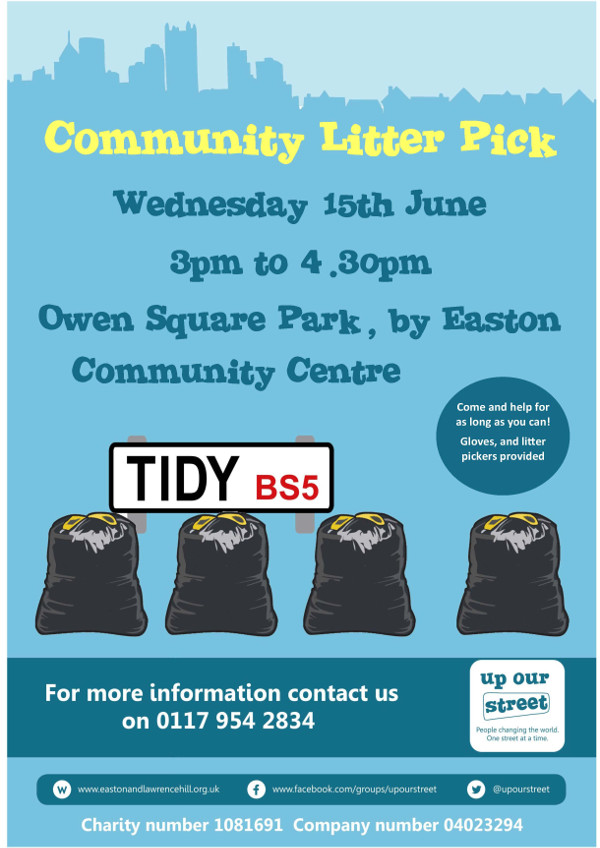
Apologies for the short notice, but there’s a community litter pick taking place tomorrow, 15th June, at Owen Square Park in Easton (map) from 3.00 pm to 4.30 pm.
See the poster below.
Owen Square Park is having its grand re-opening on 18th June, so Tidy BS5 supporters Up Our Street were asked to get involved and support a litter pick just prior to the weekend event.
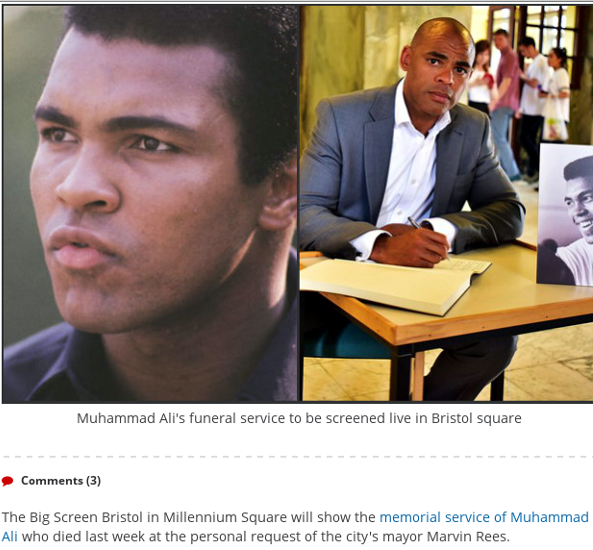
Like many, I was saddened to hear of the death of Muhammad Ali. As a young lad growing up in the 1960s and keen on sport of all kinds, he was a large presence on the TV sports programmes and the newspaper sports pages.
His achievements in the ring and his stand against conscription and the Vietnam War helped reinforce his reputation: he really did end up as “the greatest“.
However, news emerges via the Bristol Post that Ali’s death may not be all it seems: Muhammad’s demise could have been at the behest of Marvin Rees, Bristol’s newly elected mayor.
However, as per usual, it is merely a case of the endemic bad use of English, appalling grammar and ambiguity by the Post’s semi-literate hacks.
One of the joys of the illiteracy of the Bristol Post – the city’s newspaper of warped record – is the unintentional humour the manifestations of that lack of skill inspire.
Such an instance occurred yesterday when the Post reported, with a local angle of course, on the reopening of the inquest into the victims of the Birmingham pub bombing by the IRA on 21st November 1974.
One of the survivors – Frank Thomas – now happens to live in Bristol and the Post’s reported duly managed to get rumble and rubble confused, as shown in the following screenshot of the article’s first paragraph.
Should any passing Post hack wish to avoid future confusion, the definitions of rumble and rubble are helpfully transcribed below from Cambridge Dictionaries Online.
Rumble (n.) – a low continuous sound.
Rubble (n.) the piles of broken stone and bricks, etc. that are left when a building falls down or is destroyed.
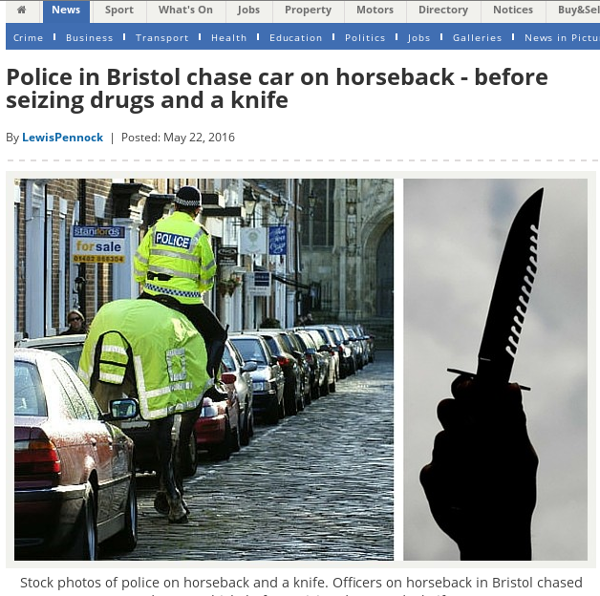
Unfortunately, the reporter concerned fails to tell readers how the car was able to stay in the saddle, given the inability of the car’s wheels to fit into the stirrups. 😉
Very soon after graduating and getting my first job with Imperial Group, I was taught by my then manager to avoid any ambiguity when writing. Times have clearly changed!
Jack Lopresti, the MP for the Filton & Bradley Stoke constituency on Bristol’s northern fringe, has questioned the UK’s treatment of the Afghan interpreters employed by the British armed forces during their deployment in Afghanistan between 2001 and 2014.
The former Army reservist said it was a “stain on our country’s honour” that Afghan interpreters who had helped British soldiers, including his own 29 Commando RAs when they were mobilised in 2008-09, had been “abandoned”.
He told the Prime Minister that many had been murdered upon returning to their country and pleaded that all of them be offered “sanctuary” in the UK.
The PM said there was a “very generous scheme” to help those who had not been translators [sic] long enough to qualify to come to Britain.
According to Hansard, the full verbatim exchange between Lopresti and Cameron is as follows:
Jack Lopresti (Filton and Bradley Stoke) (Con)
During military operations in Afghanistan, British forces were heavily reliant on locally employed interpreters, who constantly put themselves in harm’s way alongside our people. I saw with my own eyes during Herrick 9 just how brave these interpreters were. Does the Prime Minister agree that it is a stain on our country’s honour that we have abandoned a large number of them to be threatened by the Taliban? Some have been murdered and others have had to flee their homes, in fear of their lives. We owe the interpreters a huge debt of gratitude and honour, and we must provide safety and sanctuary for them here.
The Prime Minister
We debated and discussed around the National Security Council table in the coalition Government and then announced in the House of Commons a scheme to make sure that those people who had helped our forces with translation and other services were given the opportunity of coming to the UK. We set up two schemes: one to encourage that, but also another scheme, a very generous scheme, to try to encourage those people who either wanted to stay or had not been translators for a long enough period to stay in Afghanistan and help to rebuild that country. I think it is important to have both schemes in place, rather than simply saying that everyone in any way involved can come immediately to the UK. Let us back Afghans to rebuild their own country.
If Mr Cameron cannot tell the difference between interpreters and translators, in spite of his expensive education at Eton College and Oxford University, I suggest he consults this handy illustrated guide. 🙂
Although they are more likely to be seen in upland areas of south-west England, Wales, the north Pennines and Lake District and much of Scotland, sightings of ravens are not unknown in the low-lying city of Bristol.
Common raven (corvus corax). Photo courtesy of Wikimedia Commons
Your ‘umble scribe has seen single ravens around Temple Meads railway station, as well as in such inner-city districts as Easton. More often than not, I have heard the raven’s distinctive call before seeing it with the naked eye.
The largest number I’ve ever spotted at one time was a few weeks ago, when I sighted three ravens circling over Barton Hill, being mobbed by aggressive members of the area’s resident gull population.
Mythology and legend
Ravens have long featured in European mythology. In Irish mythology, the goddess Morrígan alighted on the hero Cú Chulainn‘s shoulder in the form of a raven after his death. In Welsh mythology ravens were associated with the Welsh god Bran the Blessed, whose name translates to “raven.” According to the Mabinogion, Bran’s head was buried in the White Hill of London as a talisman against invasion.
In Norse mythology, Huginn (from the Old Norse for “thought”) and Muninn (Old Norse for “memory” or “mind”) are a pair of ravens that fly all over the world, Midgard and bring the god Odin information.
In England a legend developed that the country would not fall to a foreign invader as long as there were ravens at the Tower of London (invasions are averted by the simple expedient of clipping the wings of the resident ravens. Ed.). Although this is often thought to be an ancient belief, Geoffrey Parnell, the official Tower of London historian, believes that, like so many other legends of the British Isles, this is actually a romantic Victorian invention.
In culture
In western culture ravens have long been considered to be birds of ill omen and death, partly due to the negative symbolism of their all-black plumage and the eating of carrion.
As in traditional mythology and folklore, the common raven features frequently in more modern writings such as the works of William Shakespeare, and, perhaps most famously, in the poem “The Raven” by Edgar Allan Poe. Ravens have also appeared in the works of Charles Dickens, J. R. R. Tolkien and Stephen King, amongst others.
Ravens have also featured in song. “The Three Ravens” is an English folk ballad, printed in the song book Melismata compiled by the appositely named Thomas Ravenscroft and published in 1611, but it is perhaps older than that.
The music and lyrics are set out below. The latter are in their original 17th century orthography, with the refrains in italics.
The ballad takes the form of 3 ravens conversing about where and what they should eat. One tells of a newly slain knight, but they find he is guarded by his loyal hawks and hounds. Furthermore, a “fallow doe”, an obvious metaphor for the knight’s pregnant (“as great with young as she might go”) lover or mistress comes to his body, kisses his wounds, bears him away and buries him, leaving the ravens without a meal.
Music for The Three Ravens
There were three rauens sat on a tree, Downe a downe, hay down, hay downe
There were three rauens sat on a tree, With a downe
There were three rauens sat on a tree,
They were as blacke as they might be. With a downe derrie, derrie, derrie, downe, downe
The one of them said to his mate,
‘Where shall we our breakefast take?’
‘Downe in yonder greene field,
There lies a knight slain vnder his shield.
‘His hounds they lie downe at his feete,
So well they can their master keepe.
‘His haukes they flie so eagerly,
There’s no fowle dare him come nie.’
Downe there comes a fallow doe,
As great with yong as she might goe.
She lift vp his bloudy hed,
And kist his wounds that were so red.
She got him vp vpon her backe,
And carried him to earthen lake.
She buried him before the prime,
She was dead herselfe ere euen-song time.
God send euery gentleman,
Such haukes, such hounds, and such a leman.
Your correspondent does not know what the three ravens circling Barton Hill found to eat, as dead knights are not exactly common in that part of the city. 😀
Open source software was an essential element in the work of 2 Bristol modern languages tutors who have just won an award.
The University of Bristol has announced that Marcella Oliviero and Andrea Zhok have won first prize in the 2016 Apereo Teaching & Learning Awards (ATLAS) for a project that helped first-year students in the Department of Italian teach elements of grammar to their peers. With support from University staff, students were encouraged to develop their own tutorials using Xerte, an open source software package for the creation of interactive teaching and learning materials, which has been developed by the University of Nottingham. As a result, students gained a greater stake in their own learning, improved their subject knowledge and acquired new IT skills.
Apereo is a network that develops and maintains e-learning software used in thousands of educational institutions worldwide. Packages like Xerte permit the use of a wide range of functions and media to make the learning experience richer and more diverse than is possible with traditional methods. The tutors’ success was announced at the 2016 Xerte Conference in Nottingham and they have also been invited to present their work at the Open Apereo conference in New York later this month.
I’m indebted to Twitter user @StapletonRd for the following photograph of communal bins in the prosperous Clifton area of Bristol.
Communal bins screened by Bristol City Council to protect the delicate eyes of Clifton residents.
As you can see, no effort – or expense – has been spared to make communal bins acceptable to the area’s rich residents, who have sharp elbows and loud voices, not to mention the ear of the council.
Now let’s contrast this with Milsom Street in Easton, where communal bins were imposed on residents in 2012 after a botched council consultation (with the emphasis on the first syllable of consultation. Ed.).
Somewhere under that pile of furniture is a communal bin.
Somewhere under that pile of fly-tipped furniture (reported to Bristol City Council this morning. Ed.).
In Easton the communal bins were introduced by the council as a remedy to tackle an endemic local fly-tipping problem. One can see how well it’s worked.
One can also see that no effort has been made to make the communal bins more attractive to Easton residents: no off-street siting of bins; no wooden fencing to screen them from delicate eyes and so on.
Many years ago, east Bristol residents campaigning to retain public access to Packer’s Field, 7 acres of much-used green space for informal public recreation, were told by council officers that they “were not the kind of people the council listened to“.
By the unequal treatment of Clifton and Easton residents in respect of communal bins, that attitude is still alive, well and kicking very, very hard indeed down at the Counts Louse (or City Hall as some now call it. Ed.).
One can only hope that after the mayoral and council elections on Thursday, those newly elected will finally start to break down the discrimination and unequal treatment of different areas that has blighted Bristol City Council’s administration of the city for generations.
The wrong interpreters continue to be sent to courts throughout the country.
Following on from a case earlier this week in Telford (posts passim) where sending the wrong kind of interpreter resulted in a delay of 5 months in a rape trial, the wrong interpreter has now also been sent to Bristol for the case of an Iranian Kurd.
Yesterday’s Bristol Post reports on a hearing at Bristol Crown Court in the case of a man charged with possession of a knife on the city’s Fishponds Road.
Bristol Crown Court
Regarding the interpreter blunder, the Post states:
Arman Qabadi also said he had been provided a Farsi interpreter when he needed a Khurdish [sic] one.
It doesn’t appear in this instance that the interpreter cock-up will delay the administration of justice since the necessary pre-sentence report had not been produced and the defendant continues to be remanded in custody.




 Open source software was an essential element in the work of 2 Bristol modern languages tutors who have just won an award.
 Apereo is a network that develops and maintains e-learning software used in thousands of educational institutions worldwide. Packages like Xerte permit the use of a wide range of functions and media to make the learning experience richer and more diverse than is possible with traditional methods. The tutors’ success was announced at the

