Bristol

  • Is Cabot Circus employing Smurfs?

    The modern mobile phone is a sophisticated and very useful item: mine is a miniature marvel – a Linux-based computer that fits comfortably in the hand, plays music, acts as a radio, takes video and still images and also allows me to make telephone calls.

    Venturing into central Bristol, one notices that nearly everyone one passes has one and entering the Cabot Circus shopping centre – that latter day monument to retail therapy – is no exception to this general observation.

    Having noticed a couple of years ago that visitors to Cabot Circus have their progress around that Temple of Mammon tracked by means of their mobile phone signal (posts passim), it has been my practice ever since to turn my mobile phone off before entering; and I don’t turn it back on until I’m well clear.

    Cabot Circus mobile phone recharging cabinetIt’s bad enough being tracked from shop to shop, but there’s another threat to the privacy and security of mobile phones and their users in Cabot Circus… but you’ll only discover it if you happen to use the mobile phone charging points (shown left) kindly provided by the centre’s management.

    On the face of it, these charging points – 3 in number – are a boon to visitors. After all, who hasn’t been in a situation where one’s battery is running low. It does seem benevolent of the managers of Cabot Circus to provide half an hour’s gratis battery top-up, doesn’t it?

    Now, you remember me saying about turning my phone off before entering? Good! With my device switched well and truly OFF I have now placed my phone in the recharging facility whilst paying a call of nature. Upon return a few minutes later, I have in each instance retrieved by phone from the locker – and found it to be switched ON!

    Needless to say out of consideration for my security and privacy, I shall not be using one of these charging points again.

    As regards using the mobile phone charging points, the Cabot Circus website states the following:

    Because we want our visitors to have a stress free [sic] shopping experience within our centre, Cabot Circus has now installed three ChargeBox phone charging stations, ideal for when your battery goes flat at the most inconvenient times.

    Easy to use in three simple steps, connect your phone, lock, take the key and relax. The ChargeBox stations allow you to charge your phones for free and enjoy 30 minutes extra shopping time!

    The ChargeBox stations at Cabot Circus are located:

    – Level 1 outside Costa
    – Upper Ground at the Information Desk
    – Ground floor toilet lobby

    Curiously, there’s nothing in the above text that I can see about the points’ ability to turn on a mobile phone that’s been switched off.

    However, let’s be generous and assume that specific piece of information was omitted by mistake. 🙂

    When I charge my turned-off phone elsewhere, either by using a USB cable connected to a PC/laptop or the adapter that came with it, it definitely stays off. That being so, I began thinking how could the lovely folk at Cabot Circus generously providing me with free electricity be turning my phone back on when I’d left it firmly switched off.

    A quick internet search reveals no logical or plausible benign explanation as to why a switched-off phone is turned on by the charging station.

    The only tools of which your correspondent is aware for doing such things to a mobile phone is the Smurf suite of tools used by the British State’s snoopers at GCHQ, as revealed by NSA whistleblower Edward Snowden. In this suite of tools, one called “Dreamy Smurf” can allegedly turn a phone on or off, whilst another called “Nosey Smurf” can activate a phone’s microphone to use it for audio surveillance. “Tracker Smurf” is a geo-location tool that Snowden says offers a more accurate method of locating a phone and its carrier than using triangulation. Another Smurf can operate a smartphone’s camera, while “Paranoid Smurf” does its best to hide the activities of the other Smurfs.

    One therefore has to wonder whether that the operators of Cabot Circus, by turning visitors’ phones on, are infringing their privacy and presenting a security threat to their mobile devices.

    Care to come clean, Cabot Circus, on whether you’re employing Smurfs or using something analagous?

  • Tidy BS5 at the Mayor’s Question Time

    George Ferguson looking trustworthyOn Wednesday evening Bristolians had an opportunity to question the city’s elected mayor, George Ferguson, at the City Academy on Russell Town Avenue.

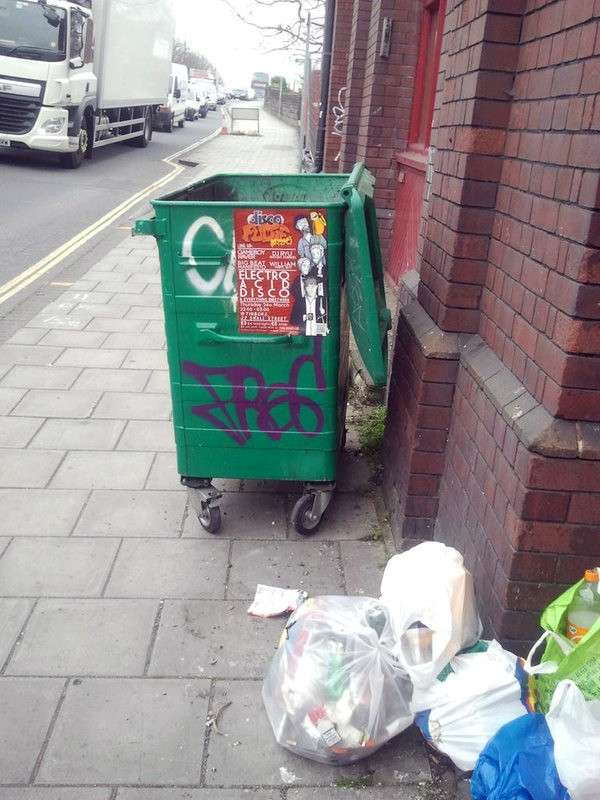
    Your ‘umble scribe attended, hoping to ask George a question on the city council’s dreadful record on keeping on top of fly-tipping, litter and other environmental crimes within the city as a whole and east Bristol in particular.

    The session was chaired by BS5 resident and freelance journalist Pamela Parkes, who did an excellent job.

    Your correspondent was successful in putting his question to the mayor, which read as follows:

    This year Stoke-on-Trent City Council managed to find ÂŁ750K of additional funding to tackle environmental crimes such as fly-tipping. What additional budget allocations will the mayor be making this year to emulate the Potteries?

    Needless to say, the mayor ducked answering the additional funding bit (from which one can infer that no additional resources will be made available in Mr Ferguson’s forthcoming budget. Ed.) and laid great emphasis on ÂŁ80m cuts imposed by central govt. on Bristol and how much Bristol City Council was actually spending on waste management in Bristol. I thought most of his answer was emollient waffle, blustering about the establishment of Bristol Waste, early days for them etc. However, facilitator Pamela Parkes pointed out that despite all the campaigning by residents, both informally and formally under the banner of Tidy BS5, the situation locally hasn’t improved at all. To be fair to George Ferguson, he did make a good point about the need to promote the repair and reuse of consumer goods, to reduce the amount going to landfill.

    George then handed over to the head of Bristol Waste whose name I cannot remember. She made the point that fly-tipping had remained constant in Bristol over recent years. When challenged about the level of fly-tipping – four times that in neighbouring local authorities, back came the defeatist line that fly-tipping is always higher in cities.

    So overall it looks like there will be little change in the council’s competence or motivation in tackling fly-tipping in the city

    Besides my question, others tackled the mayor on education, housing and homelessness, the treatment of BME communities (following the cancelling of this year’s St Paul’s Carnival and current management problems at the Malcolm X Centre) and transport.

    At the end there was a lively open session, during which there was a lot of hostility to the mayor from the public on various matters – the previously mentioned carnival and Malcolm X woes, growing Islamophobia, declining community cohesion and the total waste of Green Capital (which GF characterised as the most successful Green Capital year yet. Ed.), to mention but a few.

    George placed great emphasis on his listening skills, stating he’d listen to anybody. However, he has past form in his post-listening dismissals of members of the public. This was not lost on his audience on Wednesday, one of whom queried along the lines of: “You may be listening George, but are you hearing what they’re saying to you?”

    T-shirt slogan I've listened now f**ck off
    A T-shirt design produced after George’s dismissal of a member of the public in 2013. Picture courtesy of Wikimedia Commons.

    In the end the session overran and City Academy staff were heartily thanked for sacrificing their time so generously.

  • 2016 – the greenwash continues

    Bristol’s wasted year as European Green Capital (posts passim) may be over, but the greenwash* continues, as shown by the advertising hoarding below by the side of the A4032 Easton Way, a dual carriageway blasted through this inner-city community in the late 1960s or early 1970s to speed motorists from one jam to another. To be more specific, the hoarding itself is conveniently situated next to the traffic lights by the Stapleton Road bus gate, where bored commuters can gawp at it waiting for the lights to change as they suffocate in their own traffic fumes and poison the rest of us.

    poster subvertised with wording Red Trouser Greenwash
    Picture credit: StapletonRd

    As can be seen from the photo, at least one local hasn’t fallen for the greenwash and has said so, pinpointing the source as the trousers of Bristol’s elected mayor. 🙂

    The mayor – and the local authority he runs – had an ideal opportunity during Green Capital Year to tackle some of Bristol’s endemic problems, such as the chronic over-reliance on the motor car, abysmal public transport and the unending stream of litter and fly-tipping blighting the inner city, but decided to do very little on these matters, preferring instead to spend money on pointless art projects and mutual back-slapping events for the great and good.

    * Greenwash (n.), a superficial or insincere display of concern for the environment that is shown by an organisation.

  • An evening’s poaching in Bristol

    My late mother Gladys grew up living next door to the village poacher – a gentleman now long departed called Tom Cook – in her childhood home of Blo’ Norton in Norfolk.

    During my youth in Market Drayton, Shropshire, Derek Podmore – otherwise known as Poddy the Poacher – was another character one encountered who achieved a certain notoriety. At one stage this notoriety reached national level when he featured on the centre pages of the now defunct News of the World after breaking into the Duke of Bedford’s safari park at Woburn Abbey one night and shooting milord’s bison… for a bet.

    I was therefore very pleased to learn that Bristol Radical History Group (BRHG) is organising a talk on poaching by Steve Mills at 7.00 p.m. on Thursday 28th January at Hydra Books in Old Market Street, Bristol, BS2 0EZ (map).

    Entitled “Poaching in the South West: The Berkeley Case“, Steve’s talk will cover the contents of his recent BRHG pamphlet “Poaching in the South West“, which considers the poaching wars in rural areas in the 18th and 19th Centuries and the arms race conducted between the poaching gangs, landowners and gamekeepers. He will also look at the development of the “poaching” laws in the period and the famous Berkeley Case.

    William Hemsley's The young poacher 1874
    William Hemsley, The Young Poacher (1874). Picture courtesy of Wikimedia Commons.

    More information on Steve Mills’ pamphlet here.

  • Send George a Tidy BS5 postcard

    Now landing on Bristol Mayor George Ferguson‘s desk are postcards from residents of BS5 to bring him back down to earth with a thump after being honoured with a prestigious award by Lord Gnome of Private Eye (posts passim).

    one of the Tidy BS5 postcard
    Photo credit: @StapletonRd

    The cards remind George that BS5 residents are fed up with the fly-tipping they have to endure every day, a problem that was neither tackled nor mitigated by council action during the city’s wasted year as European Green Capital (posts passim).

    If you have difficulty getting hold of a postcard, supplies are available from the Up Our Street office in the Beacon Centre in Russell Town Avenue (map).

    Your correspondent took a dozen or so with him to the pub the other night and had no difficulty coming home minus his entire stock of postcards. There are evidently lots of fed up BS5ers out there, George, so you’d better exdigitate on getting to grips with fly-tipping in East Bristol and not just send any postcards you receive down to Streetscene Enforcement to clutter up their desks, as Tidy BS5’s spies down the Counts Louse inform us you are doing. 😉

  • Email encryption talk in Bristol

    As part of Alternative Bristol’s Breaking the Frame series of talks, an email encryption talk for beginners will be taking place at Hydra Books in Old Market Street, Bristol (map) from 7.30-9.30 p.m. on Friday 22nd January.

    public key encryption graphic
    How public key encryption works

    According to the organisers, an ordinary e-mail is like a postcard without an envelope: anybody who can put their hands on it can read it. Unlike a postcard an email is copied (rather than moved) to many different computers on its travels. All of these computers’ owners we can’t possibly trust and know. This makes them feel uncomfortable and is not necessary with simple email
    encryption.

    After this short (one hour!) workshop attendees will be able to email anyone else who makes it to the workshop without the email being intercepted by a third party.

    Certain organisations (e.g. journalists, unions, activists, etc.) have a responsibility to transmit sensitive messages securely and currently do not always do this. Don’t think what does this one email say about me? (or its recipient), think rather when examined en masse over time (most emails are stored indefinitely these days) what does this reveal about the way you live?

    It would save time if prospective attendees had Thunderbird set up and receiving your emails. If you have Ubuntu or another Linux distribution, it would help if you installed both Thunderbird and GPG before attending the talk. If you already use email encryption and want to help or share your key please come by too. No experience necessary, but if you have a laptop and USB stick please bring them with you.

    More details available via Facebook.

    Reposted from Bristol Wireless.

  • Bristol Mayor wins greenwash award

    As a fitting end to Bristol’s year as European Green Capital, Mayor George Ferguson has won the Greenwash Award in Private Eye’s Rotten Boroughs awards for 2015.

    screenshot of Private Eye item

    From your correspondent’s vantage point in the inner city, it has to be said that Bristol’s year as Europe’s beacon of best environmental practice has hardly been crowned with glory, with money wasted on pointless art projects, widespread wildlife habitat destruction and the continuing blight of fly-tipping.

    Will George Ferguson be collecting his award in person from Lord Gnome? 😉

  • Wifi from wee

    Bristol boffins have developed a pair of socks embedded with miniaturised microbial fuel cells (MFCs) and fuelled with urine pumped by the wearer’s footsteps that have powered a wireless transmitter to send a signal to a PC. This is the first self-sufficient system powered by a wearable energy generator based on microbial fuel cell technology, the University of the West of England (UWE) reports.

    microbial fuel cell socks
    Microbial fuel cell socks

    This world first feat is described in the scientific paper, ‘Self-sufficient Wireless Transmitter Powered by Foot-pumped Urine Operating Wearable MFC’ published in Bioinspiration and Biomimetics.

    diagram of fuel cell, wifi transmitter and PC
    How the set-up works

    This paper describes a lab-based experiment led by Professor Ioannis Ieropoulos, of the Bristol BioEnergy Centre at the UWE. The Bristol BioEnergy Centre is based in Bristol Robotics Laboratory (BRL), a collaborative partnership between the UWE and the University of Bristol.

    Soft MFCs embedded within a pair of socks were supplied with fresh urine, which was then circulated by the human operator walking. Normally, continuous-flow MFCs would rely on a mains powered pump to circulate the urine over the microbial fuel cells, but this experiment relied solely on human activity. The manual pump was based on a simple fish circulatory system and the action of walking caused the urine to pass over the MFCs and generate energy. Soft tubes, placed under the heels, ensured frequent fluid push–pull by walking. The wearable MFC system successfully ran a wireless transmission board, which was able to send a message every two minutes to the PC-controlled receiver module.

    Professor Ieropoulos says, “Having already powered a mobile phone with MFCs using urine as fuel, we wanted to see if we could replicate this success in wearable technology. We also wanted the system to be entirely self-sufficient, running only on human power – using urine as fuel and the action of the foot as the pump.”

    “This work opens up possibilities of using waste for powering portable and wearable electronics. For example, recent research shows it should be possible to develop a system based on wearable MFC technology to transmit a person’s coordinates in an emergency situation. At the same time this would indicate proof of life since the device will only work if the operator’s urine fuels the MFCs.”

    MFCs use bacteria to generate electricity from waste fluids. They tap into the biochemical energy used for microbial growth and convert it directly into electricity. This technology can use any form of organic waste and turn it into useful energy without reliance on fossil fuels, making this a valuable green technology.

    Originally posted on Bristol Wireless.

  • No fossil fuel power plant in St Werburghs

    On Wednesday councillors on Bristol City Council’s Development Control Committee B voted overwhelmingly – by 8 votes to 2 with one abstention – to accept the planning officers’ recommendation to refuse an application filed by UK Power Reserve Ltd. for 14 gas-fired generators with 11 metre high flues for a site off Gatton Road.

    The recommendation for refusal was soundly based on both national and local planning guidelines for reasons of noise and air pollution, plus visual amenity.

    drawing of one of the 14 generators refused planning permission
    One of the 14 generators refused planning permission

    The application attracted nearly 700 objections and over 50 personal statements by members of the public, including your correspondent, whose statement is reproduced below.

    I have been a resident of the Easton area for nearly 4 decades.

    I have read the case officer’s report on this application and am pleased to note he has recommended its rejection since it contravenes both local and national planning policies in many regards.

    It should be pointed out that this speculative application – one of 3 for fossil fuel generating plants in Bristol’s less prosperous communities – is being driven by central government’s ideologically-driven mismanagement of electricity production in the UK.

    I live downwind of the proposed facility and feel the air quality in my part of Easton is already bad enough with the traffic pollution from the M32 and Stapleton Road, plus diesel fumes from the nearby railway line.

    By filing this application in the way it did, the applicant has shown contempt both for the local authority and local residents in St Werburghs and Easton.

    Contempt to the local authority is demonstrated by the application’s filing during Bristol’s year as European Green Capital. Nothing further need be said on that point in respect of a generating plant powered by polluting fossil fuels.

    As regards local residents, consultation has been minimal and I believe that the applicant is guilty of what is called “environmental racism”. This is a concept from the United States defined as: “is placement of low-income or minority communities in proximity of environmentally hazardous or degraded environments, such as toxic waste, pollution and urban decay”.

    If this facility is so clean and aesthetically pleasing to the eye, why did the applicant not decide to site in, say, Stoke Bishop?

    Any future applicant thinking of indulging in further environmental racism in Bristol’s inner city communities will be told very firmly what they can do with their applications and where they can stick their proposed facilities.

    Three local councillors – Rob Telford and Gus Hoyt from Ashley ward – and Lawrence Hill’s Marg Hickman also spoke against UKPR’s plans.

    There was only one speaker from the public gallery in support of the application; and that was from UKPR’s agent. He urged the committee to defer a decision to allow them to mitigate the air quality impact by fitting catalytic converters, reduce noise problems and reduce the height of the chimneys. However, the councillors on the committee gave this late concession short shrift.

    Indeed, the only councillor on the committee to speak in favour of the application was Conservative Richard Eddy (described as a ‘dickhead’ by a fellow councillor. Ed.). He and fellow Tory Kevin Quartley voted in favour of the power plant, whilst Chris Windows, the third Tory on the committee, abstained.

    Two further planning applications for similar plants powered by dirty diesel in Lockleaze and at Avonbank (posts passim) were withdrawn a few days before the meeting. Along with the St Werburgh’s application, they would have formed part of the STOR back-up energy programme subsidised by the Government.

Posts navigation