Olive oil – a definition
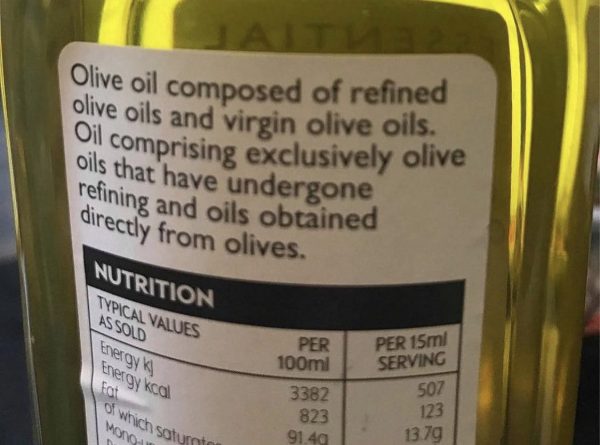
If you have ever wondered about the derivation of olive oil, here is the ultimate definition courtesy of my Twitter feed.

No further comment is required.
.
If you have ever wondered about the derivation of olive oil, here is the ultimate definition courtesy of my Twitter feed.

No further comment is required.
.
“The vision thing” is a comment made by George H. W. Bush ahead of the 1988 United States presidential election when urged to spend some time thinking about his plans for his prospective presidency.
The embracing of vision – with or without the thing – is widespread in public life in Britain at both local and national levels. Every party leader is expected to have one; and any plans for the wholesale remodelling of large areas of our town and cities are expected incorporate vision too.
An investigation into the prevalence of vision in the organs of the British state reveals just how ingrained use of the term is. A quick Google search for items containing “vision” on websites within the .gov.uk domain is revealing.

No, your eyes do not deceive you – 2.3 million instances of use.
Looking more locally, a recent search (mid-April) of the Bristol City Council website for the term returns a total of over 4,200 hits. It has probably risen since last month (and with all that evident ocular deployment, one would have thought that the inhabitants of the Counts Louse – which some refer to as City Hall – would realise there’s a major cleanliness problem with the city’s streets. Ed.).

With all that vision in use in the country, opticians and their colleagues must be raking in the money. ๐

Or is it necessarily opticians and associated practitioners that should be profiting from this phenomenon? There is some scepticism about the benefits of visions.
George H.W. Bush was mentioned at the start of this post. One of his contemporaries was the former West German Chancellor Helmut Schmidt.
Schmidt was very dismissive of visions and is on record as stating the following:
Wer Visionen hat, soll zum Arzt gehen.
This translates into English as:
Anyone who has visions should go to the doctor.
Will anyone working for the British state be visiting their GP soon, either individually or en masse?
I doubt it.
Finally, when someone summoned up the courage to ask Schmidt what his big vision was, he is reputed to have referred them to Bush! ๐
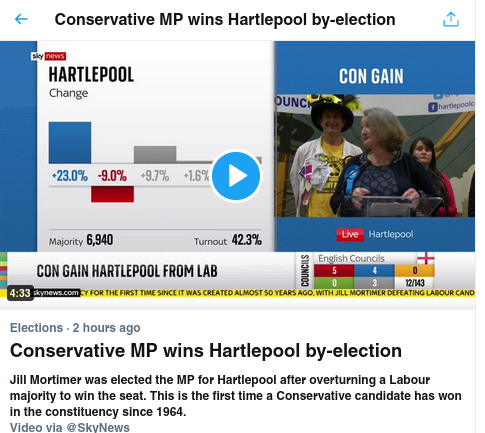
The media and social media today are awash with the result of yesterday’s Hartlepool by-election which was surprisingly won from Labour by the Tories*.
However, some of the language being used to describe the victory is prone to error, such as the example below from Twitter’s trending topics.

As the winning Tory was not the sitting MP, the correct way to describe her is as a candidate, not an MP. She only becomes an MP upon winning a parliamentary (by-)election.
In times past such a basic error would have been picked by a sub-editor or similar, but they were all dispensed with some years ago. ๐
*= Hartlepool hasn’t had a Tory Member of Parliament since it was represented in Westminster by Peter Mandelson. ๐
We’re now in May and one reliable natural occurrence of the time of year is the flowering of common hawthorn (Crataegus monogyna), which is also known as the oneseed hawthorn, or single-seeded hawthorn.
Other common names include may, mayblossom, maythorn, quickthorn, whitethorn, motherdie, and haw.
The Woodland Trust have produced a short video depicting one year in the life of the hawthorn.
The specimen below can be found in the Easton section of the Bristol & Railway Path near the Brixton Road access point.

Hawthorn is amongst the first trees to start budding in the spring (the above specimen first put out leaves in late January. Ed.) and is also a fast-growing plant. This may explain the alternative name of quickthorn.
As it forms a dense, thorny mass of branches, it is often used for hedging, particularly where livestock has to be contained.
Besides its agricultural value as hedging, common hawthorn can support more than 300 insects. It is a food plant for caterpillars of numerous moths. Its flowers are eaten by dormice and provide nectar and pollen for bees and other pollinating insects. The haws (berries) are rich in antioxidants and are eaten by migrating birds, such as redwings, fieldfares and thrushes, as well as small mammals.
Furthermore, the dense, thorny foliage makes fantastic nesting shelter for many bird species of bird.

Hawthorn is a pagan symbol of fertility and has associations with May Day stretching back beyond written history. It was the forerunner of the Maypole and its leaves and flowers provided the source of May Day garlands as well as appearing in the wreath of the Green Man.
In medieval times hawthorn was never brought indoors as it was generally believed that bringing its blossom indoors would result in illness and even death. In those times it was also commonly believed that hawthorn blossom smelled like the plague. In more recent times scientists have discovered the chemical trimethylamine (which smells like ammonia or rotting flesh. Ed.) in hawthorn blossom is also one of the first chemicals formed in rotting animal fish, hence the tree’s traditional linking with illness and death.
In spite of the beliefs and symbolism outlined above, the young hawthorn leaves, flower buds and young flowers are all edible. The leaves are often described as having the flavour of bread and cheese. They can be added to green salads and grated root salads. The developing flower buds are particularly good. The haws can be eaten raw (beware a stomach upset. Ed.), but are most commonly used to make jellies and wines.
In my own life, the blossoming of the hawthorn always reminds me that spring is giving way to early summer.
In particular, it reminds of when I was 8 years old and my mother took my 2 younger siblings and me by train all the way from Stafford to Harling Road in Norfolk – the nearest station to my grandmother’s home. The journey took the best part of a day (showing how difficult it was to travel cross-country in England, even in pre-Beeching times. Ed.). The fields on either side of the railway lines on which we travelled were thick with hawthorn blossoming pink and white.
Whenever I see hawthorn in bloom these days, I’m immediately reminded of that one train journey, even though it’s now almost 6 decades in the past.
Update: After writing this post, I asked both my siblings if they remembered that journey and if so, what they recalled. My sister replied that she recollected the journey as being interminable and her chief memory was all the trackside telegraph poles, whilst my brother – the youngest of us – responded with a question as to whether that was the railway trip during which he was sick. He obviously had other matters than lineside shrubbery on his mind. ๐
Courtesy of my old college friend Paddy, I’ve been sent the following clipping from the dead tree edition of the Evesham Journal via social media.
It relates to problems on the River Isbourne, a tributary of the Warwickshire Avon.
Even though the elderly have had a bath thanks to ambiguity and poor proofreading in the Evesham Journal’s dead tree version, this age discrimination has thankfully been eliminated from the paper’s online version of the report.
No pensioners were harmed – or dunked – in the drafting of this blog post.
Yesterday, which was Earth Day, US President Joe Biden organised a two-day virtual climate summit bringing together dozens of world leaders.
Apart from world political leaders, Biden also inexplicably invited one Alexander Boris de Pfeffel Johnson, Britain’s part-time alleged Prime Minister, to participate.
Besides his propensity never to let the truth escape from his lips, Johnson is well known for his lack of attention to detail, his loose tongue and gaffes; and true to form he didn’t fail to embarrass the country of which he is supposed to be the highest elected public official, as shown in the following video clip.
Yes, you did hear that correctly – “politically correct green act of bunny hugging“!
Needless to say, Bozo the Clown had half of the country’s social media users rolling their eyes in despair, condemning his cavalier attitude and wondering what the blonde buffoon was going to sully next with his reverse Midas Touch.
However, it wasn’t just Britons who reacted to Bozo’s gaffe.
Amongst them was one Greta Thunberg, an 18 year-old Swede whose name is not exactly unknown on the world stage where climate change is concerned.
Greta very quickly changed her Twitter bio to reflect Johnson’s words.

Nice work, Greta! ๐
As for the embarrassment that is part-time alleged Prime Minister Alexander Boris de Pfeffel Johnson, you can consider yourself well and truly pwned.
Friday afternoon update: the Green Party has now joined in the general mockery of Johnson’s remarks.

It’s getting close to election time again and the period of what is informally known as “purdah” (also known rather more formally and stuffily in local authority circles as the “pre-election period” Ed.), which has very little to with purdah’s original definition, i.e. a religious and social practice of female seclusion prevalent among some Muslim and Hindu communities, and more to do with preventing central and local government from making announcements about any new or controversial initiatives that could be seen to be advantageous to any candidates or parties in the forthcoming election.
Here in the Bristol area, elections are being held not only for the local council, but also for the elected Mayor of Bristol, the Avon & Somerset Police and Crime Commissioner and the Mayor of the West of England Combined Authority (WECA).
As is usual with matters electoral, I keep a record on a LibreOffice spreadsheet of all election leaflets received, which ultimately end up in their rightful place – the waste paper recycling box (apart from personally addressed material, which is fed to the confidential waste shredder. Ed.).
The latest state of the parties – as of first thing this morning – is shown below.

As can be seen, the Greens are clearly putting a major effort into depriving Labour of their 2 ward seats for Lawrence Hill in the council chamber.
Whilst elections may be regarded as a vehicle of change, there are certain features that are reassuringly familiar and are thus recycled election after election.
For instance, the first leaflet received after the notices of persons nominated were announced was one from the Liberal Democrats, as per their decades-long reputation for opportunism.
That leaflet also comprised other reassuringly familiar Liberal Democrat tropes, such as the bar chart below for the WECA Mayor. I am reliably informed by a fellow linguist who took a ruler to the y axis, that the column sizes are reasonably accurate (for once. Ed.)

That just leaves the equine graphic with the heading “It’s a 2 horse race! (Insert_party_name) can’t win here!” and the traditional graphics requirements for LibDem leaflets will have been fulfilled.
More leaflets can of course be expected to land on the doormat as polling day approaches, so updates will be provided in due course.
Spotted earlier this week in Stratford, London and arriving on my screen via social media.
It is believed to have been created by London-based conceptual, video and installation artist Jeremy Deller, whose work has strong political overtones.
Given the current Conservative government sleaze and “chumocracy” scandals, no further comment is necessary.

One Twitter account I follow is Miss PunnyMany for her insights into Scots English. She’s just asked a very important question of manners and terminology in this tweet, as shown below.

Well, is “hen” rude?
Let us see.
An accurate definition would be a good place to start.
A general glossary of Scots vocabulary posted on Stirling University’s website provides the following definition:
hen: vocative term for a woman (e.g. โIt’s aw richt, henโ), or a general term of endearment for anyone.
Note the phrase “general term of endearment“. That’s a big clue, indicating that its use is confined to close friends and acquaintances.
This view is largely borne out by the tone of the responses to Miss PunnyMany’s tweet.
Furthermore, a few respondents rightly point out that, like “pal” south of the Border, “hen” may be used in a pejorative or threatening manner to people outside one’s immediate social circle.

An example of this can be found in a place a fair way from Scotland, namely the chamber of the House of Commons in Westminster.
Back in March 2017, SNP Member of Parliament Mhairi Black gave rise to comment in the media and on social media when appearing to mouth the words “You talk shite, hen” to a response by Tory minister Caroline Nokes, then the Under Secretary of State in the Department for Work and Pensions.
Ms Black had just made an impassioned speech that criticised a Government proposal to withdraw housing benefits for 18-21-year-olds. Her silent, but lip-read comment denoting her clear displeasure came during Ms Nokes’ reply which naturally defended the government’s cruel proposal.
So there you have it, use “hen” sensibly and restrict it to family, close friends and acquaintances, you shouldn’t go too wrong.
One fascinating aspect of the country’s foolhardy departure from the European Union is the fate of Britons in the 27 member states of the European Union; and more particularly how they are depicted here now that the “free and independent coastal state” of Brexitannia has “taken back control“.
Keen observers of the British media will note all foreigners seeking to come to the English Empire (which some refer to as the United Kingdom. Ed.) to settle are referred to as “migrants“. When used by the right-wing press or politicians, “migrants” has a clear pejorative tone to the effect that these people are not as good as us.
However, in line with British exceptionalism as Brits seeking to or having taken up residence abroad are termed “expats” by the fourth estate, as per this typical specimen from yesterday’s Daily Brexit, which some still call Daily Express.

Of course, what the Daily Brexit forgets is that even in Greece and Cyprus, holders of those nice, new and allegedly blue British passports will still be classed as third country citizens by the Greek and Cypriot authorities; and if they try staying there for longer than the maximum period without applying for a residence permit, they’ll be regarded as illegal immigrants, just as they are now finding out on the Costa del Sol.
“Expat” is of course a truncation of the term “expatriate“, with the shorter form’s first recorded use in the first half of the 1960s.
When people move for work, settlement or other reasons, the language used about them is always full of meaning. In earlier, less judgemental times those who left British shores to settle abroad might have been referred to as “รฉmigrรฉs” or “emigrants“, whilst those coming here for permanent settlement were “immigrants“, which had more than its fair share of negative connotations in times past.
Nowadays all those negative connotations are to a certain effect by “migrant“, which, unlike “immigrant” or “emigrant” is not specific about the person’s direction of travel.
Nevertheless, I can see the exceptionalism continuing and am not expecting the Daily Brexit to refer to Brits resident abroad as “British immigrants” at any time soon. ๐
PS: Apologies to Robert Browning for this post’s title.