media

  • Election special: Corbyn crosses the floor

    [Update at end]

    There’s a phrase in English politics – crossing the floor. The floor is that of the House of Commons and it means that an elected MP has switched allegiance from one party to another.

    One former MP – Sir Hartley Shawcross – was rumoured to be constantly on the point of changing allegiance throughout the early and mid-1950s and was consequently nicknamed Sir Shortly Floorcross. 😀

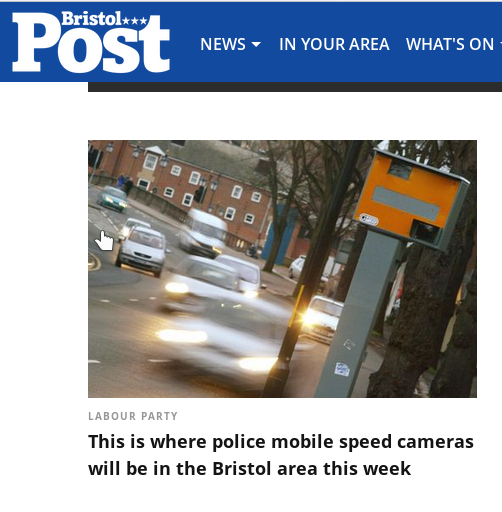
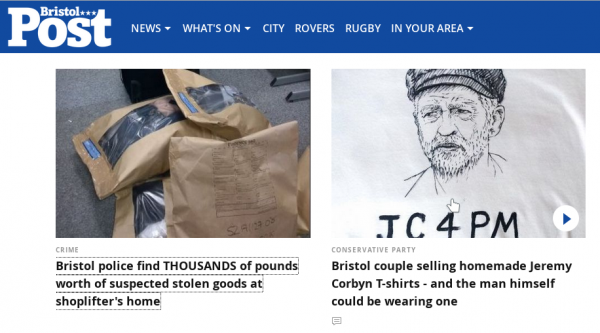
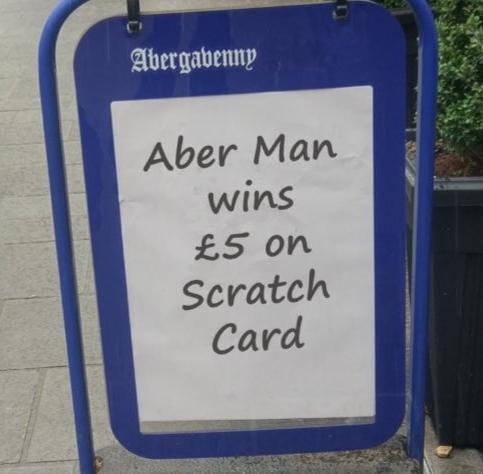
    It is a practice normally indulged in by rank and file MPs, not party leaders, unless Bristol’s newspaper of (warped) record is to be believed as per the following screenshot.

    Above headline are the words Conservative Party
    A proper Red Tory?

    Yes, your eyes are not deceiving you. According to the Bristol Post, Labour leader Jeremy Corbyn has joined the Conservatives just 3 weeks away from a general election.

    Your correspondent is now awaiting confirmation of this report from other mainstream media outlets.

    Update: 14.00 hrs, 21st May – The header over the link has now been changed to read “Politics”. However, use of a special creative writing technique would have avoided the original gaffe. Its name: proofreading! 😀

  • Election special: Tory buzzword bingo

    Cricket fans have long been acquainted with the delights of Boycott Bingo (posts passim), where the regular verbal mannerisms on Test Match Special of the greatest living Yorkshireman have been turned into a game.

    Following the recent announcement of the snap general election next month, followers of politics can now play their own game of buzzword bingo with the stock phrases and soundbites of the nation’s political leaders and election candidates.

    Expect these buzzwords to be wheeled out until everyone is absolutely fed up with them, usually after about 48 hours.

    The Conservatives’ soundbites are particularly limited in scope and number and, from what I’ve seen and heard, to call their candidates’ and leader’s performance wooden would be an insult to trees.

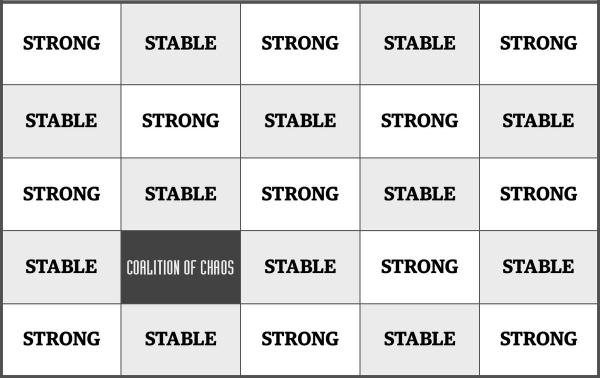
    Below, courtesy of The Guardian, is your very own buzzword bingo card for use with Tory leader Theresa May (whose main method of operation seems to consist of avoiding saying anything of substance. Ed.) and her colleagues.

    Good luck!

    bingo card featuring words strong, stable and coalition of chaos

  • British press puts truth in intensive care

    In 1918 US Senator Hiram Warren Johnson is purported to have said: “The first casualty when war comes is truth.

    There may not be a war, but classifying the status of truth as a mere casualty may be insufficient and it now finds itself on life support in intensive care when the predominantly right-wing British press is reporting politics, particularly politics abroad.

    Yesterday saw France go to the polls in the first round of the 2017 presidential election, with 11 candidates standing.

    Under the French system, the 2 front runners in the first round of the election go forward to a straight winner takes all ballot in the second round.

    In yesterday’s ballot the independent candidate Emmanuel Macron polled around 23.7% of vote with Marine Le Pen, leader of the fascist Front National coming in second on roughly 21.5%.

    Early opinion polls also give Macron a lead of over 20 percentage points over Le Pen with regard to second round voting intentions and he’s currently predicted to garner 60% of second round votes, thus excluding Le Pen from the Elysée Palace.

    However, looking at certain sections of the British press, anyone would think right-wing intolerance had triumphed in this first round.

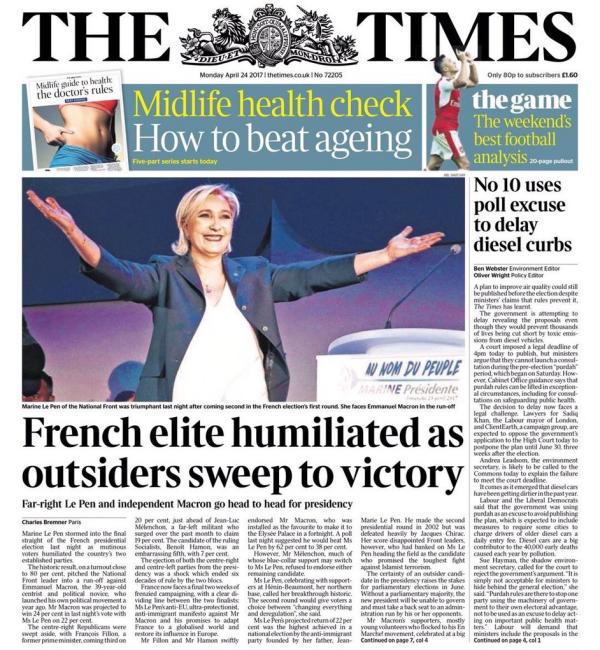
    Here’s The Times, formerly regarded as Britain’s newspaper of record, now reduced to a sad mouthpiece parroting the extreme right-wing agenda of the deeply unpleasant Rupert Murdoch.

    Times front page featuring large photo of Marine Le Pen

    Note the large photograph of Marine Le Pen. It’s also worth noting that despite the hype from right-wing media around the world, a $9.8m loan to the FN from a Russian bank with Kremlin links and alleged Russian social media support, Le Pen polled little better than in the 2012 presidential election when she finished third with nearly 18% of the vote.

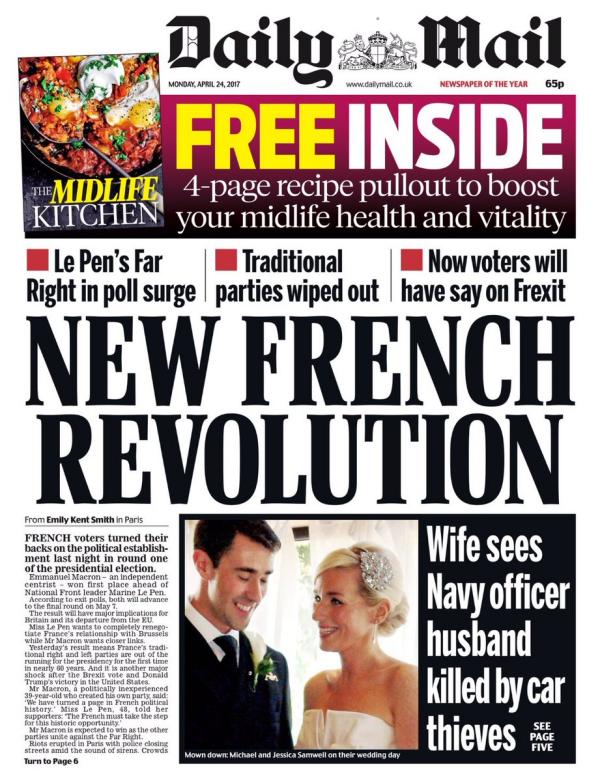
    However, The Times was not alone in its stilted coverage. Here’s the Daily Mail’s front page.

    Daily Mail front page misreporting

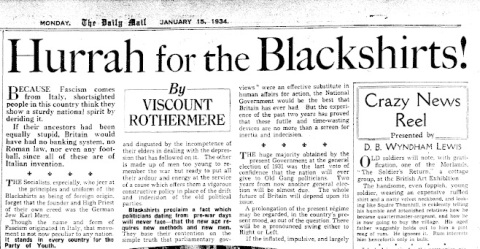
    All that can be said is that editor Paul Dacre has presided over misinformation and distortion on a massive scale, but then again the Mail has decades of experience in promoting fascism dating right back to the 1930s and its founder Viscount Rothermere’s infamous “Hurrah for the Blackshirts” piece.

    Mail's Hurrah for the Blackshirts headline

    Comme on dit en France, plus ça change…

  • Vocabulary – what a bummer

    It’s a well-known adage that Britain and the United States are 2 countries divided by a common language.

    However, that doesn’t seem to stop constant encroachment from over the other side of the Atlantic, as illustrated by the following letter from yesterday’s The Grauniad (dead tree edition).

    shot of letter complaining assholery should have been arseholery

  • Je suis saboteur

    Today’s Daily Mail front page is in full censorious mode following the announcement yesterday morning of a snap election by the UK’s not at all unelected Prime Minister.

    Daily Mail front page with headline crush the saboteurs

    As can be seen, those who voted remain in last year’s EU referendum have now been reclassified by the Mail. We’re no longer Remoaners, but Saboteurs.

    Indeed the Mail headline has been greatly exercising the Twittersphere this morning, with its wording being compared with both extreme wings of politics (the phrase “Crush the Saboteurs” was first used by Lenin in January 1919. Ed.), with several reminders of the Mail’s infamous Hurrah for the Blackshirts headline from January 1934.

    Mail's Hurrah for the Blackshirts headline

    Since this morning Mrs May has defended the Mail’s intemperate stance and headline, pleading “freedom of the press”. Some would argue freedom comes with a sense of responsibility attached, Mrs May.

    As someone who voted remain in the referendum and still regards the course towards a so-called hard Brexit favoured by the Prime Minister and entailing leaving the Single Market, the course of action she is advocating looks to me like the ultimate sabotage.

    As a person whose life is built around words, the definition and etymology of the word sabotage interests me.

    According to Dictionary.com, sabotage has the following meanings as a noun:

    • any underhand interference with production, work, etc., in a plant, factory, etc., as by enemy agents during wartime or by employees during a trade dispute; and
    • any undermining of a cause
    • .

    Sabotage can also be used as a verb, meaning to injure or attack by sabotage.

    As regards the origins of sabotage, it came into use in English in the late 19th/early 20th century, emanating from the French, equivalent to sabot(er) to botch, orig., to strike, shake up, harry, derivative of sabot, which dates back to the 13th century and denotes a clog or wooden shoe. Sabot originates from an unidentified source that also produced similar words in Old Provençal, Portuguese, Spanish (zapata), Italian (ciabatta), Arabic (sabbat) and Basque (zapata).

    As regards sabotage in the context of the UK’s relationship with the European Union/EEC, it must be remembered that the Europhobes (later called Eurosceptics. Ed.) were moaning even before the ink was dry on the signatures of Edward Heath, Alec Douglas-Home and Geoffrey Rippon on the 1972 Treaty of Accession.

    The Europhobes have consistently sabotaged Britain’s relationship with Europe ever since and, as someone who is diametrically opposed to their plans, I am therefore proud to declare: “Je suis saboteur!”

  • Grauniad terminology failure

    On Twitter, the ITI has kindly pointed out a terminological error in last week’s Guardian. I appeared in the text of the article shown below, taken on the occasion of the UK’s not at all unelected prime minister Theresa May’s visit to those nice people in Saudi Arabia who are kind enough to buy lots of weapons off the British for use in Yemen.

    shot of page of paper version of Guardian

    The person identified as Person 2 is described as “the most important person in the room, the translator”.

    I’m afraid you are wrong there, Grauniad. He may be the most important person in the room, but alas he is no translator.

    The error of the Grauniad’s ways was helpfully pointed out in a letter on Tuesday by fellow linguist Jane Straker and her letter is reproduced in full below.

    The big picture (5 April) was good and the numbered captions helpful. It was a boost for our profession to have the man below the late King Abdullah’s portrait described as “perhaps the most important person in the room”. However, translators are not normally people who listen and speak (sometimes simultaneously) in meetings: that is the job of interpreters. Some translators are trained to interpret, but they usually excel at writing, keyboard skills and carefully honing text. Speech is not writing; transfer of meaning between languages and cultures requires not only accuracy, speed and clarity, but impartiality. Interpreters should have no vested interest in the outcome of a meeting. It would be useful to know whether Theresa May had a British Arabic-English interpreter in her delegation.

    To avoid future blunders and save interpreters from putting pen to paper – or fingers to keyboard – passing Grauniad (& other) journalists are advised to consult my handy illustrated guide to translators and interpreters.

    Some linguists have remarked that the two sides of the profession should stop being so pedantic about terminology. However, I believe terminological exactitude is a crucial skill for both translators and interpreters. Give your thoughts in the comments below.

  • Post exclusive: broadcaster now runs Bristol hospital

    The Bristol Post, the city’s newspaper of warped record, has recently revamped its website, which now uses the standard template for Mirror Group titles.

    In addition, the standard of what passed in recent decades for journalism from the title seems to have taken a dive too. Whether this is related to the change of template cannot be corroborated.

    One thing that has not changed is the inability of the Post’s reporters to concentrate on the most relevant facts of a story.

    An example from today is shown in the screenshot below.

    Heading to article says BBC. Headline reads Bristol Royal Infirmary suffered three cyber attacks last year

    The story itself relates that the Bristol Royal Infirmary (BRI) suffered 3 cyber attacks involving ransomware last year.

    This is only to be expected if major organisations continue to base their IT infrastructure on Microsoft’s insecure operating systems.

    For me, the important point was on the front page as shown in the screenshot, according which the BRI now comes under the aegis of the National Health Service, although for some unfathomable reason, there is no mention whatsoever in the article itself of the British Broadcasting Corporation.

    To echo the purported words of a proper, old-school journalist, the late Bill Deedes, “Shome mishtake shurely?” 🙂

  • Recognition

    On Tuesday March 21st, your correspondent had a special appointment to keep up at the Mansion House in Clifton, the official residence of the Lord Mayor of Bristol.

    The occasion was the presentation of Lord Mayor’s Medals to what Jeff Lovell, the current Lord Mayor, described in his opening remarks as “community champions”.

    Only some 20 medals are awarded each year and your ‘umble scribe was a recipient this year.

    Receiving the medal from the Lord Mayor
    Receiving the medal from the Lord Mayor. Picture courtesy of Up Our Street

    According to the citation, I was commended for my work in the voluntary and community sector in East Bristol, including all the Tidy BS5 efforts to make Easton and Lawrence Hill a cleaner, more pleasant environment.

    However, I was not the only recipient with a BS5 postcode. Three other locals received recognition.

    Hannah Crudgington was recognised for her work for Tidy BS5 (particularly her videos. Ed.) and her efforts to show a more positive side to Easton than is generally given by the local media.

    Bruce Yates was commended for his work in turning around local youth organisation Baggator at The Pickle Factory in All Hallows Road, as well as his work for RADE Bristol, which campaigns for inner-city clean air and against efforts to install polluting standby electricity generating plant in the city.

    Last but not least, Amy Harrison received a medal for her work for Up Our Street.

    All four of us are shown in the photograph below.

    BS5 recipients of the Lord Mayor's Medal
    The BS5 recipients of the Lord Mayor’s Medal. Picture courtesy of Up Our Street.

    It was, all told, a lovely afternoon, which was made even more special by a surprise visit by my eldest niece Katherine and boyfriend Martyn, who were subsequently treated to a night on the tiles in Easton.

Posts navigation