tech

  • BarnCamp burns the nerd gag

    Last weekend saw the staging of BarnCamp 2015 (in which Bristol Wireless’ volunteers have been involved since its inception. Ed.). Running from Friday 19th June to Sunday 21st, BarnCamp was as usual a low-cost rural DIY skillsharing event open to everyone, including UK activists, campaigners, people involved in social and community groups and anybody else with an interest in technology and how to subvert it to put it to good use.

    According to the sales pitch: “All skill levels are invited and we promise that workshops are not too geeky due to our infamous nerd gag” (of which more later. Ed.).

    Once again we were the guests of Highbury Farm, a housing co-operative set in some 30 acres of unimproved but rather steep grassland at Redbrook in the beautiful Wye Valley south of Monmouth.

    Looking north towards Monmouth from Highbury Farm
    Looking north towards Monmouth from Highbury Farm

    Your correspondent formed part of the forward crew who went to site on Wednesday to set up the event. This year a few more of us were on hand to ensure that all the essential infrastructure – large tents for workshops, signage, kitchen, other refreshment facilities, camp fire, showers and the like – was all in place for the first arrivals. Indeed it was more or less complete by lunchtime on Thursday. Well done all!

    Once into the event proper, each day started with breakfast, followed by a plenary session, then workshops, lunch, more workshops and concluding with supper and socialising.

    The workshops this year had the usual variety: an introduction to satellite communications, basic electronics, using WordPress and OpenStreetMap, to mention but a few. There were even sessions on basic self defence, whilst Ben’s ever-popular wild food walk took place on no fewer than 3 occasions.

    Your correspondent was in charge of building the nightly campfire, a duty that occasionally involved some sheltering of the previous night’s embers from the rain, whilst even the woodpile showed its geeky side.

    sign on woodpile reading session locked; enter password
    The pyromaniac’s equivalent of the locked screen

    The woodpile geeking out wasn’t the only bit of strangeness occurring on site during BarnCamp. There was also the the intriguing sounding shamanic laptop massage that happened somewhere in the surrounding woodland, for which scant photographic evidence exists.

    Shamanic laptop massage montage
    Shamanic laptop massage

    What’s happened to the nerd gag? And what is it in the first place? This was a standard implemented some years ago to stop the less technical becoming too intimidated to the use of too much jargon by the more technically adept. Workshop presenters are encouraged to explain things properly if anyone so asks; this year there was even a space on the information wall where BarnCampers could share the jargon they had just acquired.

    BarnCamp jargon buster
    The jargon buster

    Nevertheless, there was one workshop – Sunday morning’s session on server optimisation – that not only ripped off the nerd gag, but set light to it and threw it away! (And that was just with the first slide of the presentation! That one slide contained more technical acronyms than the rest of the programme put together. Ed.) However, this was perhaps the most jargon-laden session of the weekend and the most geeky, but it did come with lots of laughs… as long as you could get the jokes.

    I hope all my fellow BarnCampers had as good a weekend as I did and once again my thanks go out to the good folk at Highbury Farm for their friendliness and hospitality. See you at the next one! 🙂
  • Microsoft sits in homophone corner

    This blog has discussed homophones before (posts passim). Homophone corner is a space to which people who cannot distinguish their homophones are banished to consider the errors of their ways – rather like the corner of the classroom to which misbehaving children were exiled during my primary school days.

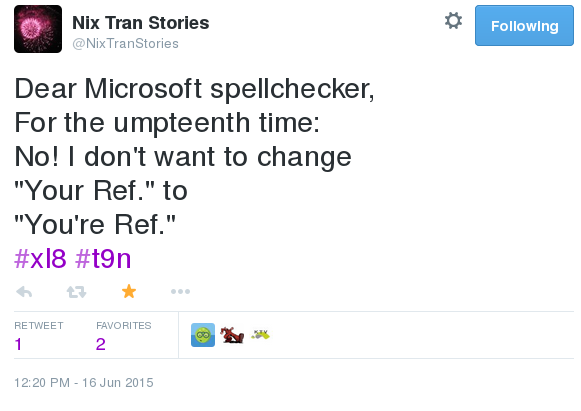
    It now appears as though the curse of the homophone is spreading to the giants of the technology world, as shown by the following tweet from Nix Tran Stories.

    image text reads Dear Microsoft spellchecker, For the umpteenth time: No! I don't want to change Your Ref. to You're Ref.

    I’ve used Microsoft Word/Office since the days of Windows 3.1 and its spelling and grammar checking tools have in my opinion never been particularly good: I’ve always run rings around them; and now it appears that the spellchecker has been coded by an illiterate.

    I suppose the least I could do is pat the leader of the MS Office team on the shoulder and mouth the platitude “their, there, they’re!“. 😉

  • LibreOffice 2015 Conference – call for papers

    The call for papers for this year’s LibreOffice Conference has today been announced on Twitter by Collabara’s LibreOffice team.

    LibreOffice Conference 2015 logo

    Proposals should be submitted by 15th July 2015 in order to guarantee that they will be considered for inclusion in the conference programme.

    The conference programme will be based on the following topics:

    • Development, APIs, Extensions, Future Technology;
    • Quality Assurance;
    • Localisation, Documentation and Native Language Projects;
    • Appealing Libreoffice: Ease of Use, Design and Accessibility;
    • Enterprise and Public Sector Deployments and Migrations, Certifications and Best Practices;
    • Open Document Format, Document Liberation and Interoperability; and
    • Building a successful business around LibreOffice.

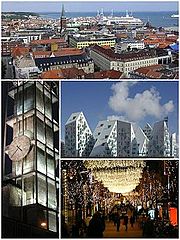
    Aarhus montageThis year’s event will be held in Aarhus, Denmark’s second city, from 23rd to 25th September inclusive.

    Venue

    The venue will be a completely new venue on the harbour in Aarhus called “Dokk1 – Urban Media Space Aarhus“.

    Urban Media Space is described as “a flexible and dynamic sanctuary for everyone in search of knowledge, inspiration and personal development – an open and accessible learning environment supporting democracy and community and is also going to be an example of the library of the future.”

    Conference communication channels

    The official communication channel during the conference will be the conference mailing list, conference@global.libreoffice.org. All participants will automatically be subscribed to that list, whilst the archives can be browsed at http://listarchives.libreoffice.org/global/conference/.

    Primary Danish conference contacts

    The primary conference contacts in Denmark have likewise been announced; they are:

    • Carsten Agger (Open Space Aarhus);
    • Line Dybdahl (Municipality of Aarhus);
    • Leif Lodahl (LibreOffice Denmark); and
    • René Lagoni Neukirch (LibreOffice Denmark).
  • Microsoft finally enters 20th century

    Nearly one decade and a half into the 21st century, Microsoft has announced that it is finally going to enter the 20th century by offering SSH support for its PowerShell offering.

    Windows PowerShell session screenshot
    Windows PowerShell session screenshot. Image courtesy of Wikimedia Commons.

    This move means that users will in future also be able to access and administer other systems remotely using the SSH protocol.

    In its implementation Microsoft will be backing the OpenSSH project, which is popular in the open source world; MS wants to join the project and contribute its own code. It is still not certain when the initial results of this work can be expected as things are currently in an early planning phase.

    Microsoft becoming more open to open source

    MS’ blog post also reports that the developer team has been attempting to extend PowerShell with SSH functionality for quite some time. This proposal was made as early as the first two versions of PowerShell, but was rejected. “Changes in the management and culture” of the company have now encouraged the development team to attempt it again. Pressure from the community and several requests via social media have resulted in the idea now having full senior management support.

    The company has become more amenable to open source ever since Satya Nadella took over running the software giant and as a consequence the complete .NET framework has been released as open source.

  • Don’t let the Snoopers’ Charter bounce back

    online spying imageIn the Queen’s Speech the Government announced it’s going to introduce an Investigatory Powers Bill (posts passim). This is the new Snoopers’ Charter and will more than likely comprise even greater powers for the police and GCHQ to spy on British citizens. (Will the Government’s longer term aim of a British Bill of Rights comprise the right to be spied upon by the State? Ed.)

    This is the fifth time a UK Government has tried to bring in a Snoopers’ Charter. The Home Office wants to give the police and intelligence services even more powers to look at what Brits do and who they talk to.

    Do Britons really want to live in a country where all their communications are monitored by the State?

    Precise details of the Home Office’s plans but there might be an attack on the encryption technology that helps keep our emails and online banking and shopping secure.

    The police and intelligence services should concentrate on targeting people suspected of crimes instead of collecting everyone’s data all of the time.

    It’s unclear whether the Home Office’s collect-it-all approach is effective or giving taxpayers value for money. The perpetrators of heinous crimes like the murder of Lee Rigby and the Charlie Hebdo attack were already known to the British and French intelligence services respectively, but those services decided to stop monitoring them due to lack of resources.

    ORG logoThe Open Rights Group (ORG) has set up a petition to campaign against the revived Snoopers’ Charter.

    The text of the petition reads:

    We demand an end to indiscriminate retention, collection and analysis of everyone’s Internet communications, regardless of whether they are suspected of a crime.

    We want the police and intelligence agencies to have powers that are effective and genuinely protect our privacy and freedom of speech.

    Sign the petition.

    The ORG will also be organising a lobby day soon so supporters can go to Parliament, get a briefing about the Bill and then talk to their MPs.

    Reposted from Bristol Wireless, with minor re-editing.

  • OpenMandriva’s next release to pay homage to its Mandrake heritage

    The sad news arrived earlier this week that French Linux gurus Madriva were being wound up (posts passim).

    One of its community spin-offs, OpenMandriva, has now announced that its next release will be a tribute to its Mandrake heritage.

    OpenMandriva’s history is well known. It was born at the end of 2012 with the help of the community and Mandriva SA to continue the work on the distribution after Mandriva SA could not continue to do so.

    OpenMandriva screenshot

    OpenMandriva has expressed its thanks to Mandriva SA for the latter’s initial support and it has wished former Mandriva employees well for the future.

    The OpenMandriva Association was created to unite the distribution formerly known as Mandriva (aka Mandrake) and to return it to its roots through listening to peoples needs and getting closer to its users and developers. Since then OpenMandriva has been independent (though it still remains open to cooperative effort). It will continue to do this and will be releasing a new release of OpenMandriva Lx 3 (2015) in the near future that will include new features and an update of many of the core components.

    OpenMandriva states that Mandrake was the first Linux distribution to make a free operating system available which could be installed and configured by anyone who could use a keyboard and a mouse. When many people first entered the “Linux” world, there were two types of distro: the ones that gave you headaches as soon as you put the CD in the drive; and Mandrake. The vision of Mandrake’s founder Gaël Duval created an operating system which undoubtedly allowed many, many people access to modern technology and in doing so added greatly to the strength of the free software community.

    Reposted from Bristol Wireless.

  • LibreOffice Viewer for Android released

    The Document Foundation, the organisation behind LibreOffice, the most popular free and open source office suite, has announced the release of a native application for viewing ODF documents on Android devices.

    The app can be installed from the Google Play Store, whilst direct download of the APK will be made available at http://www.libreoffice.org/download/android-viewer.

    LibreOffice Viewer screenshotLibreOffice Viewer also offers basic editing capabilities, like modifying words in existing paragraphs and changing font styles such as bold and italics.

    Editing is still an experimental feature which has to be enabled separately in the settings, and is not stable enough for mission critical tasks. Full-blown editing will be enabled in the future with
    the help of LibreOffice’s steadily growing developer community. The editing features provided in the current release have been developed thanks to donations to The Document Foundation.

    Feedback and bug reports for the app are very welcome to help developers improve its quality en route to a fully-fledged editor. Users are invited to report problems, using the bug tracker and attaching files that have triggered the issue at http://documentfoundation.hosted.phplist.com/lists/lt.php?id=N09VVkUAB00ABgsI.

    LibreOffice Viewer uses the same engine as LibreOffice for Linux, OS X and Windows. This, combined with a new front-end based on Firefox for Android, reads documents similarly to a desktop version of LibreOffice.

    LibreOffice Viewer has been developed by Collabora and Igalia, backed by Smoose, with contributions from Google Summer of Code students, together with The Document Foundation and the LibreOffice community. SUSE provided a key foundation of cross-platform support, whilst the Mozilla Corporation – makers of Firefox- made several core components available.

  • The return of the Snoopers’ Charter

    Like a boomerang curry, the Snoopers’ Charter (posts passim) is back – and with a vengeance this time.

    image of Theresa May
    Home Secretary Theresa May, the woman who wants to read all your emails
    Wired UK reports that this morning’s Queen’s Speech setting out the government’s legislative programme for the next year. In her speech in the House of Lords, the Queen said new legislation would “modernise the law on communications data.”

    The new legislation will be known as the Investigatory Powers Bill and will not only cover everything included in the previously-blocked charter, but also allow security services to intercept the content of communications in bulk.

    The Bill will allegedly “provide police and intelligence agencies with the tools” to keep people safe, whilst changes will also be made to close “ongoing capability gaps” that the government believes prevent law enforcement and intelligence services from tackling terrorism and serious crime. The new bill would also introduce “appropriate oversight and safeguard arrangements.” The latter are long overdue.

    Reposted from Bristol Wireless.

  • Adieu Mandriva

    Things were never easy for Mandriva, which was founded in 1999 as MandrakeSoft: with Mandrake Linux the company was originally aiming for a user-friendly desktop Linux. However, the major breakthrough for Linux on the desktop failed to appear and thus financial squeezes run like a strand through the company’s history in spite of the rapid expansion of the product portfolio for commercial solutions, German technology website heise reports.

    Mandriva logo

    The company did achieve a successful launch on the French stock market in 2001. However, MandrakeSoft had to apply for creditor protection only two years later. The company’s renaming as Mandriva took place in 2005 in the wake of the merger with Brazil’s Conectiva; Mandrake’s founder Gaël Duval left the company shortly afterwards due to a dispute.

    There were financial problems once again in 2010 and Mandriva (at that time the company had over 70 employees) was looking for a buyer. Though an investor was eventually found, some 30 former Mandriva employees , developers and community members nevertheless founded the Mandriva fork Mageia at the end of that year. The fork was intended to ensure the continuity of Mandriva Linux since Mandriva’s commitment to its desktop Linux distribution had declined sharply. Insolvency loomed once again at the end of 2011, but was able to be repulsed ultimately with a recapitalisation.

    The idea for OpenMandriva arose from the realisation that there was no money to be made with Linux for the desktop: an independent association was to continue producing Mandriva Linux as a community project. With Mageia and OpenMandriva there are now two community distributions, both of which have nevertheless lost some of their verve: the current Mageia 4 was released at the start of 2014; and OpenMandriva LX 2014.1 from September 2014. However, work is continuing on new versions of both distributions.

    Mandriva is now in liquidation according to French company register societe.com. Lawyer Frédérique Lévy has been appointed as the administrator. The mandriva.fr and mandriva.com are no longer available.

  • Tidy BS5: reporting online

    Everywhere one travels in the United Kingdom, the common perception of residents is that their council is useless and costs too much.

    Bristol is no exception to this commonly accepted opinion of local authorities.

    In the past your correspondent has been no stranger to criticising Bristol City Council. However, there is one aspect of its operations where praise is due; and that’s its online presence. Compared with some local authority websites I have visited, Bristol City Council’s ranks amongst the best in my opinion. Indeed this blog has in the past praised Know Your Place, where one can get an intimate knowledge of the city and its long, proud history (posts passim). The open data section is worth a browse too.

    fly-posting on Easton Way Bristol
    Fly-posting: report it online

    This amazingly useful online presence is also apparent if one is concerned with street care and cleaning in Bristol. This is where one can report and obtain information on all kinds of problems encountered in urban steets.

    The following can all be reported online:

    graffiti on communal bin
    Graffiti or overflowing bin? Report it online

    Reporting road and cleaning problems online is by far the most convenient way of letting the council know of any problems encountered and as such can help to expedite their remedying, so get reporting. Most problems seem to be resolved within the promised 2 working days, although I must point out to any passing councillors and/or BCC officers that the system does occasionally break down.

Posts navigation