tech

  • LibreOffice 4.4.2 released

    The Document Foundation has today announced the release of LibreOffice 4.4.2, the second minor release of the LibreOffice 4.4 “fresh” family, with over 50 fixes compared with LibreOffice 4.4.0 and 4.4.1.

    LibreOffice about window

    New features introduced by the LibreOffice 4.4 family are listed in the release notes.

    The Document Foundation suggests to deploy LibreOffice in enterprises and large organizations when backed by professional support by certified people, of whom the Foundation maintains a list.

    People interested in technical details about the release can see the changelogs for the bugs fixed in RC1 and bugs fixed in RC2 respectively.

    Download LibreOffice

    LibreOffice 4.4.2 is immediately available for download from http://www.libreoffice.org/download/.

    LibreOffice users, free software advocates and community members can support The Document Foundation with a donation. Money collected will be used to improve the project’s infrastructure and support marketing activities to increase the awareness of the project at both global and local levels.

    I’ve been using version 4.4.2 for a while now since I downloaded a pre-release development build (version 4.4.2.2) and have found it both stable and easy to use.
  • Evolve OS name change forced by trade mark dispute with UK government

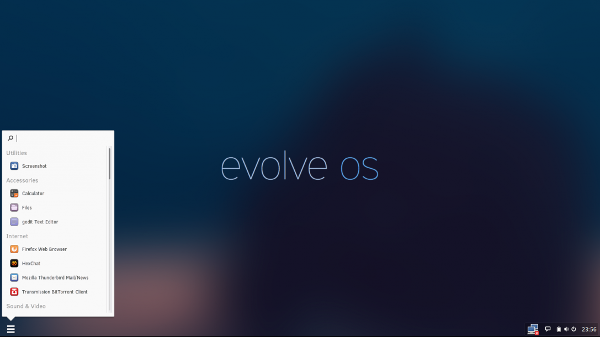
    The Evolve OS desktop Linux distribution is being forced into a change of name due to potential trade mark problems with the UK government, Softpedia reports.

    Evolve OS screenshot

    The bone of contention is not the Evolve element, but OS, which is apparently a trade mark registered to registered to the Secretary of State for Business, Innovation and Skills, whose trade mark agents are a company called Field Fisher Waterhouse LLP.

    In its headline, Softpedia describes this trademark registration as “stupid“.

    Writing yesterday on Google+, the developers stated:

    This is not an April Fools post

    We will be required to change the name of the Evolve OS project, to avoid unnecessary legal action. All I will say right now is that the dispute is UK specific, and I have been informed that the relevant trademarks are held by the Secretary of State.

    The letter goes beyond asking for a withdrawal of trademark application and asks we stop using the “mark”.

    Clearly this is going to be an expensive and painful road in either direction, so we shall go with a rename.

    The developers have also asked for the help of the free and open source community to come up with a new name that would be free of trademark infringements.

    Reposted from Bristol Wireless.

  • Debian Jessie target release date announced

    Debian logoNiels Thykier of the Debian release team has announced the release date for the forthcoming version 8 of Debian, codenamed Jessie. Jessie should be ready on Saturday 25th April. The could only change, Thykier writes, if something really critical pops up or it is not possible to publish the release on time for technical reasons.

    There is still time until 18th April for final bug fixes; there should be no further changes to Debian in the final week before release. Managers of packages with bugs must therefore work speedily on getting them fixed. Until the release packages with critical bugs could still be removed from the distribution. Thykier writes that there are currently at least twelve release-critical bugs which could result in the removal of the packages concerned from Debian 8.

  • World’s less spoken languages get a boost with Openwords

    Over half of the world’s people, i.e. those that speak a language with less than 100 million native speakers, do not have a language learning mobile app suited for their language or needs, according to Opensource.com.

    Most of these languages are disregarded by mobile app developers, but Openwords is a start-up that aims to address this problem.

    Openwords can mine massive, existing public data resources such as Wiktionary or the Apertium open machine translator and will thus be able to provide content quickly for populations without language learning apps. Other companies would need to build this content themselves, but Openwords uses pre-existing open data.

    Openwords has already proved this concept can work by collating content for more than 1,000 languages and will be running a campaign to raise funds to complete the Openwords app that will provide a language learning platform for this open content collection.

    Emphasis on freedom

    The Openwords app will emphasise freedom. Whereas many existing apps do not allow learners to decide what they will learn, whereas Openwords will give learners this freedom while also allowing them to follow a default curriculum. It will also be free (gratis) for learners.

    Most importantly, Openwords’ content is in the public domain. This means all Openwords’ educational content is copyleft and owned by the public. This is the major philosophical difference between Openwords and proprietary language learning apps. The Openwords app will function as a reader of open content. Whenever Openwords content is added or improved, contributors will be building something for everyone’s benefit.

    Openwords aims to provide:

    • Free, open domain, educational material.
    • Diverse education material for populations without electronic foreign language learning content.

    Openwords is asking the open source community for guidance on how to fulfill all obligations to the open source community successfully. Openwords has made a lot of progress in making the Openwords database available and has constructed an HTTP API available through Openwords.org, which hosts the Openwords word and language problem database.

  • EU Commission updates its open source strategy

    EU flagThe European Commission has announced the updating its strategy for internal use of open source software. The Commission, which is already using open source for many of its key IT services and software solutions, will further increase the internal role of this type of software. The renewed strategy puts a special emphasis on procurement, contribution to open source software projects and releasing more of the software developed within the Commission as open source.

    Highlights

    The specific objectives of the renewed strategy are:

    Equal treatment in procurement

    The Commission will ensure a level playing field when procuring new software. This means that open source and proprietary software will be assessed on an equal basis, being both evaluated on the basis of total cost of ownership, including exit costs.

    Contribution to communities

    The Commission services will increasingly participate in open source software communities to build on the open source elements used in the Commission’s software.

    Clarification of legal aspects

    To enable easy collaboration with the open source communities, Commission developers will benefit from appropriate legal coaching and advice on how to deal with the intellectual property aspects of open source software.

    Open source and interoperable software developed by the Commission

    Software produced by the Commission departments, and particularly software produced for use outside the Commission, will be released as open source under the European Union Public License (EUPL) and published on the Joinup platform. The software produced should aim to be interoperable and use open technical specifications.

    Transparency and better communication

    The updated strategy emphasises improved governance, an increasing use of open source in the field of security and this strategy’s alignment with the EC’s ISA Programme, enabling the modernisation of cross-border and cross-sector eGovernment services.

    Reposted from Bristol Wireless.

  • LibreOffice to take to the cloud

    LibreOffice, the best free and open source office suite produced, is set to become the cornerstone of the world’s first global personal productivity solution – LibreOffice Online – following an announcement by IceWarp and Collabora of a joint development effort, The Document Foundation blog reports today. LibreOffice is available as a native application for every desktop operating system and is currently under development for Android. Furthermore, it is available on virtual platforms for Chrome OS, Firefox OS and iOS.

    LibreOffice banner

    “LibreOffice was born with the objective of leveraging the OpenOffice historic heritage to build a solid ecosystem capable of attracting those investments which are key for the further development of free software,” says Eliane Domingos de Sousa, Director of The Document Foundation. “Thanks to the increasing number of companies which are investing on the development of LibreOffice, we are on track to make it available on every platform, including the cloud. We are grateful to IceWarp for providing the resources for a further development of LibreOffice Online.”

    Development of LibreOffice Online started back in 2011 with the availability of a proof of concept of the client front end, based on HTML5 technology. That proof of concept will be developed into a state of the art cloud application, which will become the free alternative to proprietary solutions such as Google Docs and Office 365. It will also be the first to offer native support for the Open Document Format (ODF) standard.

    “It is wonderful to marry IceWarp’s vision and investment with our passion and skills for LibreOffice development. It is always satisfying to work on something that, as a company, we have a need for ourselves,” says Michael Meeks, Vice-President of Collabora Productivity, who developed the proof of concept back in 2011 and will oversee the development of LibreOffice Online.

    The launch of LibreOffice Online will be announced at a future date.

  • Document Freedom Day: why open standards matter

    Document Freedom Day dove posterToday is Document Freedom Day, an annual international celebration of open formats and open standards and an opportunity to promote their use.

    The use of open standards is definitely gaining ground, particularly where it matters, such as in dealings with government bodies. This was amply illustrated last year by the UK Cabinet Office’s announcement of the adoption of open standards for collaborating on government documents.

    Why do open standards matter?

    Open standards are vital for interoperability and freedom of choice. They provide freedom from data lock-in and the accompanying vendor lock-in. This makes open standards essential for governments, companies, organisations and individual users of information technology.

    What is an open standard?

    An open standard refers to a format or protocol that is:

    • Subject to full public assessment and use without constraints in a manner equally available to all parties;
    • Without any components or extensions that have dependencies on formats or protocols that do not meet the definition of an open standard themselves;
    • Free from legal or technical clauses that limit its use by any party or in any business model;
    • Managed and further developed independently of any single supplier in a process open to the equal participation of competitors and third parties;
    • Available in multiple complete implementations by competing suppliers, or as a complete implementation equally available to all parties.

    How do open standards affect you?

    April, the French open source advocacy organisation, has produced a handy graphic in English to illustrate the difference between open and closed formats. Click on the image below for the full-sized version.

    April leaflet showing difference between open and closed formats

    Examples of open standards

    Many open standards are in wide use. Here are 3 examples:

    • Plain text (.txt);
    • HTML, the language of the web;
    • ODF, the default file format of free and open source office suites such as LibreOffice and OpenOffice. ODF can also be handled by Microsoft Office versions from Office 2007 onwards.

    Document Freedom Day is being promoted on social media by the use of the #DFD2015 hashtag.

  • GNU nano 2.4.0 text editor released

    Four years after the last major update to version 2.3.0, the developers of the GNU nano text editor have now announced the release of version 2.4.0. In his email Chris Allegretta nano now has a fully functional undo system which is now enabled by default, vim-compatible file locking, linter support, formatter support, syntax highlighting flexibility and many fixes for bugs reported since version 2.2.

    nano screenshot

    Besides the source code package (in tar.gz), the new version of nano is available from the GNU nano website for various Linux distributions and Windows. The latest unstable release of the 2.3 branch is also available for download.

  • TidyBS5 news

    A week ago yesterday, there was a meeting of the TidyBS5 task force with council officers and Councillor Marg Hickman at the offices of Up Our Street.

    It was a good opportunity for the officers to update community volunteers on what the council has done, is and will be doing.

    fly-tipping in Jane Street Redfield
    Jane Street in Redfield earlier today

    For Stapleton Road a deep clean is planned for this year; this will mean giving the footways a thoroughly good scrub and removing chewing gum from their surfaces. In addition, hanging baskets will be provided on approx. 30 lamp posts to help make the street a bit more colourful and attractive.

    The city council’s streetscene enforcement team has now moved into the area and has already had some success: 5 traders have been issued with £300 fixed penalty notices for abusing the communal bins intended for household waste only. In addition, some minor offenders have been fined smaller amounts.

    Turning to communal bins, task force members have been invited to assist in devising the communal bins consultation that the council is organising for the Stapleton Road corridor. Two task force members, Hannah and myself, informed officers that we were monitoring clearance times after fly-tipping had been reported. From my own monitoring since then, communal bins seem to be implicated in some 60% of sites notified to the council.

    After the update from the offices, it was pointed out to them that, while all this attention being lavished on the Stapleton Road area was appreciated, it should not detract from equally bad problems along the Lawrence Hill/Church Road corridor, home to the infamous Jane Street (see above).

    During my discussion on social media with BCC’s Chief Enterprise Architect Gavin Beckett about open standards (posts passim), he invited me to submit feedback on using the council website; this will be done from the aspect of reporting street cleaning matters, where the website still has a couple of interesting foibles.

    Up Our Street is organising a community litter pick on Saturday 28th March from 11 am to 1 pm. Volunteers are asked to assemble at Lawrence Hill roundabout (map). For more details, contact Lorena on 0117 954 2835.

    Big Clean publicity poster

    Finally, don’t forget to sign the TidyBS5 e-petition!

Posts navigation