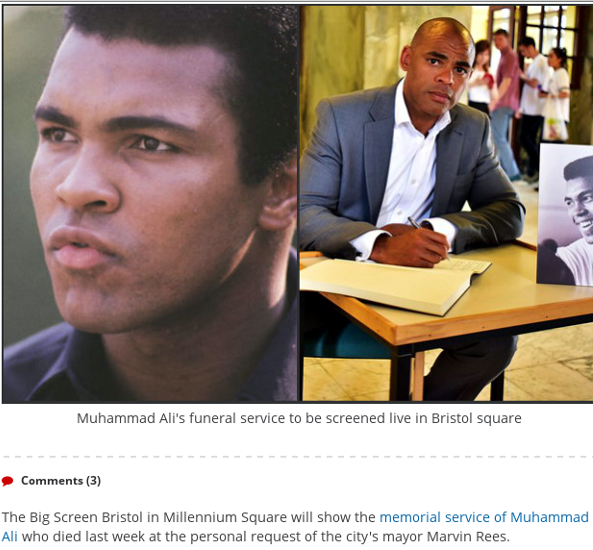
Like many, I was saddened to hear of the death of Muhammad Ali. As a young lad growing up in the 1960s and keen on sport of all kinds, he was a large presence on the TV sports programmes and the newspaper sports pages.
His achievements in the ring and his stand against conscription and the Vietnam War helped reinforce his reputation: he really did end up as “the greatest“.
However, news emerges via the Bristol Post that Ali’s death may not be all it seems: Muhammad’s demise could have been at the behest of Marvin Rees, Bristol’s newly elected mayor.
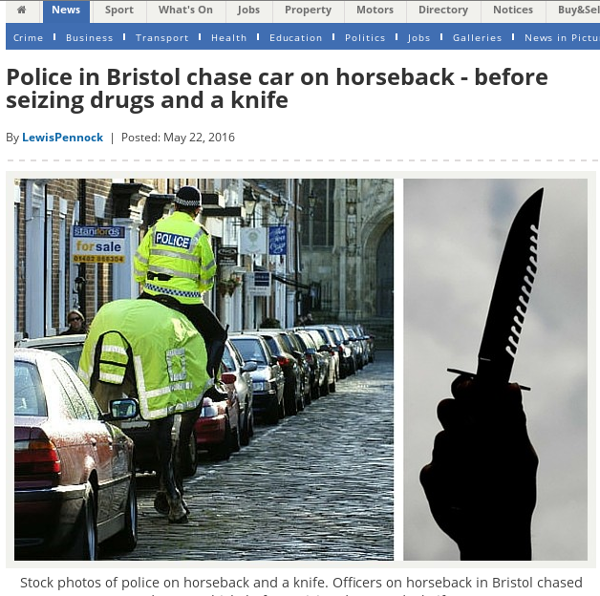
However, as per usual, it is merely a case of the endemic bad use of English, appalling grammar and ambiguity by the Post’s semi-literate hacks.
Unfortunately, the reporter concerned fails to tell readers how the car was able to stay in the saddle, given the inability of the car’s wheels to fit into the stirrups. 😉
Very soon after graduating and getting my first job with Imperial Group, I was taught by my then manager to avoid any ambiguity when writing. Times have clearly changed!
For any Brit with republican leanings who is still trying to forget yesterday’s antediluvian pantomime in Westminster otherwise known as the State Opening of Parliament, 19th May 1649 is a significant date.
On that day in 1649 the English Parliament enacted a law entitled “Act Declaring and Constituting the People of England to be a Commonwealth and Free-State“, abolishing both the monarchy and the House of Lords.
The text of the Act is available on Wikisource*, from whence it has been transcribed from the accompanying PDF with the original 17th century spelling and punctuation.
BE IT DECLARED and enacted by this present Parliament and by the Authoritie of the same:—
That the People of England and of all the Dominions and Territoryes thereunto belonging are and shall be and are hereby constituted, made, established, and confirmed to be a Commonwealth and free State And shall from henceforth be Governed as a Commonwealth and Free State by the supreame Authoritie of
this Nation, the Representatives of the People in Parliament and by such as they shall appoint and constitute as Officers and Ministers under them for the good of the People and that without any King or House of Lords.
* Originally taken from Acts and Ordinances of the Interregnum, 1642-1660, edited C H Firth and R S Rait (London, 1911)
Although they are more likely to be seen in upland areas of south-west England, Wales, the north Pennines and Lake District and much of Scotland, sightings of ravens are not unknown in the low-lying city of Bristol.
Common raven (corvus corax). Photo courtesy of Wikimedia Commons
Your ‘umble scribe has seen single ravens around Temple Meads railway station, as well as in such inner-city districts as Easton. More often than not, I have heard the raven’s distinctive call before seeing it with the naked eye.
The largest number I’ve ever spotted at one time was a few weeks ago, when I sighted three ravens circling over Barton Hill, being mobbed by aggressive members of the area’s resident gull population.
Mythology and legend
Ravens have long featured in European mythology. In Irish mythology, the goddess Morrígan alighted on the hero Cú Chulainn‘s shoulder in the form of a raven after his death. In Welsh mythology ravens were associated with the Welsh god Bran the Blessed, whose name translates to “raven.” According to the Mabinogion, Bran’s head was buried in the White Hill of London as a talisman against invasion.
In Norse mythology, Huginn (from the Old Norse for “thought”) and Muninn (Old Norse for “memory” or “mind”) are a pair of ravens that fly all over the world, Midgard and bring the god Odin information.
In England a legend developed that the country would not fall to a foreign invader as long as there were ravens at the Tower of London (invasions are averted by the simple expedient of clipping the wings of the resident ravens. Ed.). Although this is often thought to be an ancient belief, Geoffrey Parnell, the official Tower of London historian, believes that, like so many other legends of the British Isles, this is actually a romantic Victorian invention.
In culture
In western culture ravens have long been considered to be birds of ill omen and death, partly due to the negative symbolism of their all-black plumage and the eating of carrion.
As in traditional mythology and folklore, the common raven features frequently in more modern writings such as the works of William Shakespeare, and, perhaps most famously, in the poem “The Raven” by Edgar Allan Poe. Ravens have also appeared in the works of Charles Dickens, J. R. R. Tolkien and Stephen King, amongst others.
Ravens have also featured in song. “The Three Ravens” is an English folk ballad, printed in the song book Melismata compiled by the appositely named Thomas Ravenscroft and published in 1611, but it is perhaps older than that.
The music and lyrics are set out below. The latter are in their original 17th century orthography, with the refrains in italics.
The ballad takes the form of 3 ravens conversing about where and what they should eat. One tells of a newly slain knight, but they find he is guarded by his loyal hawks and hounds. Furthermore, a “fallow doe”, an obvious metaphor for the knight’s pregnant (“as great with young as she might go”) lover or mistress comes to his body, kisses his wounds, bears him away and buries him, leaving the ravens without a meal.
Music for The Three Ravens
There were three rauens sat on a tree, Downe a downe, hay down, hay downe
There were three rauens sat on a tree, With a downe
There were three rauens sat on a tree,
They were as blacke as they might be. With a downe derrie, derrie, derrie, downe, downe
The one of them said to his mate,
‘Where shall we our breakefast take?’
‘Downe in yonder greene field,
There lies a knight slain vnder his shield.
‘His hounds they lie downe at his feete,
So well they can their master keepe.
‘His haukes they flie so eagerly,
There’s no fowle dare him come nie.’
Downe there comes a fallow doe,
As great with yong as she might goe.
She lift vp his bloudy hed,
And kist his wounds that were so red.
She got him vp vpon her backe,
And carried him to earthen lake.
She buried him before the prime,
She was dead herselfe ere euen-song time.
God send euery gentleman,
Such haukes, such hounds, and such a leman.
Your correspondent does not know what the three ravens circling Barton Hill found to eat, as dead knights are not exactly common in that part of the city. 😀
With the notable exception of Test Match Special‘s cricket commentary on long wave, BBC sports commentators seem to be employed more for their ability to shout than proficiency in the English language, judging from the rare bits of sports commentary that get broadcast as part of Radio 4’s news bulletins.
This opinion received further support yesterday when the BBC Sport Twitter account sought the views of Aston Villa FC fans on news that the club at the bottom of the Premier League (that’s the English First Division in old money. Ed. 🙂 ) table would be playing in the Championship (the old Second Division. Ed.) next year, as per the following tweet, which has since been deleted:
Wait off the shoulders, Auntie? This blog is giving you a red card and you should now proceed from the field of play for an early bath and thence to your reserved place in Heterograph Corner! 🙂
Yesterday evening there was dark smoke on the skyline as your correspondent returned from an early evening pint. However, it wasn’t until this morning that its full significance and exclusive nature was revealed by the Bristol Post, the city’s newspaper of warped record.
As per the screenshot above, the Post duly reported a fire at a scrapyard in the Fishponds area, although a later report moved the fire to nearby Speedwell.
Furthermore, the conflagration must have been painful on the ears for anyone in the vicinity or downwind as the smoke was “bellowing“.
However, as the witnesses interviewed by the paper make no mention of noise, it can only be assumed that the hapless hack had an unfortunate vowel movement.
The later report did state correctly that “A scrapyard in Speedwell left dark smoke billowing over parts of Bristol,” but not until the hopeless howler had caused much merriment in the reports comments section.
If the reporter in question happens upon this post, the definitions of bellow and billow are given below for future reference:
Bellow: (of a person or animal) emit a deep loud roar, typically in pain or anger: e.g. “he bellowed in agony”
Billow: (of smoke, cloud, or steam) to move or flow outward with an undulating motion: e.g. “smoke was billowing from the chimney-mouth”.
Eggs have long been associated with Easter since for Christians the Easter egg is a symbol of Christ’s empty tomb.
The custom of the Easter egg originated in the early Christian community of Mesopotamia, which stained eggs red in memory of the blood of Christ, shed at his crucifixion.
This practice still survives in Greece where hard-boiled eggs are dyed bright red to symbolise the spilt Blood of Christ and the promise of eternal life. They are also cracked together to celebrate the opening of the Tomb of Christ.
In more recent times since those of the early Christians of Mesopotamia egg hunts have become a fixture of the Easter events calendar.
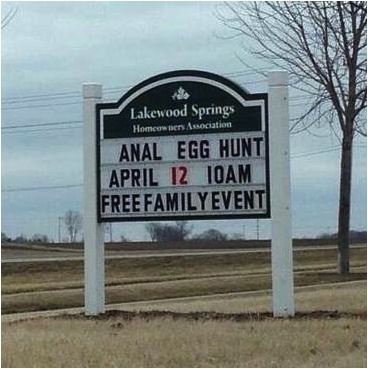
However, here’s one event from recent years from Lakewood Springs in Illinois that sounded a little too intimate for comfort…
On 5th May elections will be held in England for local councils, local police and crime commissioners and in Bristol the elected Mayor.
As part of the election process, there’s a period before the announcement of the election and the final election results in which central – in the case of general elections – and local government is prevented from making announcements about any new or controversial government initiatives (such as modernisation initiatives or administrative and legislative changes) which could be seen to be advantageous to any candidates or parties in the forthcoming election.
This period has traditionally been called “purdah” after the practice in certain Muslim and Hindu societies of screening women from men or strangers, especially by means of a curtain. “Purdah” itself originates from Urdu and Persian “parda“, meaning a “veil” or “curtain“.
Earlier this month I attended the quarterly meeting of Bristol’s Ashley, Easton & Lawrence Hill Neighbourhood Partnership. At this meeting attendees were clearly told by the officer serving the partnership that “purdah” was no longer an acceptable term and that the time in question should be referred to as the “pre-election period“.
This occurred after “purdah” had already been used a few times by elected councillors and makes your correspondent wonder if colourless, unaccountable, unelected council officers (whose wages we pay. Ed.) should be allowed to dictate the vocabulary which is used in meetings.
I don’t think they should.
Do you agree or disagree with my conclusion? Please comment below.
Last Thursday I was in Shrewsbury, county town of the county of my birth. Shrewsbury is steeped in a wealth of medieval history, including plenty of ancient street names (mostly based upon the shops sited there – e.g. Butcher Rown, Fish Street, etc. Ed.), amongst them the intriguingly titled Grope Lane.
Grope Lane street signA look back down Grope Lane towards High Street
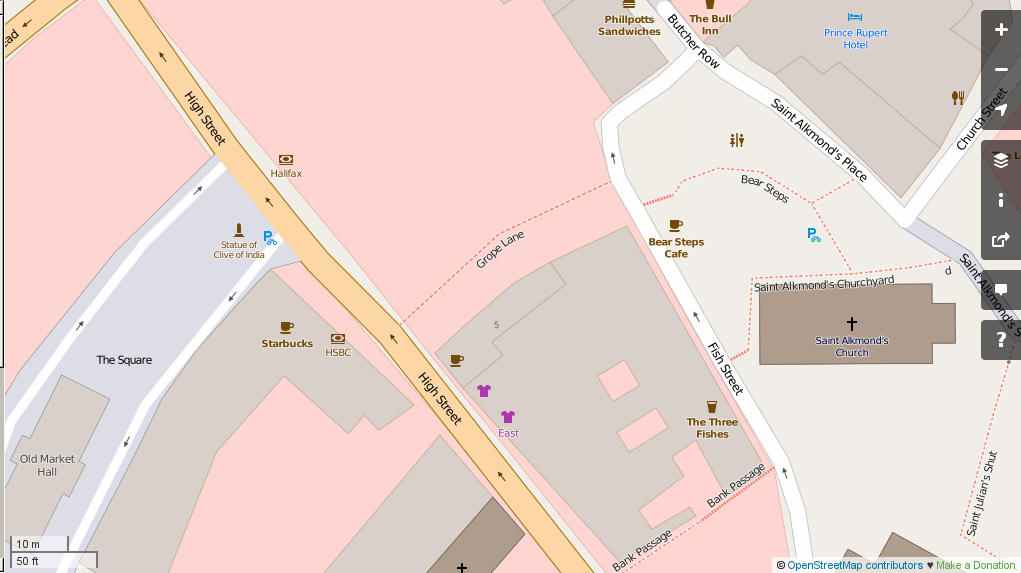
Grope Lane in Shrewsbury is a narrow alley connecting High Street and Fish Street in the heart of the old medieval town, as shown on the location map below.
Location of Grope Lane in Shrewsbury. Image courtesy of OpenStreetMap. Click on image for full-sized version
As with many towns in the Middle Ages, Shrewsbury’s Fish Street (and nearby Butcher Row. Ed.) are named after the trades that occupied them. However, Grope Lane is also reputed to be linked to trade – this time the pleasures of the flesh.
Wikipedia has an excellent page on this street name in its unsanitised version.
Gropec*nt Lane, says Wikipedia, was a street name found in English towns and cities during the Middle Ages, believed to be a reference to the prostitution centred on those areas… Gropec*nt, the earliest known use of which is in about 1230, appears to have been derived as a compound of the words grope and c*nt (our medieval forebears were less sensitive and more earthy in their use of language than their modern descendants, as anyone who had read Chaucer in the original Middle English can testify. Ed.). Streets with that name were often in the busiest parts of medieval towns and cities.
Towns and cities with active quays or ports often had an adjacent Grope(c*nt) Lane, as in the case of Bristol, although that street name recorded in the reign of Edward III (1312-1377), was subsequently changed to Hauliers Lane and has since been changed again (see below).
Although the name was once common throughout England, changes in attitude resulted in its replacement by more innocuous versions such as Grape Lane. A variation of Gropec*nt was last recorded as a street name in 1561.
In Shrewsbury a street called Grope Countelane existed as recently as 1561 and connected the town’s two principal marketplaces. At some unspecified date the street was renamed Grope Lane, which it has retained to the present day. In Thomas Phillips’ History and Antiquities of Shrewsbury (1799) the author is explicit in his understanding of the origin of the name as a place of “scandalous lewdness and venery”, but Archdeacon Hugh Owen’s Some account of the ancient and present state of Shrewsbury (1808) describes it as “called Grope, or the Dark Lane”. As a result of these differing accounts, some local tour guides attribute the name to “feeling one’s way along a dark and narrow thoroughfare”.
Other towns and cities in England also had their own local Grope(c*nt) Lane including the following:
London (several examples);
Bristol (now called Nelson Street);
York;
Newcastle upon Tyne;
Worcester;
Hereford;
Oxford (now Magpie Lane);
Norwich (now Opie Street);
Banbury (now Parsons Street);
Glastonbury (now St Benedicts Court); and
Wells (initially changed to Grove Lane, now Union Street).



 Earlier this month I attended the quarterly meeting of Bristol’s