Lookalikes: his master’s voice

Hat tip: John Porter.
Hat tip: John Porter.
Apologies for the short notice, but there’s a community litter pick taking place tomorrow, 15th June, at Owen Square Park in Easton (map) from 3.00 pm to 4.30 pm.
See the poster below.

Owen Square Park is having its grand re-opening on 18th June, so Tidy BS5 supporters Up Our Street were asked to get involved and support a litter pick just prior to the weekend event.
This week the House of Commons is due to debate the Investigatory Powers Bill, the latest version of the Snoopers’ Charter (news passim), that will allow the United Kingdom’s police and services to regard the entire UK population as potential organised criminals, suspected terrorists and other assorted ne’er-do-wells and enable those same services to monitor the UK residents’ internet traffic and telecommunications.
In advance of the parliamentary debate and to publicise the illiberal nature of Home Secretary Theresa May’s bill, the Open Rights Group installed a public toilet on a busy Friday afternoon in Brick Lane in east London. However, the public toilet was not all that it seemed; it was a toilet with a difference.
The Open Rights Group has also provided a helpful, fact-packed page for MPs on the Snoopers’ Charter to brief them ahead of the debate.
Originally posted by the author on Bristol Wireless.
Italo Vignoli has written today about the Italian Defence Ministry’s migration (posts passim) from the proprietary MS Office suite to a free and open source alternative, LibreOffice.

On 30th May, General Sileo of the Italian Defence Ministry gave a presentation on migrating to LibreOffice at Milan University within the scope of meetings organised by the university’s centre for innovation and organisational change in the public sector (Icona Centre), with this particular event being organised by the Department of Economics, Management and Quantitative Methods for the public management degree course.
General Sileo explained how the adoption of the migration procedure enabled the project to be implemented on the basis of Italian and international best practice, combining the best experience of the community – such as LibreUmbria – and making all elements common factors to avoid surprises, problems and rejection during the migration.
At the end of the migration, which involves some 150, workstations, the Italian Defence Ministry will have saved €26-29mn., which will then be available for use on “strategic” activities.
For any Brit with republican leanings who is still trying to forget yesterday’s antediluvian pantomime in Westminster otherwise known as the State Opening of Parliament, 19th May 1649 is a significant date.
On that day in 1649 the English Parliament enacted a law entitled “Act Declaring and Constituting the People of England to be a Commonwealth and Free-State“, abolishing both the monarchy and the House of Lords.
The text of the Act is available on Wikisource*, from whence it has been transcribed from the accompanying PDF with the original 17th century spelling and punctuation.
BE IT DECLARED and enacted by this present Parliament and by the Authoritie of the same:—
That the People of England and of all the Dominions and Territoryes thereunto belonging are and shall be and are hereby constituted, made, established, and confirmed to be a Commonwealth and free State And shall from henceforth be Governed as a Commonwealth and Free State by the supreame Authoritie of
this Nation, the Representatives of the People in Parliament and by such as they shall appoint and constitute as Officers and Ministers under them for the good of the People and that without any King or House of Lords.
* Originally taken from Acts and Ordinances of the Interregnum, 1642-1660, edited C H Firth and R S Rait (London, 1911)
Hat tip: Westengland
 Jack Lopresti, the MP for the Filton & Bradley Stoke constituency on Bristol’s northern fringe, has questioned the UK’s treatment of the Afghan interpreters employed by the British armed forces during their deployment in Afghanistan between 2001 and 2014.
Today’s Bristol Post reports that Mr Lopresti asked the Prime Minister about the fate of the Afghan linguists.
To quote from the Post:
The former Army reservist said it was a “stain on our country’s honour” that Afghan interpreters who had helped British soldiers, including his own 29 Commando RAs when they were mobilised in 2008-09, had been “abandoned”.
He told the Prime Minister that many had been murdered upon returning to their country and pleaded that all of them be offered “sanctuary” in the UK.
The PM said there was a “very generous scheme” to help those who had not been translators [sic] long enough to qualify to come to Britain.
According to Hansard, the full verbatim exchange between Lopresti and Cameron is as follows:
Jack Lopresti (Filton and Bradley Stoke) (Con)
During military operations in Afghanistan, British forces were heavily reliant on locally employed interpreters, who constantly put themselves in harm’s way alongside our people. I saw with my own eyes during Herrick 9 just how brave these interpreters were. Does the Prime Minister agree that it is a stain on our country’s honour that we have abandoned a large number of them to be threatened by the Taliban? Some have been murdered and others have had to flee their homes, in fear of their lives. We owe the interpreters a huge debt of gratitude and honour, and we must provide safety and sanctuary for them here.The Prime Minister
We debated and discussed around the National Security Council table in the coalition Government and then announced in the House of Commons a scheme to make sure that those people who had helped our forces with translation and other services were given the opportunity of coming to the UK. We set up two schemes: one to encourage that, but also another scheme, a very generous scheme, to try to encourage those people who either wanted to stay or had not been translators for a long enough period to stay in Afghanistan and help to rebuild that country. I think it is important to have both schemes in place, rather than simply saying that everyone in any way involved can come immediately to the UK. Let us back Afghans to rebuild their own country.
If Mr Cameron cannot tell the difference between interpreters and translators, in spite of his expensive education at Eton College and Oxford University, I suggest he consults this handy illustrated guide. 🙂
I’m indebted to Twitter user @StapletonRd for the following photograph of communal bins in the prosperous Clifton area of Bristol.

As you can see, no effort – or expense – has been spared to make communal bins acceptable to the area’s rich residents, who have sharp elbows and loud voices, not to mention the ear of the council.
Now let’s contrast this with Milsom Street in Easton, where communal bins were imposed on residents in 2012 after a botched council consultation (with the emphasis on the first syllable of consultation. Ed.).

Somewhere under that pile of fly-tipped furniture (reported to Bristol City Council this morning. Ed.).
In Easton the communal bins were introduced by the council as a remedy to tackle an endemic local fly-tipping problem. One can see how well it’s worked.
One can also see that no effort has been made to make the communal bins more attractive to Easton residents: no off-street siting of bins; no wooden fencing to screen them from delicate eyes and so on.
Many years ago, east Bristol residents campaigning to retain public access to Packer’s Field, 7 acres of much-used green space for informal public recreation, were told by council officers that they “were not the kind of people the council listened to“.
By the unequal treatment of Clifton and Easton residents in respect of communal bins, that attitude is still alive, well and kicking very, very hard indeed down at the Counts Louse (or City Hall as some now call it. Ed.).
One can only hope that after the mayoral and council elections on Thursday, those newly elected will finally start to break down the discrimination and unequal treatment of different areas that has blighted Bristol City Council’s administration of the city for generations.
The wrong interpreters continue to be sent to courts throughout the country.
Following on from a case earlier this week in Telford (posts passim) where sending the wrong kind of interpreter resulted in a delay of 5 months in a rape trial, the wrong interpreter has now also been sent to Bristol for the case of an Iranian Kurd.
Yesterday’s Bristol Post reports on a hearing at Bristol Crown Court in the case of a man charged with possession of a knife on the city’s Fishponds Road.

Regarding the interpreter blunder, the Post states:
Arman Qabadi also said he had been provided a Farsi interpreter when he needed a Khurdish [sic] one.
It doesn’t appear in this instance that the interpreter cock-up will delay the administration of justice since the necessary pre-sentence report had not been produced and the defendant continues to be remanded in custody.
Today’s Shropshire Star reports that a rape trial at Shrewsbury Crown Court has had to be delayed by five months “after a blundering agency sent the wrong interpreter.”
The blundering agency in question – although not mentioned by the Star is most likely our old friends Capita Translation & Interpreting, which still has the courts and tribunals interpreting contract for England and Wales despite persistent difficulty in hitting performance targets.

Anyway, back to story…
Roberto Roa Vallejo of Telford, who is originally from the Dominican Republic, was due to stand trial for rape at Shrewsbury Crown Court yesterday. Vallejo denies the alleged offence, which took place on 29th March 2015.
At previous hearings Vallejo had the services of a Spanish interpreter with proficiency in his own Dominican dialect.
The same interpreter had been requested for his Crown Court trial. However, basic Spanish interpreter was provided instead.
Prosecuting counsel Ms Lynette McClement informed the court that the defendant couldn’t understand the interpreter. As no replacement interpreter could be guaranteed for today, Judge Peter Barrie adjourned the trial to the next available date, which is 19th September, with the blunder costing the public purse between £2,000 and £3,000.
Commenting on the cock-up, Judge Barrie is reporting by the Star as saying: “It is not the court’s fault, but it is deeply regrettable.”
When a Crown Court judge describes something as “regrettable“, one can be fairly certain s/he is in reality absolutely livid.
Since your correspondent starting campaigning seriously on litter and fly-tipping some 2 years ago, he’s become quite well known to the crews of the dustcarts and the local street sweepers.
Both these bodies of men (and they are all men. Ed.) quite often stop me in the street to exchange a few words and from them I’ve gleaned much valuable information, such as e.g. how there’s only one 5 tonne truck assigned to patrolling the streets of Bristol and collecting the fly-tipping that’s reported – a textbook example of woeful under-resourcing.
From these gentlemen I’ve received more reliable and concise information in a few minutes about the state of play in Bristol’s waste management arrangements than I’ve received in interminable hours of meetings with the council officers set over them who fly desks to earn their crust.
A short while ago while I was heading down the Stapleton Road, the dustcart pulled up beside me and the driver told me that he and his colleagues had received fresh instructions. They were not to pick up fly-tipping such as black plastic refuse sacks that had been dumped alongside the area’s notorious communal bins (posts passim), but this was to be left in situ for collection and examination for enforcement purposes. However, this might be a fruitless exercise, as the city council has admitted in meetings that only 3% of the fly-tipping collected off the streets comprises any evidence that might point to the criminal who dumped it.
Both the dustcart crews and I could see the result of these new orders: any fly-tipping not cleared as per the previous arrangement by dustcart crews would be left on the street for longer, making the place look grottier, as well as constituting a health risk, e.g. if it had sharp edges or was a hazardous substance; and if the fly-tipping contained food waste this would also be a health risk, as well as attracting vermin such as gulls and rats.
The result of this new policy can be seen in the photograph below, which was taken on Lawrence Hill on Tuesday after the communal bin had been emptied by the chaps from Bristol Waste.
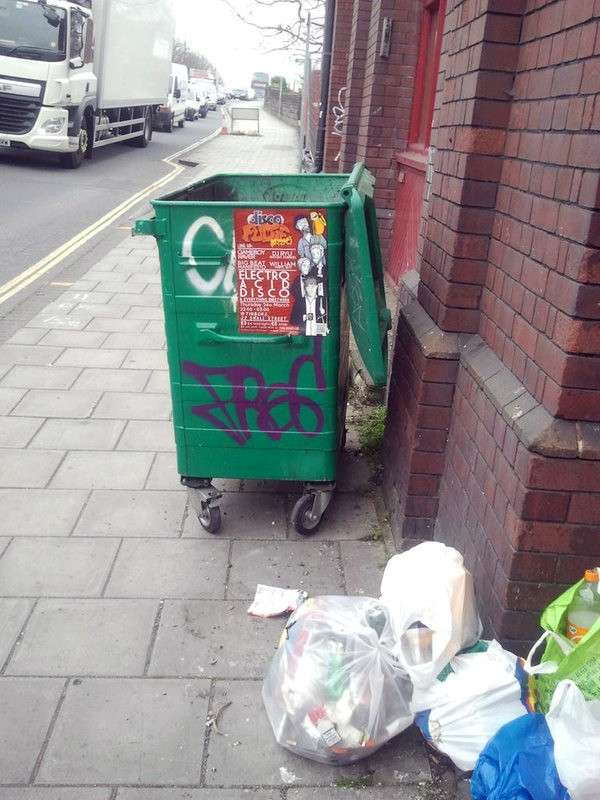
There are times when I wonder if I’m wasting my time fighting litter and fly-tipping in east Bristol, particularly when it seems I and my fellow campaigners are also having to fight the idiocies emanating city council and Bristol Waste, its arms-length, wholly-owned waste management company as well.