tech

  • Crowdfunding for Bristolians only

    What could have been a fine report on a local space technology story has been ruined by poor writing in the Bristol Post.

    Yesterday’s Post carried a story on Bristol SpacePlanes and its efforts to develop a reusable orbital vehicle.

    CGI impression of Bristol SpacePlanes Ascender craft
    A CGI impression of the Bristol SpacePlanes Ascender craft

    The Post’s journalist gets off to a bad start in the first sentence:

    Bristolians are being invited to help launch planes into space in a new crowd-funding [sic] campaign.

    Just Bristolians, Bristol Post?

    I thought the idea of crowdfunding (minus the hyphen. Ed.), was that anyone can be part of the crowd that provides the funds, irrespective of geography.

    This suspicion is borne out by 30 seconds research. The first item on crowdfunding I found, from Wikipedia, states: “Crowdfunding is the practice of funding a project or venture by raising monetary contributions from a large number of people, typically via the internet.

    Nowhere in the Wikipedia entry is there is indication at all that crowdfunding is to be restricted solely to Bristolians.

    Or am I just misreading to local media’s propensity to find a local angle to a story? Here’s a hint: it already has one, featuring a local high technology company and doesn’t need a second one! 🙂

  • Technology encourages boys and poorer children to read for longer

    New technology is unlocking the key to the biggest problem that has been bedevilling the education world for years – the poor performance of white working-class boys in reading, The Independent reports.

    The Early Years Literacy Survey shows the role touch-screen devices play in the home and pre-school learning environments.

    image of Kindle ebook reader

    Figures show that a higher number of children from low income groups (DE households) are more likely to read stories on touch-screen devices for longer and use them for educational activities than those from high income groups (AB households). Findings show that:

    • Twice as many young children from DE households than from AB households read stories on a touch-screen for longer than they read printed stories (29.5% vs. 17.4%);
    • A higher number of children from DE households than AB households use technology more for educational activities than for entertainment (43.2% vs. 30.4%). Figures also reveal that boys are more likely to use touch-screen devices for reading and educational activities for a longer period than paper;
    • Twice as many boys as girls look at or read stories on a touch-screen for longer than they look at or read printed stories (24.0% vs. 12.0%); and
    • More boys than girls use a touch-screen device for educational activities than for entertainment (36.0% vs. 28.2%).

    The survey also found that 91.7% of children aged 3-5 have access to touch-screen technology at home and access to touch-screen technology in early years settings has doubled since last year. Moreover, the majority of pre-school teachers and practitioners said they would like to see more touch-screen technology in use in early years environments.

  • China testing free WiFi on trains

    Passengers on board Train No. T809 from Guangzhou, China’s third largest city, to Hum Hong station in Kowloon (Hong Kong) enjoyed free wireless internet access for the first time yesterday (Friday), according to ChinaDaily Europe, marking the inauguration of the first WiFi access service on the Chinese railway network.

    image of train providing Guangzhou-Kowloon service
    One of the trains serving the Guanzhou-Kowloon route

    The other 23 trains serving the route will also be fitted with the equipment to provide the service soon. After installation there will be a trial service period of three months before the service is launched officially.

    The equipment on the train is able to provide WiFi for up to 1,000 passengers at a time.

    It is not known whether there will be a charge for the service once it is officially launched.

  • Everyday sexism: Barbie can’t code

    As is well known, the world of IT is a preponderantly male world. For instance, over at Wikipedia, under 20% of users who edit articles are women. Elsewhere, women tend to be thin on the ground at any professional IT gathering.

    However, telling girls and young women that IT is not a field for them is just wrong. It isn’t; I know of many excellent women coders and programmers, ranging from web developers to those who write the code for microprocessors and mobile phone chips (although I shall refrain from identifying them here. Ed.). Indeed, the person regarded as the world’s very first programmer, Ada Lovelace, was – unsurprisingly given her name – a woman (posts passim).

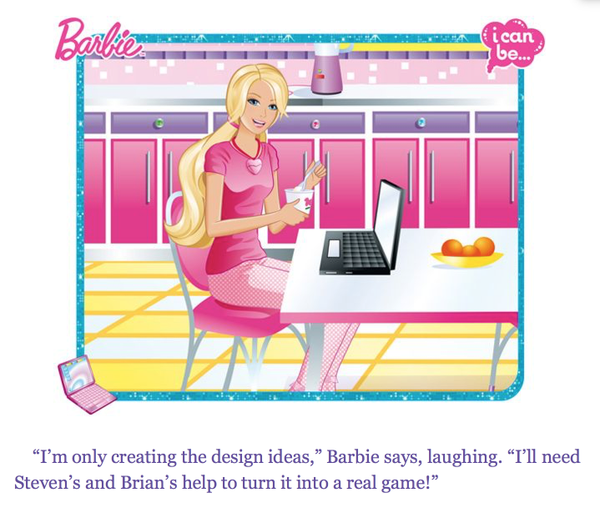
    It’s therefore with a sense of exasperation that I came across the image below this afternoon.

    image showing Barbie calling for Steven and Brian to code up her game idea

    Mattel, makers of Barbie since 1959, should be ashamed of themselves if they are responsible for putting out the message that the world’s most prominent promoter of all things pink needs the help of 2 men to code up her game. It helps reinforce the erroneous stereotype that IT isn’t the done thing for girls or is too hard for them, especially as Barbie is aimed at young, impressionable minds. What’s more, the gender role stereotyping is further reinforced by having Barbie sat in a kitchen… Oh dear!

    Update 21/11/2014: Mattel has since apologised for its crass mistake, according to CNET, to whom Lori Pantel, vice president of global brand marketing for Barbie gave the following statement:

    “The ‘Barbie I Can Be A Computer Engineer’ book was published in 2010. Since that time we have reworked our Barbie books. The portrayal of Barbie in this specific story doesn’t reflect the Brand’s vision for what Barbie stands for. We believe girls should be empowered to understand that anything is possible and believe they live in a world without limits. We apologize that this book didn’t reflect that belief.

  • LibreOffice 4.3.4 released

    The Document Foundation blog has announced the release of LibreOffice 4.3.4. This is the fourth minor release of LibreOffice 4.3 “Fresh” family, which is a stable release of the more advanced version of the software, and is targeted to users focusing on features. The new release contains over 60 bug fixes.

    LibreOffice banner

    For technical details of LibreOffice 4.3.4, consult the change log.

    LibreOffice 4.3.4 “Fresh” can be downloaded for free from http://www.libreoffice.org/download/, although The Document Foundation would welcome donations to support its work from LibreOffice users, free software advocates and community members.

  • Gnome trademark applications dropped by Groupon

    Gnome logoFollowing on from news yesterday of the threat to the GNOME trademark from a series of applications for the same name by Groupon (posts passim), the latter has now withdrawn those applications and issued the following statement.

    Groupon is a strong and consistent supporter of the open source community, and our developers are active contributors to a number of open source projects. We’ve been communicating with the Foundation for months to try to come to a mutually satisfactory resolution, including alternative branding options, and we’re happy to continue those conversations. Our relationship with the open source community is more important to us than a product name. And if we can’t come up with a mutually acceptable solution, we’ll be glad to look for another name.

    UPDATE: After additional conversations with the open source community and the Gnome Foundation, we have decided to abandon our pending trademark applications for “Gnome”. We will choose a new name for our product going forward.

  • Help the GNOME Foundation defend the GNOME trademark against Groupon!

    Gnome logoThe GNOME Foundation is a non-profit organisation promoting the goals of the GNOME Project, helping it to create a free software computing platform for the general public that is designed to be elegant, efficient and easy to use.

    Groupon's Gnome offeringThe Foundation is currently facing a threat to its GNOME trademark from global deal-of-the-day website merchants Groupon, who have recently announced a product that’s also called Gnome. Groupon’s Gnome comes in the form of a tablet-based point-of-sale “operating system for merchants to run their entire operation.” It therefore has little to do with creating an elegant, efficient, easy to use free software platform for the general public, but more with liberating cash from the wallets and purses of the general public. The Groupon offering is shown on the left.

    As a result of this threat from Groupon, the GNOME Foundation has released the following statement and appeal for funds.

    “GNOME” has been a familiar name in software for the past 17 years, and a registered trademark since 2006. The GNOME project has been a staple desktop for GNU/Linux and BSD desktops. It was the default desktop for Sun Microsystems workstation class machines, continues to be the default desktop for the Red Hat Enterprise Linux and SUSE Linux Enterprise Server distributions, and it is the default desktop of Fedora and Debian. SUSE Linux Enterprise Point of Service solution for the retail industry is based on GNOME. GNOME technology can be found in TVs, tablets, phones, consumer devices, and in common software everywhere.

    Recently Groupon announced a product with the same product name as GNOME. Groupon’s product is a tablet based point of sale “operating system for merchants to run their entire operation.” The GNOME community was shocked that Groupon would use our mark for a product so closely related to the GNOME desktop and technology. It was almost inconceivable to us that Groupon, with over $2.5 billion in annual revenue, a full legal team and a huge engineering staff would not have heard of the GNOME project, found our trademark registration using a casual search, or even found our website, but we nevertheless got in touch with them and asked them to pick another name. Not only did Groupon refuse, but it has now filed even more trademark applications (the full list of applications they filed can be found here, here and here). To use the GNOME name for a proprietary software product that is antithetical to the fundamental ideas of the GNOME community, the free software community and the GNU project is outrageous. Please help us fight this huge company as they try to trade on our goodwill and hard earned reputation.

    We want to show that our brand matters and that you care. Of the 28 trademark applications Groupon filed, we have to file formal proceedings to oppose 10 of them by December 3, 2014. Help us raise the funds to fight back and most of all call public attention to this terrible behavior by Groupon. Help us make sure that when people hear about GNOME software they learn about freedom and not proprietary software. Our counsel has advised us that we will need $80,000 to oppose the registration of the first set of 10 applications. If we are able to defend the mark without spending this amount, we will use the remaining funds to bolster and improve GNOME. Please help us raise the money to protect GNOME’s trademark and strengthen Free Software!

    GNOME will gratefully accept donations to fight this trademark dispute to preserve free software.

    Reposted from Bristol Wireless.

  • Calibre 2.9 recognises footnotes

    The newest version 2.9 of Calibre, the cross-platform ebook management software, recognises footnotes and shows them in a separate window section, heise reports. Scrolling with the mouse wheel in the cover browser has also been improved.

    screenshot of Calibre

    Calibre 2.9 displays footnotes separately. Shortly after the update to version 2.8, which provided a driver for the Tolino-2-Vision e-reader, Kovid Goyal released a new version of his e-book manager. Calibre 2.9 recognises footnotes and displays these in a separate window section if they are clicked on in the preview. Calibre is thus using both the footnote label of the EPUB 3.0 format and heuristics too.

    In addition, mouse scrolling in the program window’s cover browser has also been improved. An additional shop for e-books has been added with Portugal’s Bubok. Calibre will now load large libraries which use user-defined columns from templates more quickly.

    Calibre 2.9 also corrects a number of errors, e.g. those involving the global menu in the Linux Unity desktop and Imagemagick. The changelog on the Calibre website lists all the new features of Calibre 2.9, where the new version can also be downloaded for Linux, Mac OS X and Windows.

  • Bristol opens Europe’s first speech lab for non-native English speakers

    Earlier this week Bristol University announced the opening in Bristol of Europe’s first speech laboratory designed to break down communication barriers faced by those who speak English as a second language.

    microphone and recording equipmentIn a linguistically diverse society, with many people speaking English as their second language, researchers at Bristol University are pioneering a new approach to help understand how factors such as accent influence communication.

    The speech lab, which is funded by the European Commission through a four-year €100,000 Marie Curie grant, uses state-of-the-art audio technology to capture and analyse second language speech samples and to train people to assess the speech in a purpose-built environment.

    The insights gained will then be used to train those who speak English as a second language and also to improve the teaching of English by targeting the elements of speech most likely to achieve successful communication.

    Dr. Talia Isaacs, Director of the Second Language Speech Lab, conducts research at the lab as part of a research programme with international collaborators to identify aspects of speech that are most important for engaging in effective communication when English is not the speaker’s primary language.

    general view of speech labShe said: “Reducing language barriers is a pressing social and educational challenge, especially in countries like the UK where the linguistic palette is very rich.

    “Improving oral communication skills for non-native English speakers will help with many aspects of everyday life – from success in the workplace and in education to improving social integration and accessing vital services.

    “Although accents are very noticeable to listeners and may lead to social stereotyping, someone who sounds different is not necessarily communicating ineffectively. In fact, a whole host of factors, such as pronunciation, grammar and vocabulary, contribute to the successful transmission of a message. So we often need to listen beyond the accent.

    “Research conducted at the lab will enable us to study the linguistic factors that contribute to breakdowns in communication in greater depth and identify ways to mitigate these.”

    By way of an example, future research could collect data from GP consultations, where either the doctor or the patient is speaking English as a second language. This could help to ensure such consultations are conducted with greater clarity.

    Furthermore, there could be instances where engineers from various countries are collaborating on a joint project and there’s a need to ensure that everyone fully understands each another and can communicate their findings effectively.


  • Freeze for Debian 8

    Debian logoDebian 8, codenamed Jessie, will be the next stable release of the Debian GNU/Linux operating system.

    The Debian release team has frozen the current software status of Jessie, German IT news site heise reports. From now on the developers will only include important bug fixes in the distribution.

    Jonathan Wiltshire of Debian’s release team has announced that the current software status of Debian Jessie (version 8 of the operating system) has been frozen according to plan. The only changes that are now possible are only bug fixes for critical errors and major bug fixes for program packages that do not form the core of the Debian distribution.

    At present the developers have counted over 300 release-critical bugs for Jessie, but there is still no definite deadline for the release of Jessie as Debian’s next stable release, although this will probably be in the next few months.

    Your correspondent has been using Debian Jessie on his laptop for over one year now and it’s been very stable and reliable, even though it was still in the testing phase and not really intended for use in a production environment.

Posts navigation