Bristol

  • Spring’s golden heralds

    It’s a bright, sunny day in Bristol and there’s a hint of spring in the air. In addition, the daffodils are out in their brazen glory, like these fine examples planted by Bristol City Council in Castle Park.

    daffodils in Castle Park

    Along with the blossom of the cherry, in honour of which A.E. Housman wrote “Loveliest of Trees” (posts passim), daffodils are another spring favourite celebrated in poetry, in this case William Wordsworth‘s “I Wandered Lonely as a Cloud”.

    I wandered lonely as a cloud
    That floats on high o’er vales and hills,
    When all at once I saw a crowd,
    A host, of golden daffodils;
    Beside the lake, beneath the trees,
    Fluttering and dancing in the breeze.

    Continuous as the stars that shine
    And twinkle on the milky way,
    They stretched in never-ending line
    Along the margin of a bay:
    Ten thousand saw I at a glance,
    Tossing their heads in sprightly dance.

    The waves beside them danced; but they
    Out-did the sparkling waves in glee:
    A poet could not but be gay,
    In such a jocund company:
    I gazed–and gazed–but little thought
    What wealth the show to me had brought:

    For oft, when on my couch I lie
    In vacant or in pensive mood,
    They flash upon that inward eye
    Which is the bliss of solitude;
    And then my heart with pleasure fills,
    And dances with the daffodils.

  • Addio XP

    It’s not just the Bristol & Bath Linux User Group (LUG) that’s organising an event to mark the end support for Microsoft’s superannuated Windows XP operating system (posts passim).

    In Italy a consortium of the Perugia GNU/Linux User Group, LibreUmbria, the Perugia Centro di Competenza Open Source and Girl Geek Life is also organising a half-day event to inform people that they don’t need to buy a new computer to have a modern, secure operating system again; all that’s needed is a change to a free and open source Linux operating system and its vast range of software.

    publicity for Perugia GNU/LUG's XP event
    Addio XP, ciao software libero!

    The Perugia event takes place at Perugia University on Saturday, 5th April 2014 from 9.00 am to 1.00 pm. Full details can be found at http://xpaddio.perugiagnulug.org/.

    Windows XP Zombie Edition
    Install Linux: don’t end up with an operating system that should died years ago!

    Support for XP (and MS Office 2003 too. Ed.) ends on 8th April 2014.

  • It’s Bristol Radical Film Festival week

    Bristol Radical Film Festival logoBristol Radical Film Festival is on this week with a wide choice of events from today, 3rd March until 8th March. The films will be screened in a wide range of venues, which include and have in the past included digital outreach projects, social centres, political squats, radical bookshops, community bicycle hubs, trade union buildings, etc.

    The Festival first took place in 2011 and showcases contemporary and historical works of overtly political documentary and fiction film-making. Organised by staff, students and alumni from the Centre for Moving Image Research and the Film team at the University of the West of England (UWE), the Festival also aims to draw attention to a range of other progressive, community-based initiatives in the city.

    Two of this year’s offerings in particular take my fancy.

    Firstly, there’s a screening of McLibel, the David and Goliath story of two people who fought back against one of the most powerful corporations on the planet. Ronald McDonald may have won their libel case against Helen Morris and Dave Steel, but it was very much a Pyrrhic victory. McLibel is being shown at Knowle West Media Centre, Leinster Avenue, Knowle West, Bristol BS4 1NL (map) on Thursday, 6th March at 7 pm. Entry is free.

    The second offering to take my fancy is Uomini contro (English title: Many Wars Ago), produced in 1970. The film is set in Italy in 1917. Society is violently split down the middle over the question of whether to continue intervention in the war. Anarchists and socialists are intent on causing so much trouble that continued intervention is impossible. Railway lines are ripped up, battle lines are drawn. On the Isonzo front a General smells socialism behind the troops reaction to his orders and a disastrous Italian attack upon the Austrian positions leads to a mutiny among the decimated troops. The screening is being hosted by Bristol Radical History Group as part of its World War 1 series of events. The film will be screened at 5.00 pm on Saturday 8th March and the venue will be 2nd Floor, The Arc, 27 Broad Street, BS1 2HG (map) and there’ll be a £4 admission charge.

  • Let Bristol be Bristol

    Within 2 days last week, we had the latest pair of proposals from a member Bristol’s great and good and a London property developer to try and turn the city into somewhere else.

    On Monday last week Bristol 24/7 carried a story entitled “Bristol… the ‘New Orleans of the UK’?”.

    According to the article, local businesses are being urged to help elevate Bristol to a world-class centre for jazz and blues music as part of Mayor George Ferguson’s ambitions to make the city the ‘New Orleans of the UK’.

    By the end of the week, apparently plans had shifted from trying to turn Bristol into a city founded by French colonists in 1718 on the banks of the Mississippi to property developers and their scheme to convert some of the city into Shoreditch, now an inner city part of London in the borough of Hackney, which was originally named after Edward IV’s mistress, Jane Shore, who was reputedly buried in a ditch in the area.

    This news appeared on Bristol Business News, which reported as follows:

    Verve Properties, the niche developer behind Bristol’s highly-successful Paintworks creative quarter, has started work on the first speculative office refurbishment in the city for five years as the market recovery continues to gathers pace.

    London-based Verve said it saw a gap in the Bristol office market for trendy office workspace of the type now common in the Shoreditch/Tech City area of East London that would appeal to the Bristol’s vibrant creative sector.

    What I like about Bristol is precisely that it is Bristol. It’s quirky, diverse and has its own unique features not found anywhere else, like the centuries of architectural variety on display on Old Market Street and West Street, the City Docks and the wealth of green, open spaces which the public can enjoy, even in the city’s less prosperous parts.

    a Bristol montage
    A Bristol montage: image courtesy of Wikimedia Commons

    Where attempts have been made to turn the city into somewhere else, it’s been a disaster. One only has to look at Bristol’s so-called ‘Shopping Quarter’ – Broadmead, Cabot Circus and the Mall Galleries – to see the result: bland and unedifying. The area is filled mostly with identikit local branches of national retail chains. Rearrange the shops and you could easily in another large UK town or city.

    I like Bristol because it’s Bristol and it should furthermore be left to be itself and not try to be somewhere else.

    One has to ask the question: do those who profess to love the city but want to turn it into somewhere else really love the city; or do they actually hate it?

  • Bristol Post Balls – the invisible Widdecombe

    The Bristol Post has for years given favourable coverage to a North Somerset ‘zoo’ which has an interesting sideline in promoting creationism.

    Today’s edition continues this trend.

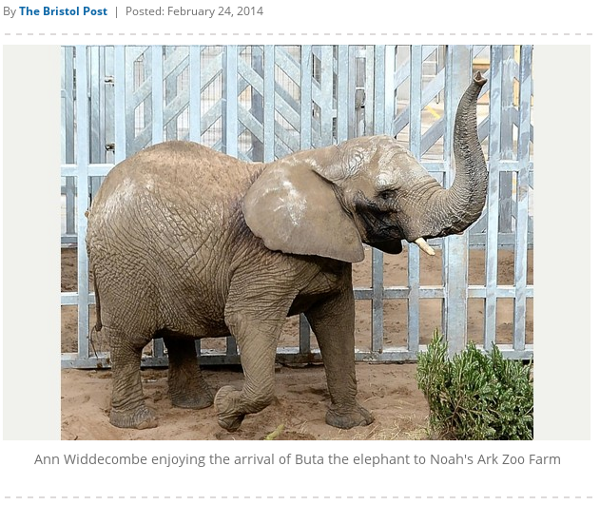
    Noah’s Ark ‘Zoo’ Farm has just taken delivery of a new African elephant and former Tory MP Ann Widdecombe was allegedly there to welcome its arrival, according to the photo caption in the report.

    Bristol Post screenshot

    I’d like to congratulate Ann on her choice of camouflage outfit!

    If you can see Ann in the picture, please let me know via the comments below.

  • Breathe new life into your old XP box with Linux Live

    image of Tux, the Linux kernel mascotMicrosoft announced some time ago that it will be ending support for Windows XP, now 12 years old, on 8th April 2014.

    The Bristol & Bath Linux Users’ Group (BBLUG) has seen this as an opportunity to introduce people still using XP to a reliable free and open source Linux operating system and has planned an event called “Linux Live 2014” to be held from 10.00 am to 4.00 pm on Saturday, 15th March 2014 – a couple of weeks before the official end of XP support – at the Pervasive Media Studio, Watershed, 1 Canons Rd, Bristol, BS1 5TX (map).

    Linux Live 2014 is part of a worldwide initiative to turn tired old computers running XP into efficient, well running ones running Linux. An old, tired computer can be given a whole new lease of life by installing a modern Linux operating system (Linux has lower system requirements than MS operating systems. Ed). BBLUG has decided to plan an event for people in Bristol and the surrounding area to inform them of the various uses and benefits of Linux.

    BBLUG’s Peter Hemmings says: “As Windows XP is not being supported from April 2014 we have decided to hold ‘Linux Live 2014’. It is a free workshop held by Linux user groups like ours where members get together to introduce new users to various distributions and give them a Live USB Stick to try on their hardware without interfering with other operating systems. Time permitting, it can be installed on hardware during the event or the Live USB Stick can be taken home to install. In holding an event such as this, we help extend the life of the hardware, saving people money in time of austerity. Simply bring your personal computer/laptop to the event and we will help you get Linux up and running on it, for free!”

    The BBLUG Linux Live 2014 event has its own website and is being sponsored LinuxIT of Emerson’s Green.

  • Engineers make major step towards quantum computer

    For the first time scientists and engineers from an international collaboration led by Bristol University’s Dr Mark Thompson have generated and manipulated photons (i.e. individual particles of light) on a silicon chip – a major step forward in the race to build a quantum computer.

    in the labQuantum computers and quantum technologies in general are widely anticipated as the next major technology advance and are poised to replace conventional information and computing devices in applications ranging from ultra-secure communications and high-precision sensing to immensely powerful computers. Quantum computers themselves will probably lead to breakthroughs in the design of new materials and the discovery of new drugs.

    Although still in their infancy, quantum technologies are making rapid process and a revolutionary new approach pioneered by Bristol University is exploiting state-of-the-art engineering processes and principles to make leaps and bounds in a field previously dominated by scientists.

    Featuring on the front cover of Nature Photonics, this latest advance is one of the important pieces in the jigsaw needed to produce a quantum computer. Whilst previous attempts have required external light sources to generate photons, this new chip integrates components that can generate photons internally.

    “We were surprised by how well the integrated sources performed together,” admits Joshua Silverstone, the paper’s lead author. “They produced high-quality identical photons in a reproducible way, confirming that we could one day manufacture a silicon chip with hundreds of similar sources on it, all working together. This could eventually lead to an optical quantum computer capable of performing enormously complex calculations.”

    Group leader Mark Thompson explained: “Single-photon detectors, sources and circuits have all been developed separately in silicon but putting them all together and integrating them on a chip is a huge challenge. Our device is the most functionally complex photonic quantum circuit to date, and was fabricated by Toshiba using exactly the same manufacturing techniques used to make conventional electronic devices. We can generate and manipulate quantum entanglement all within a single mm-sized micro-chip.”

    The group, which, includes researchers from Toshiba Corporation (Japan), Stanford University (USA), University of Glasgow (UK) and TU Delft (The Netherlands), now plans to integrate the remaining necessary components into a chip and show that large-scale quantum devices using photons are possible.

    “Our group has been making steady progress towards a functioning quantum computer over the last five years,” said Thompson. “We hope to have within the next couple of years, photon-based devices complex enough to rival modern computing hardware for highly-specialised tasks.”

    However, these are just the first steps. To produce useful quantum machines a new breed of engineers will be required: quantum engineers, individuals capable of understanding the fundamentals of quantum mechanics and applying this knowledge to real world problems.

    Bristol’s newly established Centre for Doctoral Training in Quantum Engineering will train a new generation of engineers, scientists and entrepreneurs to harness the power of quantum mechanics and lead the quantum technology revolution. This innovative centre bridges the gaps between physics, engineering, mathematics and computer science, working closely with chemists and biologists while having strong links with industry.

    A full copy of the research paper is available from Nature Photonics.

    Initially published by Bristol Wireless.

Posts navigation