tech

  • OPW’s success partly to blame for GNOME expenditure freeze

    Gnome logoAccording to German IT news site Heise, the financial cushion of the Gnome Foundation -non-profit organisation that furthers the goals of the GNOME Project, helping it to create a free software computing platform for the general public that is designed to be elegant, efficient, and easy to use – has declined so sharply that the organisation has frozen part of its expenditure. The success of the Gnome Outreach Program for Women (OPW) is said to be partly to blame for this situation (posts passim).

    The situation was explained in an email to Foundation members over the weekend.

    Dear Foundation members,

    Due to a shortfall in the budget, the Foundation board voted on 2014-04-08 to freeze all expenditure which is not essential to the running of the Foundation. This freeze affects sponsorship expenses
    which are unpaid at this time, but it does not affect the funds which we hold for other organisations.

    By keeping our expenditures to a minimum while we regain some delayed revenue, we aim to have things back to normal within a few months. All Foundation members who expect to receive reimbursements within the next three months have already been informed of the issue and most have responded positively. The board will prioritise these pending reimbursements over other expenses.

    The issue has been caused by a number of factors. These include increased administrative overheads in the last few years due to the increased turnover which has been caused by to the Outreach Program
    for Women (OPW), and the associated payments going out while the associated income has been slow to come in.

    The board expects that you may have some questions or would like to know more details about the problem, please read https://wiki.gnome.org/FoundationBoard/CurrentBudgetFAQ and contact the board at board-list gnome org if you have any further questions.

  • LibreOffice 4.2.3 released

    The Document Foundation has announced on its blog the release of LibreOffice 4.2.3, the third minor release of the LibreOffice 4.2 family. Codenamed “Fresh”, LibreOffice 4.2.3 is the most feature rich version to date of this free and open source office suite. The release itself is described by The Document Foundation as being suited for early adopters. For enterprise use and more conservative users, The Document Foundation recommends the more mature LibreOffice 4.1.5 release.

    People interested in this release’s technical details and bug fixes can view the change logs as follows:

    In addition, the released version of LibreOffice 4.2.3 adds a security fix for the Heartbleed bug (CVE-2014-0160).

    screenshot of Calc spreadsheet program
    LibreOffice’s Calc spreadsheet program running on Ubuntu Linux

    Downloading LibreOffice

    LibreOffice 4.2.3 and LibreOffice 4.1.5 are both available for download from http://www.libreoffice.org/download/. Extensions and templates to increase the software’s functionality and add specific features are available at http://extensions.libreoffice.org/.

  • ODF recommended for Galicia’s public sector

    Galicia's coat of armsJoinup, the EU’s public sector open source news website, reports that the government of Spain’s autonomous region of Galicia is recommending that the region’s public sector organisations adopt Open Document Format (ODF, ISO 26300) for editable electronic documents and PDF for non-editable electronic documents.
    “This will facilitate the re-use of documents and the creation of derivative works”, the government writes in a guide which was published on 26 March, Document Freedom Day (posts passim). Public sector bodies are also being advised to make their documents available using a copyleft licence, such as Creative Commons’ CC-by-SA.

    The guide ‘Boas prácticas para a liberación de publicacións da Xunta de Galicia‘ (Good Practice Guide for liberating Galicia government documents) has been written by Galicia’s free software resource centre, the ‘Oficina de Coordinación de Software Libre’ (Ocfloss). The report is available in both ODT and PDF formats is also published under the CC-by-SA licence.

    The guide also contains advice for the public sector on how to manage intellectual property rights in respect of its documents, images and multimedia files, as well as guidance on the creation of derivative works.

  • Progress

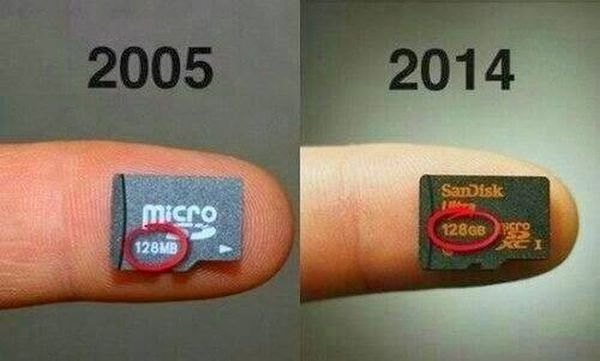
    Technology is advancing at a pace that’s blistering.

    If anything can illustrate the progress of technological change, it’s the picture below: a smaller footprint and a massive increase in storage capacity in under 10 years.

    tech_advance

    It’s not just capacity that’s changed. Prices have changed too. Back in 1998 I paid £140 for a 3.5 hard drive with 8 GB of storage. Nowadays I can buy a USB device with an equivalent capacity for £10 in most large supermarkets.

    Hat tip: OpenSure

  • Big Retail is watching you

    Cabot Circus is hardly my favourite place in Bristol. It’s an out-of-town shopping centre with associated multi-storey car park plonked at the inner city end of the M32. It consists of 3 floors full of identikit national chain stores, plus CCTV and surly security guards to track and/or keep out those who have no intention of buying overpriced, mass-produced consumer tat they probably don’t want, definitely don’t need and most likely cannot really afford.

    Today I noticed another reason for avoiding Cabot Circus – mobile phone surveillance.

    image of notice at Cabot Circus
    Warning! Big Retail is watching you.

    Note the exemplary use of newspeak: spying on your mobile is “in use at this site to improve our customer service“.

    I’m not convinced by the bland assurance regarding personal data either, as will be explained below.

    The Footpath technology in use in Cabot Circus has been developed by a company called Path Intelligence and is in use in a number of shopping centres around the UK, including Gunwharf Quays in Portsmouth, Princesshay in Exeter, the Buchanan Galleries in Glasgow, Bon Accord & St Nicholas in Aberdeen and The Centre, Livingston, all of which like Cabot Circus are operated by Land Securities Ltd. The surveillance system works through units placed in shops which detect the changing signals of mobile phones.

    Unless people entering the shopping centre happen to see the warning signs (which are conveniently placed alongside lots of others telling the public what they’re not allowed to do, such as use skateboard, take photographs. Ed.) they’re probably unaware that their phones are being monitored.

    According to Path Intelligence
    , the Footpath technology works as follows:

    The vast majority of visitors to any given location now carry a mobile (cell) phone. To be able to make and receive calls, the telephone network must understand the phone’s geographical location. The technology behind this is complicated, but in basic terms, the phone and the network continuously ‘talk’ (ping) to each other (sending a unique signal), sending and updating information every time the location of the phone changes.

    Footpath technology from Path Intelligence consists of discreet monitoring units able to read the anonymous signals that all mobile phones send. So we’re able to ‘see’ where the phone is (but not the data on it) and map its geographic movements from location to location accurately to within a few meters [sic]. In isolation the information isn’t very revealing but when aggregated, patterns and trends start to emerge. It’s those patterns and trends that are of interest in business planning.

    The data collected is fed back to our data centers [sic] 24 hours a day, seven days a week, to be audited and have sophisticated statistical analysis applied. This results in continuously updated information on the flow of people in any monitored location.

    As no source code is available for Footpath, no check can be made on its lack of ability to collect personal data or telephone numbers.

    Concerns were expressed by Big Brother Watch about the tracking of shoppers’ mobiles 2 years ago.

    At present the technology is not capable of recording phone numbers or personal information, but this will probably change as the system improves and as highlighted by Big Brother Watch:

    However, as technology improves, those facilities will become more accessible, and consumers need to have faith that the law protects their privacy. Uncertainty over when and how technology is being used only undermines trust and confidence in any system using mobile phones.

    To avoid being tracked, turn off your mobile when visiting Cabot Circus or any other shopping centre operated by Land Securities.

  • Introducing the Document Liberation Project

    DLP logoThe Document Foundation blog today announced the birth of the Document Liberation Project, a home for the growing community of developers united to free users from vendor lock-in of contents. Together, these hackers will offer a solution to the routine problem faced by many computer users who have their personal digital contents stored in an old, outdated and inaccessible file format.

    A routine problem encountered by computer users today is the discovery of personal digital content created years ago and stored in old, outdated file formats. These old files often cannot be opened by any application on the user’s current operating system. The users are quite simply locked out of their own content. The most common reason for this inability to access old data is the use of proprietary file formats that result in vendor lock-in.

    The Document Liberation Project has been created in the hope that it would enable individuals, organisations and governments to recover their data from proprietary formats and provide a mechanism to convert that data into open file formats, returning effective control of the content from software companies to the actual authors.

    The Document Liberation Project believes:

    • documents and their content belong to their creators, not software vendors;
    • that access to content you own should not be hindered by the fact that the application that created it is not maintained any more or that the application does not work on the particular operating system that you use;
    • that use of truly open and free standards for encoding digital content is the only long-term guarantee that a user’s digital content will never be beholden to a single vendor;
    • that implementation of free and open source software that can read proprietary file formats is the best solution to escape vendor lock-in during the transition period to truly open and free standards.

    Its mission is as follows:

    • to try to understand the structure and details of undocumented proprietary file formats;
    • to use that understanding of the file formats to implement libraries that are able to parse such documents and extract as much information as possible from them;
    • to use our existing framework to encode this data in a truly free and open standard file format: Open Document Format.

    Developers have so far provided read support for proprietary file formats including MS Visio, CorelDraw, MS Publisher, Apple Keynote and a handful of different old Macintosh formats. In addition to LibreOffice, import libraries for these file formats are used by Abiword, Calligra, CorelDRAW File Viewer, Inkscape and Scribus.

  • Call for proposals to improve major LibreOffice/OpenOffice features

    The Office Interoperability Working Group of the Open Source Business Alliance has called for proposals to improve major features in LibreOffice and OpenOffice suites.

    OSB logoAs announced in September 2013, the OSB Alliance’s Office Interoperability Working Group has held a requirements engineering workshop in Stuttgart. OSB Alliance members Munich city council, Leipzig city council, Jena city council, the Swiss Federal Court, and the Swiss Federal IT Steering Unit FITSU defined commonly required improvements for the open source LibreOffice and OpenOffice suites. Other public authorities will providing supporting funding.

    A new specification entitled “Major Feature Improvements for LibreOffice/Apache OpenOffice” (PDF) has been developed recently on the basis of the Stuttgart workshop. It proposes six major improvements, as follows:

    1. Improve mail merge in Writer;
    2. Improve paragraph handling in Writer;
    3. Implement styles in all content elements of Writer;
    4. Add chart styles in Calc;
    5. Make more functions available in shared spreadsheets in Calc;
    6. Develop a change tracking specification for the ODF standard.

    ODF file iconOne important feature of today’s office suites is change tracking within documents: both LibreOffice and OpenOffice offer change tracking in ODF files. However, Microsoft Office has not implemented change tracking for ODF, stating that the current change tracking specification within the ODF standard is insufficiently defined. The last of the above requirements therefore covers the exact specification of change tracking within the ODF standard to enable Microsoft to implement it in future versions of Microsoft Office.

    Open source providers are now invited to submit offers to cover one or more of these requirements. The detailed requirements, general conditions and tendering procedure are described in the specification document. All proposals need to be submitted until 30 April 2014 to the working group’s spokesman, Dr. Matthias Stürmer (email: stuermer (at) osb-alliance.com).

  • A lost Bristol street re-emerges

    Avon Archaeology is currently conducting a dig on a site at the junction of Wade Street and Little Ann Street in St Judes that is going to be redeveloped for housing; it was most recently used as a secure car park.

    Yesterday I managed to get a couple of pictures through the fencing around the site.

    image of archaelogical dig in St Judes

    The red brickwork in the centre foreground is the remains of a collapsed vault, suggesting there was a cellar beneath the building.

    image of archaeological dig in St Judes

    The cobbled and accompanying paved footways are one of Bristol’s lost streets seeing daylight again.

    The street itself was known as Pratten’s Court and can be seen on the following screenshot from the excellent Know Your Place website (posts passim) showing the 1880 Ordnance Survey map layer.

    Screenshot showing Pratten's Court on 1880s OS map

    The housing around Pratten’s Court was originally developed in the 18th century and demolished some time in the first half of the 20th century. It does not show up on the 1946 aerial photographs layer on Know Your Place.

    Avon Archaeological Unit carried out an assessment of the Wade Street area in 2000 which concluded as follows:

    An archaeological desk-based assessment of sites on the north and south sides of the junction of Wade Street and Little Ann Street was carried out by Andrew Smith for the Avon Archaeological Unit in April 2000. The likely survival of palaeo-environmental evidence for the formation of the floodplain of the river Frome, for Romano-British activity and for the development of the area as artisanal housing in the early-eighteenth century was noted.

    Further down Wade Street crosses the River Frome. Somewhere in this area a Roman Road, the Via Julia, which went from London to South Wales via Portus Abonae (now better known as Sea Mills. Ed.) crossed the Frome. In 1865 2 Roman lead pigs were discovered near the river. This find was reported in Part 23 of the Archaeological Journal in 1866. Know Your Place records this find as follows:

    In 1865, during commercial excavations in Wade Street possibly associated with the construction of a stone revetment wall for the river Frome, two lead ingots of Roman date (one weighing 76 pounds and the other 89 pounds) were found. Both carried inscriptions with identical damage, which was taken to suggest that the ingots had been cast from the same mould. The inscription read “IMP’ CAES’ A[NTON]INI’ AUG’ PII P’ P”. One (89 pounds) passed into the possession of a Mr. Edkins and the other was taken to Sheldon, Bush shot works on Redcliff Hill. Mr. Arthur Bush subsequently donated this ingot to the British Museum (Anon. 1866). Elkington (in Branigan & Fowler, 1976 195) implies that the ingots were almost certainly produced by the Mendip lead-mining industry and points out that flaws on the Wade Street ingots establish that they were cast in the same mould as two of the four ingots found at Rookery Farm, Green Ore, near Wells in 1956 (Anon. 1957, 230-231). However, sampling of the ingot held by Bristol Museum and Art Gallery in 2001 by Vincent Gardiner as part of his postgraduate research into the technology and distribution of Romano-British lead pigs found that the isotopes present suggested an origin in the Bristol/Frome/Weston-super-Mare area.

  • Today is DFD 2014

    logo for Document Freedom Day 2014Today is Document Freedom Day (DFD) 2014. DFD is an annual celebration of and opportunity to promote the use of open formats and standards for digital documents and takes place on the last Wednesday in March each year.

    Document freedom means documents that are free can be used in any way that the author intends. They can be read, transmitted, edited, and transformed using a variety of tools.

    Open standards are formats which everybody can use free of charge and restriction. They come with compatibility “built-in” – the way they work is shared publicly and any organisation or person can use them in their products and services without asking for permission. Open Standards are the foundation of co-operation and modern society.

    However, don’t just take my word for it.

    Below are some testimonials for open standards and document freedom from people with a bit more influence than your ‘umble scribe.

    Neelie Kroes, Vice-President, European Commission

    I know a smart business decision when I see one – choosing open standards is a very smart business decision indeed.

    Stephen Fry, actor, screenwriter, author, playwright, journalist, poet, comedian, television presenter and film director

    Open standards make sense. What makes no sense is that large companies in the field still do not understand this. It is time once and for all to end the pointless nonsense of one document sent on one platform being incomprehensible to the user of another.

    Chris DiBona, Open Source Manager, Google

    Over time, files that have been saved in closed formats tend to be less and less accessible to their creators. We prefer people to use modern and truly open formats like ODF whenever possible to ensure that they can continue to access and enjoy their work today and into the far future.

    Happy DFD 2014!

  • Canary Islands government to adopt OpenOffice

    The autonomous government of Spain’s Canary Islands has announced in a press release (Spanish) that the Directorate General of Telecommunications and New Technologies has proposed that the free and open source OpenOffice 4.0 office suite be adopted by the government of the islands as its corporate office productivity software.

    screenshot of OpenOffice splash screen

    At the same time it also announced a standard for web site content management systems to be preferred by all Canary Islands government departments. It decided on “Portal web Tipo”, a package built in-house as part of the islands’ Platino e-government services platform. Platino and its components are being made available as open source to other Spanish public sector organisations via the CTT (Centro de Transferencia de Tecnología – Technology Transfer Centre) software repository.

Posts navigation