WhatsApp is a mobile messaging company; or it was until the story fell into the hands of the illiterati in the BBC newsroom, who suffered one of their periodic vowel movements. 🙂
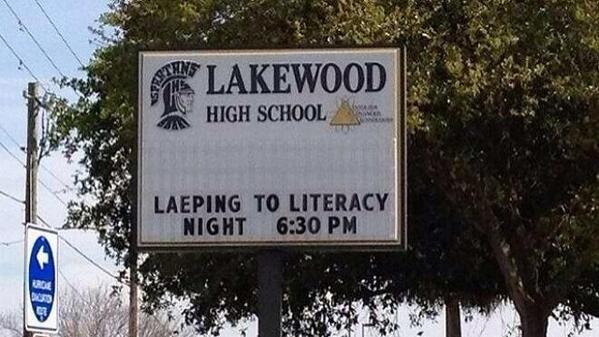
Murphy’s Law was working well when Lakewood High School of St Petersburg in Florida decided to hold a literacy event for parents back in 2012 (on 29th February apparently to tie in with the leap year. Ed.), as shown by the illuminated sign below.
One really has to admire the journalists at the Bristol Post, getting the news out to the public 6 days a week, sometimes in the face of extreme adversity.
For instance, a Sunday morning is a bad time for the spellchecking software to have a dicky fit. After all, no IT support will be available until Monday.
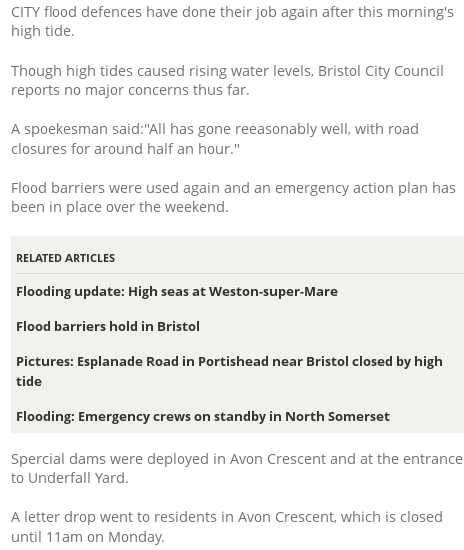
Never mind, in the absence of a spellchecker, the Post’s Geoff Bennett ploughed valiantly on to produce this report, part of which is shown in the screenshot below.
How long will it take before ‘spoekesman’, ‘reeasonably’ and ‘spercial’ are added to the Oxford English dictionary?
This blog recently reported on the removal of apostrophes – and other punctuation – in street names by Cambridge City Council as they “could lead to mistakes, particularly for emergency services” (posts passim).
Some heartening news now arrives courtesy of Private Eye on the response of Cantabrigians to their illiterate local authority.
It just goes to show that one cannot keep good pedants down.
This blog has drawn attention before to the lamentable lack of knowledge of certain bodies, e.g. the BBC and various newspapers, to the difference between translating and interpreting.
As the screenshot below shows, these bodies have now been joined by Capita Translation & Interpreting, that arm of the Crapita empire which is busy wasting public money by failing to provide interpreters – or those of good enough quality – for courts and tribunals under a contract with the Ministry of Justice (posts passim).
This exchange came into my Twitter timeline on the same day as the Law Gazette reports that Capita T&I has never managed to reach its 98% performance target under its Framework Agreement with the Ministry of Justice in the 2 years it has held the contract and just a few days before Ursula Brennan, Permanent Secretary at the MoJ, is due to appear before the House of Commons’ Public Accounts Committee as they examine the interpreting contract for a second time (posts passim).
As the Crapitards in charge of the Capita T&I are clearly confused by the difference between translators and interpreters, I can only recommend they too read my illustrated guide post.
There’s some bloke called Brendan Cole off something called Strictly Come Dancing on the television that’s currently got a show on at Bristol’s Hippodrome called ‘Licence to Thrill’, as shown by the publicity featured below.
Earlier today the Bristol Post’s review of the show featured a translation of the show’s title into American English, no doubt in a bid to help transatlantic visitors to Bristol (alternatively, it could have been caused by letting an American intern loose in the news room or a keyboard/software configuration cock-up. Ed.), as shown by the following screenshot.
The spelling of the headline has since been corrected.
Last year Mid Devon District Council took the daft and ungrammatical decision to ban the use of apostrophes – and other punctuation – in street signs (posts passim).
Mid Devon’s decision was justified by the pathetic excuse that removing punctuation was to “avoid confusion”.
This same line is now being trotted out by Cambridge City Council, in whose hallowed halls the city’s reputation for learning and scholarship appears has lost a battle with the dead hand of bureaucracy, as the Cambridge News reported on Friday.
According to the Cambridge News
Officers said they were following national guidance which warned apostrophes could lead to mistakes, particularly for emergency services.
Hobson’s Conduit. Soon to be Hobsons Conduit courtesy of Cambridge City Council?
Needless to say, with such a high profile city, the move has been criticised by language experts.
I know some people think apostrophes are superfluous but we really need them and I think it’s the first step on a slippery slope.
If councils are getting rid of them, what kind of message does that give out to students at schools?
Dropping apostrophes is pandering to the lowest denominator and while eradicating them anywhere is dreadful, it is particularly bad to do it in Cambridge.
Quite.
One must wonder what kind of English language teaching the officers of Cambridge City Council underwent at school, particularly since according to the British Council‘s grammar reference for people learning English, the rules for the use of apostrophes are “very simple”.
Apostrophes
We use an apostrophe (‘) to show either possession or that there is a letter missing (e.g. the apostrophe in ‘she’s’ shows that there is a letter missing in ‘she is’)
We use apostrophes with people or animals to show possession.
My sister’s house.
The dog’s blanket.
For things we use ‘of’ (the front of the car, NOT the car’s front.)
The position of the apostrophe depends on whether the noun is singular or plural. look at these two examples.
My friend’s house. This is about one friend.
My friends’ house. This is about two or more friends who share a house.
If a plural noun does not end in ‘s’ (e.g. men, people, children) we use ‘s to show possession.
The children’s bedroom.
A pair of women’s sunglasses.
We also use an apostrophe in some time expressions.
two weeks’ holiday
ten years’ experience
If people are really getting confused by apostrophes, doesn’t this indicate that English language teaching – particularly that related to punctuation – needs to be improved? After all, banning something you don’t understand is the action of a philistine.
If you either travel into or out of Bristol from the south or sail into or out of the city docks, you’ll be familiar with the Plimsoll Bridge, a swing bridge built over the Cumberland Basin in 1965.
Bristol’s Plimsoll Bridge in action. Picture courtesy of Wikimedia Commons
Unfortunately, there’s been some trouble with the bridge recently: during one recent rush hour swing some vital part broke and the bridge remained open – and closed to motor traffic – until the next day when it was cranked closed by hand.
The various repairs that need to be carried out will require several weeks and vessels with high masts will therefore not be able to get into and out of the docks for that period.
Besides its use in the agricultural context, the term ‘cowboy‘ has long been in use informally to describe a person who is an irresponsible or unscrupulous operator, as in the phrase cowboy builder.
Today’s Bristol Post carries a report where it’s uncertain as to who are the cowboys – the builders or the journalists who wrote the piece.
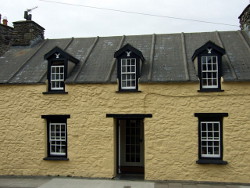
The report in question covers repairs and refurbishment works currently underway at the former home of Thomas Chatterton (20th November 1752 – 24th August 1770), Bristol’s renowned 18th century poet and forger of alleged medieval literary works.
With a sharp eye for inaccuracies, my attention was drawn to the following passage in paragraph 8:
Lathe and plaster is being used on the walls and re-rendering on the outside is being carried out with limestone instead of modern materials so the original stonework can “breathe”.
For anyone familiar with traditional building techniques, the 2 absolute howlers in there are immediately apparent.
For anyone unfamiliar with traditional building techniques, such as passing Bristol Post journalists in search of enlightenment, here’s an illustrated guide showing where the authors went wrong.
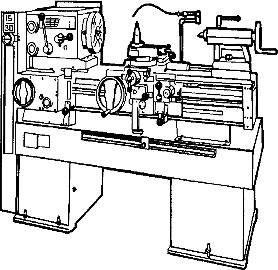
Here is a lathe: this one is for working metal; other types can be used for wood and other materials.
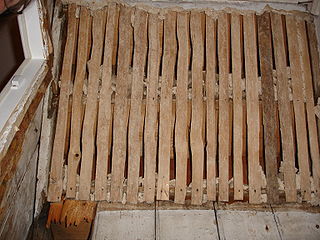
Here are some laths, minus their original plaster coating.