Bristol

  • North Somerset libraries to offer free wifi

    glassy wifi symbolNorth Somerset Council – Bristol’s immediate neighbour to the south – has announced that free wi-fi will be available in almost every library across North Somerset from 1st August.
    This will allow library users (not ‘customers’, as stated in your press release, North Somerset! Ed.) to bring their own laptops and other devices into their local library to use the internet.

    Wi-fi will be available to everyone by simply visiting any library during opening hours. There will be no need to book and visitors will not need to be a library member to set up an account, although first time users will need to approach a member of the library staff to set up an account.

    However, there’s library where this facility won’t be available – the mobile library.

    Potential users can find out more details of the scheme and opening times at http://www.n-somerset.gov.uk/mylocallibrary.

    First posted on Bristol Wireless.

  • Bristol Post Balls 4 – a classic homophone

    Today’s cock-up by the Bristol Post, from a story entitled ‘Man on lilo rescued after drifting out to sea off Weston-super-Mare’, has gained Bristol’s newspaper of record a seat in homophone corner.

    For the benefit of passing Post journalists a homophone is “a word that is pronounced the same as another word but differs in meaning. The words may be spelled the same, such as rose (flower) and rose (past tense of “rise”), or differently, such as carat, caret, and carrot, or to, two, and too.”

    Now let’s see (or sea. Ed.) what landed the Post this particular accolade.

    screenshot of homophone from Bristol Post
    What did he drift out to see, Bristol Post?
  • Boycott bingo

    The second Ashes Test match is currently underway at Lord’s in London between England and Australia.

    Over the years I’ve become a fan of the live coverage provided by the Test Match Special team on Radio 4 LW; local Bristol community station BCfm interferes with the signal on Radio 4’s FM signal where I live.

    portrait of Geoff Boycott
    Geoff Boycott
    As a consequence, I’ve got to know and appreciate the consummate broadcasting skills of Aggers, Blowers and company, including Geoff Boycott, regarded by some as the ‘greatest living Yorkshireman’.

    One of the joys of listening to the coverage is the banter between the team, especially the ribbing of Boycott and the interplay between him and Aggers in particular.

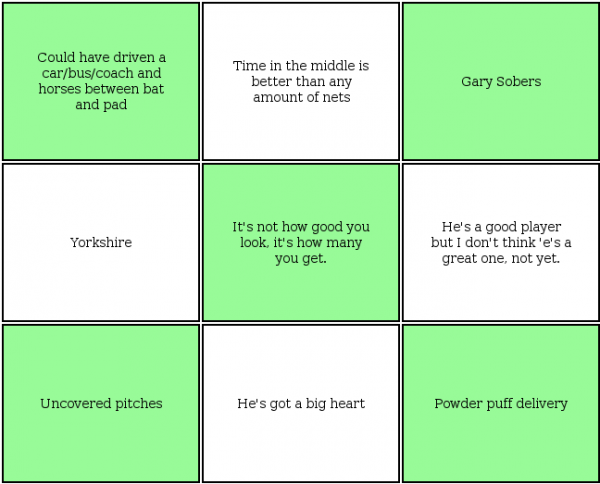
    Now Geoffrey is not known for keeping his counsel to himself, being a man of strong opinions. Like all of us, he’s got little foibles in his speech and recurring phrases, affectionately known as ‘Boycottisms‘. These Boycottisms have been used to produce ‘Boycott bingo’ cards like the example below.

    image of a Boycott bingo card

    You can get your own Boycott bingo card at http://boycott.gdb.me/.

    Play along and enjoy the game!

  • Little bird, big name

    The other afternoon I was having a rare afternoon pint in the shady garden of The Volunteer Tavern in St Judes when mine host Peter Gibbs asked me a question along the lines of: “What are these small brown birds I keep seeing in the garden?”

    I told him that I’d frequently seen (and heard; as the RSPB remarks, “For such a small bird it has a remarkably loud voice.” Ed.) wrens in the garden.

    image of a wren
    The Eurasian Wren (Troglodytes troglodytes) Image courtesy of Wikimedia Commons

    The wren is Britain’s smallest bird, measuring 9.5-10 cm, and used to feature on the back of Britain’s smallest coin – the pre-decimal farthing, which ceased to be legal tender after 31st December 1960.

    image of George VI farthing
    George VI farthing. Image courtesy of Wikimedia Commons

    Despite its small size, the wren has a big binomial name: Troglodytes troglodytes.

    The wren is found across the UK in a wide range of habitats – woodland, farmland, heathland, moorland and islands and is a regular visitor to gardens, including pub gardens in central Bristol. 🙂

    In European folklore, the wren is named the King of the Birds. According to a fable attributed to Aesop by Plutarch, when the eagle and the wren strove to fly the highest (presumably for the title of King of the Birds. Ed.), the wren initially rested on the eagle’s back and then when the eagle tired, the wren took off from his back, soared above him and so won the accolade.

  • Bristol Post Balls 2

    Below is a screenshot of the story in today’s Bristol Post reporting on Professor Peter Higgs – one of the team that postulated the existence of the particle named after him back in the 1960s – being granted the freedom of the city of Bristol.

    screenshot of Bristol Post article
    Headline quality control in action. Click on image for full size version.

    Professor Higgs is a former pupil of Bristol’s Cotham Grammar School.

    For a local media report of the event that has a proper headline, I recommend Bristol 24/7’s offering.

    Bristol & Avon Family History Society has some interest background information on the history of the Freedom of Bristol and Burgesses, as Freemen (and they were men in medieval times. Ed.) were originally known.

  • Tourism in Lawrence Hill

    “What’s that Gromit, people have been visiting Lawrence Hill to see you in your Lodekka livery, looking like an old-style Bristol Bus Company bus in British racing green?”

    Gromit sculpture in Lawrence Hill
    Gromit attracts a crowd

    “Cracking!”

    Here in BS5, we’re very pleased to have one of the Gromit sculptures placed around the city as part of Gromit Unleashed – a public art exhibition in which giant sculptures of Gromit, decorated by invited artists, have been unleashed on the streets of Bristol and the surrounding area.

    At the end of the art trail, the sculptures will be auctioned to raise funds for Wallace & Gromit’s Grand Appeal, the Bristol Children’s Hospital charity.

  • Bristol and birds of prey

    It’s always a good idea to keep one’s ears open walking around the city – or anywhere for that matter.

    Yesterday lunchtime when crossing St Philips Bridge (below) my ears heard a real treat – a peregrine falcon in the heart of Bristol.

    St Philips Bridge and the former Bristol Tramways power station.
    St Philips Bridge and the former Bristol Tramways power station. Picture courtesy of Wikimedia Commons

    peregrine falcon image
    Peregrine falcon
    Following the sound, I spotted the peregrine perched on a ledge near the top of the old Bristol Tramways power station, the building whose end is covered in scaffolding in the picture.

    I’ve seen peregrines before near Bristol, particularly down the Avon Gorge, where I’ve spotted them nesting in the Gorge’s old quarries, but never before in the heart of the city.

    Naturally, I was quite excited by this and asked Bristol’s Twitter users how unusual this was. After a couple of hours, I received a reply from naturalist and broadcaster Ed Drewitt, who informed me there was a “family of 3 chicks around Cabot Circus way” (they might help keep the city centre’s gull and feral pigeon population under control. Ed.).

    Around my home patch of Easton I have over the years seen both sparrowhawks and kestrels, whilst moving further afield the patchwork of open grassland and woodland on Purdown and Stoke Park is ideal buzzard territory.

    Finally, there’s one bird of prey I believe I’d heard that I’d really love someone else to corroborate. Returning home some years ago, I could have sworn I heard a tawny owl hooting in the vicinity of the railway embankment between Stapleton Road and Lawrence Hill railway stations. If anyone else has heard hooting there too, I’ll know I wasn’t imagining things. 🙂

Posts navigation