politics

  • Snowden addresses Hope X

    image of Edward Snowden
    Edward Snowden. Image courtesy of Wikimedia Commons

    Edward Snowden, the NSA whistleblower who revealed the extent of internet and telecommunications surveillance by the USA’s National Security Agency and Britain’s GCHQ to the world, made a surprise appearance at the Hope X conference in New York over the weekend.

    In his address, Snowden called upon geeks of the world to develop anti-surveillance technology to prevent governments spying on their citizens, stating: “You, in this room right now, have both the means and the capabilities to help build a better future by encoding our rights into the programs and protocols on which we rely on every day.”

    Snowden also stated that the technology developed needed to be easy to use. “We need non-attributable communications for unattributed internet access that is easy, transparent and reliable,” he said and added that GPG, while effective, was “damn-near unusable” for the average user.

  • DRIP: a drippy response from my MP

    image of Stephen Williams MP
    DRIP, DRIP, the erosion of civil liberties – voted for by Stephen Williams MP
    Earlier today I received a response to my email of earlier this week to Bristol West MP Stephen Williams (posts passim) on the repressive Data Retention and Investigatory Powers (DRIP) Bill, which was rushed through both Houses of Parliament in 3 days and received royal assent yesterday.

    Stephen Williams’ response is reproduced in full below.

    The only comments I will make on his email is that like the Home Office propaganda it persistently parrots, it is wholly unsatisfactory and inadequate as a response. It’s full of scarcely credible weasel words, as well as being well stuffed with Liberal Democrat self-promotion, which is never a pretty sight. Finally, I was flabbergasted by Williams’ definition of ’emergency legislation’.

    Data Retention and Investigatory Powers Bill

    Thank you for getting in touch with me to share your concerns about the Data Retention and Investigatory Powers (DRIP) Bill. Over the course of this email I would like to outline why I voted in favour of the legislation, along with the vast majority of MPs from all three main parties.

    First and foremost, this legislation is about retaining existing powers, not creating new ones. It also contains a significant number of new safeguards, thanks largely to Liberal Democrat pressure and involvement from my colleagues Simon Hughes, the Justice Minister, and Julian Huppert, the Lib Dem Home Office spokesman in the Commons and a former board member of Liberty.

    It is clear that a balance must be struck between protecting civil liberties on the one hand and ensuring the safety of society on the other. Ultimately, I believe that our security forces must have certain powers at their disposal to counter domestic and international threats. However, there must be limits to such powers and the key factors here are regulation and transparency. That is why I am pleased that there are a number of checks and balances included in the DRIP Bill that will ensure tighter control over data retention and increased transparency.

    One of the main reasons why the European Court of Justice (ECJ) struck down the Data Retention Directive was because it contained no adequate safeguards. When we implemented the Directive, we embedded it in to a set of pre-existing laws, which already included a range of safeguards, and ensured that access to stored data had to be necessary, proportionate and for defined purposes. This framework complied with the European Convention on Human Rights (ECHR) and we had already applied many of the safeguards that the ECJ was calling for.

    The government’s proposals introduce further safeguards on top of this, the most significant of which is that the legislation is time-limited. It is to expire at the end of 2016 and at this point would need further approval by Parliament to continue.

    Liberal Democrats in government have also secured a further package of checks and balances, including the establishment of a Privacy and Civil Liberties Oversight Board, further reform of the Intelligence and Security Committee, compulsory annual transparency reports and the restriction of the number of public bodies (such as councils) that are able to approach phone and internet companies for communications data. In addition, the Independent Reviewer of Terrorism Legislation is to carry out a review of our communications data and interception laws as part of the proposals. I believe that these are all important reforms in order to ensure that the government, or indeed any other body, cannot and does not disproportionately infringe on people’s privacy.

    In response to the ECJ ruling, we included a range of measures in the technical regulations that accompany the Bill. These include oversight of data storage by the Information Commissioner, and a more flexible system that will allow for shorter retention periods than 12 months where appropriate. We are confident that these changes will mean that our data retention laws will be compliant with the court ruling and with the European Convention on Human Rights.

    The Liberal Democrats and I care passionately about civil liberties, privacy and the need to limit abusive state surveillance. Since entering government we have resisted, and will continue to resist, anything that might give rise to a “Snooper’s Charter”. While we accept that there is a need for the police and intelligence agencies to have the tools to do their job, we must of course ensure that these tools are very carefully controlled, appropriately used and proportionate to the threat faced. It is a balance.

    Many people have questioned the need for such reforms so promptly. It is true that the UK is not in a state of national emergency but that is not what this legislation is about. Emergency legislation means that the Bill is being brought through on an accelerated timetable, in this case because if we did not act now, internet and phone companies would imminently start deleting data and refusing to service interception warrants. This in effect would harm the ability of our security services to bring criminals to justice and keep us safe.

    I am proud of the Liberal Democrats record in government and, unlike previous administrations, we have done much to support and defend civil liberties. We have scrapped ID cards, ended 28-day detention without charge, curtailed stop and search powers, ended routine child detention for immigration purposes, reformed the libel laws to protect free speech, and much more. If it was down to us we would have made even more progress but these measures, and in this case the several safeguards included in the DRIP Bill, would simply not have happened without us in government.

    I hope that you have found this response useful. Please do not hesitate to contact me if I can be of further assistance on this matter, or any other.

    Yours sincerely,

    Stephen

    Stephen Williams | MP for Bristol West

  • Debate: should Britain go to war with Germany?

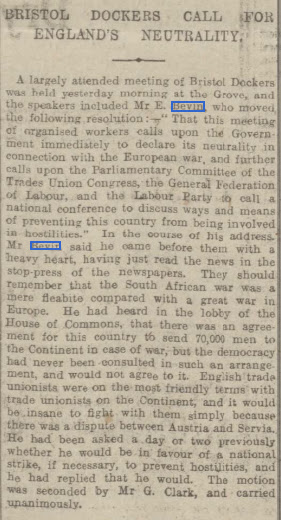
    On 4th August 1914 Britain declared war on Germany. On August 2nd, Bristol Dockers’ Union held a mass meeting on the dockside to debate whether Britain should go to war. The meeting voted unanimously against war. This was one of many anti-war meetings and demonstrations held across the country.

    The Western Daily Press of 3rd August 1914 carried a report of the original debate, which is shown in the image below.

    WDP report of 3rd August 1914

    The planned commemorations of the outbreak of war will ignore the voices of the many people who spoke out against war a hundred years ago. Rather than people being united in wanting to attack Germany, a debate raged as to whether or not Britain should go to war.

    Remembering The Real World War 1 will be re-staging the Bristol dockers’ debate at 2.00 pm on Saturday 26th July near the Arnolfini on Narrow Quay (map) in Bristol.

    front of flyer

    Everyone is welcome to come along and join in the debate; I shall be participating as an anti-war nautical type! Period costume will be more than welcome, as will flags, banners & placards.

    For more information visit the Remembering the Real WW1 website.

  • #tidyBS5 in the Bristol Post

    This blog has previously highlighted the problem of fly-tipping in the Easton and Lawrence Hill areas of Bristol (posts passim).

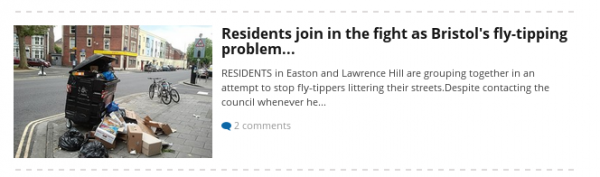
    The move to get more people involved in reporting and combating this menace that blights the inner city took another step forward two days ago when it was featured in the Bristol Post, as shown by the following screenshot.

    Bristol Post article image

    I was contacted by the Post’s Sophie Prideaux and we exchanged emails that went on to form the basis of the article and, as I’m feeling charitable, I’ll even forgive her for changing my surname from plural to singular halfway through the piece. 🙂

    Sophie also contacted my local councillor, Marg Hickman, who’s been a great support from the outset.

    Another purpose of the article was to publicise the #tidyBS5 hashtag, which is being used to highlight the scourge of fly-tipping in the BS5 postal area on social media, such as Twitter.

    As regards Marg’s involvement, the Post states:

    Mrs Hickman, a Labour councillor for Lawrence Hill ward, is urging residents to get behind #tidyBS5, saying it’s an “important initiative to improve the quality of life of residents living in BS5”.

    Read the Post’s report.

  • Companies House to make all of its digital data available for free

    Yesterday, while David Cameron was rearranging the deckchairs on his governmental re-enactment of the SS Titanic, one significant piece of news (apart from the DRIP Bill. Ed.) seems to have escaped the personality-obsessed British media.

    open data stickersThe news was the Department for Business, Innovation and Skills announced that Companies House is to make all of its digital data available free of charge. It has hitherto charged users for anything but the most basic company information on its website.

    This will make the UK the first country to establish a truly open register of business information.

    As a result, it will be easier for members of the public and businesses to research and scrutinise the activities and ownership of companies and their directors. Last year (2013/14), users searching the Companies House website spent £8.7 million accessing company information on the register.

    The release of company information as open data will also provide opportunities for entrepreneurs to come up with innovative ways of using the information.

    This change will come into effect from the second quarter of 2015 (April – June).

  • DRIP: I write to my MP

    This week the British government, with the collusion of the so-called opposition, will be attempting to railroad the Data Retention and Investigatory Powers Bill (DRIP) through Parliament as emergency legislation. This is deeply illiberal legislation and I’ve written about it this morning to my MP, Stephen Williams.

    My email is reproduced below.

    Dear Mr Williams

    I am writing to you as your constituent to express my deep concerns about the Data Retention and Investigatory Powers (DRIP) Bill due to be rushed through both Houses of Parliament this week.

    Firstly, it is my understanding that the government is describing it as emergency legislation. This is a misnomer: there is no emergency at least as far as the alleged terrorist threat is concerned; according to the MI5 website (https://www.mi5.gov.uk/home/the-threats/terrorism/threat-levels.html#history), the terrorism threat level has remained the same for the last 4 years! In the light of that information, 4 years seems like a tardy response to a so-called emergency. Any legislation – including alleged emergency legislation needs proper scrutiny by MPs, peers and civil society. It would appear that the UK has learned nothing from the idiocies that came in the wake of earlier ’emergency’ legislation, such as the Official Secrets Act of 1911, which dogged the rest of the 20th century.

    Secondly, the European Court of Justice recently ruled blanket data retention – as implemented by the European Data Retention Directive and the respective domestic legislation enacted as a consequence thereof – incompatible with human rights legislation. Any new legislation should comply with that judgement. DRIP is just an attempt by the UK government to sidestep that ruling. If enacted, I fully foresee civil society groups fighting DRIP all the way through the UK courts and all the way up to the ECJ. Furthermore, the latter ruling against DRIP would have the unintended consequence of giving the UK’s large tribe of Eurosceptics and Europhobes yet more ammunition to stir up anti-European sentiment.

    Thirdly, the UK has an obligation to comply with the European Convention on Human Rights, of which it is a signatory and which the UK we should uphold as an example internationally, particularly as the UK was a prime mover for its initial drafting.

    Fourthly, I understand that the Prime Minister has promised a review of RIPA as a concession to get MPs to approve the legislation; this is an inadequate sop to the back benches and as such should be rejected.

    Finally, I would like to mention the fact that I am nearly 60 years old. In all that time I have never been convicted of any criminal act, arrested or detained by the police, i.e. I’m of previous good character. Blanket surveillance of the communications of the entire UK population makes them every single member of the population a suspect: it throws doubt on their previous good characters. Blanket communications surveillance has not failed to stop foolish young people disappearing off to the Middle East as jihadists; it has to the best of my knowledge likewise failed to stop some serious crimes being committed. If the police and/or security services wish to search my home, they need a warrant. They should require the same to interfere with my communications.

    I trust you will look seriously upon my concerns.

    Yours sincerely
    Steve Woods

    I would urge you to contact your MP today on DRIP. You can find his/her identity (if unknown) via the excellent WriteToThem. In addition, the Open Rights Group provides some excellent guidance for your letter.

    DRIP is a most appropriate acronym. It’s the sound made by falling water: falling water causes erosion and this Bill seriously erodes civil liberties, as well as showing utter contempt for the European Court of Justice.

    Meanwhile Paul Bernal calls the government’s course of action a “shabby process for a shady law“.

    Quite.

  • #tidyBS5 gains momentum

    After the last Easton & Lawrence Hill Neighbourhood Forum meeting where I talked about fly-tipping in my area of Bristol (posts passim), it was suggested to me that I devise a hashtag for use on Twitter and elsewhere to help highlight the problem. My answer was #tidyBS5.

    The hashtag and its use have now been given another boost by publicity in the fortnightly Easton & Lawrence Hill Neighbourhood Management email bulletin.

    image from newsletter featuring tidybs5

    There’s also a meeting with councillors and officers on fly-tipping and rubbish in just over a week’s time to which I’ve also been invited. Let’s hope it ends in some proper enforcement and action to make scenes like the one below a thing of the past.

    image of Stapleton Rd fly-tipping

  • EU Commission locked into Microsoft

    EU flag with MS Windows logo inside circle of starsThe European Commission has recently renewed its commitment to a proprietary desktop and secret file formats, the Free Software Foundation Europe (FSFE) writes. The Commission is refusing to make a serious effort to break free from vendor lock-in and is ignoring all available alternatives. In doing so, the EU’s civil service fails to practice what it preaches.

    In April, the Commission signed two contracts with Microsoft: firstly, an agreement for “high-level services” worth €44 million and secondly a framework agreement on software licensing conditions. The actual licences are provided by Hewlett-Packard under a separate contract from 2012 that itself is worth €50 million. The contracts cover the Commission itself and 54 other EU organisations.

    “We are extremely disappointed about the lack of progress here,” says FSFE president Karsten Gerloff. “The Commission has not even looked for viable alternatives. Its lazy approach to software procurement leaves the Commission open to allegations of inertia and worse.”

    The Commission recently admitted publicly for the first time (PDF) that it is in “effective captivity” to Microsoft. Documents obtained by the FSFE reveal that the Commission has made no serious effort to find solutions based on open standards. As a consequence, a large part of Europe’s IT sector is essentially prevented from doing business with the Commission.

    In a strategy paper (PDF) which the Commission released in response to official questions from Amelia Andersdotter MEP, the EC lays out a three-track approach for its office automation platform for the coming years. This strategy will only deepen the Commission’s reliance on closed proprietary file formats and programs.

    “The Commission should be setting a positive example for public administrations across Europe,” comments FSFE’s Gerloff. “Instead, it shirks its responsibility as a public administrations, and simply claims that such alternatives don’t exist. Even the most basic market analysis would have told the Commission that there’s a vibrant free software industry in Europe that it could have relied on.”

    Many public sector organisations in Europe are successfully using free software and implementing open standards. Examples include the German city of Munich with its internationally recognised Limux project and (believe it or not! Ed.) the UK government, which has made great strides in using free software and open standards to obtain better value for money in IT procurement.

    However, the FSFE says it will continue to work with the Commission in spite of this setback and will help it to improve its software the way it buys software, such as by relying on specifications and standards rather than brand names, by using open invitations to tender instead of talking to a single vendor and by incorporating future exit costs into the price of any new solution. These practices are fast becoming the norm across Europe’s public sector. The EC should practice what it preaches and adopt these practices for its own IT procurement.

    This post originally appeared on Bristol Wireless.

  • Ministerial photo opportunity

    Last Friday, the Bedfordshire News website published a story of a visit by Defence Minister and Tory MP for Ludlow Philip Dunne to the hangars at Cardington, one of the major British sites historically involved in the development of airships.

    From the screenshot below, the visit provided a photo opportunity.

    screenshot featuring group looking like it's been excreted from giant bottom

    The ministerial party looks like it’s been excreted from or is about to be crushed by a giant bottom. Don’t ministers and their civil service minders ever check behind them before smiling for the camera?

  • Goodbye Ebenezer

    Despite the best efforts of campaigners (posts passim), east Bristol is losing another part of its dwindling number of buildings of historical interest as the former Ebenezer Chapel in Midland Road in the city’s St Philips area is currently being demolished by its owners, no doubt to make way for yet more soulless ‘apartments’ of zero architectural merit (like much of Bristol’s post-war architecture. Ed.).

    The building itself has had a chequered history: it opened as a Primitive Methodist chapel in 1849. Henry Overton Wills II, from the local tobacco dynasty, laid its foundation stone. It closed as a Methodist chapel in 1938 but reopened as a Christadelphian hall in 1958 after WW2 bomb damage had been repaired. It was converted into business premises in the 1980s.

    Ebenezer Chapel demolition

    I feel that the demolition has been aided and abetted by a gutless local authority which could have stepped in and refused the demolition order. Bristol City Council justified its actions by giving two reasons:

    • the building is not listed; and
    • the building is not in a conservation area.

    The fact that the Ebenezer Chapel was neither listed nor included in the nearby Old Market Conservation Area is indicative of the abject failings of Bristol City Council as a local authority.

    The chapel was the first Primitive Methodist chapel built in Bristol. Surely it deserved listing solely for that single reason?

    Furthermore, unlike the more conventional Gothic style employed for chapel buildings at the time, the Ebenezer Chapel was designed with decorative round arched windows in a very rare bold Romanesque style. This should have been yet another reason for listing.

    Regarding the chapel, Kathy Clark, conservation officer at the Victorian Society has said: “Ebenezer Chapel, or at least its distinctive front wall, should be reused and extended for a new use, whilst preserving a worthy piece of Bristol’s heritage. We urge Bristol Council to work for retention of the chapel.”

    There’ll be no chance of that now that half the front wall has been demolished! 🙁

    So, I’ll bid a sad farewell to the Ebenezer, as no doubt will the thousands of people that pass it every day, but I will end with a question to Bristol City Council: when will the historical and architectural heritage of east Bristol – traditionally a poorer and less prosperous part of the city – be given equal treatment with its counterpart in Bristol’s better-off districts?

    Perhaps the city council would like to answer that question using the comment form below.

Posts navigation