If there’s one characteristic of the English Empire’s free and fearless press and the news media in general that’s immediately apparent to anyone with more than one brain cell, it’s their usually remote relationship with the truth.
In the last week or so a new word has emerged – pingdemic – in relation to the coronavirus pandemic to describe the large volume of self-isolation warnings issued by the Covid track and trace app (aka pings (pl.), as derived from the computer networking utility of the same name. Ed.).
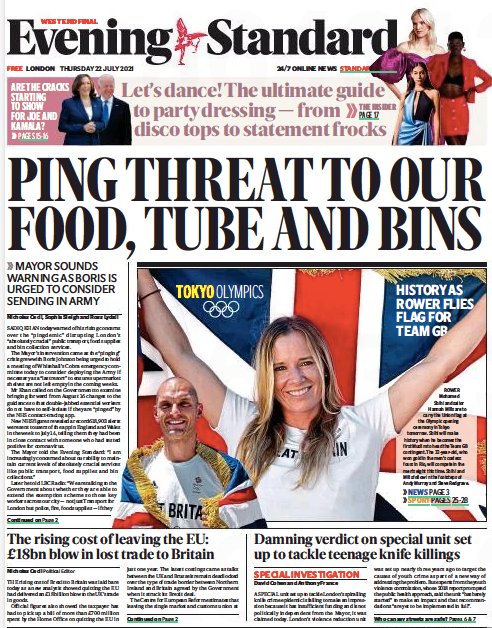
Thus the terms ping and pingdemic have become part of normal newspaper and news media vocabulary, as shown in this typical example from yesterday’s London Evening Standard.
Whoever wrote the headline Ping threat to our food, tube and bins has clearly not thought the matter through.
It’s not the pings that are the threat but the viral plague which is giving rise to rocketing Covid, aided and abetted by an apology for a government that has removed restrictions far too soon and relinquished – in exemplary Pontius Pilate mode – all responsibility for safeguarding people’s health in the rush to let all their rich mates resume making Loadsamoney again.
All news is to a certain extent manipulated, but if those that right it cannot even get the basic details correct in a headline, is it any wonder that there is deep mistrust in the media?
Still, never mind with all this gloom and doom. Immediately adjacent is a prime example of look over there in the form of the current 2020 Olympic games in Tokyo.
The staff of the Standard clearly seem to have adopted the comment by Juvenal, the 2nd century Roman poet famous that the common people are only interested in bread and circuses (Latin: panem et circensis. Ed.) as editorial policy
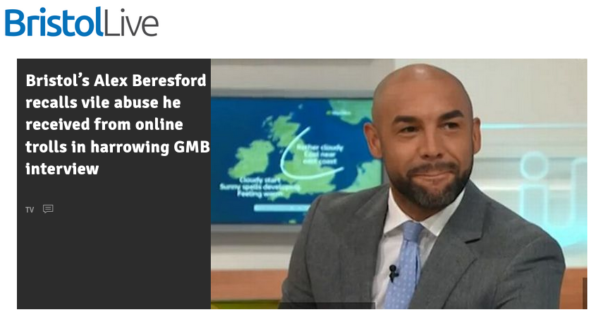
Bristol Live, formerly the Bristol (Evening) Post, aka the Temple Way Ministry of Truth, has an enduring reputation locally for the poor quality of some of its reporting.
The report gets off to a bad start with the headline boldly and falsely proclaiming Popular Weston-super-Mare seafront water park to close this month, making it sound as if the attraction is to close permanently, not temporarily.
Note too the use of popular, a term normally reserved by Bristol Live for failing cafés and restaurants.
However, the real howler in the piece occurs in the obligatory quotation from a Town Council spokesperson. In his second sentence he is quoted as saying:
We apologise for the incontinence and look forward to welcoming you back with new improvements ready for the summer holidays.
Whether the specified incontinence originated from any communication from the council, erroneous predictive text or any other source is unclear. Nevertheless, earlier in the piece readers are informed that “the water has remained off due to covid [sic] guidelines“, so the origin of any incontinence is unclear.
When the facility reopens, we are informed that the cost of admission is £2.50 per child.
In view of the purported incontinence, perhaps that ought to be raised to a Tena. 😉
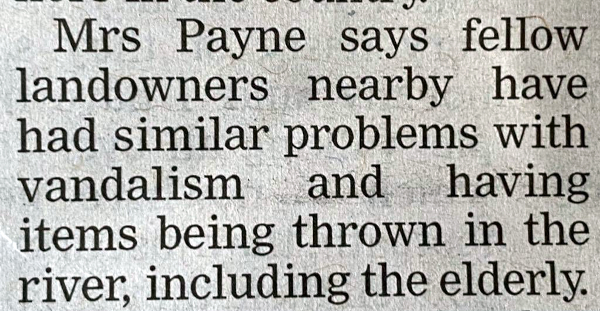
Even though the elderly have had a bath thanks to ambiguity and poor proofreading in the Evesham Journal’s dead tree version, this age discrimination has thankfully been eliminated from the paper’s online version of the report.
No pensioners were harmed – or dunked – in the drafting of this blog post.
Yesterday, which was Earth Day, US President Joe Biden organised a two-day virtual climate summit bringing together dozens of world leaders.
Apart from world political leaders, Biden also inexplicably invited one Alexander Boris de Pfeffel Johnson, Britain’s part-time alleged Prime Minister, to participate.
Besides his propensity never to let the truth escape from his lips, Johnson is well known for his lack of attention to detail, his loose tongue and gaffes; and true to form he didn’t fail to embarrass the country of which he is supposed to be the highest elected public official, as shown in the following video clip.
Yes, you did hear that correctly – “politically correct green act of bunny hugging“!
Needless to say, Bozo the Clown had half of the country’s social media users rolling their eyes in despair, condemning his cavalier attitude and wondering what the blonde buffoon was going to sully next with his reverse Midas Touch.
However, it wasn’t just Britons who reacted to Bozo’s gaffe.
Amongst them was one Greta Thunberg, an 18 year-old Swede whose name is not exactly unknown on the world stage where climate change is concerned.
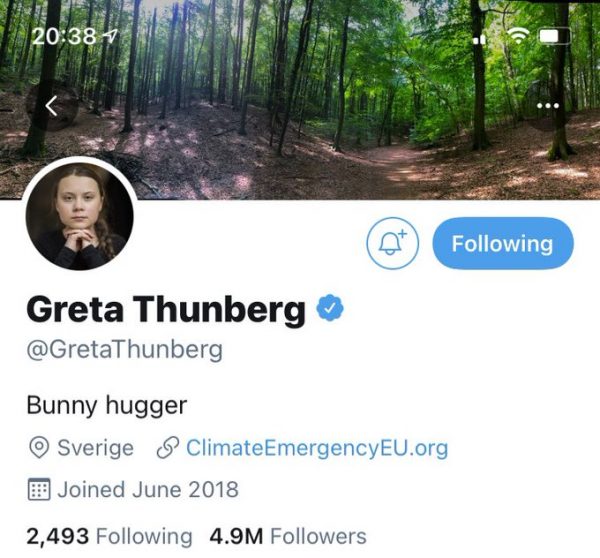
Greta very quickly changed her Twitter bio to reflect Johnson’s words.
Nice work, Greta! 😀
As for the embarrassment that is part-time alleged Prime Minister Alexander Boris de Pfeffel Johnson, you can consider yourself well and truly pwned.
Amazon was forced to apologise and blamed a “technical error” for a customer being unable to post a review in Welsh of a novel written in Welsh, Wales Online reports.
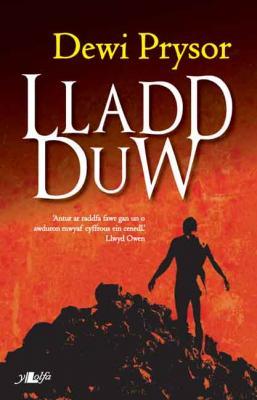
Cathryn Sherrington of Cardiff had submitted a Welsh Language review which she then translated to English of the book Lladd Duw, by Dewi Prysor.
The book is described by its publisher as a “hefty, ambitious novel set in London and an imaginery [sic] seaside town. It deals with the destruction of civilisation from the standpoint of the working class. An intense, dark novel but with the usual humour from Dewi Prysor.“
Cathryn’s review reads as follows:
Gwych Brilliant. I haven’t read a Welsh book for years – sometimes the formality of written Welsh puts me off – this is brilliant though. Hawdd i ddarllen, stori gyffroes, cymeriadau diddorol. Wedi joio fo gymaint dwi’n mynd i ddarllen mwy o lyfrau Cymraeg.”
In English the review’s second sentence reads: “Easy to read, exciting story, interesting characters. Have enjoyed it so much I’m going to read more Welsh language books“.
However, Amazon which employs 1,000 people in Swansea, emailed Cathryn implying her review might have broken its guidelines.
There then followed a social media and email exchange between Cathryn and Amazon at the end of which the latter relented, stating: “This was due to a technical error for which we apologise. It has now been resolved.”
The continuing ignorance of the hardline Tory MPs who spearheaded the UK’s departure from the European Union is a gift that just keeps on giving.
Not only do they not understand how the EU works (clue: it’s a rules-based organisation. Ed.), they also do not know how international trade works (clue: that’s also a rules-based system. Ed.).
When it comes to ignorance of the workings of international trade – and tariffs in particular – Shrewsbury and Atcham MP Daniel Kawczynski has previous form, ending up looking a lemon in respect of, er, lemons.
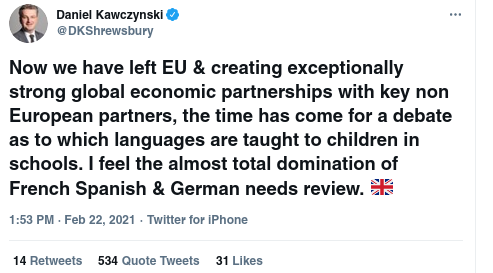
However, there appears to be no start to Daniel’s ignorance and no end to his vanity in wanting to draw attention to the same. On Monday 22nd February he posted the tweet below on his Twitter account.
Daniel no doubt believes that these languages are spoken solely in countries such as France, Spain and Germany in the hated EU.
Time to think again, Danny Boy! 😀
Let’s start with your last mentioned language shall we, Daniel (especially as it might be considered the easiest to dismiss.Ed.)?
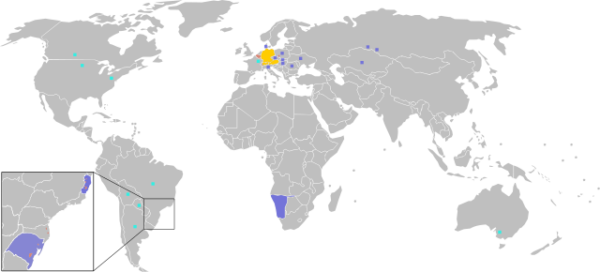
German is, of course, spoken in Germany. However, it’s also the official language in Austria as well as being one of Belgium’s four official languages. In Italy’s province of Alto Adige (also known as the Südtirol. Ed.), 62% of the population are German speakers. Outside the EU, German is also one of Switzerland’s four official languages. German is a recognised minority language in the Czech Republic, Hungary, Poland, Romania, Russia and Slovakia. Beyond Europe there are still 25,000-30,000 native German speakers in Namibia, despite it ceasing to be a German colony over a century ago: some 12,000 persons whose first language is German currently live in South Africa. Turning to South America, there are an estimated 1 million German speakers, with German-speaking minorities in almost every Latin American country including Argentina, Belize, Bolivia, Brazil, Chile, Colombia, Costa Rica, Dominican Republic, Ecuador, Guatemala, Mexico, Nicaragua, Paraguay, Peru, Uruguay, and Venezuela. In North America, there are also German-speaking minorities in both the USA and Canada.
The map below illustrates where German is spoken around the world.
The German-speaking world. Image courtesy of Wikimedia Commons.
How does Daniel fare with French?
Equally badly is the answer.
Besides the EU countries of France, Belgium and Luxembourg, French is also spoken within Europe in Monaco and parts of Italy. Throughout the world there are estimated to be some 274 million French speakers, of whom some 77 million are native speakers. Within the EU alone, French is the third most widely spoken language (after English and German), being spoken by 19.71% of the population and is the second most-widely taught language after English. It’s an official language not only in France, but Belgium, Luxembourg, Monaco and Switzerland. It is also widely spoken in Italy’s Aosta valley region.
However, it is in Africa – and particularly former French colonies and territories – that the majority of the world’s French speakers live. According to a 2018 estimate from the Organisation Internationale de la Francophonie, an estimated 141 million African people spread across 34 countries and territories can speak French as either a first or a second language. This estimate does not include those inhabitants of non-Francophone African countries who have learned French as a foreign language.
Looking at the Americas, French is the second most common language in Canada, after English, and both are official languages at the federal level. It is the sole official language in the Canada’s Quebec province. In the USA, French is the fourth most-spoken language in the United States after English, Spanish, and Chinese, when all forms of French are considered, according to the United States Census Bureau.
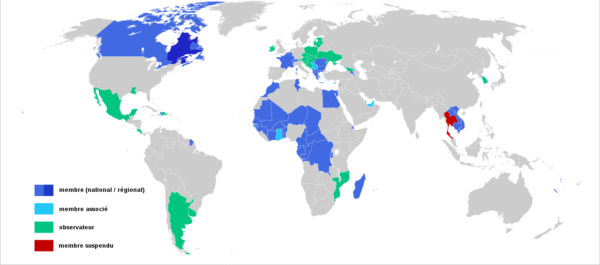
The following map shows membership of the Organisation internationale de la Francophonie, the international organisation representing countries and regions where French is either a lingua franca or customary language.
Membership of the Organisation internationale de la Francophonie. Image courtesy of Wikimedia Commons
So far that’s two own goals Daniel’s scored on the worldwide importance of 2 of the major foreign languages taught in British schools.
How does he fare with his third target – Spanish?
In short, not any better.
Today Spanish has 500 million native speakers, mainly in Spain and the Americas and is the world’s second-most spoken native language after Mandarin Chinese and the world’s fourth-most spoken language overall after English, Mandarin Chinese, and Hindi. Overall there are estimated to be 586 million speakers of Spanish in the world. As befits its large number of speakers, Spanish is one of the six official languages of the United Nations and it is also used as an official language by the European Union, the Organization of American States, the Union of South American Nations, the Community of Latin American and Caribbean States, the African Union and many other international organisations, as well as being one of the world’s most widely taught foreign languages.
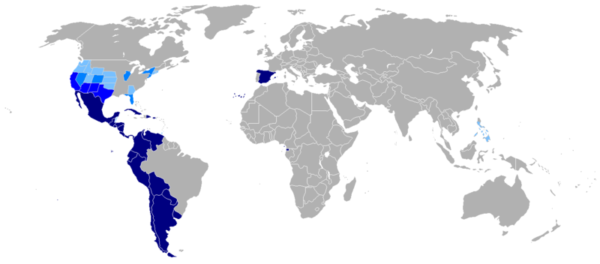
Below is a map showing where in the world Spanish is spoken.
Map of the Hispanophone world. Image courtesy of Wikimedia Commons
So how’s Daniel done?
In brief, not very well.
If Mr Kawczynski had been a footballer instead of a member of Parliament, he would have gone down in the match report as having scored three goals for the opposing side, also know as own goals (Kawczynski 3, og).
Finally, it’s worth pointing out that Daniel has been appointed the UK’s trade envoy to Mongolia. If his tweet was an attempt to increase the teaching Mongolian as a foreign language in British schools, it was, to say the least, extremely clumsy.
in my first job after graduation (translator and marketing analyst for Imperial Tobacco in Bedminster, Bristol), part of my employer’s house style I had to absorb was an avoidance of all and any ambiguity.
I well remember my chagrin at being admonished for it by my line manager, who had left school at 14 with no qualifications, started out as a messenger boy in the post room and worked his way up to senior middle management.
Collins Dictionary defines ambiguity as “the possibility of interpreting an expression in two or more distinct ways” and “vagueness or uncertainty of meaning“.
This is a lesson that the employees of the Bristol Post/BristolLive (also known by some locals as the Temple Way Ministry of Truth. Ed.) have yet learn, as shown by the latest example below.
On a rare excursion into town, I happened to notice that Castlemead, the city’s tallest office block, is currently undergoing a refurbishment and is surrounded by site hoardings which have the usual aspirational developer’s blurb splashed across it, as can be seen below.
General view of the Castlemead site on Lower Castle Street
Besides being the new benchmark, the refurbisher’s website describes Castlemead as follows:
Castlemead is a city landmark office building and offers high quality refurbished open plan accommodation from 3,450 – 11,128 sq ft and the UK’s First Platinum Plus 100 Cyclingscore Accredited facilities.
With 360 panoramic views over Bristol’s cityscape and Castlepark [sic] and with the Cabot Circus regional shopping, dining and leisure destination on your doorstep, why locate your business anywhere else?
Nevertheless, a quick glance at the images chosen to illustrate this landmark office building’s quality reveals one glaringly obvious fact.
This quality is only available to white people. All the figures shown are invariably Caucasian. There’s not a BAME face to be seen anywhere either on the site’s hoardings or in the CGIs used on the dedicated website.
Spot the BAME face 1Spot the BAME face 2
According to the city council’s website, 16% of the city’s population of 463,400 persons belongs to a black or minority ethnic group. That’s over 74,000 people.
When will developers realise and start to portray a more accurate picture of our city in their very expensive fantasy doodlings?
After all, this is not the first time the absence of non-white faces from new Bristol property developments has been pointed out. It is a phenomenon that was first highlighted back in 2009 by a fellow local blogger.
One would have expected the city’s major property moguls to have learned something by now and made a start on accurately portraying all the kinds of people in the city who will ultimately be occupying their benchmark and landmark buildings.


 Amazon was forced to apologise and blamed a “technical error” for a customer being unable to post a review in Welsh of a novel written in Welsh,