politics

  • The English north-south divide: another Roman legacy?

    In Monty Python’s Life of Brian, Reg, the leader of the People’s Front of Judea (PFJ) asks: “All right, but apart from the sanitation, the medicine, education, wine, public order, irrigation, roads, a fresh water system and public health, what have the Romans ever done for us?

    Moving well north and west from Judea to England and asking the same question about the benefits of Roman rule for the locals, one unexpected legacy of oppression under the hob-nailed caliga may well be the north-south divide, but does that political, cultural and linguistic division, which has been a permanent fixture in your ‘umble scribe’s life, really date back over one and a half millennia? It is a recognised phenomenon that has even merited its own Wikipedia page.

    Anyway, back to the Romans.

    The Roman province of Britannia was in existence from the invasion of Claudius in 43 CE until with withdrawal of the legions in around 410 CE.

    Some time, either in the late second century or early third century CE the province of Britannia was split into two, with Britannia Superior (Upper Britain) in the south governed from Londinium (London) and Britannia Inferior (Lower Britain) in the north governed from Eboracum (York). It is not known where the boundary between the two administrative regions was demarcated, with the boundary in the graphic below being purely conjectural.

    Roman province of Britannia divided into Britannia Superior and Britannia Inferior. Image courtesy of Wikimedia Commons

    Both Britannia Superior and Britannia Inferior were later sub-divided further. In 296, the emperor Diocletian undertook a major reorganisation of the empire. The newly named Diocese of Britannia was subdivided into four provinces, Britannia Prima and Maxima Caesariensis from Britannia Superior and Britannia Secunda (capital in Eboracum) and Flavia Caesariensis (capital in Lindum (Lincoln)) from Britannia Inferior.

    When Catholic Christianity came to England, it followed a similar pattern to the fate of the Roman imperial province: firstly administration as a sole archbishopric from Canterbury, then the division of the country into two provinces, Canterbury and York, with the latter archbishopric being established 735, after being a bishopric from 626. This administrative ecclesiastical division has persisted to this day, with the Archbishop of York being regarded as the Church of England’s second most senior cleric.
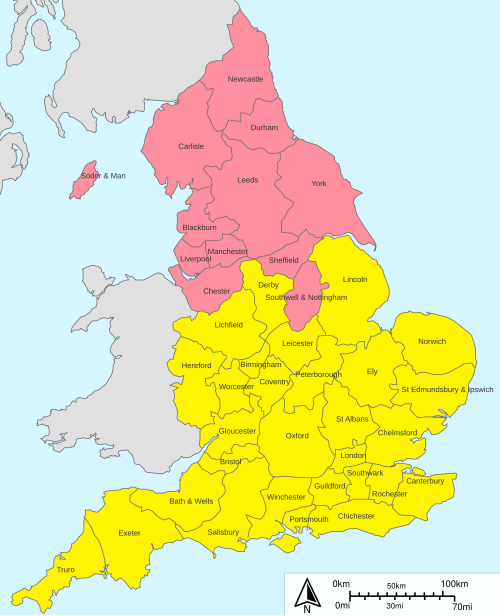
    Provinces of the Church of England. York in pink, Canterbury in yellow. Image courtesy of Wikimedia Commons

    At about the same time that the early church was developing, so were England’s seven Saxon kingdoms (established by the descendants of incomers from continental Europe from the 5th century onwards, who intermarried with the locals and whose culture became the dominant one in what was later to become England. Ed.) – otherwise known as the Heptarchy. Of these, one of the largest was Northumbria, whose capital was likewise York and whose southern boundaries extended from the Mersey estuary in the west to the Humber estuary in the east.
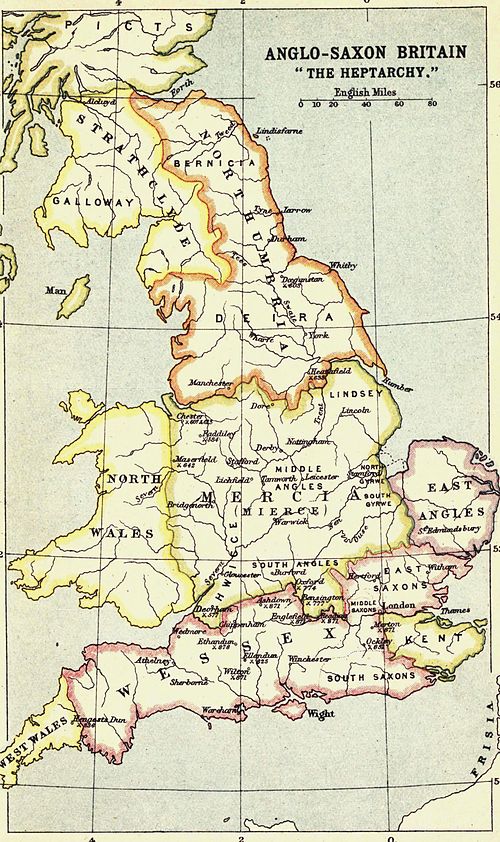
    The Heptarchy, Image courtesy of Wikimedia Commons

    However, other factors than ecclesiastical and administrative division need to be taken into account. These include the arrival and settlement of large parts of England with Norse speakers from the mid-ninth century onwards, ultimately resulting in the establishment of the Danelaw. The settlement of large numbers of Norse speakers also had a profound effect on the development of what became modern English, simplifying some of the more complicated syntax of Old English inherited from its Germanic roots, as well as enriching the language with such everyday nouns as egg and knife, plus adjectives like sly. Wikipedia has a list of English words of Norse origin, but your ‘umble scribe does not consider it complete as it has been reckoned that up to 3,000 modern English terms have their origins in Old Norse. But perhaps the most telling distinction is the difference in the origin of dialect words between the north and the south (e.g. the northern use of beck for a stream and in certain regions gan for go).

    The north-south divide also played a role in that most famous year in English history – 1066, involving as it did a fraternal dispute between the two sons of Godwin of Wessex, namely Harold (who some, particularly William of Normandy believed had usurped the English crown which he believed had been promised to him. Ed.) and Tostig, earl of Northumberland. As earl of Northumberland, Tostig governed with difficulty. He was never popular with the Northumbrian ruling class, a mix of Danish invaders and Anglo-Saxon survivors of the last Norse invasion. Tostig was said to have been heavy-handed with those who resisted his rule, including murdering several members of leading Northumbrian families. On 3rd October 1065, the thegns of York and the rest of Yorkshire descended on York and occupied the city. They killed Tostig’s officials and supporters, then declared Tostig outlawed for his unlawful actions. Shortly after, Kind Edward the Confessor exiled Tostig at the behest of his brother Harold.

    When Edward died and was succeeded by Harold, his rule was challenged by Tostig and Harald Hardrada of Norway, both of whom were killed at the Battle of Stamford Bridge on 25th September 1066. Hard on the heels of that encounter, Harold Godwinson himself lost the crown by being defeated by William (nicknamed both the Conqueror and the Bastard. Ed.) Duke of Normandy at Hastings on 14th October 1066.

    The Norman takeover of England was not wholeheartedly welcomed everywhere and more particularly he William faced a series of rebellions and border skirmishes in Dover, Exeter, Hereford, Nottingham, Durham, York and Peterborough. However, the biggest revolt came in the northern part of England and is generally know to history as the Harrying of the North. In 1086, twenty years after William the Bastard’s invasion and the battle of Hastings, his great survey of the country known as the Domesday Book lists many areas as being waste, i.e. unproductive land yielding no tax revenue, so great had been his retribution for the revolt against his rule.

    The fourteenth century is our next halt on this journey down the English north-south divide.

    In 1381 there was a popular uprising now known to history as the Peasants’ Revolt (although plenty of people other than peasants were involved. Ed.) occurred. Although the main events occurred in the south-east of England, particularly Essex, Kent and London, revolts and public unrest occurred in other parts of England too; and the north did not escape.

    Wikipedia records that:

    In the town of Beverley, violence broke out between the richer mercantile elite and the poorer townspeople during May. By the end of the month the rebels had taken power and replaced the former town administration with their own. The rebels attempted to enlist the support of Alexander Neville, the Archbishop of York, and in June forced the former town government to agree to arbitration through Neville. Peace was restored in June 1382 but tensions continued to simmer for many years.

    Hard on the heels of the events of 1381, 1395 was a pivotal year in English literary history with the appearance of Geoffrey Chaucer’s Canterbury Tales. Chaucer himself wrote (and probably spoke) in the East Midlands dialect which was prevalent in places such as London, Oxford and Cambridge, and was one of the most influential medieval English dialects in forming Modern English. However, he knew the Northern dialect too and it is spoken by the two northern clerks in the Reeve’s Tale.

    The tale concerns Symkyn, a miller of Trumpington near Cambridge. He overcharged the steward of Soler Hall (which later became part of Trinity College), the college steward was too ill to face him. Two clerical students there, John and Aleyn, originally from Strother in north east England (a place now lost in the historical and geographical record. Ed.), are outraged at this theft and vow to beat the miller at his own game. The north-eastern accent of the two clerks is also the earliest surviving attempt in English literature to record a dialect from an area other than that of the main writer and is believed to be the first effort in English to extract comedy from imitating accents.

    And that linguistic divide has existed since at least Chaucer’s time, with occasional low-level mutual disdain for the accents and dialects of north and south. One of my nieces – a Lancashire lass – did her degree in London. Whilst in London she was constantly told how northern she sounded; during visits back to the red rose county, the perceived loss of her accent and perceived adoption of southern speech were also remarked upon.

    Over the centuries distinct differences other than linguistic have also grown up. Take food for instance. Bury has long been regarded by many as the traditional home of black pudding, whilst London will always be associated with jellied eels. Pie lovers generally associate decent pies with the north (see Hairy Bikers. Ed.). Turning to music, London has the Royal College of Music; Manchester is home to the Royal Northern College of Music. On the sports field the north has long been the home of rugby league (13 players per side) whilst rugby union (15 per side) has long predominated in the south. Plenty of other examples in other fields are also available.
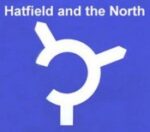
    Motorway style signage indicating roundabout exit for Hatfield and the NorthBefore drawing to an end, it’s worth noting that where the north and south of England both begin and end is not fixed. If one is on the M1 down near London, the motorway signage clearly indicates that the North begins beyond Hatfield in Hertfordshire. In contrast, my Mancunian friend Steve defines the start of the North as anywhere north of a horizontal line at Knutsford Services on the M6 in line with the general rule that the further north one goes, the further north the south begins.

    So, returning to and paraphrasing the PFJ’s Reg, apart from the sanitation, the medicine, education, wine, public order, irrigation, roads, a fresh water system and public health, did the Romans also give England its north-south divide? Have your say in the comments below.

  • A new salute

    At one time right-wingers and fascists could be recognised by their giving the Roman salute (also known as the fascist salute. Ed.) or Nazi salute.

    In the former the right hand is swung from the left shoulder to fully extend the right arm forward perpendicular to the torso, with palm down, and fingers touching. In some versions, the arm is raised upward at an angle; in others, it is held out parallel to the ground. In the latter the salute is performed by raising and extending the right arm forward at an upward angle with a straightened hand, fingers together, and palm facing downward.

    In recent times, however, it appears these two traditional gestures of the far right have been superseded by another that is popular amongst populists – the thumbs-up signal, as demonstrated when they dined in Florida at the weekend by the disgraced 45th and current disgraceful 47th President of the United States, adjudicated sexual predator, condemned business fraudster, convicted felon and compulsive liar, one Donald John Trump (who is on a personal quest to Make America Grate Again or something similar. Ed.) and the part-time dishonourable member of parliament for Clacton, a grifter and charlatan rejoicing in the name of Nigel Paul Farage.

    Trump and Farage giving the thumbs up
    Image courtesy of the White House

    Farage’s trip has drawn plenty of adverse criticism, including from Lib Dem leader Ed Davey: “I see Farage is off to Mar-a-Lago to talk down Britain and suck up to Trump. There’s nothing patriotic about cheering on a foreign leader whose illegal war is sending British families’ energy bills through the roof.

    For those who bemoan modernisation, there are plenty of those out there on the right who still prefer tradition, like Elon Musk.

  • Bezos title cheerleading for war

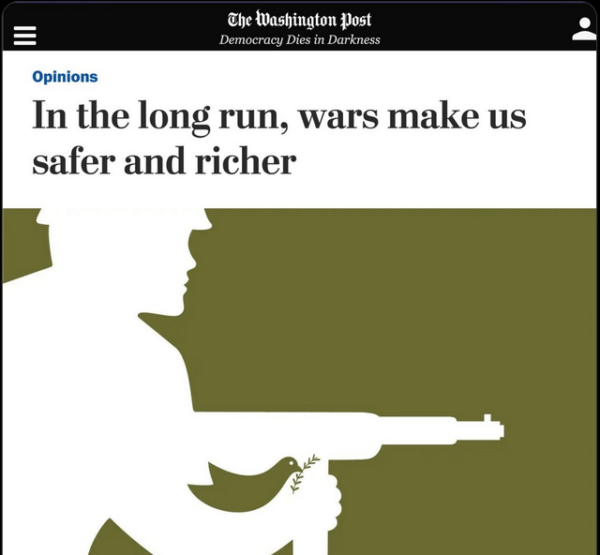
    The image below courtesy of the Washington Post (proprietor one Trump-supporting, union-bashing billionaire rejoicing in the name of Jeffrey Preston Bezos. Ed.) came into your ‘umble scribe’s social media timeline this morning.

    Washington Post opinion piece with a headline reading In the long run, wars make us safer and richer

    There have always been those who profit from wars, from spivs operating on the black market (posts passim) to arms manufacturers.

    Wars always entail casualties, one of the first being reputed to be the truth.

    The Washington Post’s attitude illustrated in the opinion piece’s title reminds your correspondent of the quotation attributed to the then British Prime Minister Stanley Baldwin during a tough spell in the 1930s:

    What the proprietorship of these papers is aiming at is power, and power without responsibility—the prerogative of the harlot throughout the ages.

    No further comment is necessary, save perhaps one sentence from my political science lecturer, the late Elfed Roberts, in a lecture on war over five decades ago: “War is the destruction of the fittest“.

  • Bigotry blasted by Bedford BC

    The world’s 3 Semitic religions, Judaism, Christianity and Islam, frequently have festivals or periods of observance that overlap, coincide or occur very close together,

    One of those periods is happening right now towards the end of the second week of February. Islam’s holy month of Ramadan, a period of fasting and prayer, started yesterday, whilst Lent, the Christian period of repentance and fasting leading up to Easter, began today.

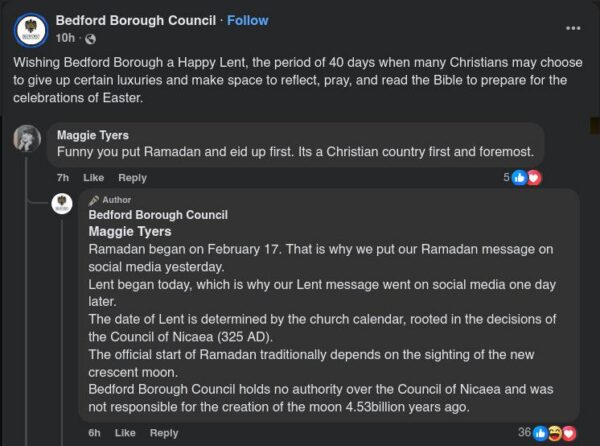
    The starts of the two periods of religious observance were duly announced on its Facebook account by Bedford Borough Council, a procedure no doubt emulated by their Bedford’s counterparts around the land.

    However, one bigoted respondent took the council to task for allegedly showing favouritism to Islam and claiming that the country is apparently first and foremost a Christian country, as shown by the following thread.

    Bedford Borough Council - Wishing Bedford Borough a Happy Lent, the period of 40 days when many Christians may choose to give up certain luxuries and make space to reflect, pray, and read the Bible to prepare for the celebrations of Easter. Reply by MaggieTyers - Funny you put Ramadan and eid up first. Its a Christian country first and foremost. Bedford Borough Council response - Ramadan began on February 17. That is why we put our Ramadan message on social media yesterday. Lent began today, which is why our Lent message went on social media one day later. The date of Lent is determined by the church calendar, rooted in the decisions of the Council of Nicaea (325 AD). The official start of Ramadan traditionally depends on the sighting of the new crescent moon. Bedford Borough Council holds no authority over the Council of Nicaea and was not responsible for the creation of the moon 4.53 billion years ago,

    Imagine the ignominy of being corrected and taken down a peg or two so comprehensively by an English local authority since these are organisations not universally renowned for their competence, let alone deep knowledge of religious matters.

    One final point. If Bedford Borough Council – or any other local authority – had had some authority over the decisions of the (first) Council of Nicaea, then perhaps the date of Easter would be founded on a basis that did not play havoc with council bin collection dates. 😀

  • Racist: it’s your fault you’re offended

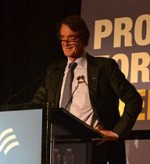
    Racist Jim Ratcliffe
    Ratcliffe the racist. Image courtesy of Wikimedia Commons.
    After the revelations in the news this week, it’s a fair comment to say that ‘Sir’ Jim Ratcliffe has more money than brain cells. Indeed he has so much money that he is no longer resident in the Untied Kingdom and has moved to Monte Carlo, the historic sunny place for shady people, to spend time with substantially more of his money due to the micro-state’s generosity to the super rich in matters fiscal.

    However, having a view of the Côte d’Azur has not prevented him from having some vile, bigoted views of what’s happening north of the English Channel.

    In an interview earlier this week with Sky News, the ‘businessman‘ and minority shareholder in Manchester United remarked that the UK has been “colonised by immigrants“, as well as having a swipe at those unfortunate enough to be forced to claim Blighty’s less than generous state benefits.

    His racism drew criticism not only from just from the country’s political elite, but also from his club Manchester United’s own football fans.

    Outside Old Trafford itself, the following billboard subvertisement has appeared according to your ‘umble scribe’s social media timeline, with a billboard outside Old TRafford being subvertised with the slogan: “Immigrants have done more for this city than billionaire tax dodgers ever will“.

    One day later, Ratcliffe issued the by now standard non-apology, stating “sorry that my choice of language has offended some people in the UK and Europe and caused concern“, i.e. if you were offended by my choice of language, that’s entirely your own fault and not mine.

    Commenting on Ratcliffe’s remarks, today’s Guardian editorial states: “Normalising inflammatory language which presents migrants as hostile invaders does not enhance the possibility of civilised discussion. It contributes to the rise of everyday racism and xenophobia on the UK’s streets.”

  • Additional Barton Hill litter pick this Saturday

    Last Saturday our community litter pick team in Barton Hill held its regular monthly event. removing 6 bags of waste and recyclable materials – plus a load of bulky grot – from Ducie Road car park.

    Eric, Ronit and Alex pose with the rubbish removed from Ducie Road car park
    Eric, Ronit and Alex pose with the rubbish removed from Ducie Road car park

    However, that was not the only litter pick planned for Barton Hill this month

    Next Saturday is St Valentine’s Day and Barton Hill residents are being invited to ‘love their community‘ in a series of events planned by Barton Hill Activity Club, Bristol Somali Resource Centre, Travelling Light Theatre and Wellspring Settlement.

    One of the off-site events planned is a litter pick of both Gaunts Ham Park and the Urban Park. Those wishing to help are asked to assemble at the Wellspring Settlement at 12 noon for an hour of spring cleaning before retiring for tea and cake.

    Organiser Harriet has asked people to bring along their own picker if they have one. Hi-vis clothing, gloves and bags will be provided.

    See you there!

  • French raid X offices

    X/Twitter logoThe Paris Public Prosecutor’s office has today issued the press release in English below concerning a visit by its own officers and those of other agencies to the offices of the right-wing propaganda machine masquerading as a social media platform X.com, which was known as Twitter before its acquisition by far-right man-baby Elon Musk.

    A search is being carried out today at the French premises of the X platform, as part of the investigation opened in January 2025 by the cybercrime section of the Paris prosecutor’s office, with the UNCyber unit of the gendarmerie and in the presence of Europol.

    In parallel, summonses for voluntary interviews on April 20, 2026, in Paris, were sent to Mr. Elon Musk and Ms. Linda Yacarino, in their capacity as de facto and de jure managers of Platform X at the time of the events. Employees of Platform X are also summoned during the week of April 20-24, 2026, to be heard as witnesses. The voluntary interviews of the managers are intended to allow them to present their position on the events and, where applicable, the compliance measures envisaged.

    The conduct of this investigation is, at this stage, part of a constructive approach, with the objective of ultimately ensuring Platform X’s compliance with French law, insofar as it operates within the national territory.

    As a reminder, this investigation was opened following two reports received on January 12, 2025. On July 9, 2025, the Paris Public Prosecutor’s Office entrusted the investigation to the Directorate General of the National Gendarmerie (DGGN). The investigation was expanded following further reports denouncing Grok’s operations on the X platform, which led to the dissemination of Holocaust denial content and sexually explicit deepfakes.

    The investigations concern the following criminal offenses:

    • complicity in the possession of child pornography images of minors a © complicity in the organized distribution, offering, or making available of child pornography images of minors
    • violation of the right to privacy (sexually explicit deepfakes)
    • denial of crimes against humanity (Holocaust denial)
    • fraudulent extraction of data from an automated data processing system by an organized group
    • falsification of the operation of an automated data processing system by an organized group
    • Administration of an illegal online platform by an organized group.

    Elon Musk issued a typically petulant response to the action, calling it a “political attack“. If there’s any attack, Mr Musk, it concerns your platform’s lax attitude to responsibility.

    Furthermore, Musk was corrected in no uncertain terms by the French Ministry of Foreign Affairs account on X, which replied as follows:

    Tweet from Musk reads This is a political attack. French Foreign Ministry responds Investigating child sexual abuse material isn’t controversial. Turning it into political theater is manipulation. Maybe that logic flies on some island. Doesn’t fly in France.

    Your ‘umble scribe wonders if the French reference to “some island” is a less than subtle dig atMusk’s expression of interest in visiting paedophile Jeffrey Epstein’s child abuse island.

    In contrast to the muscular approach taken by the French, the UK Information Commissioner’s Office (ICO) has opened a formal inquiry into X and xAI over whether Elon Musk’s companies have complied with data protection law after the Grok AI tool was used to generate sexual deepfake images without consent.

  • A nightmare at the movies

    A new ‘documentary’ film is currently being shown in cinemas across the United States. Entitled Melania, it documents the life of Melania Knauss Trump, the first lady of the United States, in the twenty days before the second presidential inauguration of her husband, the disgraced 45th and current disgraceful 47th President of the United States, adjudicated sexual predator, condemned business fraudster, convicted felon and compulsive liar, one Donald John Trump (who is on a personal quest to Make America Grate Again or something similar. Ed.).

    According to The Guardian, Amazon MGM Studios bought the rights to the film for $40m – which reportedly included a considerable sum to the subject of the film (no surprise there! The whole tRump family are high gains grifters. Ed.) – and is spending $35m on a global marketing push. This spend has so far been mostly in the US, with TV spots, billboards and a takeover of Las Vegas’s immersive events venue The Sphere.

    However, the film is not proving popular either with the public or the critics. As regards the latter, this might just be due to the mainstream press not being invited by Amazon the the premiere at the Kennedy Center.

    The exclusion of the Fourth Estate may also explain the dire reviews the film has been receiving, such as the one below ascribed to Variety, although Yahoo News suggests this could be a misattribution.

    Post reads Best review ever. On the Netflix Melania “documentary”:
'If they showed this film on a plane, people would still walk out.' -Variety

    What is more, it’s not just film critics that have been drawing attention to the film’s awfulness. Members of the public reviewing it on IMDb have given it an average score of 1.3 out of ten.

    However, this criticism is quite mild compared with the defaced bus stop poster portrayed below, which prompts ypour ‘umble scribe to ask when exactly will the so-called Epstein Files be released in full?

    Bus stop poster for film with addendum My husband fucks kids

    Update 31/01/2026: Another tranche of the Epstein Files was released yesterday, with at least one wag on social media suggesting the files’ release was intended to distract from from the Melania documentary.

    Post reads Can't believe they released the Epstein files to cover up for the Melania movie.

    Update 03/02/2026: The film continues to get panned, as revealed by this social media post referring to a recent review in The Grauniad.

    Post reads Brutal correction on the Guardian’s review of Melania: “The star rating for this film was corrected on 2 February 2026. A formatting issue led an earlier version to be awarded one star, when the reviewer’s intention was zero”
  • Irish language to have equal status with English during Irish EU presidency

    Ireland coat of armsThe presidency of the Council of Ministers rotates between the European Union’s member states every six months. The presidency is currently occupied by Cyprus until 30th June 2026.

    On 1st June 2026 the presidency switches to Ireland, which has announced that for the first time in its membership of the organisation, the Irish language will have equal status with English during its presidency.

    Irish is recognised by the Constitution of Ireland as the national and first official language of the Republic of Ireland (English being the other official language). However, in spite this, almost all government business and legislative debate is conducted in English.

    According to the Irish Times piece, all official documents, policy programmes and press releases will be in Irish and English, while content on the Irish presidency website will be available in Irish, English and French.

    Furthermore, the Irish government has also given a commitment that content requiring immediate publication, such as European Council decisions, will be published simultaneously in Irish and English where feasible and within a very short period of each other, if not, with the aim of ensuring that Irish has close to equal status to English during the six-month term of the presidency.

    The commitment to the Irish language even extends to encouraging the use of Irish at all formal council meetings in Brussels and Luxembourg and during informal meetings in Ireland.

    The Irish EU presidency will also feature cultural programmes involving Irish language literature, arts and music. This programme will be co-ordinated by Culture Ireland in consultation with the Department of the Gaeltacht.

    Whereas Irish used to be the first language of the majority of Ireland’s population before the 20th century, its usage has since declined considerably. According to Wikipedia, the total number of people (aged 3 and over) in Ireland who declared they could speak Irish in April 2022 was 1,873,997, representing 40% of respondents, but of these, 472,887 said they never spoke it and a further 551,993 said they only spoke it within the education system.Linguistic analyses of Irish speakers are therefore based primarily on the number of daily users in Ireland outside the education system, which in 2022 was 20,261 in the Gaeltacht and 51,707 outside it, totalling 71,968.

  • EU Commission investigates Grok and X under DSA

    EU Commission logoThe European Commission has today announced a new formal investigation against X (the conduit of hate alleged social media platform formerly known as Twitter. Ed.) under the Digital Services Act (DSA). In parallel, the Commission extended its current investigation launched in December 2023 into X’s compliance with its recommender systems risk management obligations.

    The new investigation will examine whether the company properly assessed and mitigated risks associated with the deployment of Grok’s functionalities into X in the EU, including risks related to the dissemination of illegal content in the EU, such as manipulated sexually explicit images, including child sexual abuse material.

    These risks seem to have materialised, exposing EU citizens to serious harm. Consequently, the Commission will further investigate whether X complies with its DSA obligations to:

    • Diligently assess and mitigate systemic risks, including of the dissemination of illegal content, negative effects in relation to gender-based violence and serious negative consequences to physical and mental well-being stemming from deployments of Grok’s functionalities on its platform;
    • Conduct and transmit to the Commission an ad-hoc risk assessment report for Grok’s functionalities in the X service with a critical impact on X’s risk profile prior to their deployment.

    Furthermore, the Commission has extended its continuing formal proceedings initiated against X in December 2023 to determine if X has properly assessed and mitigated all systemic risks (as defined in the DSA) associated with its recommender systems, including the impact of its recently announced switch to a Grok-based recommender system.

    If proven, these failures would constitute infringements of Articles 34(1) and (2), 35(1) and 42(2) of the DSA. The Commission will now carry out an in-depth investigation as a matter of priority. The opening of formal proceedings does not prejudge its outcome.

    In the run-up to this investigation, the Commission has closely collaborated with Coimisiún na Meán, the Irish Digital Services Coordinator. In addition, Coimisiún na Meán will be associated with this investigation pursuant to Article 66(3) as the national Digital Services Coordinator in the EU country where X is based.

    The opening of formal proceedings empowers the Commission to take further enforcement steps, such as adopting a non-compliance decision. The Commission is also empowered to accept any commitment made by X to remedy the matters subject to the proceeding.

Posts navigation