tech

  • EU Commission investigates Grok and X under DSA

    EU Commission logoThe European Commission has today announced a new formal investigation against X (the conduit of hate alleged social media platform formerly known as Twitter. Ed.) under the Digital Services Act (DSA). In parallel, the Commission extended its current investigation launched in December 2023 into X’s compliance with its recommender systems risk management obligations.

    The new investigation will examine whether the company properly assessed and mitigated risks associated with the deployment of Grok’s functionalities into X in the EU, including risks related to the dissemination of illegal content in the EU, such as manipulated sexually explicit images, including child sexual abuse material.

    These risks seem to have materialised, exposing EU citizens to serious harm. Consequently, the Commission will further investigate whether X complies with its DSA obligations to:

    • Diligently assess and mitigate systemic risks, including of the dissemination of illegal content, negative effects in relation to gender-based violence and serious negative consequences to physical and mental well-being stemming from deployments of Grok’s functionalities on its platform;
    • Conduct and transmit to the Commission an ad-hoc risk assessment report for Grok’s functionalities in the X service with a critical impact on X’s risk profile prior to their deployment.

    Furthermore, the Commission has extended its continuing formal proceedings initiated against X in December 2023 to determine if X has properly assessed and mitigated all systemic risks (as defined in the DSA) associated with its recommender systems, including the impact of its recently announced switch to a Grok-based recommender system.

    If proven, these failures would constitute infringements of Articles 34(1) and (2), 35(1) and 42(2) of the DSA. The Commission will now carry out an in-depth investigation as a matter of priority. The opening of formal proceedings does not prejudge its outcome.

    In the run-up to this investigation, the Commission has closely collaborated with Coimisiún na Meán, the Irish Digital Services Coordinator. In addition, Coimisiún na Meán will be associated with this investigation pursuant to Article 66(3) as the national Digital Services Coordinator in the EU country where X is based.

    The opening of formal proceedings empowers the Commission to take further enforcement steps, such as adopting a non-compliance decision. The Commission is also empowered to accept any commitment made by X to remedy the matters subject to the proceeding.

  • Danish shoppers get app to help them avoid US products

    German news website heise.de reports that a new app is available for Danish consumers to help avoid buying US consumer products in the wake of the efforts of the disgraced 45th President and disgraceful current 45th President of the United States, adjudicated sexual predator, condemned business fraudster, convicted felon and compulsive liar, one Donald John Trump (who is on a personal quest to Make America Grate Again or something similar. Ed.), to acquire the autonomous Danish territory of Greenland on spurious national security grounds.

    A wave of protest in Denmark gave rise to a Facebook group “Boycott goods from the USA“, in which some 100,000 Danes exchange ideas about how best to avoid American products. To put its membership into perspective, Denmark has around six million inhabitants.

    Although it is only available at present for Apple phones, an Android version is promised for the near future.

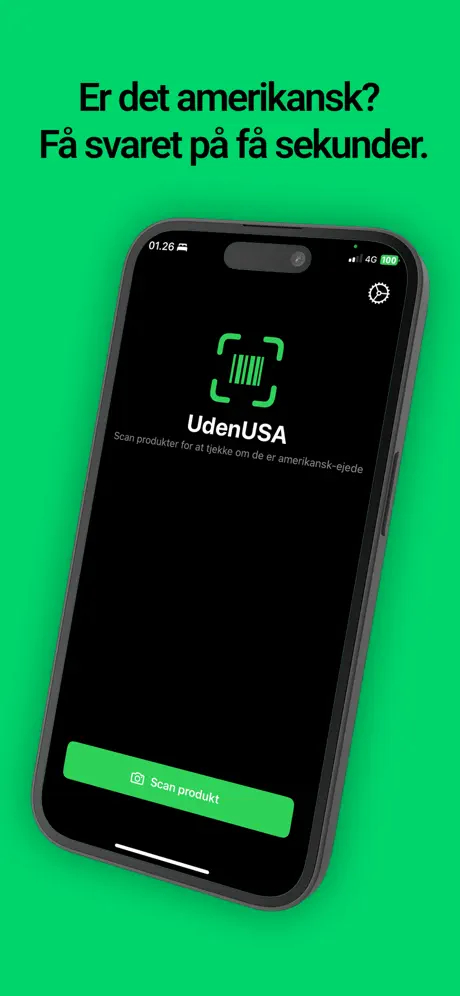
    Screenshot of UdenUSA app on phone
    Is it American? Get the answer in seconds

    According to the app store blurb:

    UdenUSA helps you identify and avoid American products in your everyday life. With our intuitive scanning function, you can easily check whether a product is American-owned and find Danish alternatives.

    Furthermore, app developer Pipper told the DPA press agency: “We noticed that it was important for many people to avoid food from the USA. But it’s not always so easy to recognise them in the supermarket.

    The app is provided in two versions – a free version which allows users to scan 2-5 products per day and a subscription version for bulk purchases, which costs DKr. 19.00 per month.

    The developer’s website also pointedly asks visitors ‘Are you supporting Trump when you shop?

    The Irish Times also points out that the app is not without a few geeky touches. Users who scan a product using their camera phone are then confronted with the message: “Now hacking into the Pentagon … no, wait, don’t worry.

  • The seven deadly sins in the tech age

    According to the Catholic version of Christianity, there are seven deadly sins, i.e. pride, greed, wrath, envy, lust, gluttony, and sloth. Although they are not explicitly listed in the Bible, they developed within early Christian theological tradition. Furthermore, Psychology Today speculates that their origins ‘are nebulous and likely trace back to before Hellenistic Greece‘, even though if offers no source for such an assertion. All evidence of their orin tends to point to the early Christian era and more specifically Evagrius Ponticus, a monk in fourth century Egypt.

    These seven transgressions are also known as cardinal sins, although whether this alternative naming is derived from the sinning scarlet-garbed clergy committing them is not well documented. This naming is likely derived from the other definition of cardinal, i.e. fundamental, of the greatest importance (think the cardinal points of the compass. Ed.).

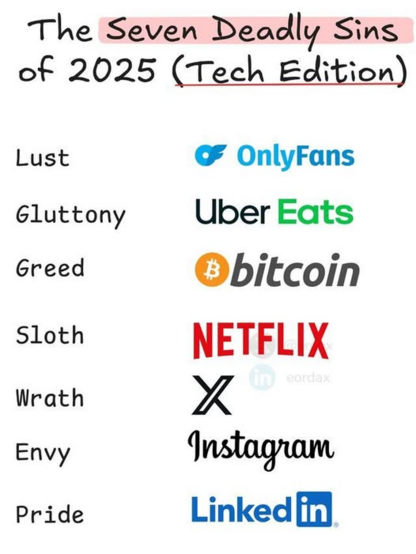
    Anyway, a new revision of the seven deadly sins has been posted on social media updated for the early 21st century and it bears a distinctly technological character.

    Graphic showing modern tech expressions of the seven deadly sins - Lust by Only Fans, gluttony by Uber Eats, greed by Bitcoin, sloth by Netflix wrath by x/Twitter and envy by Instagram.

    Is this an accurate rendition? Have your say below in the comments.

  • Meta must grant EU users full access to their data

    New logo as Facebook morphs into MetaAustria’s Der Standard reports that Meta, the parent company of both Facebook and Instagram, must grant European Union users full access to all their personal data within 14 days. The Austrian Supreme Court (OGH) ruled so on Thursday 19th December, according to the Vienna-Based data protection organisation noyb. The lawsuit was filed in 2014 by noyb founder Max Schrems.

    Schrems, an Austrian lawyer and data protection activist, started attempting to gain full access to his personal data stored by Meta in 2011. According to a press release from noyb, the company merely referred those affected to a “download tool” and its general privacy policy.

    14 days term

    According to a press release from the data protection authorities, the OGH has now ruled that Meta must disclose all personal data and provide information about this data, such as the source, recipients and purpose of the processing, within 14 days – i.e. by 31st December 2025.

    The court also found that Meta had unlawfully collected data from third-party apps and websites, according to a press release. Personalised advertising may only be shown with the explicit consent of the individuals concerned. Meta must also ensure that sensitive data is not processed together with other data.

    The case was heard three times before the OGH and twice before the European Court of Justice over the past eleven years. Schrems has been awarded €500 in compensation.

    Situation has changed

    Meta has told Reuters that it had taken note of the ruling. However, it referred to the situation as it existed at the time the lawsuit was filed. Meta stated that it no longer uses sensitive data for personalised advertising. EU users can now also use Facebook and Instagram for free with personalised or less personalised advertising or pay a subscription to prevent their data from being used for advertising purposes.

    In December 2025 the EU competition authorities approved Meta’s proposal to use less personal data under this pay-or-consent model.

  • Time to ditch Microsoft 365

    Microsoft has recently announced it is raising the price of its Microsoft 365 offering from July 2026.

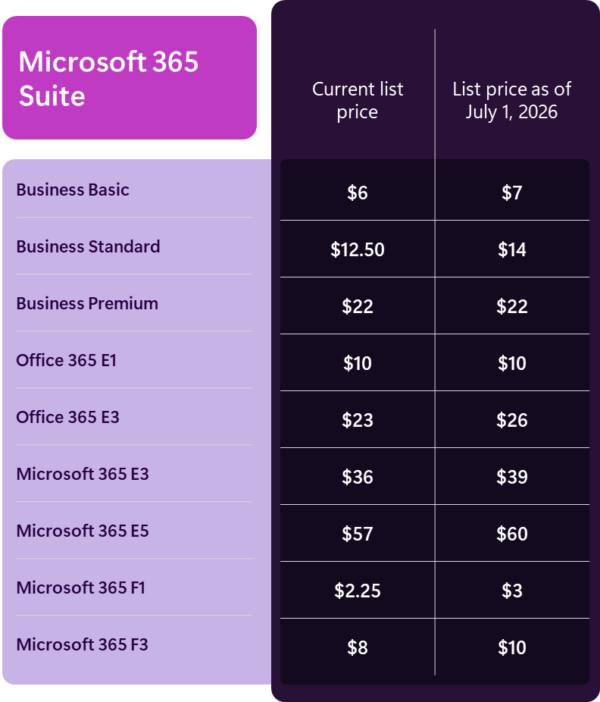
    The new pricing for using Microsoft 365 will be applicable worldwide and as follows.

    Microsoft's pricing for the various MS 365 products from 1st July 2026
    Image courtesy of Microsoft

    Many people will no doubt be considering alternatives to this Microsoft subscription services to help keep business costs in check.

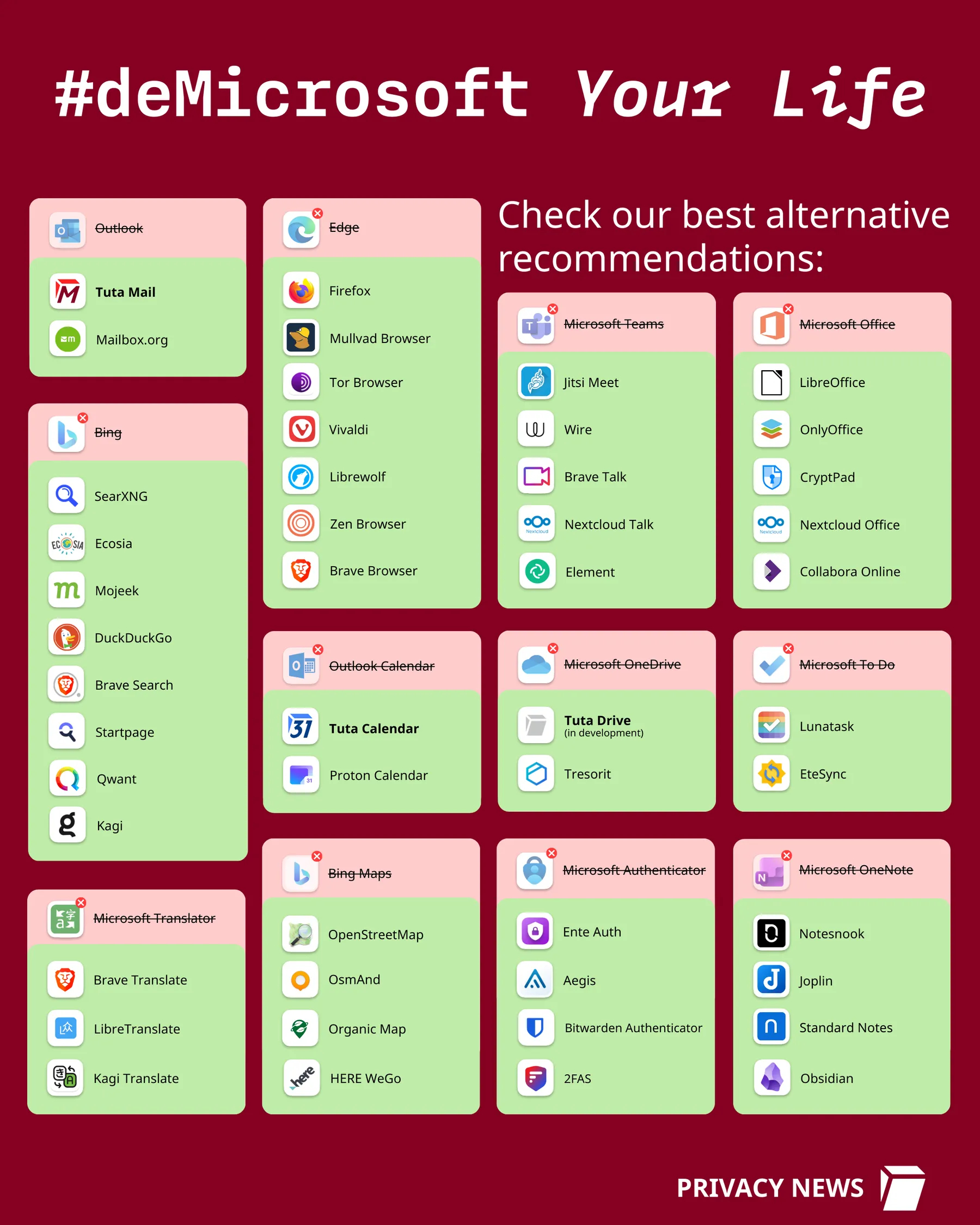
    Fortunately, many free and open source alternatives to the services provided by Microsoft 365 are available, work just as well and won’t cost users a penny. Email provider Tuta.com (recommended! Ed.) has kindly provided a useful summary under the deMicrosoft your life banner which is shown below should you consider ditching Redmond’s overpriced office offering and its other software.

    Free and open source alternatives to Microsoft products
    Click on the image for the full-sized version
  • EU Commission launches yet another investigation into a US tech giant

    EU flagAfter fining X €120 mn. last month for breaching the transparency obligations of the Digital Services Act, the European Commission has announced it has initiated a formal anti-trust investigation to assess whether Google has breached EU competition rules by using the content of web publishers and content uploaded to YouTube, for artificial intelligence (‘AI’) purposes.In particular, the investigation will examine whether Google is distorting competition by imposing unfair terms and conditions on publishers and content creators or by granting itself privileged access to such content, thereby disadvantaging the developers of rival AI models.

    The Commission is concerned that Google may have:

    • Used the content of web publishers to provide generative AI-powered services (‘AI Overviews’ and ‘AI Mode’) on its search results pages without appropriate compensation and without offering them the possibility to refuse such use of their content. AI Overviews shows AI-generated summaries responsive to a user’s search query above organic results, while AI Mode is a search tab similar to a chatbot answering users’ queries in a conversational style. The Commission will investigate to what extent the generation of AI Overviews and AI Mode by Google is based on web publishers’ content without appropriate compensation for that, and without the possibility for publishers to refuse without losing access to Google Search. Indeed, many publishers depend on Google Search for user traffic, and they do not want to risk losing access to it.
    • Utilised video and other content uploaded on YouTube to train Google’s generative AI models without appropriate compensation to creators and without offering them the opportunity to reject such use of their content. Content creators uploading videos to YouTube are obliged to grant Google permission to use their data for different purposes, including training generative AI models. Google does not remunerate YouTube content creators for their content, nor does allow them to upload their content on YouTube without allowing Google to use such data. At the same time, rival developers of AI models are barred by YouTube policies from using YouTube content to train their own AI models.

    If proven, the practices under investigation may breach EU competition rules that prohibit the abuse of a dominant position (Article 102 of the Treaty on the Functioning of the European Union (‘TFEU’)) and Article 54 of the European Economic Area (‘EEA’) Agreement.

    Commenting on the launch of the investigation, Teresa Ribera, Executive Vice-President for Clean, Just and Competitive Transition remarked as follows:

    A free and democratic society depends on diverse media, open access to information, and a vibrant creative landscape. These values are central to who we are as Europeans. AI is bringing remarkable innovation and many benefits for people and businesses across Europe, but this progress cannot come at the expense of the principles at the heart of our societies. This is why we are investigating whether Google may have imposed unfair terms and conditions on publishers and content creators, while placing rival AI models developers at a disadvantage, in breach of EU competition rules.
  • Evolution

    Life forms are not the only things that undergo evolution, i.e. a change in characteristics over generations and/or time.

    This is also true of technology. One only has to compare and contrast one’s present operating system and its applications and what was in use twenty years ago, for example.

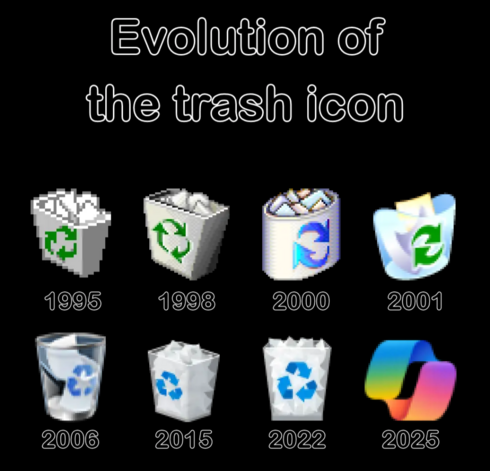
    That brings us neatly to the graphic below acquired from social media, which sarcastically tracks the progress of the trash icon on Microsoft’s Windows desktop over the decades.

    Evolution of the trash icon through various Windows releases and ending with the Copilot AI icon

    For those unfamiliar with the final icon on the bottom right, it’s that of MS’ Copilot generative artificial intelligence chatbot, which has not been without criticism. Indeed, one Microsoft Tech Community post has even called the software a “frustrating flop in AI-powered productivity“.

    More specifically, the post states:

    Here’s the problem: when you ask Copilot to alter a document, modify an Excel file, or adjust a PowerPoint presentation, it’s practically useless. Instead of performing the tasks as requested, it often leaves you hanging with vague suggestions or instructions. Users don’t want to be told how to perform a task—they want it done. This is what an AI assistant should do: execute commands efficiently, not just offer advice.

    If the MS tech enthusiasts are less than impressed, your ‘umble scribe need say no more!

  • Commission eyes up Microsoft and Amazon – again

    EU flagLast week the EU Commission announced it had opened three market investigations into cloud computing services under the Digital Markets Act (DMA). Two of these investigations will assess whether Amazon and Microsoft should be designated as gatekeepers for their cloud computing services, Amazon Web Services and Microsoft Azure under the DMA, i.e. whether they act as important gateways between businesses and consumers, despite not meeting the DMA gatekeeper thresholds for size, user number and market position. The third market investigation will assess if the DMA can effectively tackle practices that may limit competitiveness and fairness in the cloud computing sector in the EU.

    sticker text reads there is no cloud just other people's computers
    Market investigations into Amazon Web Services and Microsoft Azure

    Recent analyses of cloud markets seem to indicate that tMicrosoft Azure and Amazon Web Services occupy very strong positions in relation to businesses and consumers. The Commission will also assess if certain features of the cloud sector may further reinforce the position of Microsoft Azure and Amazon Web Services.

    If the Commission finds that Microsoft Azure and Amazon Web Services qualify as important gateways under the DMA, these would be added to the list of core platform services for which Amazon and Microsoft have already been designated as gatekeepers.

    Market investigation on the DMA’s application to cloud markets

    Furthermore, the Commission is also gathering information from relevant market players to assess whether the current obligations under the DMA are effective in addressing practices that limit competitiveness or are unfair in the cloud sector. Amongst other things, the investigation will cover obstacles to interoperability between cloud computing services, limited or conditioned access for business users to data, tying and bundling services and potentially unfair contractual terms.

    Next Steps

    Should the Commission conclude Microsoft and Amazon meet the criteria to be designated as gatekeepers for their cloud computing services under the DMA, Amazon and Microsoft would have six months to ensure full compliance of their designated cloud computing services with the DMA obligations.

    The market investigation on the DMA’s application to cloud markets will result in a final report to be published within 18 months, which may propose the update of DMA obligations in respect to cloud by way of a delegated act pursuant to Article 12 and 49 DMA.
  • Core VLC developer receives European SFS Award 2025 at SFSCON

    VLC logoThe VLC media player is a great piece of software which your ‘umble scribe has been using since he was rookie on Windows 9* machines

    What makes it greater is that it’s open source software and is one of the recommendations on my free and open source software page.

    It’s just been announced that the Free Software Foundation Europe (FSFE) and the Linux User Group Bolzano-Bosen-BUlsan (LUGBZ) have presented VLC president and core developer Jean-Baptiste Kempf with the European SFS award at the Bozen Free Software Conference (SFSCON) for his long-term dedication to the project. What began as a student initiative has, through his continuous effort, evolved into one of the most widely used media players with hundreds of millions of users worldwide.

    Jean-Baptiste Kempf  receives his award.
    Picture by NOI Techpark – Marco Parisi CC-BY-SA 4.0.

    Born as a student project in 1996, this software has evolved into an essential, all-in-one media player that plays almost anything effortlessly. Originally a simple network streaming client, it has grown into a powerful universal media player that continues to evolve and impress.

    For many people running non-free operating systems, it was the very first Free Software they ever installed. For many people running Free Software, it saved them from installing and booting into a proprietary operating system”, declared FSFE president Matthias Kirschner during the award ceremony.

    Jean-Baptiste Kempf joined the project as a student and when it was in danger of dying after the graduation of its original developers, he took the reins. With the help of other core developers, he transformed it into the indispensable media player we enjoy on today.

    Over the years, Mr Kempf has become not only the president of VideoLAN, which hosts the project itself, but also one of the lead developers of VLC media player and the founder of VideoLabs. “It’s small, fast, friendly, and seems to understand everything you throw at it. I have always thought of it as the program that eats everything”, said Raphael Barbieri, a member of LUGBZ, during the winner’s announcement.

    Accepting the award, Mr Kempf said: “I am extremely honoured to receive the European SFS Award. The Free Software multimedia community is quite niche and unknown, but we work hard so that video content can be free, can be played and processed. The work done around the VideoLAN community has been tremendous, despite its little resources. I want to thank the whole VideoLAN and FFmpeg teams, who spend their time on those projects, often with little recognition“.

    The European SFS Award recognizes individuals whose work has made a significant and sustained difference in advancing Free Software across Europe. Since 2023 it has been presented jointly by LUGBZ and the FSFE and honours those whose efforts strengthen software freedom, community building and the ethical foundations of technology.

  • Australia initiates consumer protection proceedings against Microsoft

    Microsoft 365 ;ogoThe Australian Competition & Consumer Commission, which is responsible for ensuring individuals and businesses comply with Australian competition and consumer protection laws has announced that it has initiated proceedings in the Federal Court against Microsoft Australia and its parent company Microsoft Corporation for allegedly misleading approximately 2.7 million Australian customers when giving notice of subscription options and price increases after it integrated its Copilot AI assistant into Microsoft 365 subscription plans.

    The ACCC alleges that since 31st October 2024, Microsoft has told Microsoft 365 Personal and Family plan subscribers with auto-renewal enabled that to maintain their subscription, they must accept the integration of Copilot and pay higher prices for their plan, or else cancel their subscriptions.

    Copilot logoFollowing the integration of Copilot, the annual subscription price of the Microsoft 365 Personal plan increased by an eye-watering 45% from $109 to $159. In contrast, the annual subscription price for the Microsoft 365 Family plan increased by a mere 29% from $139 to $179.

    Microsoft’s communications with subscribers did not refer to the existence of the “Classic” plans without Copilot integration and the only way subscribers could access them was to begin the process of cancelling their subscriptions. This involved accessing the subscriptions section of their Microsoft account and selecting “Cancel subscription”. It was only on the following page that subscribers were given the option to move to the Classic plan instead.

    MS cancel subscription screenshot
    Click on the image for the full-sized version

    Maximum penalties

    Should Microsoft lose the case, the maximum penalty for each breach of the Australian Consumer Law is the greater of the following three options:

    • $50 million;
    • three times the total benefits that have been obtained and are reasonably attributable; or
    • if the total value of the benefits cannot be determined, 30 per cent of the corporation’s adjusted turnover during the breach turnover period.

    For Microsoft Australia, not to mention its parent company, the emphasis in the word consumer is firmly on its first three-letter syllable.

Posts navigation