Steve Woods

Written by a human.

  • Parking meters arrive in Easton

    On 1st April – April Fool’s Day – Bristol City Council’s Easton & St Philips Residents’ Parking Scheme comes into operation. (Some would consider the choice of date most apposite. Ed.)

    road sign announcing works for Easton RPZ
    Does Easton have one resident? Do you proof-read your signs, Bristol City Council?
    This is just one of many Residents’ parking schemes being introduced by the council at the instigation of the autocratic elected Mayor, George Ferguson, the man in red trousers (posts passim).

    Needless to say, the schemes haven’t exactly received universal support from the residents of a city with a high level of car ownership and an abysmal level of public transport provision. Overall, it’s been condemned by residents as a ‘parking tax’ as residents will have to acquire permits, both for their own vehicles, as well as for visitors arriving by motor vehicle.

    There has been consultation, of course. However, as is usual with Bristol City Council, consultation is a portmanteau word, a crafty elision of ‘confidence trick’ and ‘insult’. With a city council consultation, the stress is always firmly on the first syllable. When something goes out to consultation, what the council wants to do is usually a fait accompli.

    There have been howls of protest about the Residents’ Parking Schemes in the local press, particularly the car-loving Bristol Post, which has even enlisted the odd high-profile petrolhead to trash the Mayor’s plans.

    image of parking meter on Stapleton Road
    A new parking meter on Stapleton Road
    As this post is being written, the streets of Easton are being prepared for the arrival of the new parking regime. New double yellow lines and parking bays marked on the streets. In addition, there’ll be parking charges for visitors and parking meters have started to make their appearance both on main thoroughfares like Stapleton Road and the backstreets.

    Bristol’s residents’ parking schemes programme is very flawed.

    One of the justifications for implementing them is to dissuade the thousands of daily commuters from outside the local authority area clogging up residential roads by parking there all day. As the scheme doesn’t cover the whole city, the thousands of commuting motorists will just park a bit further out in districts not covered by residents’ parking schemes, such as the area where your ‘umble scribe happens to live.

    Where I live, it’s the residents that are guilty of problem parking; the streets are Victorian, narrow and were intended for use by horse and cart, not 21st century motor vehicles. Pavement parking is rife in the backstreets, making pavements impassable to wheelchair users and parents with children in prams and pushchairs. There’s minimal enforcement to combat such anti-social parking. Indeed, the police often contribute to the problem themselves (posts passim).

    If Mayor Ferguson really wanted to stop Bristol being choked by out of town commuting motorists, his counterpart in London came up with an alternative that was introduced 11 years ago. It’s called the London Congestion Charge Zone.

  • Powerful virus targets Ukraine

    malware symbolFrance’s Le Monde reports that a very powerful computer virus has infected computers in Ukraine, where 22 instances of infection has been recorded since 2013, the year that country’s political crisis started, according to a report from BAE Systems.

    This virus, baptised Snake, but also known as Ouroboros after the serpent in Greek mythology, is “one of the most sophisticated and persistent threats that we track,” states BAE Systems Applied Intelligence, in a report published on Friday, 7th March.

    Although it appeared as early as 2006, Snake appears to have been deployed more aggressively since 2013, according to the same source: of the 56 instances identified since 2010 throughout the world, 44 have been recorded since last year. Ukraine is the main target with 22 instances since 2013, of which 14 alone have been confirmed since the start of 2014 when that country’s political crisis accelerated with the fall of its pro-Russian president at the end of February.

    Lithuania, Britain and Georgia are amongst the other countries where Snake has also shown up.

    Snake’s operators act on weekdays and operate mainly from a time zone corresponding to Moscow, BAE Systems states. “Our report shows that a technically sophisticated and well-organised group has been developing and using these tools for the last eight years,” said David Garfield, the managing director of cyber security at BAE Systems Applied Intelligence.

    “There is some evidence that links these tools to previous breaches connected to Russian threat actors but it is not possible to say exactly who is behind this campaign.”

    Snake’s controllers can access all of the computer systems they have infiltrated, in addition to which the virus’ capacity to hibernate by remaining completely inactive for many days makes its detection complex.

    According to Saturday’s Financial Times (paywall), the virus has in particular infiltrated the Kiev government’s computer systems and those of major Ukrainian organisations.

  • Sausages!

    pack shot of sausagesToday for breakfast I indulged in some sausages; not just any sausages, but Sainbury’s Outdoor Bred Pork Sausages. They were delicious and disappeared off the plate in double-quick time.
    However, there was one thing that stuck in my throat: the product name.

    Can inanimate objects – even ones made of once living matter – breed?

    If so, I should congratulate Sainbury’s on this fine achievement in the field of al fresco coitus? If not, should I condemn their marketing department for coming up with an idiotic product name that’s a complete physical impossibility?

    Digging further into this term, it is apparent that Sainsbury’s are not the only sinners here, as a quick image search for “outdoor bred” sausages will reveal. Moreover, if I had my way, Tesco, Waitrose, Rankin, Morrison’s, Marks & Spencer, Asda and many more suppliers should all be standing in the corner of the room with Sainsbury’s trying on the dunce’s hat for size. ๐Ÿ™‚

    Nevertheless, my suggesting that all these corporate grocers are a bunch of illiterates is perhaps being a bit hasty and an over-reaction. Time for some final research.

    Consulting the Good Housekeeping Institute’s site, I find that outdoor bred actually has a specific meaning in food labelling terms, as follows:

    As with Outdoor Reared, this tends to apply to pork and means the pigs are born outside. However, after a few weeks theyโ€™re brought inside for fattening.

    So, outdoor bred is a proper food labelling term, although I do wish people would think more clearly about the connotations of naming products.

  • Tor network used to hide botnets and darknets

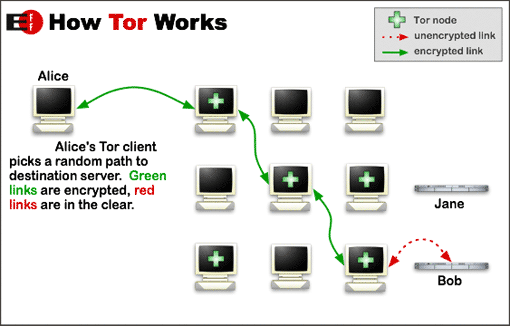
    According to IT security vendors Kaspersky Lab, the Tor anonymity network is under threat of being swamped by criminals abusing the anonymity it provides for hiding zombie networks, malicious command and control servers and ‘darknets’, Le Monde Informatique reports.

    How to works diagram

    Tor – otherwise known as The Onion Router – has always had its dark side, but last year the network’s use by criminals seems to have grown appreciably. According to researcher Sergey Lozhkin, “Kaspersky Lab had uncovered evidence of 900 services using Tor, equivalent to 5,500 nodes (server relays) and 1,000 exit nodes (servers from which traffic emerges) in total.”

    “It all started from the notorious Silk Road market and evolved into dozens of specialist markets: drugs, arms and, of course, malware.

    “Carding shops are firmly established in the Darknet. Stolen personal info is for sale with a wide variety of search attributes like country, bank, etc. Offers for customers of this kind are not limited to credit cards. Dumps, skimmers and carding equipment are for sale too”, he added.

    “In addition, command and control (C&C) servers hosted by Tor are more difficult to flush out, blacklist or eliminate,” Lozhkin continued. “Although creating a Tor communication module within a malware sample means extra work for the malware developers. We expect there will be a rise in new Tor-based malware, as well as Tor support for existing malware.”

    Experts from Kaspersky Lab have so far found Zeus with Tor capabilities and then detected ChewBacca and finally analysed the first Tor Trojan for Android.

  • Spring’s golden heralds

    It’s a bright, sunny day in Bristol and there’s a hint of spring in the air. In addition, the daffodils are out in their brazen glory, like these fine examples planted by Bristol City Council in Castle Park.

    daffodils in Castle Park

    Along with the blossom of the cherry, in honour of which A.E. Housman wrote “Loveliest of Trees” (posts passim), daffodils are another spring favourite celebrated in poetry, in this case William Wordsworth‘s “I Wandered Lonely as a Cloud”.

    I wandered lonely as a cloud
    That floats on high o’er vales and hills,
    When all at once I saw a crowd,
    A host, of golden daffodils;
    Beside the lake, beneath the trees,
    Fluttering and dancing in the breeze.

    Continuous as the stars that shine
    And twinkle on the milky way,
    They stretched in never-ending line
    Along the margin of a bay:
    Ten thousand saw I at a glance,
    Tossing their heads in sprightly dance.

    The waves beside them danced; but they
    Out-did the sparkling waves in glee:
    A poet could not but be gay,
    In such a jocund company:
    I gazed–and gazed–but little thought
    What wealth the show to me had brought:

    For oft, when on my couch I lie
    In vacant or in pensive mood,
    They flash upon that inward eye
    Which is the bliss of solitude;
    And then my heart with pleasure fills,
    And dances with the daffodils.

  • Addio XP

    It’s not just the Bristol & Bath Linux User Group (LUG) that’s organising an event to mark the end support for Microsoft’s superannuated Windows XP operating system (posts passim).

    In Italy a consortium of the Perugia GNU/Linux User Group, LibreUmbria, the Perugia Centro di Competenza Open Source and Girl Geek Life is also organising a half-day event to inform people that they don’t need to buy a new computer to have a modern, secure operating system again; all that’s needed is a change to a free and open source Linux operating system and its vast range of software.

    publicity for Perugia GNU/LUG's XP event
    Addio XP, ciao software libero!

    The Perugia event takes place at Perugia University on Saturday, 5th April 2014 from 9.00 am to 1.00 pm. Full details can be found at http://xpaddio.perugiagnulug.org/.

    Windows XP Zombie Edition
    Install Linux: don’t end up with an operating system that should died years ago!

    Support for XP (and MS Office 2003 too. Ed.) ends on 8th April 2014.

  • How to make pancakes, 16th century style

    The Good Huswifes Jewell was an English recipe book written by Thomas Dawson which appeared in the late 16th century, of which the British Library has helpfully provided a transcript of the page covering pancakes for Shrove Tuesday, otherwise known in secular Britain as Pancake Day.

    pancake

    The transcript of the pancake recipe is as follows:

    To make Pancakes

    Take new thicke Creame a pine, foure or five yolks of egs, a good handful of flower and two or three spoonefuls of ale, strain them together into a faire platter, and season it with a good handfull of sugar, a spooneful of synamon, and a little Ginger: then take a friing pan, and put in a litle peece of Butter, as big as your thumbe, and when it is molten brown, cast it out of your pan, and with a ladle put to the further side of your pan some of your stuffe, and hold your pan …, so that your stuffe may run abroad over all the pan as thin as may be: then set it to the fire, and let the fyre be verie soft, and when the one side is baked, then turn the other, and bake them as dry as ye can without burning.

    This is the first time I’ve ever come across a pancake recipe featuring ale. ๐Ÿ™‚

    As regards the author, Thomas Dawson wrote a number of popular and influential recipe books including The Good Huswifes Jewell (1585), The good Hus-wifes handmaid for the kitchen (1594) and The Booke of Carving and Sewing (1597). These books covered a broad range of subjects, including general cookery, sweet waters, preserves, animal husbandry, carving, sewing and the duties of servants.

  • Upgrading Debian from stable to testing

    Debian logoI’ve been using Debian GNU/Linux for many years and have been very pleased with its stability, reliability and security.

    Yesterday I decided to do something I’ve never done before: upgrade a production machine from Debian stable (codename ‘wheezy’) to Debian testing (codename ‘jessie’). See this guide for an explanation of Debian versions and releases.

    Anyway, after installing the apt-listbugs package which a Bristol Wireless colleague recommended, I then proceeded with the upgrade via the command line.

    The sequence of commands to perform the upgrade itself is very easy.

    # cp /etc/apt/sources.list{,.bak}
    # sed -i -e ‘s/ \(stable\|wheezy\)/ testing/ig’ /etc/apt/sources.list
    # apt-get update
    # apt-get –download-only dist-upgrade
    # apt-get dist-upgrade

    The first command backs up the software sources list, whilst the second edits the sources list to replace release versions. After that, the actual fun begins, downloading updated package information, downloading the packages themselves and then installing them.

    All told, it went very smoothly. The laptop rebooted normally after the upgrade and brought up the GUI. The only major problem was that I lost the functionality of the Broadcom wireless network card; this was resolved by reinstalling the card’s firmware – a 2 minute job. The upgrade also resulted in 2 packages being broken. The command (as root) for fixing this problem is apt-get -f install.

    In total, the upgrade took about 2 hours and I now have a machine running a more modern version of Debian on the same machine and have kept all my previous personal settings, which is a definite plus compared with a clean install where one has to spend hours reinstalling software packages not included in the ISO disc image and tweaking.

  • LibreUmbria taking free software into schools

    LibreUmbria free software in schools promotional flyerThe first of three free seminars organised by LibreUmbria – the organisation promoting free and open source software in Italy’s Umbria region – aimed at parents and teachers is being organised at the Giovanni Cena primary school in Perugia at 3.30 pm on Monday 10th March, the LibreUmbria blog reports.

    For some months the LibreUmbria working group has been making contact with a number of Umbrian schools in order to take free software into classrooms. They wish to start with primary schools where it is easy to raise children on open source (and there’s some great free and open source education software available at primary level. Ed). LibreUmbria’s wave of training is being heralded in with the arrival of spring thanks to collaboration with Perugia’s Terzo Circolo Didattico, which helped get this LibreUmbria experiment off the ground.

    The LibreUmbria@Scuola programme will include three seminars on the subjects of awareness, freedom and security. Each word will address one aspect of new technology and open up a debate with attendees.

    The seminars will be followed by two courses on the LibreOffice productivity suite in multimedia classrooms: one aimed at parents and another at teachers, who will in turn act as mentors and recommend them to colleagues and then to children in accordance with the cascade training approach.

    Just to emphasize the need for a digital culture that generates awareness, the title of the events being arranged by LibreUmbria is “Digital natives do not exist”. That awareness is currently lacking and there are as yet no “natives”.

Posts navigation