The container being loaded for shipping to TogoBristol’s University of the West of England (UWE) has announced that a shipment of refurbished computers and office furniture has just arrived in Togo after an eight week voyage. The recycled equipment was refurbished by UWE student volunteers.
The equipment is now being installed in 2 internet cafés in Lomé, the Togolese capital. Both internet cafés will be open to the public, although some time will be set aside each week for special user groups, such as orphanage children, who will receive computer training, and micro-finance clients. In addition, The cafés will provide a learning and employment opportunity for local people and aim to be profitable in about a year, earning income from providing internet access, printing and copying services.
Jo Earl, from UWE Volunteering, co-ordinated students from UWE’s Department of Computer Science & Creative Technologies to make the computers ready for use.
“Four volunteers worked as a team to assess the donated equipment, install operating systems and additional software. In total 84 PCs were shipped and the students worked really hard on a complex and time-consuming task,” said Jo.
“After refurbishing the computers, our next big task was shipping the PCs from Frenchay campus,” continued Jo, who worked with UWE facilities manager Richard Bird on packing and loading the computers, printers, desks and chairs into a shipping container.
Ebook management software Calibre has now reached version 1.0, seven years after it was first released and a year since the last major release. Lots of new features have been added to calibre in the last year — a grid view of book covers, a new, faster database backend, the ability to convert Microsoft Word files, tools to make changes to ebooks without needing to do a full conversion, full support for font embedding and sub-setting, and many more, which are listed below. However, it should be pointed out that many of the features listed below were actually introduced during the lifetime of Calibre’s 0.9.x series.
A grid view of book covers
A new, faster database backend
Virtual Libraries
Conversion of Microsoft Word documents (.docx files)
New metadata download sources
Full support for font embedding
An easy to use tool to edit the Table of Contents in ebooks
Rewritten PDF output engine
New “Polish books” tool that allows users to carry out various automated clean-up actions on ebooks
The developers of Calibre also believe now is an appropriate time to express their thanks to all the developers who have contributed many of the major new features listed above. An incomplete list of contributors is available here.
Calibre 1.0 is now available for download for Linux, MacOS and Windows.
Joinup, the EU’s public sector open source news website, reports that government of Spain’s autonomous region of Valencia has completed its migration from MS Office to LibreOffice, the free and open source office suite.
Under this initiative, LibreOffice has been installed on a total of 120,000 public sector workstations.
The initiative forms part of the costs savings and reduction programme undertaken by the autonomous government to reduce current ICT costs, and those of procuring proprietary software in particular. According to the government’s head of ICT, Sofia Bellés, “This action has already enabled us to save €1.3 mn. since the start of the project and will generate annual savings of €1.5 mn. in proprietary software licences starting from next year”.
Besides the financial benefits, the investment in LibreOffice entails other benefits, such as the availability of applications in Valencian and Spanish, vendor independence and the freedom to modify and adapt the software to the users’ needs.
Yesterday I returned from my annual meet-up in Shropshire with my sister Hilary. Dubbed the ‘sibling saunter’, it’s an opportunity we take each year to meet in Shropshire, the county of our birth, and go walking without the encumbrance of children, partners, etc.
This year we went down into the Clun area in the south-west of Shropshire and the first day’s walk took us into Wales. Following an excellent route map (PDF) prepared by the Clwyd-Powys Archaeological Trust, we visited the prehistoric burial cairns on Corndon Hill (513 m above sea level) before making to the Miner’s Arms in Priestweston for a pint and finishing off at the Mitchell’s Fold stone circle. Legend has it that one of the stones in the circle is a petrified witch, punished by locals for seeing off a magic cow that provided them with unending supplies of milk.
There’s a very convenient bench next to the trig point on the top of Corndon Hill and it’s perfect for a breather and a refreshment stop.
The porous, unclear nature of the border between England and Wales is well evidenced around this area by places with English names in Wales and Welsh ones in England. The border itself has moved around too. For instance, Montgomery – the site of one of the Marcher castles and now firmly part of Wales – is included in the Shropshire county returns of the Domesday Book.
Although our Corndon Hill walk was only 6 miles in length, we both agreed on its strenuous nature for fifty-somethings, albeit fairly fit ones.
As the first evening of our annual saunter set in, we were still undecided as to the next day’s walking route. Eventually we decided on a loop of some 10 miles in length comprising a section of the Shropshire Way to Hergan and its junction with the Offa’s Dyke Path, which here is well preserved and follows the line of the Dyke itself, down to Newcastle on Clun and then back to our base at the youth hostel in Clun.
Offa’s Dyke is a massive linear earthwork, roughly followed by some of current border between England and Wales. In places, it is up to 19.8 m wide – including its flanking ditch – and 2.4 m high, with the ditch always on the Welsh side. In the 8th century it formed some kind of delineation between the Saxon kingdom of Mercia and the Welsh. Offa himself was King of Mercia from 757 to 796.
So we set out from the grounds of Clun Castle following the Shropshire Way along the valley of the River Clun. The route is well waymarked and the Shropshire Way’s buzzard logo is well displayed on all signposts. After a couple of miles we climbed over the Cefns to Hengarn and Offa’s Dyke.
My sister, the great navigator, at the junction of Offa’s Dyke (on the left) and the Shropshire Way (on the right)
The section of the Shropshire Way over which we’d walked was shared with Wild Eadric’s Way, named after Eadric the Wild, a Saxon thegn (or thane. Ed.) who was lord of Clun and refused to swear fealty to the usurping William the Bastard of Normandy. The factual life of Eadric has since become interspersed with folklore, as shown in this article.
But back to Offa’s Dyke. The section we were walking is amongst the best preserved that remains. Furthermore, whilst descending to Newcastle on Clun, we passed the halfway point between the path’s 2 end points – Chepstow and Prestatyn. It was most fortunate we were walking on a Wednesday as there’s a community café open in Newcastle’s community centre on Wednesdays between 10.30 am and 4.30 pm; the refreshments were excellent! I recommend the ginger and lemon cake.
Once back in Clun it was time for a well-earned pint in the Sun Inn before retiring back to the youth hostel. If you’re thinking of staying in the area and have fond memories of ‘old skool’ hostelling, you’ll love Clun YH. It’s a beautifully restored water mill with plenty of the mill machinery on view. Furthermore, it’s one of those hostels where people talk to one another. Before drawing to a close, I’d like to thank Sue the volunteer warden on duty during our stay for her helpfulness and very cheery disposition. We both hope the bedding inventory didn’t do your head in! 🙂
We’re taking the sibling saunter back to the Clun and Bishops Castle area next year to explore inter alia the Iron Age hill fort of Bury Ditches.
Update: 24/08/13: About the time this post was published yesterday, the Shropshire Star reported that a section of Offa’s Dyke in Wales has been destroyed by bulldozer. Police and Cadw, the Welsh heritage organisation, are continuing to investigate how the earthwork alongside the A5 north of Chirk, came to be flattened in this blatant act of vandalism. Jim Saunders of the Offa’s Dyke Association is reported to have said: “The ditch could be dug out but the dyke has been destroyed now it will never be the same again.”
The Bristol Post website is an online disaster that just keeps on giving, as in today’s example in the screenshot below where the unnamed hapless hack can’t tell the difference between looking for something and being debauched. 🙂
There’s one major problem with that statement: no railway line runs between Bristol Parkway and Westbury-on-Trym. The closest any line runs to Westbury-on-Trym is the Henbury Loop line (posts passim), which has been closed to passenger traffic since 1964.
Is there a chance that reporter Daniel Evans was confusing Westbury-on-Trym with Westbury in Wiltshire, which does have a functioning railway station – or does he live in a Bristol in a parallel universe where public transport provision is excellent? 😉
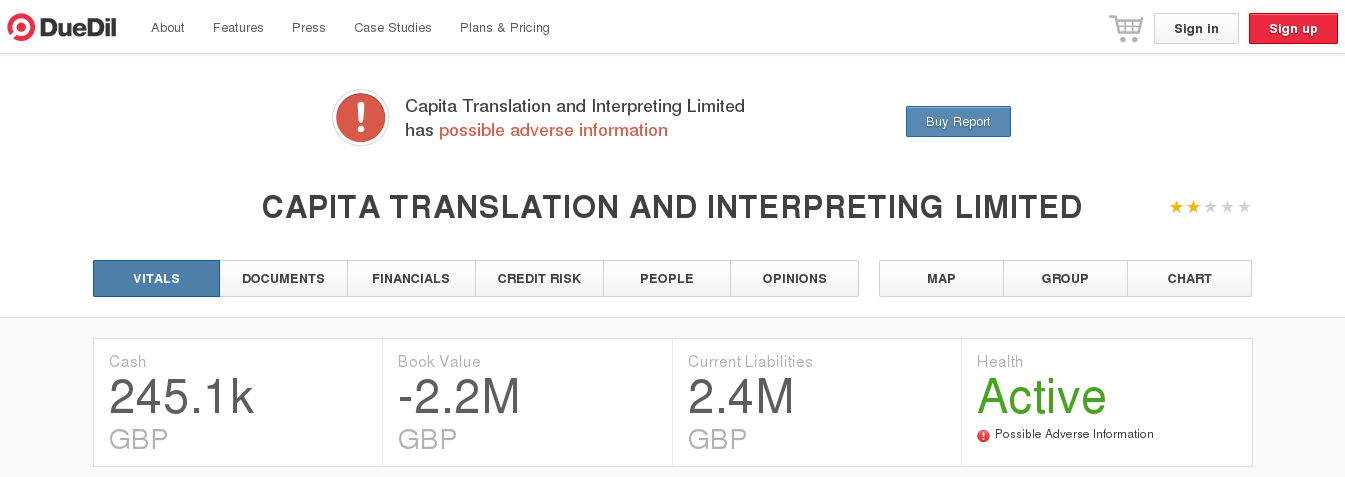
According to company financial information website DueDil, Capita Translation & Interpreting, the company that has been entrusted (rather foolishly. Ed.) by the Ministry of Justice with providing interpreting services for courts and tribunals in England and Wales (posts passim), is not doing particularly well financially, as the screenshot of the company’s latest basic financial information shows.
Today, 16th August 2013, marks the 20th birthday of Debian GNU/Linux, one of the Linux world’s most venerable and respected distributions.
Ian Murdock founded the Debian Project back in 1993 and since then it has turned out to be a truly free community project aiming to build a free Linux operating system – something that would have been impossible without Debian’s strong community of users and developers.
In the intervening 20 years, Debian has grown to be one of the most influential and largest open source projects, used as a base in many popular Linux operating systems, such as Ubuntu.
A cake with the Debian ‘swoosh’ logo
Dubbed the “universal operating system” Debian is available in over 70 languages and supports an enormous range of computer types, with over 20,000 software packages for more than 10 different computer architectures.
I use the latest version of Debian – codenamed ‘wheezy’ – on my laptop, whilst my main desktop machine runs Mepis, a Debian derivative featuring the KDE desktop. Over the years, I’ve found Debian (and derivatives) very stable, reliable and secure.
Why not treat yourself on Debian’s birthday? Go and grab a disk image and install it! 🙂
Until now, Linux users could sit back and relax when the talk turned to viruses, trojans and other malware: they weren’t a problem. As a result of the small numbers of Linux desktop users and the positive flipside of the the lack of Photoshop, iTunes et al., malicious software in the Linux world has been limited to two classes: demonstrations for exploits that have never been seen “in the wild” and targeted attacks on server software vulnerabilities.
This golden age for Linux users could now be drawing to a close. Security specialist Limor Kessem from RSA has written on her blog about the “Hand of Thief” banking trojan, which only attacks Linux machines and is currently being offered for sale in underground forums for U.S. $ 2,000 with free updates. It has been developed by a cybercrime team based in Russia.
The trojan’s developer claims it has been tested on 15 different Linux desktop distributions, including Ubuntu, Fedora and Debian. It includes a form grabber for both HTTP and HTTPS sessions; supported browsers include Firefox, Google Chrome and several other Linux-only browsers, such as Chromium, Aurora and Iceweasel. As for desktops, the malware supports 8 different environments, including Gnome and KDE.
The malicious code also incorporates virtual machine detection designed to make it more difficult for security researchers to unpick its secrets, as well as routines to block access to security updates or access to the websites of anti-virus vendors..
“Hand of Thief” exploits no special Linux security holes; the user has to install him/herself it by e.g. by opening an email attachment without checking it first or installing it from sources other than the recommended repositories of his/her Linux distribution.
Yahoo News reports that the Advertising Standards Authority (ASA) is investigating the recent Home Office poster van campaign targeting immigrants and dubbed the ‘racist van’ due to the crass insensitivity that is a hallmark of the Whitehall PR machine nowadays (posts passim).
The ASA has so far received 60 complaints expressing concerns that the advertisements were “reminiscent of slogans used by racist groups to attack immigrants in the past”.
The racist van was driven around the London boroughs of Barnet, Hounslow, Barking & Dagenham, Ealing, Brent and Redbridge – all areas with a high percentage of ethnic minority residents – as part of a £10,000 Home Office pilot scheme, which ended at the end of July.
As a counterpart to the Home Office’s mobile billboard, human rights and civil liberties organisation Liberty drove its own ‘anti-racist van’ around the streets of the metropolis.


 Joinup, the EU’s public sector open source news website,



 Until now, Linux users could sit back and relax when the talk turned to viruses, trojans and other malware: they weren’t a problem. As a result of the small numbers of Linux desktop users and the positive flipside of the the lack of Photoshop, iTunes et al., malicious software in the Linux world has been limited to two classes: demonstrations for exploits that have never been seen “in the wild” and targeted attacks on server software vulnerabilities.