According to Wikipedia, “Distracted boyfriend is an Internet meme based on a 2015 stock photograph by Spanish photographer Antonio Guillem. Social media users started using the image as a meme at the start of 2017, and it went viral in August 2017 as a way to depict different forms of disloyalty. The meme has inspired various spin-offs and received critical acclaim.”
Copyright on original: Antonio Guillem. Image courtesy of Wikimedia Commons.
Rather than waste sending any officers out from their cosy bolt-holes in the Counts Louse, Bristol City Council – along with their colleagues in the Avon and Somerset Constabulary – favours a policy of legal enforcement by public notice.
This has been applied in recent years to the authority’s duties under the Environmental Protection Act covering littering, fly-tipping (posts passim) and the like.
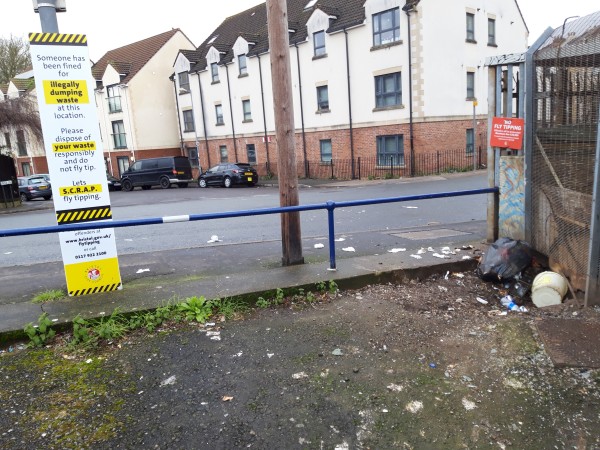
In recent months, the fly-tipping hotspots of Easton and Lawrence Hill wards have been subjected to not one, but two rounds of public notices being added to the already cluttered and confusing street scene: the first consisting of the well-known red NO FLYTIPPING [sic] signs which long been known to be totally ineffective; and the second consisting of the newer so-called lamp post wraps as shown in the photograph below which was taken in Ducie Road in Barton Hill this morning.
Do two enforcement notices work better than one? Note also the large volume of litter between both signs.
The lamp post wrap informs anyone who cares to read it that someone has recently been penalised fort dumping rubbish here. Between it and the traditional red sign, are a black waste sack and a catering size white plastic tub in the corner of the city council’s public car park in Ducie Road.
A couple of conclusions may be drawn from the above picture, as follows:
Enforcement by signage is not effective against fly-tipping; and
The city’s fly-tippers are either illiterate or don’t bother reading materials meant to dissuade them; or
They consider their chances of being penalised by a local authority constantly pleading poverty and cutting staff numbers are so close to zero that they can be discounted.
Just around the corner from Ducie Road, there’s another lamp post wrap on the bridge carrying the A420 over the railway line at Lawrence Hill. It too has been remarkably ineffective at preventing fly-tipping by the 1600 litre general waste bin that shares the railway bridge’s footway.
As a footnote, your ‘umble scribe did take the time and effort to report the incident mentioned above.
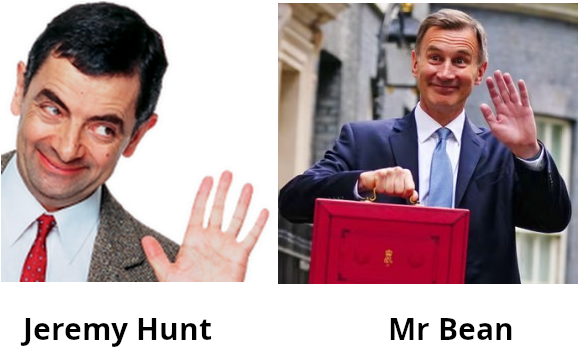
Yesterday saw Jeremy Hunt, a man who does very poor Chancellor of the Exchequer impression (preceding which he had pretended to be Secretary of State for Health, managing to incur the ire of hospital doctors while in office. Ed.), present his budget to parliament.
Many folk have remarked on social media recently on the similarity between Mr Hunt and Rowan Atkinson’s Mr Bean sitcom character, so here’s a handy image to see if their affirmations are correct.
Sticking with the same two characters, your ‘umble scribe decided to have some fun yesterday on Mastodon with a poll asking who would make the better finance minister. The unsurprising results are shown below.
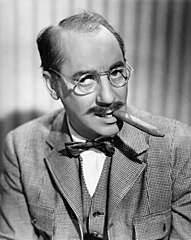
And that’s not the end of the bad news for the Blue Team. Another poll in which I participated asked who readers would like to be the next prime minister, giving the options of incumbent Rishi Sunak, Labour leader ‘Sir’ Keir Starmer, the late lamented Groucho Marx, and Larry the Downing Street mouser.
Yes, that’s right Larry the Cat, the Downing Street moggy, beat both professional politicians, as did the runner-up, a Marxist, albeit one from the Groucho wing of the movement.
We are cursed to live in the proverbial interesting times.
Even though Larry resigned from his post under the premiership of disgraced former party-time alleged prime minister Alexander Boris de Pfeffel Johnson (posts passim), as did lots of other staffers, he soon returned to his old stomping ground during the lettuce shelf life length premiership of the disastrous free marketeer Mary Elizabeth Truss, the free marketeer the markets rejected.
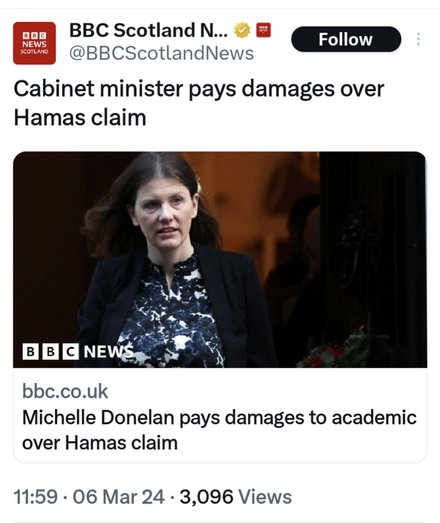
News has come to light today that Michelle Donelan, the dishonourable member for Chippenham, currently doing a nice sideline in incompetence as the Secretary of State for Science, Innovation and Technology, has retracted libellous allegations made in October 2023 against Professor Kate Sang of Heriot-Watt University in Edinburgh – an academic recently appointed to a UKRI advisory group – accusing Prof. Sang of expressing sympathy for proscribed terrorist organisation Hamas. Donelan also made similar defamatory allegations about another academic, Dr Kamna Patel of University College London.
Donelan has now withdrawn her allegations and apologised for the remarks she initially made via social media, as well as agreeing to pay Prof. Sang undisclosed damages and legal cost have been funded by the taxpayer, in the same manner disgraced former party-time Alexander Boris de Pfeffel Johnson had his legal fees funded by the public purse when he was finally pulled up after constantly lying to the House of Commons.
The use of public funds to redress the damage done by a government minister’s private bigotry has not gone down well in some circles, to put it mildly. Those objecting include the Liberal Democrats’ deputy leader Daisy Cooper, who has has referred to the largesse of the public purse in relieving Donelan’s financial embarrassment as nothing short of a national scandal as her actions were clearly outside of her ministerial brief.
However, not all the media presented the audiences with the full facts. Here the BBC has Donelan forking out herself for the damages and legal costs. It was not alone in doing so, with The Guardian, Daily Mail and Daily Telegraph all implying Donelan is paying the agreed sum out of her own pocket.
Wikipedia helpfully mentions in its article on the minister that before entering politics, Donelan’s career was in marketing, meaning that she has previous form in peddling stuff that is patently untrue or closely related thereto (along with advertising, public relations and broadcasting, marketing is one of the so-called bullshit industries. Ed.).
Calls are now being made for her resignation, but as per usual an anonymous Number 10 source has stated that Rishi Sunak had full confidence in Donelan, calling her “an excellent minister”. The last time I looked, excellent ministers do not commit libel.
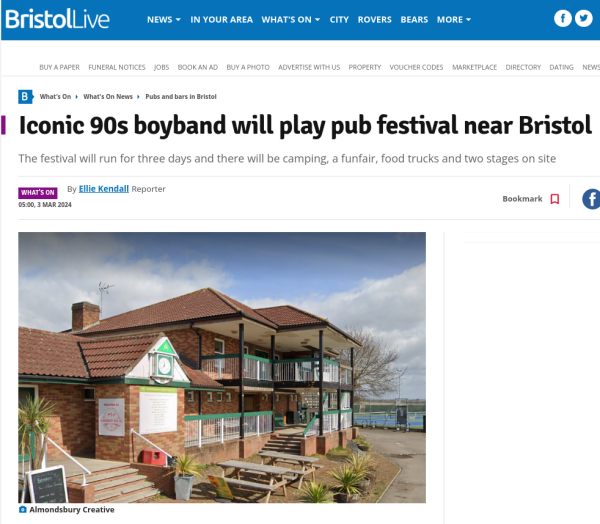
Today’s Bristol Live/Post has added another object of religious veneration, i.e. an icon, to the already burgeoning modern pantheon engendered by lazy modern ‘journalism‘ with news of a forthcoming gig in Almondsbury in South Gloucestershire, as shown in the following screenshot.
I expect to find icons in an Orthodox church, not a suburban boozer…
The boyband [sic] in question is Five, who spell it 5ive and it originated from the same stable that sired the Spice Girls, although I can’t imagine they’re doing that well if they’re gigging at a nondescript suburban West Country boozer.
However, the band is just the latest object to be saddled with the I-word, about which your ‘umble scribe has written critically before (posts passim).
However, your correspondent is not alone. Over in the USA, professional writer Garry Berman is equally not enamoured with the adjective, writing a post in April 2022 entitled Can we please stop describing everything as “iconic”?.
In it Mr Berman expresses his frustration with this extensively and lazily used adjective.
The word seems to have become the favorite go-to adjective of newscasters/reporters, commercials, documentaries, magazines, newspapers, and wherever the English language is found in our culture.
US dictionary publisher Merriam Webster has even added the note below to its definition of the I-word.
The original meaning of iconic was essentially “resembling an icon,” but today it often describes what is so admired that it could be the subject of an icon. And with that use, iconic has become part of the language of advertising and publicity: companies and magazines and TV hosts encourage us to think of some consumer item or pop star or show as first-rate or immortal or flawless—absolutely “iconic”—when that person or thing is actually simply widely known and—they assert—distinctively excellent.
Many decades ago, your ‘umble scribe recalls being taught at school that one of the secrets of good writing was to have a good vocabulary. This naturally entailed having a good stock of synonyms – words having an identical or similar meaning, so that specific words do not get overused.
Over at the Word Hippo website, there’s a wealth of synonyms for the I-word, of which a small selection is given below for the benefit of passing, journalists, reporters, broadcasters, etc.
archetypal
epochal
exemplary
quintessential
emblematic
seminal
It is not known whether Five/5ive will be performing wearing haloes, or if the stage will be surrounded by a large gilt border reminiscent of a picture frame, now the band itself has gained the status object of religious veneration thanks to the local press. Perhaps the Reach plc ‘journalist‘ who wrote the piece or the venue itself could clarify matters in the comments below if they happen to be passing. 😀
German news site heise reports that German-speaking literary translators associations are demanding stricter regulation of Artificial Intelligence (usually abbreviated to AI) due to its threats to art and literature.
“Art and democracy too are being threatened.” This is being said by German-speaking literary translators associations in Germany, Austria and Switzerland in respect of the increasing “automation of intellectual work and human speech“. They have therefore collaborated on an open letter (PDF) in which they are demanding strict regulation of AI.
Image courtesy of Wikimedia Commons.
Regulation must ensure that the functionality of generative AI and its training data must be disclosed. Furthermore, AI providers must clearly state which copyrighted works they have used for training. No works should be used for this purpose against the wishes of copyright holders. In addition to this, the open letter states that copyright holders should be paid if AI is trained using their works and a labelling requirement should be introduced for 100% AI content.
“Human language is being simulated now”
“A translation is the result of an individual interaction with an original work”, the translators write. This interaction must take place responsibly. How a sentence is constructed and what attention is focused on guides the inner experience of readers. The language skills needed for this are developed and honed in the active writing process. “The creation of a new literary text in another language makes the translator a copyright holder of a new work.”
However, text-generating AI can only simulate human speech, according to the translators. “They have neither thoughts, emotions nor aesthetic sense, know no truth, have no knowledge of the world and no reasons for translation decisions.” Due to their design, language simulations are often illogical and full of gaps; they contain substitute terms and statements that are not always immediately recognised as incorrect.
“AI multiplies prejudices”
The translators continue by saying that When AI products are advertised, it is suggested that the AI can work independently, “understand” and “learn”. “This means the huge amounts of human work on which the supposedly ‘intelligent’ products are based are kept secret.” Millions of copyrighted works are ‘scraped‘ from illegally established internet libraries to create language bots.
These and other arguments are combined in a “Manifesto for Human Language”. In it the translators write as follows: “Bot language only ever reproduces the status quo. It multiplies prejudices, inhibits creativity, the dynamic development of languages and the acquisition of language skills.” Text-generating AI is attempting to make human and machine language indistinguishable. It is not designed as a tool, but a replacement for human skill.
However, AI is not intelligence at all, since this also includes emotional, moral, social and aesthetic intelligence, practical sense and experience which arise from physicality and action. “In this respect, the technical development of language bots cannot be termed ‘progress'”, the open letter states.
The French city of Carcassonne in the département of Aude is best known – and rightly so – for its medieval citadel, which actually has a history dating back to the Gallo-Roman period and is on the UNESCO list of World Heritage Sites.
However, in recent days Carcassonne has become equally well known – in the Francophone world at least – for the poor quality of the local council’s spelling and its subsequent mockery on social media and in the mainstream print and broadcast media, as Midi Libre reports.
Like any French town or city, some of Carcassonne’s street names commemorate prominent local and/or national figures.
One of those luminaries so honoured in Carcassonne is the physicist Pierre Curie (1859-1906) In 1903, Pierre was awarded the Nobel Prize for Physics along with his wife, Marie Skłodowska–Curie and another French scientist, Henri Becquerel, the man who discovered radioactity, all of them being jointly honoured in that year for their contributions to science and knowledge.
As stated by Midi Libre, the cause for the outbreak of mainstream media and social media mockery, not to mention the presence of red faces at the local mairie, can be summarised in one single sentence.
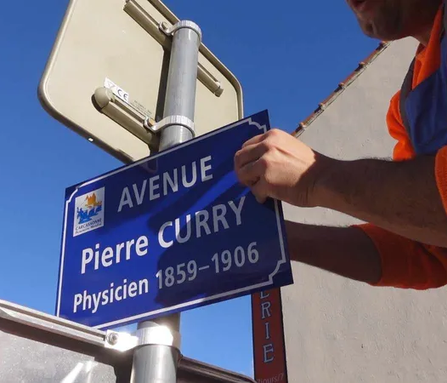
Cette semaine, deux panneaux ont été installés sur l’avenue Pierre Curie, dans la cité audoise, sauf que le célèbre physicien a été rebaptisé… “Pierre Curry” et a donc été orthographié comme la célèbre épice indienne.
Which is rendered in English as the following:
This week, two road signs were installed on Avenue Pierre Curie, in the city in Aude, except that the famous physicist was renamed… “Pierre Curry” and was thus spelled like the famous Indian spice.
The erroneous signs were quickly removed yesterday (Saturday). The council has stated that signs with the correct spelling will be installed from this coming Monday.
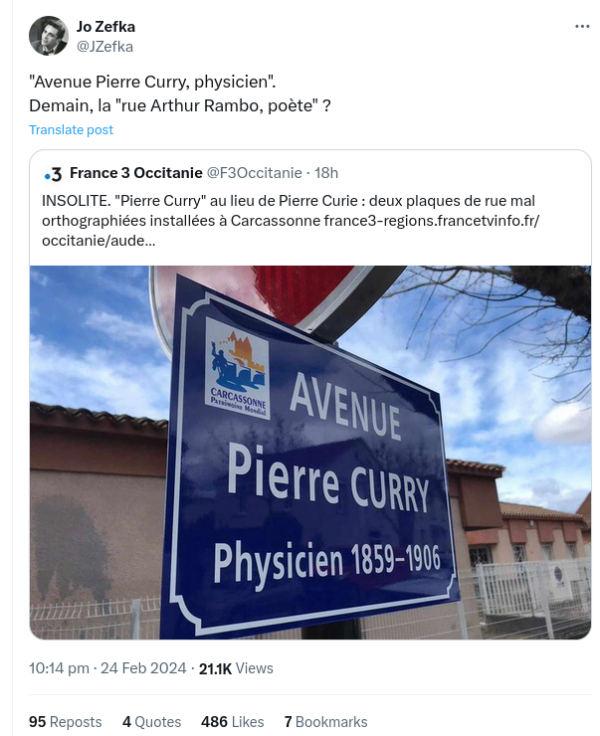
The mockery on social media took two forms: firstly, the culinary (it is not known whether Pierre and Marie invented the radioactive tandoori. Ed.), whilst Jo Zefka provides a typical post mocking the council’s poor orthographical skills.
Zefka asks:
“Avenue Pierre Curry, physicien”. Demain, la “rue Arthur Rambo, poète” ?
English version:
“Avenue Pierre Curie, physicist”. Tomorrow, “rue Arthur Rambo, poet”?
Your ‘umble scribe is pleased to note the speed with which Carcassonne town hall will be replacing the error-laden road signs. Here in the fair city and county of Bristol, the council – which is not known for its alacrity (except when pursuing council tax arrears .Ed.) – took all of four years to replace an erroneous road sign reading Morton Road (instead of Morton Street) in Lawrence Hill, perhaps because it lacked to comic cock-up quality of its Carcassonnais counterpart.
Reach plc local titles are an excellent source of exclusives, mainly due to the poor quality English of some of their employees.
Today’s Bristol Live/Post has one such exclusive, which also doubles up a secret classified for for very specialist workers in the construction trade, namely woodland builders, as per the screenshot below.
Your ‘umble scribe is glad to see that the generation of greenery has been modernised. Building woodland sounds much more contemporary and organised than just letting the shrubbery sprout naturally. It will also ensure more employment for those in the construction trade, which is always the first to suffer and the last to recover in any economic downturn. 😀
Yesterday the blog of The Document Foundation (TDF), the German non-profit organisation behind LibreOffice, published a post detailing how donations received during 2023 were used to continue development of the software and running the TDF and events
The post included a handy graphic displaying the disbursement of funds visually, which is shown below.
Graphic courtesy of The Document Foundation
Your ‘umble scribe would urge anyone who can to contribute their expertise, whether that’s writing or documentation, or helping to test pre-release versions; and if you can’t manage that, then donate! 😀
Q: what links an anonymous-looking plot of land somewhere in Missouri with Bebelplatz (also known as Opernplatz) in the city of Berlin?
A: The burning of books.
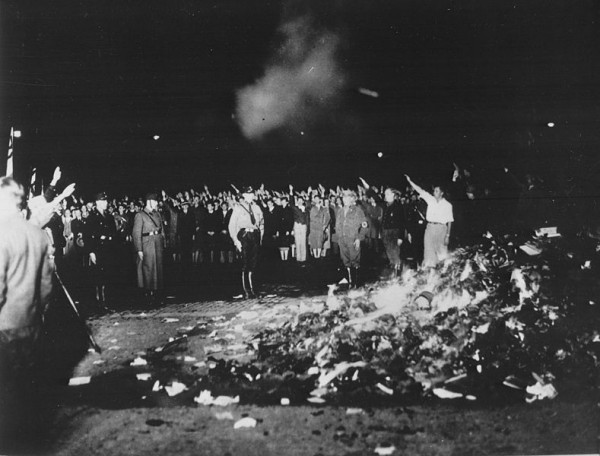
On 10th May 1933 , Nazi supporters from the German Student Association gathered in Bebelplatz to burn books. They burned around 20,000 books, including works by Heinrich Mann, Erich Maria Remarque, Heinrich Heine, Karl Marx, Albert Einstein, Erich Kästner and many other authors.
Image courtesy of Wikimedia Commons
On 6th February 2024, Valentina Gomez, a Republican Party candidate for Missouri’s Secretary of State (the state’s public officer whose duties include the oversight of elections, running the state library and the preservation of state archives. Ed.), posted a video of herself on the social media platform formerly known as Twitter showing herself using a flame-thrower to destroy 2 LGBTQ-inclusive books, as reported by NBC.
Gomez’s text accompanying the post tells one all that’s needed to know about her extreme right-wing views of the “Praise the Lord and pass the ammunition” variety. The books she destroyed were also taken from public libraries in the state, so she is also guilty of vandalism or destroying public property, but as the value of the books is under $750, she’ll probably escape censure under state law.
To return to Bebelplatz, it now contains an artwork by the sculptor Micha Ullman entitled The Empty Library, which was unveiled in May 1995. The memorial is set into the square’s cobblestones and contains a collection of empty subterranean bookcases. A few metres away is a commemorative bronze plaque containing a quotation by the author Heinrich Heine, whose books were amongst those burned.
The quotation reads:
Das war ein Vorspiel nur, dort
wo man Bücher verbrennt,
verbrennt man am Ende auch Menschen.
In English the quotation is equally chilling:
That was but a prelude;
where they burn books,
they will ultimately burn people as well
Whether or not Gomez understands the political and moral implications of book burning is unclear. The video could be a savvy and unsubtle reference, like Donald Trump’s use of terms including “vermin” and “poisoning the blood”, to Nazi ideology in an appeal to the most extreme of the MAGA base.
America, history is trying to teach you a lesson. Don’t fall asleep in class or gaze out of the window.




 Yes, that’s right Larry the Cat, the Downing Street moggy, beat both professional politicians, as did the runner-up, a Marxist, albeit one from the Groucho wing of the movement.
 We are cursed to live in the proverbial interesting times.

 The French city of
  One of those luminaries so honoured in Carcassonne is the physicist Pierre Curie (1859-1906) In 1903, Pierre was awarded the Nobel Prize for Physics along with his wife,