Amazon was forced to apologise and blamed a “technical error” for a customer being unable to post a review in Welsh of a novel written in Welsh, Wales Online reports.
Cathryn Sherrington of Cardiff had submitted a Welsh Language review which she then translated to English of the book Lladd Duw, by Dewi Prysor.
The book is described by its publisher as a “hefty, ambitious novel set in London and an imaginery [sic] seaside town. It deals with the destruction of civilisation from the standpoint of the working class. An intense, dark novel but with the usual humour from Dewi Prysor.“
Cathryn’s review reads as follows:
Gwych Brilliant. I haven’t read a Welsh book for years – sometimes the formality of written Welsh puts me off – this is brilliant though. Hawdd i ddarllen, stori gyffroes, cymeriadau diddorol. Wedi joio fo gymaint dwi’n mynd i ddarllen mwy o lyfrau Cymraeg.”
In English the review’s second sentence reads: “Easy to read, exciting story, interesting characters. Have enjoyed it so much I’m going to read more Welsh language books“.
However, Amazon which employs 1,000 people in Swansea, emailed Cathryn implying her review might have broken its guidelines.
There then followed a social media and email exchange between Cathryn and Amazon at the end of which the latter relented, stating: “This was due to a technical error for which we apologise. It has now been resolved.”
The inspiration to write this post was what an old friend referred to on social media as the Town Planners’ Little Book of Tired Clichés.
We were discussing a press report on long-term plans for Bristol Temple Meads, the city’s main railway station and its environs.
The report itself was written up from a press release issued by the literary geniuses employed in the Bristol City Council Newsroom down the Counts Louse (which some people now call City Hall. Ed.).
Bristol Temple Meads. Image courtesy of Wikimedia Commons
Whilst avoiding clichés has long been a given as advice for good creative writing, the various actors quoted in the Temple Meads piece seem to relish in their use.
Thus the surrounding area “will be rejuvenated with housing, shops and hospitality outlets creating a new area of the city where people can live, shop, visit and socialise”.
Note the exemplary use of rejuvenated.
In addition, how a new area of the city can be created by covering an existing but derelict city area in architecturally contrived arrangements of building materials is beyond me. If you have any clues, dear reader, please enlighten me via the comments.
Then there’s that essential element for anything involving urban planning – the vision thing. This is ably provided in this case in a quotation by Network Rail’s spokesperson: “We are delighted to be working with our partners on this significant regeneration project and Bristol Temple Meads station is at the heart of this vision.”
Helmut Schmidt, who served as the West German chancellor from 1974 to 1982, had a thing to say about visions: “Wer Visionen hat, sollte zum Arzt gehen“. In English: People who have visions should go to the doctor. Genau! Sie haben Recht, Herr Schmidt.
Needless to the whole glossary of hackneyed phraseology seems to have been upended into the phraseology mixing bowl to create something not only unappetising, but indigestible: ambitious; innovative; rejuvenate/rejuvenation; regeneration; gateway; transformation/transformative; integrate; blueprint; showcase.
And on the clichés go, marching tediously across and down the page.
There are nevertheless a couple of absolute gems in the piece to compensate for all this guff.
Firstly,there’s the timescale for the plans. We are are informed that “work is not expected to start for another decade with the expected completion not until 2041 at the earliest“. Thus all that hot air is being expended on something whose actual implementation is two decades in the future; if not more.
A well-known adage springs to mind: pigs might fly.
Secondly, there’s the promise of an integrated transport hub. Basically this means creating a major public transport interchange (as seen in sensible city’s where the local bus/tram serve the railway station). To my knowledge, there’s been talk of a transport hub/interchange at Temple Meads for at least 3 decades already, so for it actually to become a reality within 5 decades would entail the city’s infrastructure planning process moving at more than their usual slower than tectonic plates speed.
In a historic judgment in Italy, Lenovo was ordered to pay €20,000 euros in damages for abusive behaviour for refusing to refund the price of a pre-installed Windows licence in a case initiated by Free Software Foundation Europe (FSFE) supporter Luca Bonissi, the FSFE reports.
A grateful Luca is donating €15,000 of the award to the FSFE.
It should go without saying that everyone should be able to freely choose the operating system to run on their personal computers.However, this freedom is regularly abused by hardware suppliers to such an extent that it is almost impossible to buy a new or used system without having to pay the so-called Windows tax for an unwanted OS. Some computer manufacturers still make it very hard for consumers, forcing them to assert their rights in expensive and exhausting lawsuits.
This is what happened to Luca Bonissi.
In March 2018, Luca bought a brand-new Lenovo Ideapad and decided he didn’t want to run Windows on it. He therefore contacted Lenovo to request a refund for the pre-installed Windows system.
This initiated a lengthy two-year bureaucratic and legal all because the company twice refused to refund the €42 Luca had been charged for the unwanted Windows system. After having his requests denied twice by Lenovo, Luca tried to seek help from the Italian Competition and Market Authority (AGCM). However, when he realised that these efforts were fruitless, Luca decided to take legal action against Lenovo.
He therefore initiated proceedings in a small claims court without legal assistance, but soon sought professional aid when Lenovo proved obstinate.
In June 2019, the Justice of the Peace of Monza upheld Luca’s right to reimbursement and ordered Lenovo to refund €42 for the Windows licence and also ordered the company to pay €130 in legal costs
However, Lenovo was dissatisfied with the verdict and appealed, citing 15 grounds for appeal, implicating Luca in further legal proceedings and yet more expense for legal advice.
Finally, in December 2020, the Court of First Instance in Monza rejected all Lenovo’s arguments, upholding the consumer’s right to a refund for the unused pre-installed operating system. The court noted that the manufacturer itself had expressly assumed this obligation in the Windows licence. Furthermore, in a historic decision, the court imposed punitive damages of €20,000 on Lenovo for abusing the appeal process.
Commenting on his victory in court Luca stated: “The Monza decision demonstrated that is possible to reverse the unacceptable behaviour of big techs. What was taken away from the Free Software community has now been returned to it. I encourage everyone to fight back for their legitimate rights!”
Walls made of stone blocks are not unknown in Bristol. Since medieval times the local grey Pennant sandstone has been a common building material, as in the wall shown below, which is situated in All Hallows Road in the Easton area.
Please note the second block down in the centre of the photograph; the purply-black one that isn’t Pennant sandstone.
It’s a by-product of a formerly common industry in Bristol and the surrounding area that only ceased in the 1920s – copper and brass smelting. Brass goods in particular were mass-produced locally and traded extensively, especially as part of the triangular trade during when Bristol grew rich on slavery.
Indeed it’s a block of slag left over from the smelting process. When brass working was a major industry in the Bristol area, the slag was often poured into block-shaped moulds and used as a building material when cooled and hardened.
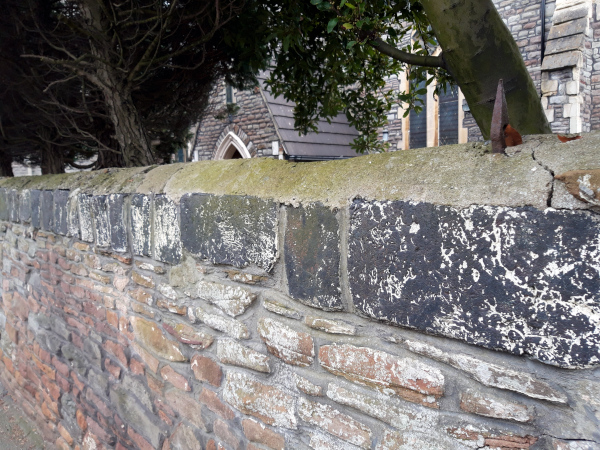
Stone walls were frequently capped with a decorative slag coping stones, as can be seen below on one of the walls of Saint Peter & St Paul Greek Orthodox Church in Lower Ashley Road. Otherwise the blocks were just used like ordinary stone blocks in masonry as above. In some instances, the blocks have been used as vertical decorative features in masonry.
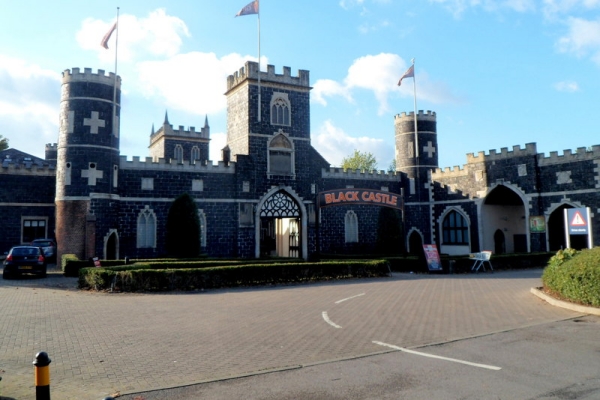
The finest example of the use of slag as a building material within the Bristol area is Brislington’s Grade I listed Black Castle pub (originally a folly. Ed.), where slag has been used extensively.
Black Castle, Brislington, Bristol. Image courtesy of Wikimedia Commons
So if you see any slag blocks in a wall in Bristol, you can be sure it usually dates to the 18th or 19th century, more usually the latter, when Bristol underwent a massive expansion.
There’s a link between Bristol’s brass industry and my home county of Shropshire in the shape of Abraham Darby I.
In 1702 local Quakers, including Abraham Darby, established the Baptist Mills brass works of the Bristol Brass Company not far from the site of today’s Greek Orthodox Church on the site of an old grist (i.e. flour) mill on the now culverted River Frome. The site was chosen because of:
water-power from the Frome;
both charcoal and coal were available locally;
Baptist Mills was close to Bristol and its port;
there was room for expansion (the site eventually covered 13 acres. Ed.).
In 1708-9 Darby leaves the Baptist Mills works and Bristol, moving to Coalbrookdale in Shropshire’s Ironbridge Gorge, the birthplace of the Industrial Revolution. In Coalbrookdale, Darby together with two business partners bought an unused iron furnace and forges. Here Darby eventually establishes a joint works – running copper, brass, iron and steel works side by side.
Below is the site of Darby’s furnace in Coalbrookdale today.
Darby’s blast furnace in Coalbrookdale. Image courtesy of Wikimedia Commons.
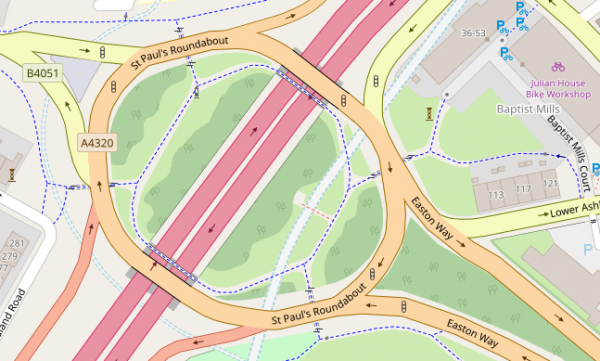
By contrast, here is what occupies the site of the brass works in Baptist Mills – junction 3 of the M32.
The site of the Bristol Brass Company’s Baptist Mills works. Image courtesy of OpenStreetMap.
The Document Foundation’s blog announced last week that the LibreOffice Documentation Team had released its LibreOffice 7.0 Getting Started Guide. The Guide, which was previously issued for LibreOffice version 6.4, has been updated to include all the new and improved features of LibreOffice 7.0, the latest version of LibreOffice, the free and open source alternative to proprietary office suites.
The guide has been drafted especially for those wanting to get up to speed quickly with LibreOffice, whether they are new users of office productivity software or already have some familiarity with other office suites, such as Microsoft’s ubiquitous and expensive offering.
The guide provides an introduction the LibreOffice’s 6 major components, i.e.:
Writer (word processing)
Calc (spreadsheets)
Impress (presentations)
Draw (vector graphics)
Base (database)
Math (equation editor)
Furthermore, it also covers some of the features common to all those components – set-up and customisation, styles and templates, macro recording, digital signing and printing.
The guide can be downloaded (PDF format) from LibreOffice’s English Documentation site., which also includes links to documentation in other languages, as well as user guides for earlier LibreOffice releases.
Nearly 80 years ago, Conservative leader Stanley Baldwin laid into the press on 17th March 1931 accusing them of wanting “power without responsibility – the prerogative of the harlot throughout the ages“.
When it comes to harlotry combined with lack of responsibility, it’s hard to emulate the Express.
For years these purveyors of xenophobia have actively campaigned for the country to leave the European Union, telling all manner of lies in the process.
Since achieving that aim the xenophobia has not abated in the slightest; and neither have the lies.
Yesterday the Daily Brexit – as it is otherwise known – reported (if it can indeed be called that. Ed.) on the the progress post-Brexit UK-US trade deal; or rather the lack of any progress.
However, anyone expecting a rational, balanced account would have been sorely disappointed.
The only con is the poor quality of Express reporting
‘It’s a CON!’ Britons react with fury after Biden puts brakes on post-Brexit trade deal‘ screamed the headline.
What? All Britons? Hardly.
In total, five Britons were quoted, all of them Express readers, hardly a scientifically selected cross-section of British society.
There is no input to the piece from the alleged government, not even a nudge or wink from the usual unidentified Whitehall source.
Not that such a minor detail matters to the bigots in the Express’ editorial office, who just wanted another opportunity to rant at these beastly foreigners and whose readers were more than happy to assist, especially as a trade deal with the USA was a major objective of Johnson’s Vote Leave government and, if achieved, would represent a major face-saver for a hardline administration whose tanking of the economy by its extremely poor deal with the EU has so far been masked by the damage done by coronavirus.
Furthermore, the piece is an opportunity for the Express to put the boot in on Katherine Tai, President Biden’s nomination for United States Trade Representative, both of whose parents were born in China, so enabling yet more causal bigotry from the Express.
Finally, it’s been a matter of general fact even before his election as president that Joe Biden does not regard the clinching of a trade deal with a post-Brexit United Kingdom as a high priority. Whereas previous US presidents have tended to use the UK as a bridge when dealing with the EU, a UK outside the EU is of less utility to Washington, since Biden has already bypassed the UK and has already been talking directly to Brussels.
If there has been a con, it’s been all the lies and British exceptionalism nonsense that the Express – exercising its power irresponsibly – has published for years.
Here’s a wee update on the bike I reported on Lawrence Hill (posts passim).
Since reporting, a member of Bristol Waste staff has been out and affixed a removal notice to the bike, giving the owner – if any – a fixed period, in this case 21 days (3 weeks), in which to recover their property before it is removed.
Abandoned bike with removal notice attached to its top tube
I trust when it is removed, the 2 redundant D-locks also affixed to the stand are likewise removed at the same time. 😀
How many of us pay that much attention to road signs when out and about on our daily business on foot as pedestrians?
I mean really pay attention, not just to the instruction being given or the advice being offered by the road sign itself, but the actual words used.
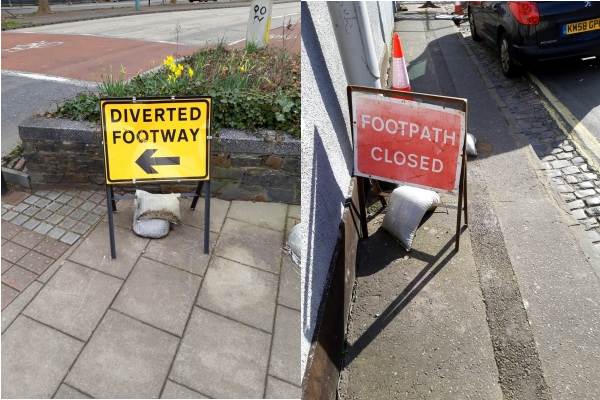
Take the two examples below, both taken during this past week on the streets of Bristol. Both are on a part of the highway used by pedestrians and generally referred to by the general public as the pavement (on which more anon. Ed.). But which – if any – is the correct term? Are footways and footpaths the same?
To answer the second question first, no; they are not the same.
If there’s one thing many decades of being a linguist has taught me, it is that terminology is important – the correct word used in the right context.
One generally has be a legislator, highway engineer or transport campaigner to know the difference between a footway and a footpath.
Fortunately, it is clearly defined in legislation, in this case the Highways Act 1980, which provides the following definitions:
“footpath” means a highway over which the public have a right of way on foot only, not being a footway; “footway” means a way comprised in a highway which also comprises a carriageway, being a way over which the public have a right of way on foot only.
In addition, Cheshire East Council provides the following information on its webpage entitled “What Are Public Rights of Way?“
You should be careful to distinguish between ‘public footpaths’ and ‘footways’. Pavements beside public roads are not public footpaths – it is better to refer to them as footways or simply pavements. Footways are not recorded on the Definitive Map as Public Rights of Way. A footway is really a part of the main highway which has been set apart for pedestrians.
Nevertheless, a caveat needs to be added to the clause where Cheshire East Council advises that “it is better to refer to them as footways or simply pavements“.
The caveat is that there’s a world of difference between what “pavement” denotes to ordinary mortals and professionals such as civil and highway engineers: for the former it’s the footway; for the latter more specialised use, Britannica gives the following definition:
Pavement, in civil engineering, durable surfacing of a road, airstrip, or similar area. The primary function of a pavement is to transmit loads to the sub-base and underlying soil.
Who would have thought two words on two such simple temporary road signs deployed for road works could be such a terminological minefield? 😉
In the middle of the week, Bristol City Council held its annual budget setting meeting.
As usual, it was riven with the traditional partisan ill feeling and rancour, as well as a rift over council housing rent increases within the ruling Labour group.
However, there was one glimmer of hope amongst the gloom. As a result of an amendment put forward by a group of Labour councillors, the council will be funding more enforcement officers to tackle the city’s seemingly insuperable environmental crime problems.
Later in the meeting, the original budget, with a Labour amendment for seven additional litter and fly-tipping enforcement officers, passed by just one vote 33-32.
Seven additional officers is a substantial increase in the complement of the enforcement team and one would hope that these additional resources will make a significant contribution to reducing levels of environmental crime within the city, as well as an increase in the woefully low number of prosecutions carried out, together with the issuing of more fixed penalty notices (FPNs).
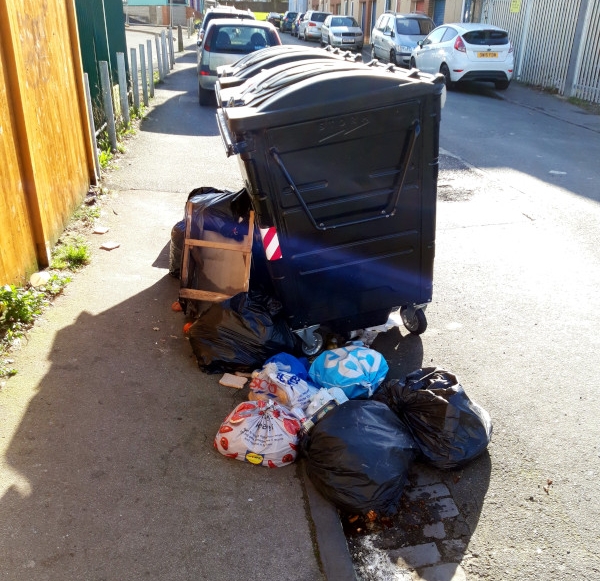
Fly-tipping in Morton Street
Fly-tipping in particular seems to have burgeoned during the lockdowns of the last year, fuelled in part by lower numbers of people on the street (and hence less casual surveillance/deterrence. Ed.), plus the twin booms of DIY projects and online shopping (the latter has also given rise to an increase in cardboard presented for recycling, according to Bristol Waste. Ed.).
PS: I’ve been informed the work I do in the local area was mentioned in the meeting when the amendment was discussed.
Update 14/07/21: Yesterday evening’s Bristol Clean Streets Forum meeting was informed that all the additional enforcement officers will be in post by the start of August.
On Wednesday the Linux Foundation and Google announced that Google would be funding two full-time maintainers for Linux kernel security development, Gustavo Silva and Nathan Chancellor.
Silva and Chancellor’s will focus on maintaining and improving kernel security, as well as associated initiatives to ensure the continuing viability of the world’s most pervasive open source software project.
The Linux Foundation’s Open Source Security Foundation (OpenSSF) and Harvard University’s Laboratory for Innovation Science (LISH) recently published an open source contributor survey report that identified a need for additional work on security in open source software, including the Linux operating system. Linux has more than 20,000 contributors. While there are thousands of Linux kernel developers, all of whom take security into consideration in their work, this contribution from Google to underwrite two full-time Linux security maintainers signals the importance of security for the future of open source software.
“At Google, security is always top of mind and we understand the critical role it plays to the sustainability of open source software,” said Dan Lorenc, Staff Software Engineer for Google. “We’re honored to support the efforts of both Gustavo Silva and Nathan Chancellor as they work to enhance the security of the Linux kernel.”
Chancellor’s work will be focused on triaging and fixing all bugs found with Clang/LLVM compilers while working on establishing continuous integration systems to support this work. Once those aims are well-established, he plans to begin adding features to the kernel using these compiler technologies. Chancellor has been a kernel developer for over 4 years.
Gustavo Silva’s full-time Linux security work is currently dedicated to eliminating several classes of buffer overflows. In addition, he is actively focusing on fixing bugs before they hit the mainline and has been contributing to kernel development since 2010.
Funding Linux kernel security and development is a collaborative effort, supported by the world’s largest companies that depend on the Linux operating system. To support work like this, discussions are taking place in the Securing Critical Projects Working Group inside the OpenSSF.
 Amazon was forced to apologise and blamed a “technical error” for a customer being unable to post a review in Welsh of a novel written in Welsh, Wales Online reports.
 historic judgment in Italy, Lenovo was ordered to pay €20,000 euros in damages for abusive behaviour for refusing to refund the price of a pre-installed Windows licence in a case initiated by Free Software Foundation Europe (FSFE) supporter Luca Bonissi, the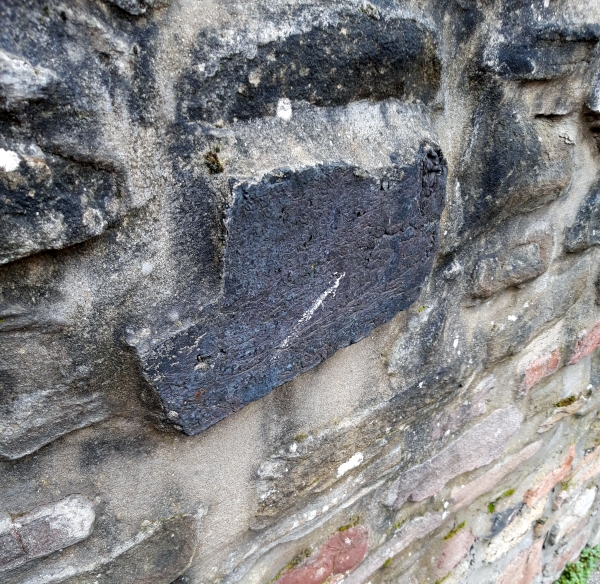

 The Document Foundation’s blog

 On Wednesday the Linux Foundation and Google