Earlier this week, version 86.0 of the Firefox web browser was released.
I have a great affection for Firefox, as I started using it in the early 2000s before version 1.0 was released when the browser market was dominated by Microsoft’s unloved but ubiquitous Internet Explorer.
Firefox is also bundled as the standard web browser in many Linux distributions including my long-term preferred distro, Debian.
According to the release notes, there have been several privacy improvements and other enhancements in the latest version.
in 10 years of campaigning for less litter and fly-tipping in east Bristol’s Lawrence Hill and Easton wards, one constant factor has been litter generated by takeaways, particularly the major franchises like Burger King, KFC and the like.
A petition has now been started on change.org to help tackle part of the problem, namely littering by their motorised customers, some of whom seem to have no compunction at just pitching the packaging their meal came in out of the vehicle window once their appetites have been sated.
Fast food litter. Image courtesy of Wikimedia Commons
The back streets of Easton and Lawrence Hill are a good mile of so from the nearest McDonalds, Burger King or KFC, but that does not stop litter from those outlets blighting the neighbourhood.
The relevant petition is entitled “Fast food restaurants to print vehicle reg on takeaway packaging to discourage littering” and reads as follows:
The recent break in fast food companies business has given us time to be able to start to clean up the streets once littered with empty McDonald’s bags, KFC boxes and other takeaway restaurant litter. KFC has been back open merely a couple of days and already pictures of carelessly discarded boxes are circulating on the internet. Let’s not slip back to where we were in terms of litter before the Covid lockdown. Let’s make compulsory that all drive through restaurants, who sell takeaway food, have to print the purchasers vehicle registration onto their bags or boxes. This will make it much easier to trace the litter back to the purchaser and result in a fine or preferably litter picking duties. I am proposing the idea of 3-4 stickers around the size of the bottom of the restaurants cup, printed with date/time and car registration, placed onto the bottom of the bags, cups and boxes to make it difficult for repeat litterers to remove their details without spilling the remaining contents into their cars/vans. The restaurants CCTV will back up this evidence with pictures of the driver and vehicle to provide solid evidence that they were the purchaser of said litter. The fine or community hours need to be big enough to cover costs of enforcement officers investigation times, resulting in nobody “slipping the net”. If we can reach 100,000 signatures I can show clear public interest and go straight to the Secretary of state for Environment, Food and Rural Affairs and demand change. As this could result in a fine for the offenders this will make it much more appealing to the government to pass as law and thus resulting in a cleaner environment for everyone to enjoy. Please help your local and national environment by merely signing this petition and sharing on social media platforms and as many large groups as you can, making a small but very needed step in the right direction. Thank you good citizens.
If the petition is successful, that just leaves how to resolve the problem of those on foot who litter after eating their takeaways whilst walking home… 🙁
Cycling has undergone an upsurge in popularity in recent times due to it being a healthy and convenient mode of transport.
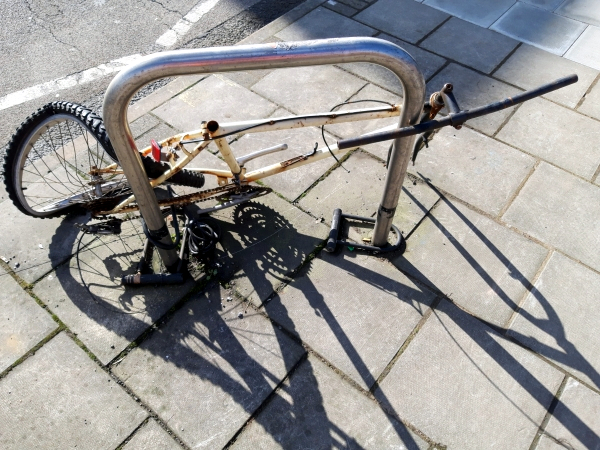
Nevertheless, this increase in popularity does have some drawbacks, one of which is damaged or abandoned cycles being left attached to cycle racks or other street furniture, like this typical example on Lawrence Hill by the station steps.
Even though I’ve been involved for a decade with trying to stem the tide of litter and fly-tipping that blight our streets, I was uncertain of the procedure to follow to report dumped bikes and get them removed.
I therefore turned to the Community Engagement Team of Bristol Waste, a council-owned company responsible for recycling and waste collections and street cleansing, for advice.
The relevant part of their response is quoted below.
The process is – logging a web form under street cleansing (https://www.bristol.gov.uk/streets-travel/street-that-needs-cleaning) and then provide the details of where the bike is. The crew will go and cut it off and dispose of it. If it looks like its owned by someone, then we put a notice on for 3 weeks and then go back and remove it if still there.
That seems very simple indeed.
Thanks, for your helpful reply, Bristol Waste!
I now hope others will join me in keeping the streets free of abandoned clutter.
NB:: as abandoned bikes are not specifically mentioned in the drop-down list of items that can be reported for attention, I chose to class it as ‘Litter‘. 😀
The continuing ignorance of the hardline Tory MPs who spearheaded the UK’s departure from the European Union is a gift that just keeps on giving.
Not only do they not understand how the EU works (clue: it’s a rules-based organisation. Ed.), they also do not know how international trade works (clue: that’s also a rules-based system. Ed.).
When it comes to ignorance of the workings of international trade – and tariffs in particular – Shrewsbury and Atcham MP Daniel Kawczynski has previous form, ending up looking a lemon in respect of, er, lemons.
However, there appears to be no start to Daniel’s ignorance and no end to his vanity in wanting to draw attention to the same. On Monday 22nd February he posted the tweet below on his Twitter account.
Daniel no doubt believes that these languages are spoken solely in countries such as France, Spain and Germany in the hated EU.
Time to think again, Danny Boy! 😀
Let’s start with your last mentioned language shall we, Daniel (especially as it might be considered the easiest to dismiss.Ed.)?
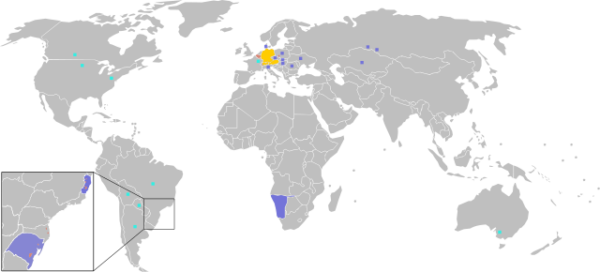
German is, of course, spoken in Germany. However, it’s also the official language in Austria as well as being one of Belgium’s four official languages. In Italy’s province of Alto Adige (also known as the Südtirol. Ed.), 62% of the population are German speakers. Outside the EU, German is also one of Switzerland’s four official languages. German is a recognised minority language in the Czech Republic, Hungary, Poland, Romania, Russia and Slovakia. Beyond Europe there are still 25,000-30,000 native German speakers in Namibia, despite it ceasing to be a German colony over a century ago: some 12,000 persons whose first language is German currently live in South Africa. Turning to South America, there are an estimated 1 million German speakers, with German-speaking minorities in almost every Latin American country including Argentina, Belize, Bolivia, Brazil, Chile, Colombia, Costa Rica, Dominican Republic, Ecuador, Guatemala, Mexico, Nicaragua, Paraguay, Peru, Uruguay, and Venezuela. In North America, there are also German-speaking minorities in both the USA and Canada.
The map below illustrates where German is spoken around the world.
The German-speaking world. Image courtesy of Wikimedia Commons.
How does Daniel fare with French?
Equally badly is the answer.
Besides the EU countries of France, Belgium and Luxembourg, French is also spoken within Europe in Monaco and parts of Italy. Throughout the world there are estimated to be some 274 million French speakers, of whom some 77 million are native speakers. Within the EU alone, French is the third most widely spoken language (after English and German), being spoken by 19.71% of the population and is the second most-widely taught language after English. It’s an official language not only in France, but Belgium, Luxembourg, Monaco and Switzerland. It is also widely spoken in Italy’s Aosta valley region.
However, it is in Africa – and particularly former French colonies and territories – that the majority of the world’s French speakers live. According to a 2018 estimate from the Organisation Internationale de la Francophonie, an estimated 141 million African people spread across 34 countries and territories can speak French as either a first or a second language. This estimate does not include those inhabitants of non-Francophone African countries who have learned French as a foreign language.
Looking at the Americas, French is the second most common language in Canada, after English, and both are official languages at the federal level. It is the sole official language in the Canada’s Quebec province. In the USA, French is the fourth most-spoken language in the United States after English, Spanish, and Chinese, when all forms of French are considered, according to the United States Census Bureau.
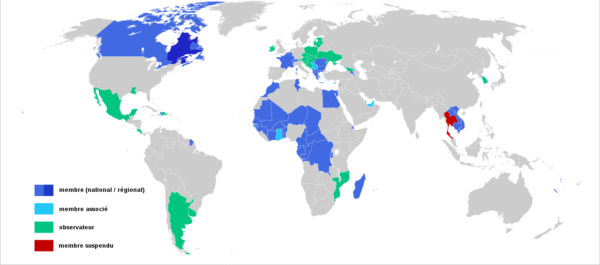
The following map shows membership of the Organisation internationale de la Francophonie, the international organisation representing countries and regions where French is either a lingua franca or customary language.
Membership of the Organisation internationale de la Francophonie. Image courtesy of Wikimedia Commons
So far that’s two own goals Daniel’s scored on the worldwide importance of 2 of the major foreign languages taught in British schools.
How does he fare with his third target – Spanish?
In short, not any better.
Today Spanish has 500 million native speakers, mainly in Spain and the Americas and is the world’s second-most spoken native language after Mandarin Chinese and the world’s fourth-most spoken language overall after English, Mandarin Chinese, and Hindi. Overall there are estimated to be 586 million speakers of Spanish in the world. As befits its large number of speakers, Spanish is one of the six official languages of the United Nations and it is also used as an official language by the European Union, the Organization of American States, the Union of South American Nations, the Community of Latin American and Caribbean States, the African Union and many other international organisations, as well as being one of the world’s most widely taught foreign languages.
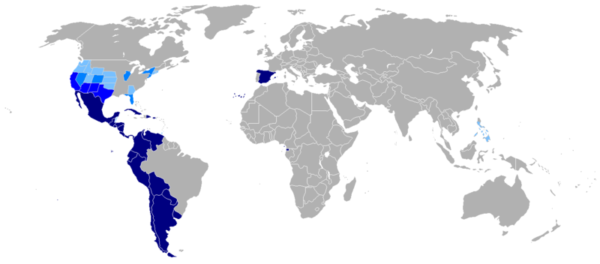
Below is a map showing where in the world Spanish is spoken.
Map of the Hispanophone world. Image courtesy of Wikimedia Commons
So how’s Daniel done?
In brief, not very well.
If Mr Kawczynski had been a footballer instead of a member of Parliament, he would have gone down in the match report as having scored three goals for the opposing side, also know as own goals (Kawczynski 3, og).
Finally, it’s worth pointing out that Daniel has been appointed the UK’s trade envoy to Mongolia. If his tweet was an attempt to increase the teaching Mongolian as a foreign language in British schools, it was, to say the least, extremely clumsy.
Following on from an initial proposal by Collabora for a Wayland driver for the Wine emulator (which enables Windows applications to be run on Linux. Ed.), the company’s developers have now posted a Request for Comment (RFC) on the upstream mailing list, Germany’s Linux Magazin reports.
The goal of this driver is to allow Windows applications to run directly on Wayland compositors, eventually removing the need for XWayland for many uses.
The goal of this driver is to allow Windows applications to run directly on Wayland compositors, eventually removing the need for XWayland for many use cases. Consequently, it should not be assumed that XWayland will get support for modern features. In a post on Collabora’s blog, chief developer Alexandros Frantzis mentions HDR imaging as such a function. Furthermore, as an additional layer, XWayland represents an unnecessary complication and possible breeding ground for inefficiency.
This RFC contains additional details of how the Wayland driver should work with Wine. Copy/paste, Drag-and-drop and changing the display mode are mentioned. Copy/paste support is already working well in both directions, according to Frantzis, i.e. both from native Wayland applications to Wine applications and vice versa. Drag-and-drop works from a native Wayland application to a Wine application in many established formats. Progress on these aspect of the driver can be seen in the video below released by Collabora.
In the 18th, 19th and early 20th centuries, Welsh children who used their native tongue in schools were subject to a particular form of punishment and humiliation – the Welsh Not.
The Welsh Not (also Welsh Knot, Welsh Note, Welsh Stick, Welsh Lead or Cwstom) was an item used in Welsh schools in the 18th, 19th and 20th centuries to stigmatise and punish children using the Welsh language, according to Wikipedia.
Typically “The Not” was a piece of wood, a ruler or a stick, often inscribed with “WN“. On any schoolday, it was given to be worn round the neck to the first pupil to be heard speaking Welsh. When another child was heard using Welsh, “The Not” was passed to the new offender: and on it went. Pupils were encouraged to inform on their classmates. The pupil in possession of “The Not” at the end of the lesson, school day or week – depending on the school – received additional punishment besides the initial shaming and humiliation.
In recent times the Welsh Not seems to have transformed from being a physical object to a mental one, but one that is nevertheless still used to stigmatise speakers of one of the country’s oldest languages – one that was already old when Old English (which some call Anglo-Saxon. Ed.) first became established as England’s common tongue.
The persistence of stigmatisation is just one matter covered in a Metro opinion piece by Lowri Llewelyn entitled Why the Welsh language deserves respect not ridicule.
Looking specifically at stigmatisation, Lowri, who learned Welsh as a child and grew up in a bilingual household, writes:
I can’t count how many times English folk have jeered about my ‘dead language’.
At least it wasn’t referred to as “gibberish“, Lowri!
To reinforce her point, she continues:
Fuelled by anti-Welsh sentiment from England, the Welsh even came to oppress and disrespect themselves.
She then goes on to point out how, as a teenager she would only speak English to friends and be dismissive of her native culture, before going on to point out how she has since changed her attitude and welcomes efforts to increase the presence of Welsh.
Lowri concludes by pointing out some of the encouraging signs of a renewed interest in Welsh.
For instance, in recent times Welsh has become the fastest growing language in the UK on the Duolingo language learning platform. One explanation might be a renewed interest in the cultures and history of the nations that make up Great Britain, given the severe restrictions on foreign travel imposed as a result of the coronavirus pandemic.
On 18th February NASA’s Perseverance Rover touched down in Mars’ Jezero Crater.
Perseverance rover
However, what is less well known is the role played by Linux and open source software in the Perseverance mission to the Red Planet, particularly as regards its hitch-hiking companion – the Ingenuity helicopter.
This has been revealed by Steven J. Vaughan-Nicholas in a piece for ZDNet.
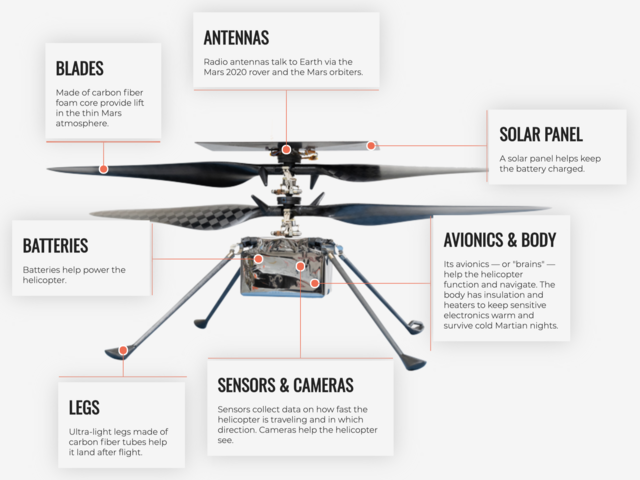
The Ingenuity Mars helicopter. Click on the image for the full-sized version.
Ingenuity weighs 1.8 kg and is attached to the belly of the 1,025 kg Perseverance rover. If its mission is successful, Ingenuity will be the first man-made vehicle ever to fly on another planet. It will fly itself using a combination of Linux and a NASA-built program based on the Jet Propulsion Laboratory‘s (JPL) open-source F´ (F prime) framework.
This will not be easy. Mars’ atmosphere is so thin, its density is one per cent that of the Earth’s whilst its gravity is one-third that of Sol III. Ingenuity is expected to make one or more flights within 30 days as a technology demonstration, according to NASA.
Timothy Canham, a JPL Embedded Flight Software Engineer, stated the following in an interview with IEEE Spectrum:
This the first time we’ll be flying Linux on Mars. We’re actually running on a Linux operating system. The software framework that we’re using is one that we developed at JPL for CubeSats and instruments, and we open-sourced it a few years ago. So, you can get the software framework that’s flying on the Mars helicopter, and use it on your own project. It’s kind of an open-source victory because we’re flying an open-source operating system and an open-source flight software framework and flying commercial parts that you can buy off the shelf if you wanted to do this yourself someday.
It still remains to be seen whether Perseverance succeeds in its mission to find traces on ancient life on Mars and if Ingenuity’s flight(s) will be successful, but yesterday Ingenuity ‘phoned home’ from the Red Planet.
in my first job after graduation (translator and marketing analyst for Imperial Tobacco in Bedminster, Bristol), part of my employer’s house style I had to absorb was an avoidance of all and any ambiguity.
I well remember my chagrin at being admonished for it by my line manager, who had left school at 14 with no qualifications, started out as a messenger boy in the post room and worked his way up to senior middle management.
Collins Dictionary defines ambiguity as “the possibility of interpreting an expression in two or more distinct ways” and “vagueness or uncertainty of meaning“.
This is a lesson that the employees of the Bristol Post/BristolLive (also known by some locals as the Temple Way Ministry of Truth. Ed.) have yet learn, as shown by the latest example below.
Following hot on the heels of the sacking of its Director of Corporate Affairs for insulting the Welsh (posts passim), comes news that frozen food giant Iceland is reviewing approach’ to bilingual signage in its Welsh stores.
The company had previously been criticised for its lack of provision of Welsh and English signage in stores, even attracting protests, such as one in Rhyl in 2018 reported by The Grocer.
At that time, Iceland was not exactly amenable to bilingual signage in its Welsh stores and even went so far as to issue a statement asserting its monoglot stance: “We do not currently provide signage in any language other than English in any of our stores in any part of the UK or Ireland.“
However, the company, which is based in Glannau Dyfrdwy (English: Deeside), had now announced this is changing, stating:
“We are currently reviewing our approach to providing Welsh signage in stores across Wales and updating this wherever possible. All new stores and those which are refitted have Welsh signage installed as standard, and this is also in place across all of our The Food Warehouse stores across Wales.”
The move has received support from Aled Roberts, the Welsh Language Commissioner, who has issued the following statement:
Research conducted by The Welsh Language Commissioner shows that customers in Wales want to see, hear and use the Welsh language in supermarkets in Wales. We have worked with a number of large supermarkets to develop their Welsh language services, supermarkets such as Coop and Lidl have responded brilliantly to develop a bilingual service. We would like to applaud their approach in working with us. We have contacted Iceland to inspire them to use Welsh, and encourage them to use bilingual signs, and we hope that they will respond to our request.
For many years the garage sitting at the apex of the junction of Russelltown Avenue, Cannon Street and Whitehall Road in BS5 has featured a changing sequence of slogans painted by Stan Jones, who lives in the house to which the garage belongs.
It was 2017 when I first noticed it and, at that time, it focussed on the madness of Brexit.
Exit Brexit
In 2019 its message was still focussed on Brexit but had been repainted to featur the wording “Buck Foris” (fine use of a Spoonerism there. Ed.) and “Fromage not Farage“, so I think it’s fair to say Stan is not impressed with the right-leaning part of what passes for Britain’s political class.
In 2019 Stan’s efforts accidentally suffered the attentions of Bristol City Council’s fight against graffit. There was, however, a happy outcome as Stan received an apology and some paint from the corporation, as the Bristol Post reported at the time.
Below is Stan’s latest contribution, which really needs no further comment from me.
 Earlier this week, version 86.0 of the Firefox web browser was released.

 Typically “The Not” was a piece of wood, a ruler or a stick, often inscribed with “WN“. On any schoolday, it was given to be worn round the neck to the first pupil to be heard speaking Welsh. When another child was heard using Welsh, “The Not” was passed to the new offender: and on it went. Pupils were encouraged to inform on their classmates. The pupil in possession of “The Not” at the end of the lesson, school day or week – depending on the school – received additional punishment besides the initial shaming and humiliation.
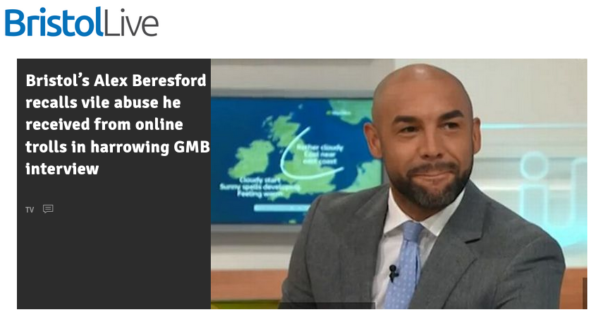
 Following hot on the heels of the sacking of its Director of Corporate Affairs for insulting the Welsh (
![Text on building reads What the [insert word of choice] is happening?](http://xislblogs.xtreamlab.net/slwoods/wp-content/uploads//sites/23/2021/02/600px_insert_word_whitehall_road.jpg)