Another Google Translate classic?

No further comment is necessary.

No further comment is necessary.
Earlier this week Wales Online reported that train company Great Western Railway will not have Welsh language announcements or signs on its new class 800 fleet that will be providing services on the Great Western route from South Wales to London Paddington.

The lack of Welsh language announcements or signs on board was first spotted by Cardiff City Labour councillor and Welsh learner Phil Bale, who raised the matter with Great Western Railway via social media.
GWR responded to Cllr. Bale as follows:
I’m afraid we have no plans to have bilingual signage and on-board announcements on these services.
Diolch yn fawr, GWR!
The decision was justified by GWR remarking that the trains serve both England and Wales they aren’t a dedicated South Wales Fleet. However, as a patronising nod in the direction of Wales having a distinct language, GWR did point out that it had leaflets available in Welsh, but passengers would have to ask for them first (presumably in English. Ed.).
In response to GWR’s monoglot policy, Councillor Bales remarked: “For me it shows that Great Western are stuck in the dark ages. We have a Welsh Government target of one million Welsh speakers and there are international transport operators who manage to provide their services in different languages all across Europe.”
As the trains do serve both countries, one would have thought that providing bilingual announcements and signs would have been a common courtesy to those who speak Welsh; and as for Councillor Bales’ remark about running services in other countries, your correspondent doesn’t believe the travelling public overseas would tolerate the incompetence and sheer bloody-mindedness of GWR.
GWR’s attitude contrasts sharply with that of fellow train company, Arriva Trains Wales, which also runs services between Wales and England (e.g. from Cardiff Central to Manchester Piccadilly. Ed.). Arriva provides both signs and announcements in both Welsh and English, as well as bilingual ticket machines and timetables, even at English stations.
Plaid Cymru described GWR’s attitude as “disrespectful“, whilst a Cymdeithas yr Iaith (Welsh Language Society) spokesman said: “Ensuring bilingual signage and announcements on trains in Wales is a matter of basic respect for the Welsh language – there is no excuse not to. The fact GWR have said they don’t intend even to ensure these simple things, and that they’ve missed easy opportunities to do so, shows that they are not a suitable organisation to provide a train service in Wales.
“The Welsh Government should publish strong language standards in the transport sector so that the Welsh Language Commissioner can force companies like GWR to respect the language.”
According to the South Wales Argus, a Welsh Language Commission spokesman said: “Great Western’s alleged lack of investment in the Welsh language is a cause for concern.
“In 2016 the Commissioner submitted a report to the Welsh Government recommending that Welsh language standards should be placed on train companies. The Commissioner continues to work with train companies and others to develop the use of the Welsh language on a voluntary basis, and discusses public concerns with them.”
Yesterday The Document Foundation (TDF) announced the release of LibreOffice 5.4.2, the second minor release of the LibreOffice 5.4 family. LibreOffice 5.4.2 continues to represent the bleeding edge in terms of features and as such is targeted at technology enthusiasts and early adopters.
TDF suggests that more conservative users and businesses deploy LibreOffice 5.3.6 with the support of certified professionals.

LibreOffice 5.4.2 includes approximately 100 bug and regression fixes. Technical details about the release can be found in the RC1 (release candidate) and RC2 change logs.
LibreOffice 5.4.2 is available for download for all major platforms (Linux, MacOS and Windows).
LibreOffice users, free software advocates and community members are invited to support the work of The Document Foundation with a donation. Donations help TDF to maintain its infrastructure, share knowledge, and organise events such as the LibreOffice Conference, with the next one taking place next week in Rome.
LibreOffice was the runaway winner in a survey of Ubuntu Linux users for desktop productivity software with 85.52% of the votes. The closest competitors were Google Docs with 4.29%, WPS Office with 3.22% and Apache OpenOffice with 1.96%, while all other office suites accounted for less than 1% responses.
“Even with Windows shipping Ubuntu/Bash on their desktop, even with Google shipping Chromebooks with Linux+Chrome pre-installed, even with Mac OS running away with a premium segment of the desktop market, even with Android phones and tablets, there are many tens of millions of passionate Ubuntu desktop users who are eager to have their voices heard! And LibreOffice continues to be THE enabler of local office productivity on the Ubuntu Desktop,” says Dustin Kirkland, Vice-President of Product Development for Ubuntu at Canonical.
The results of the Ubuntu 18.04 LTS Default Desktop Applications Survey were presented by Dustin Kirkland at the UbuCon Europe conference in Paris in September.
Yesterday’s Wales Online reports that Santander refused to deal with paperwork submitted by a customer… because it was written in Welsh.
This is in spite of the fact that the bank has a clearly stated Welsh language policy which states:
We want all of our Welsh speaking customers to feel comfortable using Welsh language in their day to day banking with us and we encourage its use wherever possible. It’s why we support a number of Welsh language initiatives, allowing customers to use Welsh language in conversations with our Welsh speaking colleagues in branch, on our cash machines in Wales and when writing to us.
This policy was clearly not known to some manager somewhere in England as the bank declined to process membership forms after they were handed in at the bank’s branch in Aberystwyth.
After their submission in Aberystwyth, the paperwork clearly landed on the desk of a bank official who clearly didn’t speak the language of Hywel Dda, as the forms were subsequently returned to the branch in question with a note which stated: “Please return these documents to your account holder. Unfortunately Santander can only accept these documents written in English.”
Unfortunately, the paperwork in question was submitted to Santander’s Aberystwyth branch by Cymdeithas yr Iaith Gymraeg (aka the Welsh Language Society).
Cymdeithas yr Iaith Gymraeg’s rights spokesperson Manon Elin, commented as follows:
This is another example of a private company refusing to provide a Welsh language service because they’re not required to do so, and that’s completely unacceptable. We must have a language law which ensures that banks have to respect basic rights to use the Welsh language. Unfortunately, the Welsh Government’s plans for new legislation make it less likely that banks will have to comply.
The vast majority of people have to bank, but there is no means of banking online in Welsh, and we have to fight for other basic services in Welsh.
The society has also raised the matter with Minister Government Alun Davies challenging him to change the bank’s policy. In a recent white paper, the Minister refused to commit to extending Welsh language rights to the banking sector because of the ‘present economic certainty‘.
In response to this incident, the bank has commented as follows:
Santander accepts documentation that we receive in Welsh in line with our Welsh language policy.
We understand our customers who live in Wales may have various documentation and forms that will be written in Welsh.
If our policy has not been followed then we apologise for any unintentional upset this matter may have caused. The matter will be reviewed to ensure this does not happen again.
For your ‘umble scribe the final sentence from Santander can be translated into plain English as: “Oops! We’ve been caught out!” 🙂
It’s a well-known fact that when the Brits go abroad and want to converse with Johnny Foreigner, the most convenient is (for Brits of course) to speak English very s-l-o-w-l-y and very LOUDLY; there’s no need to go through all that tedious process of learning how to have intercourse with the locals in the vernacular.
Mrs Theresa May, a woman who does very poor Prime Minister impressions, went to Florence in Italy on Thursday to make a speech (posts passim). However, it is unlikely that non-Brits understood it as it was delivered sotto voce.
As my working life as a linguist has been devoted to improving international understanding, I felt it was my duty to help the EU negotiators understand what Mrs May said and have therefore translated her Florence speech into foreign, as per the screenshot of her opening paragraphs below.

To convert May’s speech into foreign was simplicity itself. Indeed it was so simple I don’t know why Theresa’s staff at 10 Downing Street didn’t bother to do it themselves.
The first stage was to copy the transcript of May’s speech from the government’s website, open a new document in the excellent free and open source LibreOffice productivity suite (other, usually proprietary, office suites are available. Ed.), paste the content from the operating system’s clipboard, then hit Ctrl+A to select all the text, followed by going to the Format menu and selecting Text -> UPPER CASE.
Job done! I now had a copy of Mrs May’s Florence speech in easily intelligible foreign and one perfect for online use as it is also 100% shouty. 😉
Your ‘umble scribe’s version in foreign is available to download (PDF) should readers also wish to promote international understanding. 😀
Today Theresa May, a woman who does Prime Minister impressions, will descend on the Italian city of Florence to make a speech. She will have with her a full supporting cast of cabinet ministers, plus hangers-on from the British mainstream media.
The speech, all about Brexit, is being talked up by the British media as an attempt to prompt progress in the stalled negotiations on the UK’s exit from the European Union.
However, no senior figures from the EU will be in attendance at May’s speech at the church of Sant Maria Novella (conveniently situated opposite the main railway station for a quick getaway. Ed.).
However, for true lovers of tripe, this blog has a better recommendation: ignore Theresa’s speech altogether and go for Lampredotto instead.

This typical Florentine dish is made from the abomasum, the fourth and final stomach of the cow.
“Lampredotto” is derived from the Italian word for lamprey eels, lampreda, as the tripe resembles a lamprey in both shape and colour. Lampredotto is typically chopped, slow-cooked in a vegetable broth, seasoned with herbs and served on a bread roll; in addition, it is sometimes topped with either a piquant or green sauce.
One final point: Florence was once a leading financial centre – a status it may soon be sharing with a post-Brexit City of London.
The Délégation générale à la langue française et aux langues de France (= General Delegation for the French language and the languages of France) has published the latest version of its vocabulary recommendations for information and communication technologies (ICT), today’s Le Monde Informatique reports.
The Délégation générale à la langue française et aux langues de France has been working since 1979 on a Gallicisation of the English language terms that populate the digital world. A new version of its recommendations for ICT vocabulary terms has just been published with several updates compared with the previous version released in 2009. The document contains 488 pages and can be downloaded free of charge as a PDF.

The document brings together all the recommendations made in the last half century and published over the years in the French Official Journal. In theory, use of these terms is mandatory instead of English language terms, particularly in documents that have to be written by law in French (e.g. documents required for work in particular). After an introduction summarising the history and meaning of the work that has been completed, the main bulk of the document comprises a dictionary of recommended terms, with the entry for each word comprising not only its definition but the foreign equivalents to be excluded. The end of the vocabulary contains an index of both the French and foreign language terms.
This work could be regarded as a move to defend France’s “belle langue“. However, living languages are always enriched by contact with regional or foreign languages. The task of the vocabulary can be regarded rather as an effort to retain a consistent and fair mode of expression.
One point often made is that, drop for drop, ink for inkjet printers is more expensive than vintage champagne.
However, in France one organisation is taking a stance against the profiteering practices of some printer manufacturers, Le Monde Informatique reports.

For the HOP (Halte à l’Obsolescence Programmée = Stop Planned Obsolescence) campaign group, the office printer industry has a developed processes which force users to renew their equipment and consumables whilst they are still fully functional.
On 18th September HOP filed an initial complaint against persons unknown with the Nanterre District Court for planned obsolescence. Brands such as HP, Canon, Brother and Epson are cited in the arguments accompanying the petition. To bring its action HOP is using the Consumer Code as a basis; since 2015 this has punished “recourse to techniques by means of which the person responsible fora product’s marketing deliberately intends to reduce its service life to increase its replacement rate”. This is an offence punishable by two years imprisonment, a €300,000 fine and even a financial penalty of up to 5% of the guilty party’s turnover.
HOP rebukes manufacturers for knowingly preventing printing on the pretext that a cartridge is empty while it still contains ink. Epson, which is often cited to support the charge, uses a chip to count the number of copies and print head cleaning operations carried out in order to determine the level of ink left. The system is not particularly reliable since tests carried out on some Epson equipment have shown that there is sometime at least 20% in left in some cartridges. However, the manufacturer prevents printing at this level until a new cartridge is inserted, according to HOP, which views this as a wish to make the product unusable and thus increase replacement rate for the very expensive cartridges.
HOP’s other argument condemning the manufacturers’ planned obsolescence strategy highlights the fact that they use the same counting method to indicate the end of life of the waste ink pads fitted in inkjet printers. Once again, the paid is not full when the message is broadcast to users who are nevertheless unable to print from that point onwards. According to HOP, the proof is that reprogramming utilities enable printers to be unlocked and high quality copies produced for a long time afterwards. For manufacturers the aim is to push new equipment sales as the cost of repair and replacing the pad would be greater than a printer’s purchase price.
In addition, HOP’s petition states: “by bringing about the purchase of a new printer, the manufacturer is also bringing about the purchase of a new cartridge model that accompanies it, also gaining several months in its race against compatible cartridges. This possibility implies or gives rise to suspicion of a prior agreement between all the manufacturers.”
It remains to be seen if the court will initiate a serious inquiry into the basis of the complaint filed by HOP. If so, it would have to demonstrate the intent of the printer manufacturers. In the United States HP was sued by a consumer association for some of the same reasons put forward by HOP, with the outcome that the manufacturer had to reach an agreement, paying out $5 mn. to compensate the plaintiffs.
This coming Saturday 23rd September, Up Our Street will be organising a work day on the Bristol and Bath Railway Path from 10am to 3pm.
Up Our Street will be testing a ‘Play Zone’ on the Bristol and Bath Railway Path for four weeks to see if small interventions can improve the experience of the path for all users.
Volunteers are needed to get involved with painting and stencilling, cutting back vegetation, litter picking and making a sculpture. Ideas for further possible improvements will also be welcome.
In return volunteers will be offered lunch, tea and a rewarding day in return. This project is supported by URBACT and is part of a community research project with the University of Bristol.
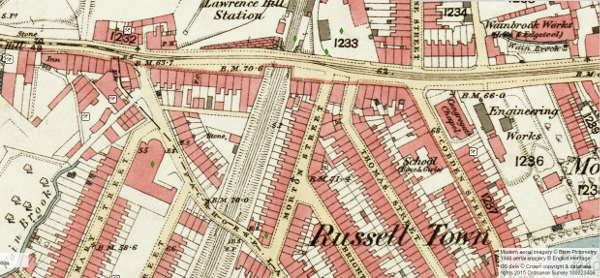
To take part, please come to Owen Square Park (map).
For further details or express your interest, contact Celia on community [at] eastonandlawrencehill.org.uk or telephone 0117 954 2834.
In addition to being a chore, there’s now more than a hint of ambiguity in grocery shopping.
Take this sign in Tesco outlets.
Is it a threat or a promise? You decide. 😉

Hat tip: @soapachu.