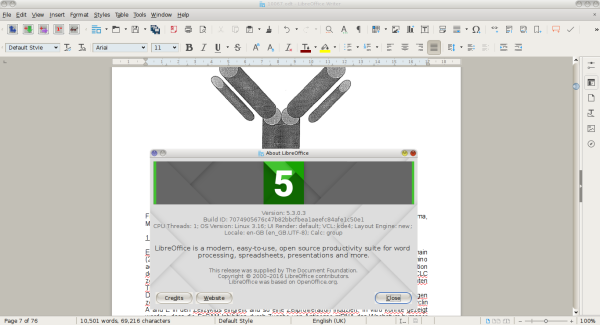
The Document Foundation’s Documentation Team has announced the release of the new Getting Started with LibreOffice guide version 5.2.
The guide has been updated to include developments in LibreOffice 5.2 and previous releases.
The guide is an introductory text for end users using the LibreOffice office suite. It is written for both individuals and organisations using LibreOffice as their preferred office suite. The text allows users to become conversant with the features and resources of LibreOffice.
The guide was produced in LibreOffice Writer in Open Document Format (ODF). The team worked to not only update the contents, but also to tidy up the formatting. This had two objectives: firstly to make the text suitable for computer-aided translation (CAT) tools and secondly to generate an online version (XHTML) of the guide.
The Getting Started with LibreOffice guide, its PDF and ODT versions, can be downloaded or read online by visiting this page, where plenty more documentation on LibreOffice is available.
Last weekend was the highlight of the Great British Spring Clean campaign when Brits were exhorted to go out and do their bit to tidy up the UK.
Bristol did its part, needless to say with the campaign dovetailing neatly into Mayor Marvin Rees’ Bristol Clean Streets campaign, for which he’s has made a pledge that Bristol will be measurably cleaner by 2020.
Marvin launched the Great British Spring Clean weekend in Bristol by returning to his old school in Easton.
Marvin Rees on Stapleton Road with children from Hannah More Primary School, plus Tracey Morgan, CEO of Bristol Waste and Kurt James, Bristol Clean Streets lead officer. Picture credit: Bristol City Council.
Litter picks were organised all over the city in both (so-called) deprived areas and prosperous communities alike, from Lockleaze to leafy and well-to-do Stockwood. It seems that litter is a problem with no class distinctions.
Needless to say the Tidy BS5 volunteers were out as well, getting their hands dirty. Two were spotted doing their own impromptu litter pick in Easton’s All Hallows Road, whilst there was a more premeditated litter pick of Owen Square Park organised by Up Our Street as part of the Love Your Community day at next-door Easton Community Centre.
In addition, Tidy BS5 also organised a stall on Lawrence Hill, near the entrance to Lidl. Leaflets featuring a residents’ pledge (along the lines of “I will do my bit to keep BS5 tidy” Ed.) were handed out to Saturday morning shoppers, mainly as a means to get them giving their views on the general state of the area. The photo below shows Hannah and Anthea on the stall, which also comprised daffodils which were handed out as a thank-you to all who stopped by.
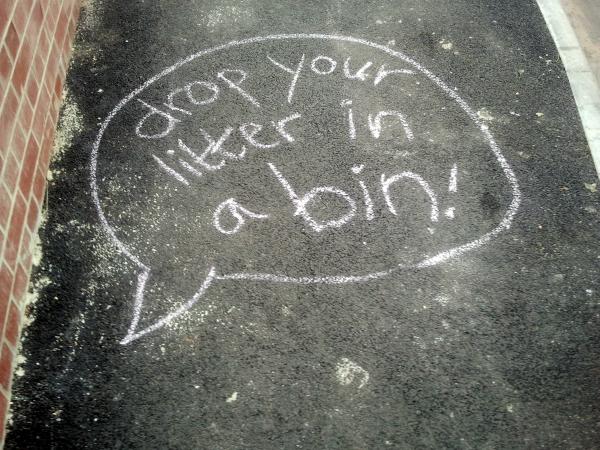
Finally, there was also some public service grafitti on the footways of Easton for the Great British Spring Clean campaign. Did it survive long enough in the weekend rain to get the message across?
There’s a skill to writing an intriguing headline that invites the reader to engage with an article.
Besides the above that skill also involves the ability to make the headline make sense.
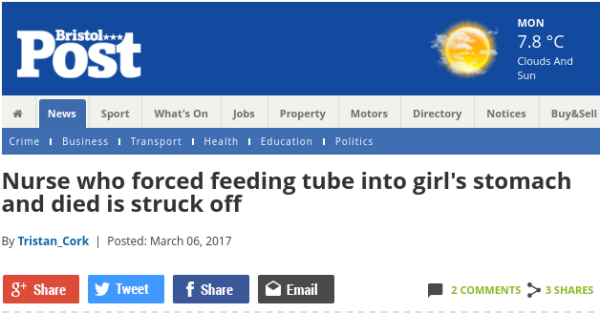
It’s an ability that seems to be lacking down at the Temple Way Ministry of Truth, headquarters of the Bristol Post, the city’s newspaper of (warped) record, as shown by the screenshot below of the head of this article.
Comments on the piece accuse the Post’s headline of not making sense, but to your correspondent it does make perfect sense… as long as nurses can get struck off posthumously.
Update 07/03/17: Perhaps prompted by the mocking nature of the comments, the headline has now been amended to reflect the gist of what actually happened.
Bing, Microsoft’s alternative to Google Translate, is used by Twitter to provide instant translation for users.
However, it isn’t very good, as this blog has repeatedly pointed out.
And it doesn’t look as if any improvements will be forthcoming soon, if the evidence below from your correspondent’s Twitter feed today is to be believed, where Bing mistook English for Estonian, a language belonging to the Finnic branch of the Uralic language family.
If Bing cannot even identify the language correctly, one has to question the quality of any translation it produces.
Some time ago in a meeting with Bristol Waste, the council-owned company responsible for cleaning the city’s streets and emptying residents’ bins, it was revealed that the company wanted to try and find commercial customers for its services.
Evidence has emerged that the company has now started seeking business customers for its collection services.
Bristol Waste employees have started handing out flyers like the one below to local shops, businesses, voluntary and community sector organisations in the Easton area of the city, all of which are responsible for making their own waste disposal arrangements (and which can be fined by the city council if these are found not be exist or be suitable. Ed.).
My informant from whom I acquired the flyer told me that Bristol Waste is trialling this scheme in Easton. This presumably follows the same line of thinking as that for the Stapleton Road waste trial (posts passim), which is generally along the lines of “if it works in Easton, we can get it to work anywhere in the city“. 🙂
Update: Bristol Waste was contacted for a comment and replied as follows:
We are speaking to businesses in a number of locations across the city including Stapleton Road, Bedminster & Avonmouth in this first phase of our commercial roll-out. The service will be available city-wide.
Besides his less endearing qualities of bullying, sexism and xenophobia, the 45th President of the United States of America is believed by some not to be very bright either, an opinion which is reinforced by the presence of a glaring typographical error in the text on his official inauguration portrait, which must at some time have passed across his desk for approval (or even been written by him. Ed.).
Proof readers and the eagle-eyed will no doubt spot it immediately, unlike POTUS did.
However, orthography and proof reading may be the least of President Typo’s worries at present. 🙂
Fake news (also called misinformation or lies. Ed.) is a term that has come to prominence recently, even though its dissemination is a far older phenomenon.
The goods and services which could be classed as fake have now been joined by another – “fake translation“. Kenya’s Nairobi News reports that a tour guide at the Serengeti National Park in neighbouring Tanzania has been arrested after incorrectly translating a tourist’s comments about the country and its people from English into Swahili.
The guide is said to have been arrested on unspecified charges on Thursday on the orders of Tanzanian Tourism Minister Jumanne Mghembe.
In an undated video clip, the tour guide translates what an English-speaking woman is saying and instead of conveying the original message’s meaning, decides to skew the visitor’s kind remarks about country completely.
An example is given below.
Visitor: “Hi. My visit to Tanzania has been beautiful and gorgeous. The people are fabulously wonderful and friendly. Greetings are always jambo. I am happy to be here. The land is beautiful, the animals are wonderful.
Tour guide: You Tanzanians complain/cry a lot about hunger. Everyday you cry about hunger when you have flowers at home. Why don’t you boil the flowers and drink [them]. It is not good to cry/complain about hunger.
The minister may have ordered the unnamed guide’s arrest as he felt the guide was either mocking the tourist or mimicking President John Magufuli, as some of the guide’s remarks echoed those used by the president at a rally last month when he called on people to stop complaining about hunger.
Tanzania is popular with tourists due to its wildlife and stunning scenery and markets itself as “The Soul of Africa“.
Yesterday The Document Foundation announced the release of LibreOffice 5.3 for Windows, macOS and Linux, as well as for the private cloud for the first time.
LibreOffice 5.3 represents a significant step forward in the evolution of this free and open source office suite: it introduces new features such as online collaborative editing and at the same time provides incremental improvements to make the program more reliable, interoperable and user-friendly.
New features
LibreOffice 5.3 offers a number of interesting new features in every area including:
a new cross-platform text layout engine that uses HarfBuzz for consistent text layout on all platforms, with significant advantages across languages and alphabets;
a revised Help menu, with new quick links to user guides and community support forums; and
better import/export filters for new and legacy MS Office documents.
New features in Writer include:
Table Styles, for applying formatting to a table which is preserved when edited; and
new Go to Page Box (activated by keystrokes Ctrl+G) makes it possible to jump to another page in the document with fewer keystrokes.
LibreOffice 5.3 Writer in action
Turning to spreadsheets, Calc provides a new set of default cell styles, with greater variety and better names than in previous releases, whilst in fresh installations, “Enable wildcards in formulas” is now the default option, rather than regular expressions, to improve compatibility with other spreadsheet software.
Impress, LibreOffice’s presentation package, now opens with a template selector to get the user off to a quick start. In addition, a new Slide Properties Deck is now available in the sidebar while in slide master mode.
As of this release, the LibreOffice UI has been extended with the addition of an experimental Notebookbar, which offers another UI option in addition to the Default UI (with two toolbars), the Single Toolbar UI and the Sidebar with a Single Toolbar. Each UI layout has been thought to serve a different cluster of LibreOffice users.
LibreOffice Online
LibreOffice 5.3 features the first source release of LibreOffice Online, a cloud office suite enabling basic collaborative editing of documents in a browser by re-using the LibreOffice “core engine”.
LibreOffice Online is fundamentally a server service and should be installed and configured by adding a cloud storage and a SSL certificate, which are not included in the package.
Builds of the latest LibreOffice Online source code are available as Docker images.
Availability
LibreOffice 5.3 is available for immediate download (your correspondent has already moved onto an as yet unreleased development version. Ed.).
However, for large scale and commercial deployments, The Document Foundation recommends the more mature 5.2.5 version (posts passim), preferably with professional support.
Labour MP Gerald Kaufman is credited with coining the phrase “the longest suicide note in history” to describe his party’s 1983 election manifesto.
Entitled “The New Hope for Britain“, the manifesto called amongst other things for unilateral nuclear disarmament, higher personal taxation for the rich, abolition of the House of Lords and the re-nationalisation of recently privatised industries such as British Telecom and British Aerospace.
In that election, Labour’s vote fell by more than 3 million compared with 1979, with the party’s representation in the House of Commons declined from 261 to 209, whilst Margaret Thatcher’s Conservative government enjoyed a 4% swing, buoyed up a wave of jingoistic fervour engendered by the conflict in the Falklands/Malvinas.
Yesterday, the House of Commons started consideration of what could be termed “the shortest suicide note in history“. Commonly known as the “Brexit Bill“, its full title is the “European Union (Notification of Withdrawal) Bill 2017“. Its purpose is grant the Prime Minister power to notify the European Union of the UK’s intention to withdraw from the EU following last year’s disastrous and divisive referendum called by the then Prime Minister David Cameron, who foolishly put the interests of his divided party above those of the country.
Confer power on the Prime Minister to notify, under Article 50(2) of the Treaty on European Union, the United Kingdom’s intention to withdraw from the EU.
Be it enacted by the Queen’s most Excellent Majesty, by and with the advice and consent of the Lords Spiritual and Temporal, and Commons, in this present Parliament assembled, and by the authority of the same, as follows:—
Power to notify withdrawal from the EU
(1)The Prime Minister may notify, under Article 50(2) of the Treaty on European Union, the United Kingdom’s intention to withdraw from the EU.
(2)This section has effect despite any provision made by or under the European Communities Act 1972 or any other enactment.
The Bill’s progress through both houses of Parliament promises to be interesting, as both major parties are still riven by pro- and anti-EU divisions, as the country still is.
Finally, let’s not forget that those critical of the EEC/EC/EU, who came to be called “Eurosceptics“, were complaining even before the ink was dry on the Treaty of Accession, so it would be most unfair – and sense of fairness is allegedly an essential part of the British character – not to allow pro-Europeans (now being termed “Remoaners”. Ed.) an equally long period to express their views, however abhorrent those opposed to the EU, who are now termed “Brexiters“.
On Wednesday, Bristol Waste held a drop-in session at the Newton Hall for residents to get some (more) feedback on trial removal of communal waste bins along the Stapleton Road corridor.
Projected onto a wall was a presentation giving some facts, figures and information about the trial removal of the area’s 164 communal bins and their replacement with regular wheelie bins and bag collections (for those with no off-street storage space. Ed.).
Since the start of the trial at the end of October/beginning of November, it seems the trial has had a drastic effect, as the following figures reveal.
Recyling: up 16.7%
Refuse: down by 40.9%
Street cleansing requirement: down by 35.8%
In addition, fly-tipping enforcement in the area has been increased, with 62 notices served on individuals on how to present waste and 16 Fixed Penalty Notices (FPNs) served on individuals. Moreover, there are currently 35 active investigations into fly-tipping from domestic properties, whilst 8 local businesses have been served FPNs and another 8 are being investigated.
The most encouraging news came at the end of the presentation, as follows:
Due to the success of the scheme in terms of reduced waste, bulky fly-tipping and increased recycling levels we are proposing that we will continue the trial until March in order to gather more data and feedback.
In March, we anticipate recommending to the Neighbourhood Partnership that the service changes we have introduced remain in place for the area.
So it looks like scenes like the one below, taken in April 2016, will finally be a thing of the past along the Stapleton Road corridor. 😀
Somewhere under that pile of furniture is a communal bin.
 The Document Foundation’s Documentation Team has announced the release of the new Getting Started with LibreOffice guide version 5.2.




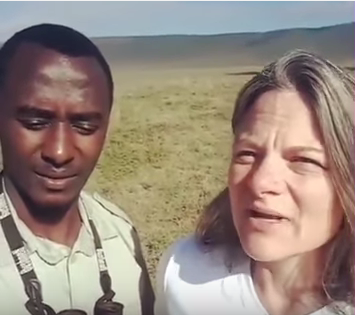 In an undated video clip, the tour guide translates what an English-speaking woman is saying and instead of conveying the original message’s meaning, decides to skew the visitor’s kind remarks about country completely.