Computer system failures in the aeronautical world are nothing exceptional, but always have a far-reaching effect, stranding thousands of passengers on the ground. This is exactly what happened last Saturday at Orly which had to halt of all its inbound and outbound air traffic for more than half an hour. Besides the inconvenience caused, it’s above all the origin of the failure that is somewhat surprising. According to the French satirical paper Le Canard Enchaîné, it was a failure linked to the Decor (Diffusion des données d’Environnement de Contrôle d’Orly et de Roissy = Orly & Roissy Environmental Control data distribution) system managing data provided by Météo France that was the culprit.
The surprising fact was this software is running on the Windows NT 3.1 operating system released by Microsoft 22 years ago, i.e. an operating system no longer supported at all by Redmond, with all the risks this involves in security terms, especially as it is connected to Météo France’s computer systems.
“The traffic was not particularly heavy on Saturday morning. But imagine during the Paris Climate Change Conference, the manoeuvring of heads of state disrupted by a piece of software dating from prehistoric times. What will that look like?”, stated an engineer quoted by Le Canard Enchaîné. When contacted by the satirical paper, the Transport Ministry gave an assurance that “equipment modernisation is planned for 2017” (no need to rush, then! Ed.).
Hardly a day goes by when the hacks at the Bristol Post exhibit the poor quality of written English so prevalent in the media nowadays; and today is no exception.
Writing about a closure of the A4174 Avon Ring Road and clearly out of his usual field of politics, reporter Ian Onions drops a real clanger which would doubtless have been picked up if the paper still employed proper, old-fashioned, omniscient sub-editors.
Having a shelf life – that’s another first for a bridge!
Shelf life is the length of time that a commodity may be stored without becoming unfit for use, consumption, or sale. In other words, it might refer to whether a commodity should no longer be on a pantry shelf (unfit for use), or just no longer on a supermarket shelf (unfit for sale, but not yet unfit for use). It applies to cosmetics, foods, medical devices, explosives, beverages, pharmaceutical drugs, chemicals, and many other perishable items. In some regions, an advisory best before, mandatory use by, or freshness date is required on packaged perishable foods.
No sign of a bridge in that list of products, unless it’s covered by “perishable items“. 🙂
The term for which Mr Onions was grasping was clearly “service life“, whose definition is once again supplied succinctly by Wikipedia.
A product’s service life is its expected lifetime, or the acceptable period of use in service. It is the time that any manufactured item can be expected to be ‘serviceable’ or supported by its manufacturer.
However, since the reports headline tried to create uncertainty about the length of any road, I reckon the Post’s objective was more concerned with whipping up emotions amongst its predominantly car-obsessed readership than with accuracy in use of the written word.
If one only read the Bristol Post, there’d be no way that residents in the wider city would have any inkling that three polluting standby electricity generating stations were currently awaiting planning permission in the European Capital of Greenwash.
Fortunately, this dreadful development has been picked up by Bristol 24/7: and here’s the unsurprising bit; they are all in the more deprived parts of the city.
It is believed these power plants will form part of the Short Term Operating Reserve (Stor) network of reserve power banks which provide additional generating capacity to feed into the National Grid at peak times.
Firstly, a planning application (ref. 15/02310/F) has been submitted on behalf of Plutus Energy for a 48 unit diesel generating plant and 2 diesel storage tanks with a capacity of 22,000 litres for 6 Feeder Road, Bristol and Avonbank, Feeder Road, Bristol, (both in the deprived Lawrence Hill ward. Ed.) close to St Philips Marsh School.
Forty-eight diesel generators will doubtless chuck out a fair old quantity of particulates, which is a component of air pollution implicated in human cancer,heart and lung damage, and mental functioning.
The applicants have not conducted an environmental impact assessment for the site since its small size (0.5 ha) is below the threshold for such a requirement. Nevertheless, local ward councillors believe such an assessment should be carried out due to the size and impact of the proposed development.
In addition, some skulduggery is evident in the noise impact assessment that has been carried out. Edward Road was chosen for the noise impact, significantly further away from the site than St Philips Marsh School. Again, local councillors think this study should be reviewed and amended to include the impact on the school and the nearby Severn Vineyard Church.
A diesel generating plant somewhere in Africa
Despite the fact that inner city Bristol already has dreadful air quality, this is not the only dirty diesel generating plant planned for the city.
An application (ref. 15/04297/F) for another such facility has been submitted for Romney Avenue in Lockleaze, another of the city’s not so prosperous areas. Once again the applicants are Plutus Energy, who want to put 32 generators on this site close to a major housing estate and obviously care very little indeed for Bristol’s air quality.
Finally, yet another application (ref. 15/04420/F) has been filed by UK Power Reserve for 10 diesel or gas generators for in in New Gatton Road in St Werburgh’s, with ten 12-metre high exhaust flues.
Below is a short video on the St Werburgh’s scheme made by local residents.
It’s quite scandalous that UK Power Reserve and Plutus Energy are even considering putting polluting power stations in or next to residential areas. On account of the need for extra domestic heating and lighting, these back-up power stations are most likely to be used on cold, foggy winter days when something called a temperature inversion occurs; this causes cold air to sink, trapping the warm air in a bubble enveloping the city, thus enabling urban pollution to build up to dangerous levels, perfect for increasing the incidence of respiratory ailments. The fact that both companies have cut corners in the form of environmental and noise impact assessments shouldn’t be forgotten.
These dangerous unwelcome schemes should be thrown out by councillors.
Finally, a language note. Over in the United States of America, this dumping of dirty, polluting and generally unwelcome facilities on poor, deprived communities has a name – environmental racism. In Wikipedia, environmental racism is defined as follows:
Environmental racism is placement of low-income or minority communities in proximity of environmentally hazardous or degraded environments, such as toxic waste, pollution and urban decay.
Although you may not realise it, Linux is the world’s largest collaborative project in the history of computing. It runs most of the world’s technology infrastructure and is supported by more developers and companies than any other operating system. In addition, it’s ubiquitous; it can be found in your phone, car and office. Besides that, it also powers the internet, the cloud, stock exchanges, supercomputers, embedded devices and more.
The latest episode of the series tries to show us how hard it is to have social connections is a universe without Linux.
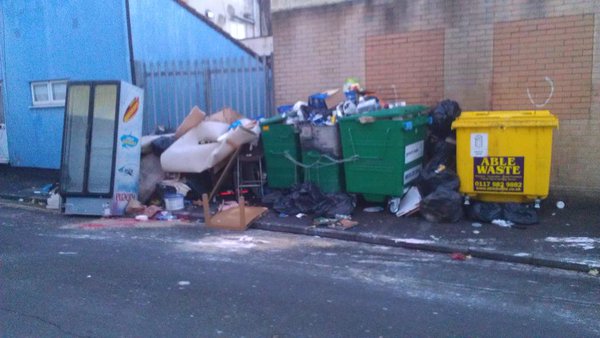
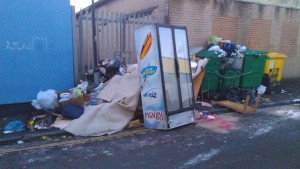
I am indebted to my friend Julien Weston for the images below of yesterday’s fly-tipping on Jane Street, a notorious fly-tipping hotspot just off Church Road in the Redfield area of Bristol (posts passim).
After 18 months of the Tidy BS5 campaign (both formally with UP Our Street and informally with residents acting on their own initiative. Ed.) to tackle litter and fly-tipping in Bristol’s Easton and Lawrence Hill wards, the cleanliness of the city’s streets doesn’t seem to be getting any better. Indeed it seems to be getting worse.
Furthermore, statistics released by central government recently reveal that Bristol is the filthiest of the West Country local authorities when it comes to fly-tipping. Fly-tipping reported to the four unitary authorities that comprise the former Avon County Council area during the 2014-15 financial year are as follows:
B&NES – 530;
South Gloucestershire – 1,359;
North Somerset – 2,343;
Bristol – 9,709.
Jane Street and the rest of Easton and Lawrence Hill wards are part of the Ashley, Easton & Lawrence Hill Neighbourhood Partnership. According to the city council’s website the Neighbourhood Partnership (NP) has the following purpose:
The Neighbourhood Partnership (NP) is about residents working with the Council to influence decisions. Its aim is to use local knowledge to make better decisions about what needs doing. It also has a small budget to spend on local improvements.
At the last NP meeting on Monday, 5th October 2015, the report of the Neighbourhood Partnership Co-ordinator promised the following change in the Area Action Plan in respect of Lawrence Hill/Church Road corridor where Jane Street is situated:
Increase responses to the ongoing problems of fly-tipping in Lawrence Hill, mainly Jane Street, Morton Street, Thomas Street, Ducie Road Car Park and Lawrence Hill.
The evidence of one’s eyes reveals that if there has been any increase in the local authority’s response, it must be starting from a very low, if not to say, almost non-existent base.
The fact that Bristol City Council allows this level of filth during its year as European Green Capital – and is seemingly helpless or hapless in tackling it – is an eloquent indictment of its treatment of its less prosperous wards like Lawrence Hill and Easton.
According to the European Green Capital website, the justification behind the establishment of the European Green Capital award is that:
Urban areas concentrate most of the environmental challenges facing our society but also bring together commitment and innovation to resolve them. The European Green Capital Award has been conceived to promote and reward these efforts.
If Bristol is prepared continually to tolerate the “environmental challenge” of high levels of persistent fly-tipping in its less prosperous districts, as well as lacking the commitment and innovation to resolve them, then I believe the city was awarded the European Green Capital accolade on false pretences.
Litter and fly-tipping are not only unpleasant to look at and live with day after day, they’re a hazard to health – both physical and mental.
Come on Bristol City Council, get your finger out and let’s not just have a tidy BS5, but a tidy city generally! Let’s see if you’re really prepared to deal with this serious level of environmental crime or are just going to carry on making placatory noises to angry residents who despair at your inability and inaction.
Footnote: my opinion of Bristol City Council’s ability and motivation to get to grips with environmental crime in Lawrence Hill and Easton has not been improved by the fact that I have reported 16 instances of fly-tipping – matching my highest daily count to date – to the local authority today. Help lighten my load by reporting fly-tipping too!
In the last year of so, the prominence of the courts interpreting contract fiasco has diminished, even though the actual problem itself has never gone away.
For instance, Wednesday’s Ilford Recorder reports that a new court date has had to be set for a man charged in connection with a stabbing in Ilford “because there were no interpreters available to translate for the defendant”.
Marcel Criahan, of Hickling Road, Ilford, appeared at Snaresbrook Crown Court via a video link yesterday after being arrested on 17th October in connection with an incident in which police found 49 year-old Florin Onea with a stab wound. After Onea died last Monday, police launched a murder investigation.
34-year-old Criahan was charged with GBH with intent on 18th October and appeared at Barkingside Magistrates Court the following day.
Today’s Guardian reports that organisers of the “Feira do grelo” food festival in As Pontes in Galicia were shocked when their event celebrating the culinary delights of turnips tops, a traditional staple turned out to be celebrating a rude part of the female anatomy.
To quote The Guardian’s piece:
But for the past few months, the small town was marketing a very different kind of festival after it used Google Translate to put the Galician word grelo into Castilian Spanish, ending up with it inviting people to take part in a “clitoris festival”.
And quoting yet again:
It meant the town’s “Feria [sic] do grelo” or rapini festival – held every February with tastings and awards for the best grelos – became “Feria clítoris” in Spanish.
Clitoris? Yes, according to Google Translate!Furthermore, The Independent adds that the error was not discovered until Castilian-speaking rapini fans visited the site to read about the upcoming festival and found themselves reading about a local clitoris festival instead of the benefits of the local vegetable.
The humorous consequences were fully reported in The Local.
The Castilian Spanish version of the town council’s website’s content about the festival included such howlers as “The clitoris is one of the typical products of Galician cuisine,” and “Since 1981, the festival has made the clitoris one of the star products of the local gastronomy.”
The reason for this embarrassing howler is that Google Translate mistakes the Galician grelo for the Portuguese word grelo – which is both the word for the vegetable as well archaic slang for clitoris.
“It’s a very serious error on the part of Google and we are thinking about making an official complaint for Google to properly recognise the Galician language so this kind of thing doesn’t happen again,” said town hall spokeswoman Montserrat Garcia.
Along with Spanish, Galician is an official language in Spain’s north-western region of Galicia, where over 2.4 million people speak the regional tongue.
Away from the world of alpha versions and bug hunting sessions (posts passim), The Document Foundation yesterday announced the arrival of LibreOffice 5.0.3 “fresh”, the 4th release of the LibreOffice 5.0 family, and LibreOffice 4.4.6, the 7th release of the LibreOffice 4.4 family. Based on feedback from both users and the media, the LibreOffice 5.0 family is the most popular version of this free and open source office suite to date.
LibreOffice 5.0.3 is more feature-rich and as such is aimed at power users and tech enthusiasts, whilst LibreOffice 4.4.6 is targeted to more conservative users and enterprise deployments as it has been in widespread use for a longer time and as such offers a better experience for document production.
For security reasons it is recommended that all LibreOffice users update their software at least to LibreOffice 4.4.6.
Both software packages include many fixes introduced since the previous versions which can be viewed here for 5.0.3 RC1 and 5.0.3 RC2 respectively and here for 4.4.6 RC1 and 4.4.6 RC3.
Download LibreOffice
Both new versions can be downloaded via the following links:
LibreOffice 5.1, the next release of the popular open source office suite, has officially entered the final stage of development with the release of the Alpha version, which has been released in time for the first Bug Hunting Session due to take place from Friday, 30th October to Sunday, 1st November (posts passim).
LibreOffice 5.1 starts twice as fast as the previous version and, as well as the usual incremental interoperability improvements with MS Office file formats (including MS Office 2016), incorporates some useful new features, such as the Chart Sidebar to change settings in a more intuitive way, easier workflow with Google Drive, OneDrive and SharePoint, plus a Style Menu in Writer.
The first LibreOffice 5.1 release candidate (RC) will be available in mid December, followed by second and third RCs in January 2016, with the release version becoming available in early February, just after FOSDEM 2016 (where LibreOffice developers will provide all the technical details about the new and improved software features).
Over the last 12 months, around 300 developers have hacked the LibreOffice source code, providing over 19,000 commits, representing a weekly average of 375 commits.
Download LibreOffice
LibreOffice is available in 2 versions codenamed “fresh” and “still” for production use*.
* Alpha and pre-release versions should only be used by technology experts or enthusiasts who don’t mind getting their fingers cut by bleeding edge software! Ed. 🙂
 Computer system failures in the aeronautical world are nothing exceptional, but always have a far-reaching effect, stranding thousands of passengers on the ground. This is exactly what happened last Saturday at Orly which had to halt of all its inbound and outbound air traffic for more than half an hour. Besides the inconvenience caused, it’s above all the origin of the failure that is somewhat surprising. According to the French satirical paper Le Canard Enchaîné, it was a failure linked to the Decor (Diffusion des données d’Environnement de Contrôle d’Orly et de Roissy = Orly & Roissy Environmental Control data distribution) system managing data provided by Météo France that was the culprit.
 Hardly a day goes by when the hacks at the Bristol Post exhibit the poor quality of written English so prevalent in the media nowadays; and today is no exception.