At this year’s Akademy conference for KDE developers, the makers of the Linux desktop environment presented a version of the Plasma desktop for mobile devices, heise reports. Plasma Mobile will be an open alternative to today’s widely used mobile operating systems, but one in which the user’s privacy and freedom are to the fore.
An early development version of Plasma Mobile is running on the LG Nexus 5. It can be deployed with the Ubuntu Phone flashing tools. The developers have their sights on a usable version for the 2016 Akademy 2016. Ubuntu Phone serves as the technical foundation upon which the Qt GUI framework and KDE Frameworks runs, together with the Wayland display manager which brings the Plasma shell to the display. In addition to KDE and Qt apps, Plasma Mobile can also runs Ubuntu Mobile apps.
Today there’s a full meeting of the elected members of Bristol City Council at 6 pm.
Each council meeting has a slot of 30 minutes allotted to statements from members of the public to raise concerns.
This evening’s meeting will be treated to 2 statements by Tidy BS5 campaigners, namely Hannah Crudgington and your ‘umble scribe.
In addition, Hannah will be screening a video of one minute duration to the assembled councillors and officers.
Hannah will also be making a statement to councillors after her video. This statement reads as follows:
I have made my home and set up my business in Easton of the last 12 years or so.
It is extremely sad to report that after an initial improvement and vibrancy, the last five years have seen a huge deterioration and this is largely due to ill thought decisions by people without practical experience of the area at grass roots level.
Bristol City Council has been made well aware of the issues of waste in BS5 and yet the problems are getting worse. In the last year, it has gone from fly tipping and litter to fly-tipping, litter and a horrendous stench. So it is no longer an annoyance or inconvenience but more a health hazard.
So what is Bristol City Council doing to resolve this, what are your time scales and finally would you put up with this?
My statement will be:
It is with a sense of profound despair and regret that I’ve watched the problem of litter and fly-tipping in the Easton area over the past few decades.
Given that Bristol is European Green Capital for 2015, it’s an absolute disgrace that scenes such as those in Hannah Crudgington’s video are a daily occurrence in the inner city.
However, fly-tipping and litter are not just an eyesore; they are a health and safety risk, attract vermin such as rats and gulls, make people feel insecure on the streets and attract anti-social behaviour; residents have observed people urinating on piles of fly-tipped rubbish and using the communal bins installed by the council as a screen for defecating in the streets.
Would you tolerate this in the area where you live? We refuse to.
Concerned residents have been raising these matters with local councillors and council officers for well over one year. Given the glacial pace at which Bristol City Council moves, it has taken that long for streetscene enforcement officers to turn their attentions to Easton and Lawrence Hill. Whilst I appreciate the enforcement officers’ efforts I feel that their presence may be a matter of too little, too late.
Furthermore, the total number of these enforcement officers is very small: there are only 6 of them to cover the whole city, far too few for the size of the city’s problems with litter and fly-tipping, which it must be remembered is not exclusive to the 2 wards in which I and other Tidy BS5 campaigners are working. I regularly receive reports – as I’m sure ward councillors do – of problems with litter and fly-tipping in Ashley, Bedminster, Fishponds, St George, Avonmouth and Lawrence Weston, to name a few more areas of our city blighted by environmental crime.
Finally, it’s worth noting that the city council employs 43 press and PR officers – more than seven times the number of streetscene enforcement officers. This suggests to me that the city council has a warped sense of priorities: it has a real citywide problem with litter, fly-tipping and other environmental crimes; it does not have a problem with weasel words.
Communal bin in Villiers Road, Easton attracting dumped furniture
The Open Document Format for Office Applications (ODF) Version 1.2, the native file format of the free and open source LibreOffice productivity suite and many other applications, has been published as International Standard 26300:2015 by ISO/IEC.
ODF defines a technical schema for office documents including text documents, spreadsheets, charts and graphical documents like drawings or presentations.
“ODF 1.2 is the native file format of LibreOffice. Today, ODF is the best choice for interoperability, because it is widely adopted by applications and is respected by applications in every area”, says Thorsten Behrens, Chairman of The Document Foundation. “ODF makes interoperability a reality and transforms the use of proprietary document formats into a relic of the past. In the future, people will tell stories about incompatible document formats between two releases of proprietary office suites as a bygone problem”.
ODF is developed by the OASIS consortium. The current version of the standard was published in 2011 and then was submitted to ISO/IEC in 2014.
The standard is available in three parts – schema, formula definition and packages – from the repository of Publicly Available Standards as a free download, as follows:
ODF 1.2 is supported by all the leading office suites and by a large number of other applications. It has been adopted by the UK Cabinet Office as the reference for all documents exchanged with the UK Government (posts passim) and is currently proposed as the reference standard by the Référentiel Général d’Interopérabilité 1.9.9 of the French Government. In addition, ODF 1.2 has been adopted by many European public sector organisations. Furthermore, in Brazil, ODF is part of the electronic government programme – Progranma do Governo Eletrônico (e-PING).
Amongst some technology enthusiasts free and open source software is promoted with a zeal approaching that of Christian evangelism, i.e. the preaching of the gospel or the practice of giving information about a particular doctrine or set of beliefs to others with the intention of converting others to the Christian faith.
Does this mean that free and open source software – also referred to by the acronym FOSS – is now a religion?
Since the foundation of the FOSS movement a couple of decades ago, there have been many developments in information technology and the working of the internet.
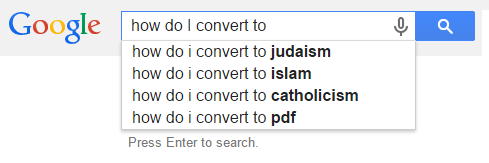
Of these one of the most notable is the development by Google of predictive search terms; as one types, Google tries to anticipate the final search string. This can have some interesting results, as evidenced by the screenshot below.
PDF – Portable Document Format – was originally a proprietary standard developed by Adobe Systems. It was released as an open standard on 1st July 1 2008 and published by the International Organization for Standardization as ISO 32000-1:2008, at which time control of the specification passed to an ISO Committee of volunteer industry experts.
No information is available as to when Judaism, Islam and Catholicism are to be released as open standards under the auspices of the International Organization for Standardization. 😉
One of the great tools not available to previous generations of those producing print for public consumption is the spell checker – an application program that flags words in a document that may not be spelled correctly. Spell checkers may be stand-alone, capable of operating on a block of text or as part of a larger application, such as a word processor, email client, electronic dictionary or search engine.
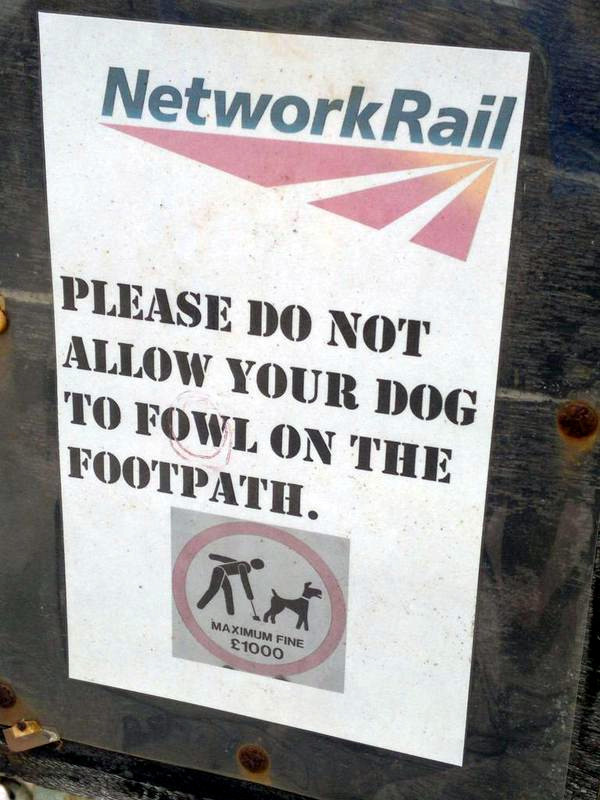
However, some people and/or organisations still seem reluctant to use them, such as UK railway infrastructure operator Network Rail, which chickened out on the occasion shown below and thus qualified for a residency in Homophone Corner. 🙂
It’s the first day of the first test match in Cardiff of the latest Ashes series being played between England and Australia.
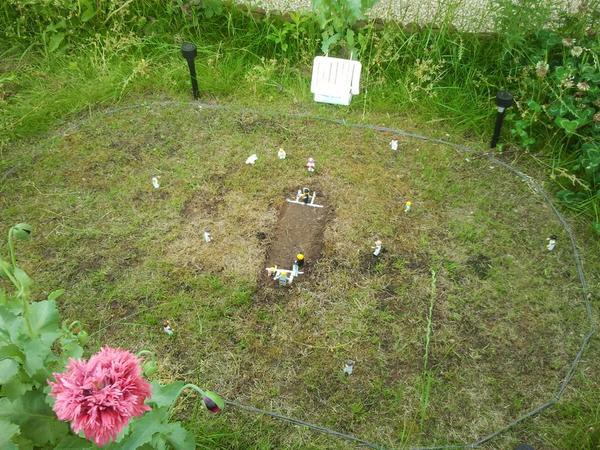
One household in Beaumont Street in the Easton area of Bristol has entered into the spirit of the occasion, as shown below.
As it’s the postage stamp-sized front garden of a terraced house, the players are a mix of Playmobil* and Lego figures, not life size.
Note the loving preparation that’s gone into the pitch, an uncovered one (naturally) in line with traditional British values and thus guaranteed to cheer the most outspoken of cricket commentators – a certain G. Boycott.
Talking of Mr Boycott, if you’re a fan of the Test Match Special radio commentary on the BBC, add to your enjoyment of the excellent commentary by Aggers, Blowers et al.; make sure you’ve got your Boycott Bingo card ready for when the world’s greatest living Yorkshireman sounds off (posts passim). 🙂
Over the weekend a new amenity – either an art installation or a new public convenience – has appeared on the A420 Lawrence Hill in east Bristol.
If the latter, it’s conveniently located next to the site of Lawrence Hill’s original Victorian public lavatories, sadly demolished some years ago by Bristol City Council and the site sold off to developers.
Public convenience or crap art installation?
Continuing with the theme of convenience, if it is a new public lavatory – whether provided at public expense or by the private sector – it will no doubt come as a relief to the thousands of commuters from Kingswood, Hanham and other parts of South Gloucestershire who clog up the A420 inbound on weekday mornings and outbound on weekday evenings respectively.
However, I suspect it is the work of east Bristol’s shadowy network of fly-tippers, in which case it needs reporting to Bristol City Council. 🙂
According to Alessandro Tomasicchio, the councillor with responsibility for technological innovation, “In this way we guarantee the participation of citizens in public sector decision-making.”
In addition, the council is adopting ODF – the standard file format of LibreOffice and other open source office suites – as the standard file format that meets all the authority’s technical requirements.
Management of the project entails various kinds of skills, from the analysis of flows of documents within the council to the management of interactions between users and IT systems. Great attention has been paid to staff training and internal communication, which are regarded as fundamental elements for achieving the local authority’s goal.
After analysing the software solutions available and practical testing, the Innvoation Department decided to adopt the free and open source LibreOffice suite, which is compatible with other proprietary office suites, including MS Office currently used by Bari.
The choice of LibreOffice, unlike proprietary software, is compliant with the provisions of Article 68 of the [Italian] Digital Administration Code and the Apulia Region‘s law on the adoption and promotion of open source by public sector organisations.
By the end of the current year at least 75% of Bari’s workstations will migrate from Microsoft Office to LibreOffice.
Antonio Cantatore, head of Bari’s Innovation Department also stated that one reason for switching to LibreOffice would be major savings in the total cost of ownership (TCO). By not having to pay licence fees to Microsoft for the Office package currently installed on 1,700 of Bari’s workstations, the local authority is looking at costs savings €75,000 +VAT.
The Call for Papers is still open until 15th July 15, 2015. Tracks for papers are based on Development, Quality Assurance, Localization, Documentation and Native Language Projects, Ease of Use, Design and Accessibility, Migrations and Deployments, Certifications and Best Practices, ODF, Document Liberation and Interoperability and Building a Business around LibreOffice.
The conference website also includes some practical info about travel and accommodation.
As a result, there have been some strange coloured – one might almost say greenwashed – buses thundering through this proud and ancient city, as captured below.
FirstGroup bus in full greenwash livery
However, FirstBus has also been able to buy a ‘greenwash-lite‘ version for its sponsorship that consists of the Bristol Green Capital logo slapped on top of its usual ‘Barbie‘ livery.
The flanks of the Barabie double-deckers now have the Bristol Green Capital logo splashed across their sides, whilst the single-deckers have a smaller version the logo above the driver’s cab.
Barbie meets greenwash
Whilst public transport is a greener option than using a private motor car, emissions from the diesel fuel on which buses run.
According to Wikipedia:
It is reported that emissions from diesel vehicles are significantly more harmful than those from petrol ones.Diesel exhaust contains toxic air contaminants and is listed as carcinogen for humans by the IARC (part of the World Health Organization of the United Nations) in group 1. Diesel exhaust contains fine particles which are harmful. Diesel exhaust pollution was thought to account for around one quarter of the pollution in the air in previous decades, and a high share of sickness caused by automotive pollution.
Any resemblance between the full greenwash livery and the British Racing Green livery of the old Bristol Omnibus Company is purely coincidental.

 ODF defines a technical schema for office documents including text documents, spreadsheets, charts and graphical documents like drawings or presentations.