Bristol

  • Fresh instructions = filthier streets

    Since your correspondent starting campaigning seriously on litter and fly-tipping some 2 years ago, he’s become quite well known to the crews of the dustcarts and the local street sweepers.

    Both these bodies of men (and they are all men. Ed.) quite often stop me in the street to exchange a few words and from them I’ve gleaned much valuable information, such as e.g. how there’s only one 5 tonne truck assigned to patrolling the streets of Bristol and collecting the fly-tipping that’s reported – a textbook example of woeful under-resourcing.

    From these gentlemen I’ve received more reliable and concise information in a few minutes about the state of play in Bristol’s waste management arrangements than I’ve received in interminable hours of meetings with the council officers set over them who fly desks to earn their crust.

    A short while ago while I was heading down the Stapleton Road, the dustcart pulled up beside me and the driver told me that he and his colleagues had received fresh instructions. They were not to pick up fly-tipping such as black plastic refuse sacks that had been dumped alongside the area’s notorious communal bins (posts passim), but this was to be left in situ for collection and examination for enforcement purposes. However, this might be a fruitless exercise, as the city council has admitted in meetings that only 3% of the fly-tipping collected off the streets comprises any evidence that might point to the criminal who dumped it.

    Both the dustcart crews and I could see the result of these new orders: any fly-tipping not cleared as per the previous arrangement by dustcart crews would be left on the street for longer, making the place look grottier, as well as constituting a health risk, e.g. if it had sharp edges or was a hazardous substance; and if the fly-tipping contained food waste this would also be a health risk, as well as attracting vermin such as gulls and rats.

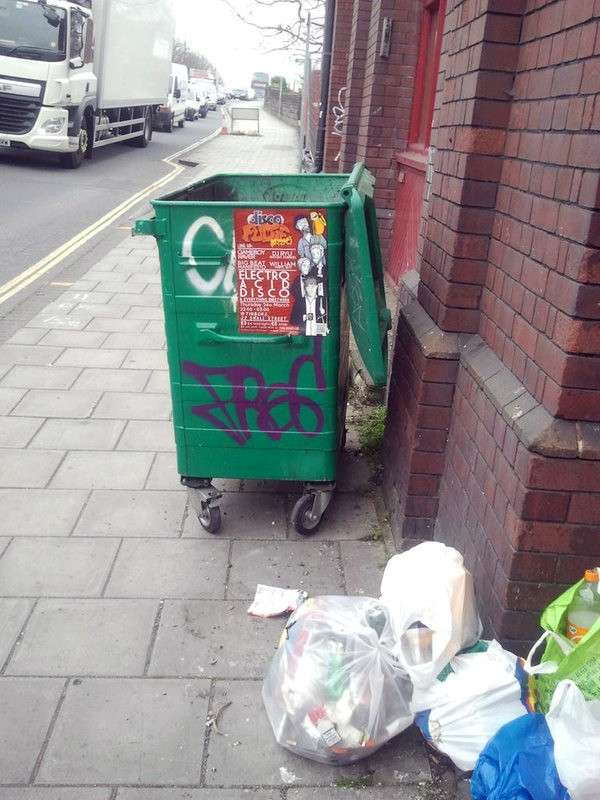
    The result of this new policy can be seen in the photograph below, which was taken on Lawrence Hill on Tuesday after the communal bin had been emptied by the chaps from Bristol Waste.

    waste left by communal bin after collection
    Bristol City Council endorses institutional squalor for east Bristol. Note the added grot factor provided by the tagging and fly-posting on the communal bin.

    There are times when I wonder if I’m wasting my time fighting litter and fly-tipping in east Bristol, particularly when it seems I and my fellow campaigners are also having to fight the idiocies emanating city council and Bristol Waste, its arms-length, wholly-owned waste management company as well.

  • West of England devolution: I write to my MP

    For as long as I can remember in my adult life, I’ve listened to budget speeches with a mixture of incredulity and a sinking heart. This is usually because Chancellors of the Exchequer have more often than not made drinking beer – one of life’s pleasures – more expensive.

    Fortunately that didn’t happen this time round.

    However, Wednesday’s offering from Gideon Oliver Osborne (aka George or Gidiot. Ed.), prompted me to write to my MP, Thangam Debbonaire, on the devolution deal for the West of England (PDF).

    Dear Thangam

    I trust you’ve fully recovered from your illness.

    I write on the above subject to express my concerns in the wake of yesterday’s budget.

    Whilst I would welcome increased public money for the area, I do feel that the manner in which this will be accomplished needs lots to be desired.

    I have downloaded and read the final draft of the deal agreed between central government and the 4 local authorities and this has increased my concern.

    I feel very much that this devolution deal is being done to us rather than for us residents. This feeling is reinforced by the fact that there has been little or no public consultation to the best of my knowledge, nor will the public have any say on the final outcome. It’s a prime example of top-down imposition.

    When this matter was tabled by Easton ward councillor Anna McMullen at the last Ashley, Easton & Lawrence Hill Neighbourhood Partnership, there was condemnation of the lack of consultation and the short amount of time remaining before this devolution deal was imposed.

    At that meeting I expressed my concern that this could be regarded the reinstatement of the little-loved Avon County Council via the backdoor. In yesterday’s Bristol Post, Liam Fox MP is quoted in the Bristol Post as saying

    “I will be making it very clear to all my councillors that I’m very opposed and I hope they will reject this.

    “It is the recreation of the Avon and the agreement would be for a metro mayor that voter have never given their assent for.

    “It is another layer of bureaucracy and it is undemocratic. It recreates the very organisation that we fought so hard to get rid of.”

    (Source: http://www.bristolpost.co.uk/1billion-devolution-deal-Bristol-region-looks/story-28936550-detail/story.html)

    It is not very often I find myself coming out with similar sentiments to that particular gentleman.

    I really feel that we, those who will be affected by this devolution measure should be firstly consulted on it and secondly have the chance to vote on both the deal itself and the creation of the office of metro mayor. However, I am not very encouraged that we shall have the chance to do so as I was notified via Twitter yesterday by a contact in Manchester that their metro mayor was imposed with no public input whatsoever.

    Reading today’s Bristol Post, I note that Pat Rooney in S. Gloucs. wants to see a referendum held on any metro mayor. I fully support this move.

    (Source: http://www.bristolpost.co.uk/Referendum-held-decide-Metro-Mayor/story-28942606-detail/story.html).

    Given the concerns of many active citizens both in the city and surrounding areas is there anything that can be done to ensure proper public input to the devolution process, which I feel is destructive of local democracy, piecemeal and ultimately bound to end in a real dog’s dinner.

    Yours etc.

    In the two days since the Budget, a petition has also been organised to reject the devolution deal that was concocted in secret by a bunch of middle-aged white men (who always think they know what’s best of us. Ed.).

    The petition’s text reads:

    The Chancellor of The Exchequer announced on March 16th a scheme to devolve powers to a Metro Mayor in Bristol, Bath and surrounding areas. Given that B&NES rejected an elected Mayoral model one week earlier, this new announcement seems to be at variance with the electorate’s preferences.

  • Election special: language Luddites ban purdah

    On 5th May elections will be held in England for local councils, local police and crime commissioners and in Bristol the elected Mayor.

    As part of the election process, there’s a period before the announcement of the election and the final election results in which central – in the case of general elections – and local government is prevented from making announcements about any new or controversial government initiatives (such as modernisation initiatives or administrative and legislative changes) which could be seen to be advantageous to any candidates or parties in the forthcoming election.

    This period has traditionally been called “purdah” after the practice in certain Muslim and Hindu societies of screening women from men or strangers, especially by means of a curtain. “Purdah” itself originates from Urdu and Persian “parda“, meaning a “veil” or “curtain“.

    Bristol City Council logo with sinking shipEarlier this month I attended the quarterly meeting of Bristol’s Ashley, Easton & Lawrence Hill Neighbourhood Partnership. At this meeting attendees were clearly told by the officer serving the partnership that “purdah” was no longer an acceptable term and that the time in question should be referred to as the “pre-election period“.

    This occurred after “purdah” had already been used a few times by elected councillors and makes your correspondent wonder if colourless, unaccountable, unelected council officers (whose wages we pay. Ed.) should be allowed to dictate the vocabulary which is used in meetings.

    I don’t think they should.

    Do you agree or disagree with my conclusion? Please comment below.

  • A salacious street name

    Last Thursday I was in Shrewsbury, county town of the county of my birth. Shrewsbury is steeped in a wealth of medieval history, including plenty of ancient street names (mostly based upon the shops sited there – e.g. Butcher Rown, Fish Street, etc. Ed.), amongst them the intriguingly titled Grope Lane.

    Grope Lane sign
    Grope Lane street sign
    A look back down Grope Lane towards High Street
    A look back down Grope Lane towards High Street

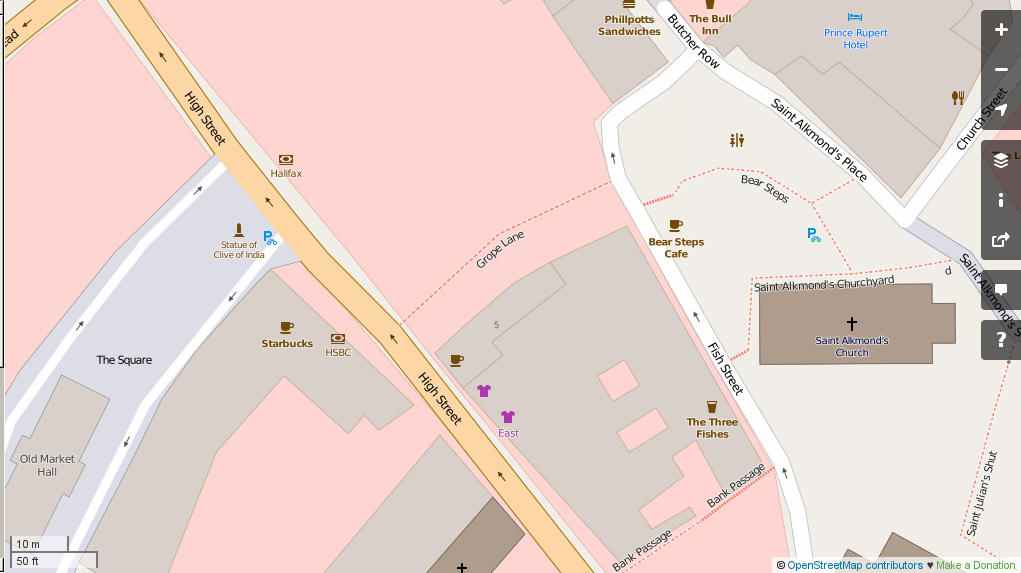
    Grope Lane in Shrewsbury is a narrow alley connecting High Street and Fish Street in the heart of the old medieval town, as shown on the location map below.

    Location of Grope Lane in Shrewsbury
    Location of Grope Lane in Shrewsbury. Image courtesy of OpenStreetMap. Click on image for full-sized version

    As with many towns in the Middle Ages, Shrewsbury’s Fish Street (and nearby Butcher Row. Ed.) are named after the trades that occupied them. However, Grope Lane is also reputed to be linked to trade – this time the pleasures of the flesh.

    Wikipedia has an excellent page on this street name in its unsanitised version.

    Gropec*nt Lane, says Wikipedia, was a street name found in English towns and cities during the Middle Ages, believed to be a reference to the prostitution centred on those areas… Gropec*nt, the earliest known use of which is in about 1230, appears to have been derived as a compound of the words grope and c*nt (our medieval forebears were less sensitive and more earthy in their use of language than their modern descendants, as anyone who had read Chaucer in the original Middle English can testify. Ed.). Streets with that name were often in the busiest parts of medieval towns and cities.

    Towns and cities with active quays or ports often had an adjacent Grope(c*nt) Lane, as in the case of Bristol, although that street name recorded in the reign of Edward III (1312-1377), was subsequently changed to Hauliers Lane and has since been changed again (see below).

    Although the name was once common throughout England, changes in attitude resulted in its replacement by more innocuous versions such as Grape Lane. A variation of Gropec*nt was last recorded as a street name in 1561.

    In Shrewsbury a street called Grope Countelane existed as recently as 1561 and connected the town’s two principal marketplaces. At some unspecified date the street was renamed Grope Lane, which it has retained to the present day. In Thomas Phillips’ History and Antiquities of Shrewsbury (1799) the author is explicit in his understanding of the origin of the name as a place of “scandalous lewdness and venery”, but Archdeacon Hugh Owen’s Some account of the ancient and present state of Shrewsbury (1808) describes it as “called Grope, or the Dark Lane”. As a result of these differing accounts, some local tour guides attribute the name to “feeling one’s way along a dark and narrow thoroughfare”.

    Other towns and cities in England also had their own local Grope(c*nt) Lane including the following:

    • London (several examples);
    • Bristol (now called Nelson Street);
    • York;
    • Newcastle upon Tyne;
    • Worcester;
    • Hereford;
    • Oxford (now Magpie Lane);
    • Norwich (now Opie Street);
    • Banbury (now Parsons Street);
    • Glastonbury (now St Benedicts Court); and
    • Wells (initially changed to Grove Lane, now Union Street).
  • Bristol to increase fly-tipping enforcement

    Yesterday Bristol City Council set its budget for the next financial year.

    While the Bristol Post’s report concentrated on the 4% increase in council tax and Bristol’s donation of £500,000 for a Concorde museum in neighbouring South Gloucestershire, its political editor, Ian Onions, somehow managed to omit some important news for those fighting environmental crime in the city.

    This news was that the city council will be employing two more so-called “streetscene” enforcement officers next year, bringing the total number of these officers employed by the city council to 8. These officers are responsible for bringing fly-tippers and litter louts to book.

    photo of Marg HickmanLawrence Hill ward councillor Marg Hickman conveyed this news to Tidy BS5 campaigners yesterday evening, stating that the Labour group’s amendment calling for the 2 additional officers was the only amendment to the Mayor’s budget to receive 100% support in the council chamber.

    Marg was one of 2 councillors to speak to the amendment (another colleague spoke on dog fouling, another of the blights of urban life, in support of the amendment. Ed.). Her speech is transcribed below and conveys many of the sentiments that Tidy BS5 campaigners have been voicing to the council for the past 2 years, with the local authority’s lack of action to date neatly summarised by the phrase “glacial speed of change“, although your correspondent reckons that glaciers actually move faster than Bristol City Council and a more accurate comparison would be with tectonic plates.

    Institutional neglect has been the impact of Green Capital on parts of the city. What is certain is that, when it comes to the cleanliness of most areas of the city, this much-praised initiative has had minimal effect.

    In 2013/14 Bristol had the unenviable status of the dirtiest place in the South West. According to government statistics, Bristol residents reported 10,472 incidents of fly-tipping – can you imagine how many more unreported incidents there must have been? It was with this statistic as a backdrop that the number of street scene enforcement officers was cut in 2013 from 10 officers, plus support staff and 3 dog wardens, to approximately 6 today. In comparison I can reveal that during our Green Capital year we had an army of PR experts – 45 in total – all employed to make the council look good. Well, I know, and I am sure many of you would agree, that our residents would prefer it if we employed more people to keep our communities looking good rather than ourselves.

    There seems to me to be complacency in the council regarding the unacceptable levels of fly-tipping and litter in areas from Lawrence Hill and Eastville to Lawrence Weston, and it is compounded in the south of the city by the Mayor’s refusal to sign off the waste recycling centre in Hartcliffe.

    In BS5, one of the city’s fly-tipping hotspots, which stretches from across the road from Cabot Circus to Eastville, there have been 32 enforcement actions taken against people. This low level of enforcement is because of the cuts and the lack of ongoing training and development of the enforcement staff. We need to augment our street enforcement officers and provide proper support and training, and learn from best practice from around the country to deal with the issue of waste at a time of shrinking budgets.

    We have to support communities across Bristol blighted by this environmental eyesore and come up with solutions that work. We need to consult affected communities, speed up the glacial speed of change, and increase the number of properly trained and supported enforcement officers.

    We have before us an amendment that will get the ball rolling and help kick-start the change we need to clean up our streets. Surely money would be better spent on this rather promoting more and more PR people.

    We would all benefit from this amendment. The communities you serve would benefit and Bristol as a whole would be a cleaner and happier city. Please support this amendment today so that Bristol can be the cleanest city in the South West and not the dirtiest.

  • Signal failure

    Where Bristol has the Bristol Post, formerly the Bristol Evening Post, as its newspaper of record (warped. Ed.), the Potteries has The Sentinel, formerly the Evening Sentinel.

    Both newspapers now belong to the Local World stable and share many common features: the content management system running their websites, difficulty in distinguishing editorial content from advertising, a cavalier attitude to the correct use of the English language and so on.

    Yesterday’s Sentinel carried a report of a railway signal failure in the Stafford area.

    The report was helpfully illustrated with a photograph as per the screenshot below.

    Shrewsbury's Severn Bridge junction and semaphore signals incorrectly captioned as Stafford by clueless Sentinel hacks

    The photograph is also helpfully captioned, as follows:

    DELAYS: Rail services have been hit by signalling problems at Stafford.

    It is evident for a number of reasons that the anonymous members of the Sentinel’s “Digital_team” who put together this report are no great users of the railway network.

    Firstly, the photograph shows semaphore signals. These are not used at Stafford, which lies on the West Coast Main Line, where semaphore signals were removed and replaced with colour light signals many decades ago.

    Secondly, the plate on the signal mast identifies the signals as part of the Severn Bridge Junction signal complex.

    Thirdly, what is the Abbey Church of St Peter & St. Paul in Shrewsbury doing in the background, lurking behind the largest sempaphore signal box in the country? 😉

  • A new perishable commodity: nuclear missile submarines

    It’s said that “to err is human“; and journalists are no exception to this.

    Some while ago, a hapless hack at the Bristol Post, disclosed to an unbelieving city readership that bridges have a shelf life (posts passim).

    Now it seems that bridges have been joined on the shelf by another perishable commodity – submarines carrying the UK’s nuclear deterrent.

    Reporting today on the pro-Trident stance of Bristol MPs Kerry McCarthy and Karin Smyth, political correspondent Patrick Daly lets the cat out of the bag:

    The four submarines, which carry nuclear warheads, are due to come to the end of their shelf-life by the late-2020s…

    A Vanguard class submarine capable of carrying Trident missiles leaving the Forth of Clyde
    A Vanguard class submarine capable of carrying Trident missiles leaving the Forth of Clyde. Image courtesy of Wikimedia Commons

    For those who need some explanation of the definition of shelf life, Wikipedia has a very useful article which starts as follows:

    Shelf life is the length of time that a commodity may be stored without becoming unfit for use, consumption, or sale. In other words, it might refer to whether a commodity should no longer be on a pantry shelf (unfit for use), or just no longer on a supermarket shelf (unfit for sale, but not yet unfit for use).

    As one of these four submarines is supposed to be at sea at all times, perhaps Mr Daly would care to explain to his readers, why the quartet is cluttering up the quartermaster’s stores instead. 😉

    Alternatively, perhaps Patrick could learn the definition of the term “service life“. 🙂

    Update 12/02/16: The piece has since been amended and the offending “shelf-life” replaced.

  • Is Cabot Circus employing Smurfs?

    The modern mobile phone is a sophisticated and very useful item: mine is a miniature marvel – a Linux-based computer that fits comfortably in the hand, plays music, acts as a radio, takes video and still images and also allows me to make telephone calls.

    Venturing into central Bristol, one notices that nearly everyone one passes has one and entering the Cabot Circus shopping centre – that latter day monument to retail therapy – is no exception to this general observation.

    Having noticed a couple of years ago that visitors to Cabot Circus have their progress around that Temple of Mammon tracked by means of their mobile phone signal (posts passim), it has been my practice ever since to turn my mobile phone off before entering; and I don’t turn it back on until I’m well clear.

    Cabot Circus mobile phone recharging cabinetIt’s bad enough being tracked from shop to shop, but there’s another threat to the privacy and security of mobile phones and their users in Cabot Circus… but you’ll only discover it if you happen to use the mobile phone charging points (shown left) kindly provided by the centre’s management.

    On the face of it, these charging points – 3 in number – are a boon to visitors. After all, who hasn’t been in a situation where one’s battery is running low. It does seem benevolent of the managers of Cabot Circus to provide half an hour’s gratis battery top-up, doesn’t it?

    Now, you remember me saying about turning my phone off before entering? Good! With my device switched well and truly OFF I have now placed my phone in the recharging facility whilst paying a call of nature. Upon return a few minutes later, I have in each instance retrieved by phone from the locker – and found it to be switched ON!

    Needless to say out of consideration for my security and privacy, I shall not be using one of these charging points again.

    As regards using the mobile phone charging points, the Cabot Circus website states the following:

    Because we want our visitors to have a stress free [sic] shopping experience within our centre, Cabot Circus has now installed three ChargeBox phone charging stations, ideal for when your battery goes flat at the most inconvenient times.

    Easy to use in three simple steps, connect your phone, lock, take the key and relax. The ChargeBox stations allow you to charge your phones for free and enjoy 30 minutes extra shopping time!

    The ChargeBox stations at Cabot Circus are located:

    – Level 1 outside Costa
    – Upper Ground at the Information Desk
    – Ground floor toilet lobby

    Curiously, there’s nothing in the above text that I can see about the points’ ability to turn on a mobile phone that’s been switched off.

    However, let’s be generous and assume that specific piece of information was omitted by mistake. 🙂

    When I charge my turned-off phone elsewhere, either by using a USB cable connected to a PC/laptop or the adapter that came with it, it definitely stays off. That being so, I began thinking how could the lovely folk at Cabot Circus generously providing me with free electricity be turning my phone back on when I’d left it firmly switched off.

    A quick internet search reveals no logical or plausible benign explanation as to why a switched-off phone is turned on by the charging station.

    The only tools of which your correspondent is aware for doing such things to a mobile phone is the Smurf suite of tools used by the British State’s snoopers at GCHQ, as revealed by NSA whistleblower Edward Snowden. In this suite of tools, one called “Dreamy Smurf” can allegedly turn a phone on or off, whilst another called “Nosey Smurf” can activate a phone’s microphone to use it for audio surveillance. “Tracker Smurf” is a geo-location tool that Snowden says offers a more accurate method of locating a phone and its carrier than using triangulation. Another Smurf can operate a smartphone’s camera, while “Paranoid Smurf” does its best to hide the activities of the other Smurfs.

    One therefore has to wonder whether that the operators of Cabot Circus, by turning visitors’ phones on, are infringing their privacy and presenting a security threat to their mobile devices.

    Care to come clean, Cabot Circus, on whether you’re employing Smurfs or using something analagous?

  • Tidy BS5 at the Mayor’s Question Time

    George Ferguson looking trustworthyOn Wednesday evening Bristolians had an opportunity to question the city’s elected mayor, George Ferguson, at the City Academy on Russell Town Avenue.

    Your ‘umble scribe attended, hoping to ask George a question on the city council’s dreadful record on keeping on top of fly-tipping, litter and other environmental crimes within the city as a whole and east Bristol in particular.

    The session was chaired by BS5 resident and freelance journalist Pamela Parkes, who did an excellent job.

    Your correspondent was successful in putting his question to the mayor, which read as follows:

    This year Stoke-on-Trent City Council managed to find £750K of additional funding to tackle environmental crimes such as fly-tipping. What additional budget allocations will the mayor be making this year to emulate the Potteries?

    Needless to say, the mayor ducked answering the additional funding bit (from which one can infer that no additional resources will be made available in Mr Ferguson’s forthcoming budget. Ed.) and laid great emphasis on £80m cuts imposed by central govt. on Bristol and how much Bristol City Council was actually spending on waste management in Bristol. I thought most of his answer was emollient waffle, blustering about the establishment of Bristol Waste, early days for them etc. However, facilitator Pamela Parkes pointed out that despite all the campaigning by residents, both informally and formally under the banner of Tidy BS5, the situation locally hasn’t improved at all. To be fair to George Ferguson, he did make a good point about the need to promote the repair and reuse of consumer goods, to reduce the amount going to landfill.

    George then handed over to the head of Bristol Waste whose name I cannot remember. She made the point that fly-tipping had remained constant in Bristol over recent years. When challenged about the level of fly-tipping – four times that in neighbouring local authorities, back came the defeatist line that fly-tipping is always higher in cities.

    So overall it looks like there will be little change in the council’s competence or motivation in tackling fly-tipping in the city

    Besides my question, others tackled the mayor on education, housing and homelessness, the treatment of BME communities (following the cancelling of this year’s St Paul’s Carnival and current management problems at the Malcolm X Centre) and transport.

    At the end there was a lively open session, during which there was a lot of hostility to the mayor from the public on various matters – the previously mentioned carnival and Malcolm X woes, growing Islamophobia, declining community cohesion and the total waste of Green Capital (which GF characterised as the most successful Green Capital year yet. Ed.), to mention but a few.

    George placed great emphasis on his listening skills, stating he’d listen to anybody. However, he has past form in his post-listening dismissals of members of the public. This was not lost on his audience on Wednesday, one of whom queried along the lines of: “You may be listening George, but are you hearing what they’re saying to you?”

    T-shirt slogan I've listened now f**ck off
    A T-shirt design produced after George’s dismissal of a member of the public in 2013. Picture courtesy of Wikimedia Commons.

    In the end the session overran and City Academy staff were heartily thanked for sacrificing their time so generously.

Posts navigation