Politics

  • Public money, public code – new FSFE brochure

    Let’s start with a trio of questions.

    1. Why should governments develop free software*?
    2. Where is free software already generating benefits in the public sector?
    3. What are free software business models?

    Answers to the above questions and practical guidelines are given in the new expert policy brochure published today by the Free Software Foundation Europe.

    Entitled “Public Money Public Code – Modernising Public Infrastructure with Free Software“, the brochure aims to answer decision-takers’ questions about the benefits of using and developing free software for public sector organisations.

    To help understand the important role that public sector procurement plays in this, the brochure presents an overview of EU free software projects and policies, uncovering legislation on software procurement.

    The FSFE will use this brochure in the forthcoming European Parliament elections to inform potential MEPs how to speed up the distribution and development of free software in the public sector and putting appropriate legislation in place.

    Download the brochure (PDF).

    Front cover of FSFE brochure

    The brochure evaluates the modernisation of public infrastructure by using free software from the perspectives of academia, law, business and government. Expert articles, reports and interviews help readers to understand the opportunities for free software in the public sector. Practical guidance is provided for decision-makers to move forward and start modernising public infrastructure with free software.

    FSFE President Matthias Kirschner states: “Free software licences have proven to generate tremendous benefits for the public sector. This is not a trend that will pass, but rather a long-term development that is based on very positive experiences and strategic considerations resulting from serious vendor lock-in cases in the past. In a few years, free software licences could become the default setting for publicly-financed IT projects. The Free Software Foundation Europe watches these developments very carefully and we want to contribute our knowledge to support the public sector in this transition.”

    Initial steps for making free software licenses the default in publicly-financed IT projects are outlined in the brochure. Other topics include competition and potential vendor lock-in, security, democracy, “smart cities” and other important contemporary topics. The language and examples used have been specifically chosen for readers interested in politics and public administrations.

    The brochure features leading experts from various ICT areas. Amongst others, these include Francesca Bria, Chief of Technology and Digital Innovation Officer (CTIO) for the Barcelona City Council, Prof. Dr. Simon Schlauri, author of a detailed legal analysis on the benefits of free software for the Swiss canton of Bern, Cedric Thomas, CEO of OW2, Matthias Stürmer, head of the Research Center for Digital Sustainability at the University of Bern and Basanta Thapa from the Competence Center for Public IT (ÖFIT) within the Fraunhofer Institute for Open Communication Systems.

    The brochure is available in both digital and printed formats, and is published under a CC BY-SA 4.0 licence and I’ll be sending a copy of the PDF to my MP for her information.

    * = In this context the definition of free software is free as in freedom, not beer.

  • The value of understanding

    It seems we live in a society that knows the cost of everything and the value of nothing.

    On Monday Kent Online reported that Kent County Council is expecting to spend £1.5 million more than the central government funding it has received to support unaccompanied asylum-seeking children (UASC) who left the care system during the current local authority financial year.

    The county has received a total of £6.9 million from the Home Office and Department for Education to help more than 900 young people who have entered the UK unaccompanied, but is looking at costs of £8.4 million.

    According to council officers, part of the problem is apparently “a shortage of translators [sic] living in the area.”

    However, one reason for the higher costs can be laid firmly at the government’s door. The government has decided to extend support for all care leavers up to the age of 25 years; it was previously 21.

    Legal costs and the immigration application process are also factors that have resulted in higher costs.

    Kent’s Director for children’s integrated services, Sarah Hammond, seems to understand the value of interpreters. She is reported as saying the following:

    It’s absolutely critical both for the young people and social workers that there is no window of doubt what the young person is saying. For that reason, we have to use trained and certified interpreters.

    The validity of the assessment work we do would fall away if we were not able to demonstrate we had the right quality and accreditation of a translation body – and that comes with significant costs.

    The reality is the majority of interpreters are coming from outside of the county, so we are incurring travel costs as well as their professional fees.

    The very words Kent Online quoted Sarah Hammond as saying shows that she at least recognises the value of understanding. Young refugee people leaving care might not always have had much opportunity to become fluent enough in English to deal with whole panoply of officialdom and bureaucracy one has to deal with once past the age of majority in the UK; and one way to ensure both parties achieve full comprehension is by using qualified linguists.

    The consequences of using unqualified interpreters has been amply illustrated down the years by the Ministry of Justice’s disastrous outsourcing of police and court language services, which is still continuing, as shown by this example from the north east of England.

    Ms Hammond’s comments are in marked contrast to the reaction of the sole councillor quoted, Conservative Rosalind Banks, who remarked: “I suspect if the translation costs were made known to the average resident of Kent, they might turn around and say I’m sure this could be done a lot cheaper“.

    Cheaper, councillor? We linguists are skilled professionals, in case you hadn’t noticed.

    Needless to say, the councillor’s ignorant, penny-pinching sentiments are reflected in the comments below the piece, the majority of which are xenophobic, if not bordering on the racist.

  • West Oxfordshire – first sighting of Brexit unicorn?

    Former Conservative Prime Minister David Cameron will go down as one of the UK’s worst peacetime Prime Ministers.

    In a bid to solve a decades-old breach in his party caused by xenophobes, racists and Europhobes, he organised an “in-out referendum” on the United Kingdom’s membership of the European Union.

    Once the referendum came up with the wrong result, Cameron immediately ran away and left others to clear up the mes he left behind, a process at which his successor Theresa May and her ministers have failed spectacularly and serially, highlighting the shallowness of the Tory Party talent pool.

    My brother and his family have the misfortune to live in “Call Me Dave” Cameron’s former constituency of Witney.

    Even though his Witney constituency voted to remain in the EU in the MP’s disastrous referendum, there might just be changes afoot.

    A unicorn, a supposedly mythical beast, with which supporters of remaining in the EU mock the extravagant and totally unreal promises made by the Leave campaign, has appeared in one of Witney’s main shopping streets, as photographed yesterday by your ‘umble scribe.

    a papier maché unicorn spotted in Witney Oxon
    An odd stance. What’s the beast trying to do?

    The reason for the unicorn’s unusual stance is unknown.

  • Cheese toastie shocker

    Yesterday’s online version of the Bristol Post (now renamed Bristol Live. Ed.) carried a shocking item about a hitherto unknown catalyst for violence: the toasted cheese sandwich.

    According to the Post, this humble snack may not be served at a proposed catering concession in Monk’s Park in Bristol’s Southmead district “amid fears a proposed hot food van could attract booze-fuelled anti-social behaviour and motorbike gangs“.

    The Post continues:

    Councillors have agreed to grant a provisional licence for cold food, such as ice cream, and tea and coffee in Monk’s Park, Biddestone Road.

    But the vendor would be barred from selling hot snacks following dozens of objections from residents, a ward councillor and the headteacher of a nearby secondary school.

    A provoker of violence, accompanied by tomato soup.
    A provoker of violence, accompanied by not quite so provocative tomato soup. Image courtesy of Wikimedia Commons.

    However, the fear of violent behaviour was not the only concern for banning hot food: councillors on the city council’s public safety and protection committee also feared children from the next-door school would be tempted to skip lessons due to the lure of grilled fermented curd.

    Following the committee’s decision the concession will now be put out to tender.

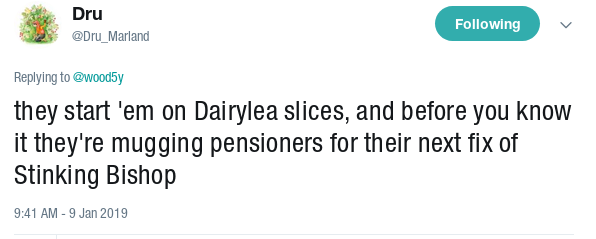
    However, the story does not end there. When your correspondent posted about the article on Twitter, one person to respond was local artist Dru Marland, whose response about fermented curd addiction was hilarious.

    XDru's tweet reads they start 'em on Dairylea slices, and before you know it they're mugging pensioners for their next fix of Stinking Bishop

    For a more complete understanding of the violence-inducing properties of cheese, I should have asked the committee about their opinions of more exotic varieties of fermented curd, such as Roquefort or Graviera, but pressure of time dictated otherwise. 🙂

    Update: Not forty-eight hours after Bristol was opened to national and international ridicule over this affair, Bristol Live reports that residents of Bristol’s Cotham district have branded a hot food catering van an “appalling idea“. You couldn’t make this stuff up!

  • Left in the lurch, not lost in translation

    During the United Kingdom’s involvement in Afghanistan, British forces were supported by some 3,000 civilian interpreters. These Afghan interpreters were often exposed to extremely dangerous situations.

    Afghan interpreter in action for a British officer
    An Afghan interpreter in action for a British officer

    In its report Lost in Translation? Afghan Interpreters and Other Locally Employed Civilians, the House of Commons Defence Select Committee has now found that Government’s scheme to safeguard Afghan interpreters threatened with reprisals for working with the British Army “has dismally failed to give any meaningful assurance of protection” from the Taliban.

    The committee’s report also calls for a more sympathetic approach to Afghan personnel seeking relocation to the UK after serving in front-line roles.

    Earlier this month, Sajid Javid, a man who does Home Secretary impressions, bowed to pressure over 150 interpreters seeking indefinite leave to remain in the UK under the Relocation Scheme, including waiving a £2,389 application fee.

    No such concessions have been made for many others who have made it to the UK or who are still in Afghanistan where they are targeted by the Taliban or Isis.

    Besides the Relocation Scheme, the government also initiated the so-called Intimidation Scheme; this had the aim of relocating interpreters within Afghanistan if they faced threats from the Taliban or Islamic State, only offering them a place in the UK as a last resort.

    However, not a single Afghan has been relocated as part of the intimidation scheme, which the Select Committee describes as an “utter failure”. It goes on to say that the scheme is perceived as unfair and miserly and that will continue until it “offers a genuine prospect that, when individuals face serious and verifiable threats to their lives, as a result of having helped UK armed forces, they will be allowed to come to the UK”.

    Amongst its recommendations, the committee has called for a more sympathetic approach and looser application of the Intimidation Scheme.

    Select Committee chairman Dr Julian Lewis said: “This is not only a matter of honour. How we treat our former interpreters and local employees, many of whom served with great bravery, will send a message to the people we would want to employ in future campaigns.”

    Many members of the armed forces who served in Afghanistan go further than the Select Committee and believe that the UK has a debt of honour to resettle all former civilian interpreters in the UK and that their former colleagues are been caught up in the racist Home Office’s crackdown on immigration.

  • A fool and his money

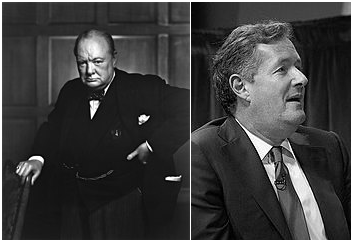
    Q: Pictured below are 2 men: Winston Churchill, who some would argue was the greatest UK Prime Minister ever; and Piers Morgan, a man of no discernible talent apart from sycophancy to those on the extreme right wing of politics. What links them?

    Winston Churchill and Piers Moron composite image

    A: A cigar butt.

    One of Churchill’s discarded cigar butts, to be precise.

    Earlier this week, Piers Morgan bought said cigar butt at auction, as reported by the Shropshire Star.

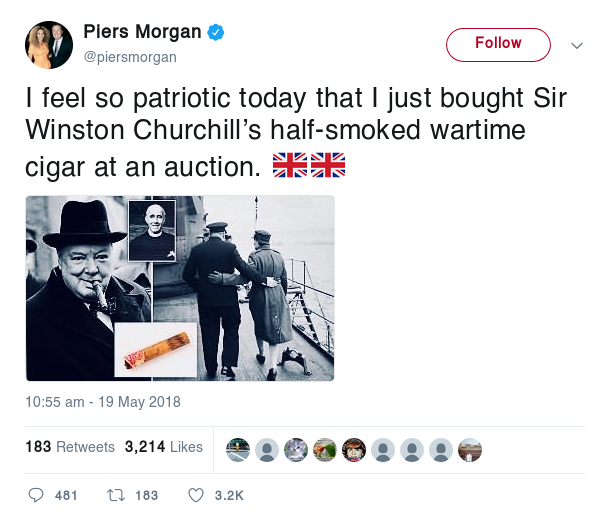
    Piers (affectionately renamed Piers Moron by Private Eye. Ed.) was so pleased with his purchase, he also tweeted about it.

    Tweet reads: I feel so patriotic today that I just bought Sir Winston Churchill’s half-smoked wartime cigar at an auction.

    Auctioneers Travanion & Dean of Whitchurch in Shropshire had been expecting the half-smoked historical artefact to sell for about £1,000.

    Piers paid £2,600 for it.

    Needless to say, the final bill would have been rather more than that once the auctioneers’ commission had been added.

    He may have considered his action patriotic, but Piers’ action reminded your ‘umble scribe of an old adage, i.e. a fool and his money are soon parted.

    That bit of folksy wisdom in turn set me researching its origins.

    The King James version of the Bible published in 1604 has something similar to this saying in Proverbs 21:20, which states:

    There is treasure to be desired and oil in the dwelling of the wise; but a foolish man spendeth it up.

    However, for a rendition slightly closer to the wording in question, one has to look at 1573’s Five Hundreth Pointes of Good Husbandrie by Thomas Tusser, reproduced below:

    A foole & his money,
    be soone at debate:
    which after with sorow,
    repents him to late.

    The form of words commonly used in the present proverb were first just over a decade after Tusser. In 1587 Dr. John Bridges writes the sentence below in Defence of the Government of the Church of England:

    If they pay a penie or two pence more for the reddinesse of them..let them looke to that, a foole and his money is soone parted.

  • The thoughts of Michael Gove

    Today’s Graunaid reports on the establishment of a new Tory think tank, erroneously called “Onward“.

    However, it is firmly denied that this anodyne moniker is meant in any way to be an echo of “En Marche!“, the movement that propelled the right-of-centre Emmanuel Macron to power in France (and Andorra; he’s also the ex-officio co-prince of the Pyrenean principality. Ed.).

    Michael Gove's official Defra photoThose at the centre of the launch in the Gruaniad’s eyes are Scottish Tory leader Ruth “tractor quotas” Davidson, the Scottish Conservative leader, and Michael Gove, the man with the most punchable face in British politics and alleged to be the UK’s current Secretary of State For Environment, Food & Rural Affairs.
    Leaving aside the sordid details of the think tank’s launch, which were given far too much attention for my mind by the Gruaniad, what struck your ‘umble scribe was the following phrase relating to the boy Michael:

    Gove, the environment secretary, who has long been one of the party’s most influential thinkers,…

    The plain truth is that thinking doesn’t come naturally to Michael. In a previous incarnation as Secretary of State for Education, he’s on record as not understanding what an average is or how it works in this oral reply to the House of Commons Education Committee in 2012:

    …we expect schools not only to be judged on the level of raw attainment but also in terms of making sure that children are on track and are not falling back-and, indeed, do better than the average.

    Meanwhile in his present post, he has in the past had difficulty in remembering which country he’s in, singing the praises of Welsh lamb in a press release for a visit to Northern Ireland (posts passim).

    Furthermore, there are also times when Michael Gove doesn’t think at all. He didn’t think of his son when he and his wife thought it acceptable to leave the 11 year-old at a hotel to go to a party.

    Thinking is a skill that can be taught and acquired, but your correspondent has yet to see that Gove has gained sufficient quantities thereof in his education at public school and thereafter at Oxford University.

    Then again, lack of talent has never been an obstacle to achieving high office for the Blue Team…

  • The GOP and the English language*

    On Saturday, a certain Melania Trump was discharged from hospital following surgery for a kidney problem.

    Needless to say her husband. one Donald John Trump, who occasionally resides at 1600 Pennsylvania Avenue NW, Washington, D.C. in between golfing trips, was delighted.

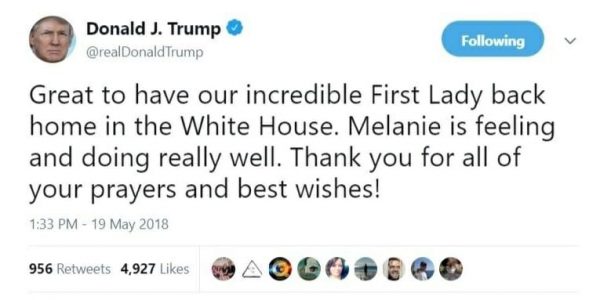
    So delighted he sent the tweet below to his followers.

    tweet reads: Great to have our incredible First Lady back home in the White House. Melanie is feeling and doing really well. Thank you for all of your prayers and best wishes!

    The reason why The Donald should misspell his wife’s name is unknown. Perhaps he had that pesky predictive text active on his tweeting device.

    However, the 45th President of the United States is not the first Republican Party occupant of that office of state to experience problems with the use of the English language.

    The 41st occupant of that office, one George Herbert Walker Bush, once quipped in an interview with Jim Lehrer on PBS: “They used to say English was my second language.”

    George H.W.’s son, George W., who was affectionately known as “Dubya” and inaugurated as the USA’s 43rd president, was so inept with his alleged mother tongue that a term – Bushisms – was coined to denote his ability to engage both tongue and brain when speaking in public. Bushisms are defined as Dubya’s unconventional statements, phrases, pronunciations, malapropisms and semantic or linguistic errors in public speaking. Besides malapropisms, Bushism’s other common characteristics included the creation of neologisms, spoonerisms, stunt words and grammatically incorrect subject–verb agreement.

    To conclude this brief excursion into members of the Grand Old Party’s difficulties with English, who can forget former Vice-President James Danforth Quayle’s erroneous correction of a school student’s correct rendition of “potato“? 😀

    * = Apologies to the late George Orwell for the title.

Posts navigation