The Bristol Post website carries an initial report today of a fire last night at Ashton Court, a 17th century mansion house in north Somerset owned by Bristol City Council.
Allegedly penned by someone called DanielEvans1, the third paragraph of the piece reads as follows:
A total of six Avon Fire and Rescue pumps and an aerial appliance were need to extinguish the fire in the early hours.
An inability to conjugate the verb ‘to need’ correctly is evidently no barrier to employment as a journalist at the Temple Way Ministry of Truth. 😉
So far this blog has recorded a dearth of Capita T&I interpreters for the jobs they’re supposed to be doing in the country’s courts (posts passim).
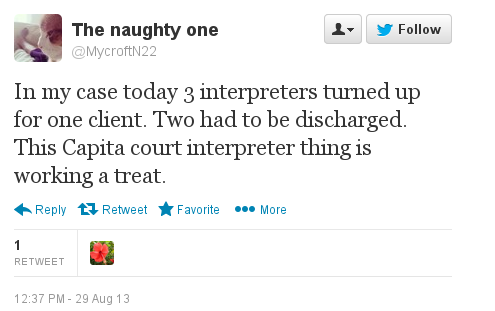
Now just for a change we’re pleased to report a surfeit, as shown in this tweet (screenshot below).
Are Capita T&I interpreters like buses – one waits for ages and then 3 turn up at once? Or do Capita’s finest believe in safety in numbers? Is any comment on this amazing development forthcoming from Helen Grant MP, the Minister for Victims and the Courts?
I represented a 52 year-old woman of good character needing an interpreter, first appearance 10 am start – she was in virtual court so she was in the police station. The interpreter was there early and promptly (and spoke the language required well) but…there was a part heard trial in another court where no interpreter had been arranged. So they took my interpreter, and my woman in the police station who had already been there from 6 pm the night before had to wait.
When I raised this with the trial DJ and said she was diabetic, she took the view that she could wait a bit because the police would look after her and carried on hearing submissions a bit longer in the part heard trial. A replacement interpreter was booked to come at 1.45 pm. When I found the replacement interpreter at 2.15 pm because the matter was put back to 2.30, he said he had to go!
When I volunteered many years ago on producing Planet Easton – a community newspaper for my part of Bristol – one of the hardest tasks for the editorial team was devising headlines for articles.
However, one unnamed employee at The Argus in Brighton deserves a special mention for the example below, a fine example of the use of alliteration and homophones.
Ebook management software Calibre has now reached version 1.0, seven years after it was first released and a year since the last major release. Lots of new features have been added to calibre in the last year — a grid view of book covers, a new, faster database backend, the ability to convert Microsoft Word files, tools to make changes to ebooks without needing to do a full conversion, full support for font embedding and sub-setting, and many more, which are listed below. However, it should be pointed out that many of the features listed below were actually introduced during the lifetime of Calibre’s 0.9.x series.
A grid view of book covers
A new, faster database backend
Virtual Libraries
Conversion of Microsoft Word documents (.docx files)
New metadata download sources
Full support for font embedding
An easy to use tool to edit the Table of Contents in ebooks
Rewritten PDF output engine
New “Polish books” tool that allows users to carry out various automated clean-up actions on ebooks
The developers of Calibre also believe now is an appropriate time to express their thanks to all the developers who have contributed many of the major new features listed above. An incomplete list of contributors is available here.
Calibre 1.0 is now available for download for Linux, MacOS and Windows.
Joinup, the EU’s public sector open source news website, reports that government of Spain’s autonomous region of Valencia has completed its migration from MS Office to LibreOffice, the free and open source office suite.
Under this initiative, LibreOffice has been installed on a total of 120,000 public sector workstations.
The initiative forms part of the costs savings and reduction programme undertaken by the autonomous government to reduce current ICT costs, and those of procuring proprietary software in particular. According to the government’s head of ICT, Sofia Bellés, “This action has already enabled us to save €1.3 mn. since the start of the project and will generate annual savings of €1.5 mn. in proprietary software licences starting from next year”.
Besides the financial benefits, the investment in LibreOffice entails other benefits, such as the availability of applications in Valencian and Spanish, vendor independence and the freedom to modify and adapt the software to the users’ needs.
Yesterday I returned from my annual meet-up in Shropshire with my sister Hilary. Dubbed the ‘sibling saunter’, it’s an opportunity we take each year to meet in Shropshire, the county of our birth, and go walking without the encumbrance of children, partners, etc.
This year we went down into the Clun area in the south-west of Shropshire and the first day’s walk took us into Wales. Following an excellent route map (PDF) prepared by the Clwyd-Powys Archaeological Trust, we visited the prehistoric burial cairns on Corndon Hill (513 m above sea level) before making to the Miner’s Arms in Priestweston for a pint and finishing off at the Mitchell’s Fold stone circle. Legend has it that one of the stones in the circle is a petrified witch, punished by locals for seeing off a magic cow that provided them with unending supplies of milk.
There’s a very convenient bench next to the trig point on the top of Corndon Hill and it’s perfect for a breather and a refreshment stop.
The porous, unclear nature of the border between England and Wales is well evidenced around this area by places with English names in Wales and Welsh ones in England. The border itself has moved around too. For instance, Montgomery – the site of one of the Marcher castles and now firmly part of Wales – is included in the Shropshire county returns of the Domesday Book.
Although our Corndon Hill walk was only 6 miles in length, we both agreed on its strenuous nature for fifty-somethings, albeit fairly fit ones.
As the first evening of our annual saunter set in, we were still undecided as to the next day’s walking route. Eventually we decided on a loop of some 10 miles in length comprising a section of the Shropshire Way to Hergan and its junction with the Offa’s Dyke Path, which here is well preserved and follows the line of the Dyke itself, down to Newcastle on Clun and then back to our base at the youth hostel in Clun.
Offa’s Dyke is a massive linear earthwork, roughly followed by some of current border between England and Wales. In places, it is up to 19.8 m wide – including its flanking ditch – and 2.4 m high, with the ditch always on the Welsh side. In the 8th century it formed some kind of delineation between the Saxon kingdom of Mercia and the Welsh. Offa himself was King of Mercia from 757 to 796.
So we set out from the grounds of Clun Castle following the Shropshire Way along the valley of the River Clun. The route is well waymarked and the Shropshire Way’s buzzard logo is well displayed on all signposts. After a couple of miles we climbed over the Cefns to Hengarn and Offa’s Dyke.
My sister, the great navigator, at the junction of Offa’s Dyke (on the left) and the Shropshire Way (on the right)
The section of the Shropshire Way over which we’d walked was shared with Wild Eadric’s Way, named after Eadric the Wild, a Saxon thegn (or thane. Ed.) who was lord of Clun and refused to swear fealty to the usurping William the Bastard of Normandy. The factual life of Eadric has since become interspersed with folklore, as shown in this article.
But back to Offa’s Dyke. The section we were walking is amongst the best preserved that remains. Furthermore, whilst descending to Newcastle on Clun, we passed the halfway point between the path’s 2 end points – Chepstow and Prestatyn. It was most fortunate we were walking on a Wednesday as there’s a community café open in Newcastle’s community centre on Wednesdays between 10.30 am and 4.30 pm; the refreshments were excellent! I recommend the ginger and lemon cake.
Once back in Clun it was time for a well-earned pint in the Sun Inn before retiring back to the youth hostel. If you’re thinking of staying in the area and have fond memories of ‘old skool’ hostelling, you’ll love Clun YH. It’s a beautifully restored water mill with plenty of the mill machinery on view. Furthermore, it’s one of those hostels where people talk to one another. Before drawing to a close, I’d like to thank Sue the volunteer warden on duty during our stay for her helpfulness and very cheery disposition. We both hope the bedding inventory didn’t do your head in! 🙂
We’re taking the sibling saunter back to the Clun and Bishops Castle area next year to explore inter alia the Iron Age hill fort of Bury Ditches.
Update: 24/08/13: About the time this post was published yesterday, the Shropshire Star reported that a section of Offa’s Dyke in Wales has been destroyed by bulldozer. Police and Cadw, the Welsh heritage organisation, are continuing to investigate how the earthwork alongside the A5 north of Chirk, came to be flattened in this blatant act of vandalism. Jim Saunders of the Offa’s Dyke Association is reported to have said: “The ditch could be dug out but the dyke has been destroyed now it will never be the same again.”
The Bristol Post website is an online disaster that just keeps on giving, as in today’s example in the screenshot below where the unnamed hapless hack can’t tell the difference between looking for something and being debauched. 🙂
According to company financial information website DueDil, Capita Translation & Interpreting, the company that has been entrusted (rather foolishly. Ed.) by the Ministry of Justice with providing interpreting services for courts and tribunals in England and Wales (posts passim), is not doing particularly well financially, as the screenshot of the company’s latest basic financial information shows.
Yahoo News reports that the Advertising Standards Authority (ASA) is investigating the recent Home Office poster van campaign targeting immigrants and dubbed the ‘racist van’ due to the crass insensitivity that is a hallmark of the Whitehall PR machine nowadays (posts passim).
The ASA has so far received 60 complaints expressing concerns that the advertisements were “reminiscent of slogans used by racist groups to attack immigrants in the past”.
The racist van was driven around the London boroughs of Barnet, Hounslow, Barking & Dagenham, Ealing, Brent and Redbridge – all areas with a high percentage of ethnic minority residents – as part of a £10,000 Home Office pilot scheme, which ended at the end of July.
As a counterpart to the Home Office’s mobile billboard, human rights and civil liberties organisation Liberty drove its own ‘anti-racist van’ around the streets of the metropolis.


 Joinup, the EU’s public sector open source news website,