• The writing on the wall

    Expressing political opinions on walls is a practice that reaches back at least 2,000 years to Roman times – as in the case of Pompeii and other Roman towns and cities – and possibly even earlier.

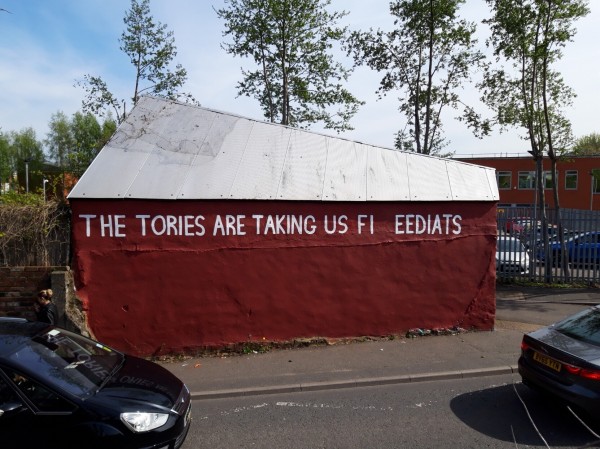
    One wall at the start of Whitehall Road in Bristol has displayed various messages – all of them anti-Conservative – over the years (see posts passim here and here. Ed.), of which the one below is the latest.

    The Tories are taking us fi eediats

    It appeared some time before last week’s English local government elections. However, your ‘umble scribe does not know the extent to which this particular slogan contributed to the Nasty Party’s disastrous losses of over 1,000 council seats and – more locally – its loss of overall control of South Gloucestershire seeing as it lies on a well-used commuter and bus route between the city and that neighbouring local authority.

  • Auntie crosses the Atlantic

    The BBC has always prided itself on the high standard of its English, both spoken and written.

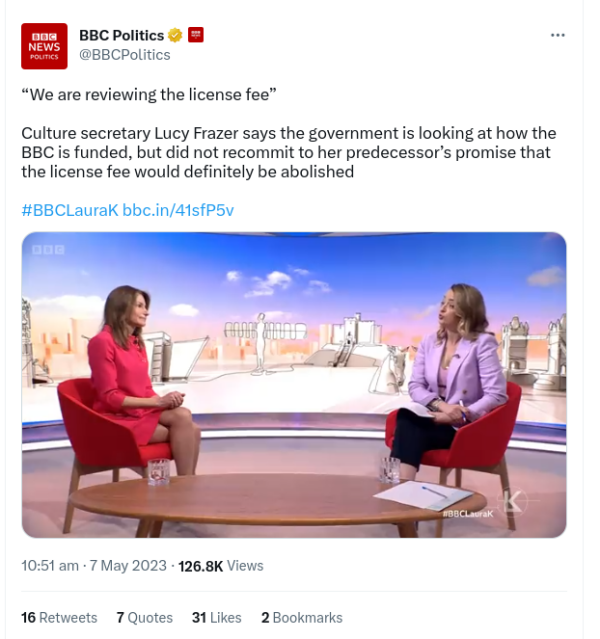
    However, that may well a thing of the past if one of today’s social media offerings from the BBC Politics Twitter account (byline: the best of the BBC’s political coverage. Ed.) is to be believed.

    Tweet reads “We are reviewing the license fee” Culture secretary Lucy Frazer says the government is looking at how the BBC is funded, but did not recommit to her predecessor’s promise that the license fee would definitely be abolished.

    Yes, you did read that correctly; license [sic]; twice; in two sentences.

    Either Auntie is employing an American to curate the BBC Politics Twitter account or an illiterate.

    If the latter, some remedial English lessons are clearly needed, as well as practice, particularly if use of the verb to practise is contemplated in future. 😀

    In amongst the predictable responses from licence fee objectors and refuseniks, numerous replies to the tweet pointed out the basic orthographic difference between British and American English. However, no acknowledgement or correction of the error has been forthcoming over 10 hours after the original tweet was posted.

  • The poorest he…

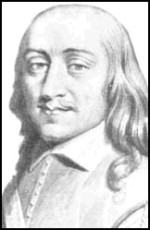
    Thomas RainsboroughIn 1647 during the English Civil War a series of discussions – the Putney Debates – was held in St Mary’s Church, Putney between 28th October and 8th November about the political settlement that should follow Parliament’s victory over Charles Stuart, the arrogant autocrat commonly referred to by history as Charles I.

    A transcript of the discussions can be found here.

    The main participants in the debates were senior officers of the New Model Army who favoured retaining a monarch within the framework of a Constitutional monarchy, and radicals such as the Levellers who sought more sweeping changes, including One man, one vote and freedom of conscience, particularly in religion.

    Amongst those Levellers whose words were transcribed is Thomas Rainsborough (pictured right), a colonel in the army, who is on record as favouring government by the consent of the governed, as expressed below.
    I think that the poorest he that is in England hath a life to live, as the greatest he; and therefore truly, sir, I think it’s clear, that every man that is to live under a government ought first by his own consent to put himself under that government; and I do think that the poorest man in England is not at all bound in a strict sense to that government that he hath not had a voice to put himself under; and I am confident that when I have heard the reasons against it, something will be said to answer those reasons, in so much that I should doubt whether he was an Englishman or no that should doubt of these things.
    Rainsborough was in particular supported by John Wildman and Edward Sexby. Sexby’s most salient contribution to the debates is as follows:
    Our case is to be considered thus, that we have been under slavery. That’s acknowledged by all. Our very laws were made by our Conquerors… We are now engaged for our freedom. That’s the end of Parliament, to legislate according to the just ends of government, not simply to maintain what is already established. Every person in England hath as clear a right to elect his Representative as the greatest person in England. I conceive that’s the undeniable maxim of government: that all government is in the free consent of the people.

    These sentiments were opposed by senior officers in the New Model Army, particularly Henry Ireton, and especially as they feared universal suffrage would remove the privileges that property ownership bestowed upon them.

    In saying so, Rainsborough, Wildman and Sexby were men well ahead of their time, given the extremely limited nature of the franchise in those distant days. The franchise was not really increased to any great extent until the so-called Great Reform Act of 1832, which extended the right to vote (but still limited it by a property qualification) and abolished the so-called rotten boroughs. Even after the extension of the franchise, in a city the size of Bristol with a population at the time of over 100,000, only 15,000 had the vote. Working class men like my two grandfathers did not receive the vote until after World War One. At the same time the franchise was also extended to women over 30.

    The incompatibility of monarchy with democracy was highlighted and put to good comedic effect by the Pythons in their 1975 film Monty Python and the Holy Grail.

    You enjoy your bling bonnet day at our expense, Mr Mountbatten-Windsor, but just remember one thing: WE didn’t vote for you!

  • Behind the wheel …of a pub

    Down at the Temple Way Ministry of Truth, the ambiguity department has been hard at work.

    Again (posts passim).

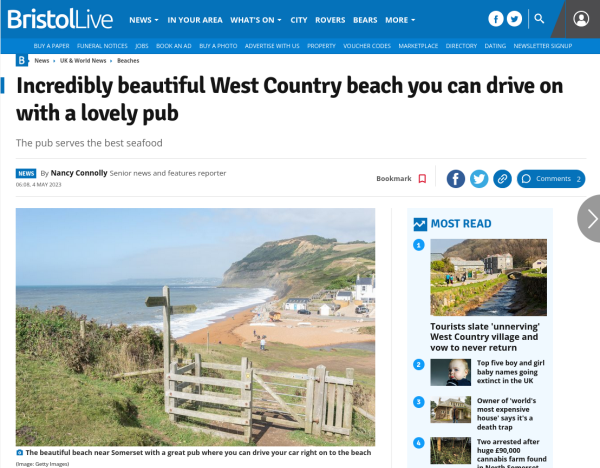
    Headline - Incredibly beautiful West Country beach you can drive on with a lovely pub

    One commenter rejoicing in the name saveenergy decided to have some fun with this latest illiteracy from the Post, as follows:

    “beach you can drive on with a lovely pub”

    What if you don’t drive a lovely pub ??

    Is it exclusively for drivers of lovely pubs, or can I drive my spit & sawdust bar on this beach; Are taverns, ale houses, inns & wine bars excluded ???

    We need to know.

    “There is a great pub right on the sea”

    How do they stop the drinks spilling when the sea is choppy ??

    Well done, sir or madam. Your ‘umble scribe could not have mocked the piece better himself. 😀

  • Community litter pick this Saturday

    Your ‘umble scribe will be ignoring all that nonsense in London SW1 involving Mr & Mrs Charles Mountbatten-Windsor for something far more vital to the health of the nation.

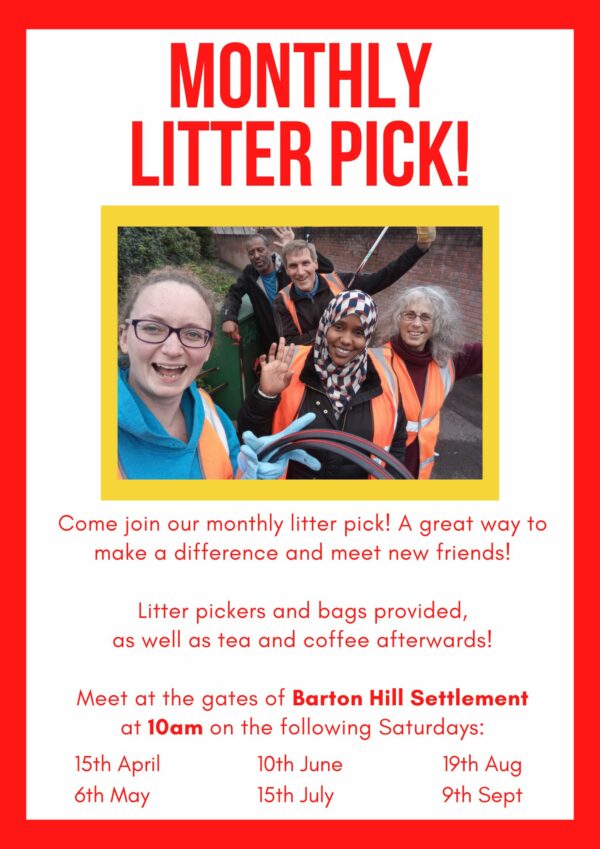
    Their bling bonnet day in Westminster unfortunately clashes with a regular event of local importance – the monthly Barton Hill community litter pick.

    Barton Hill community litter pick poster
    Stuff the coronation. This IS important!

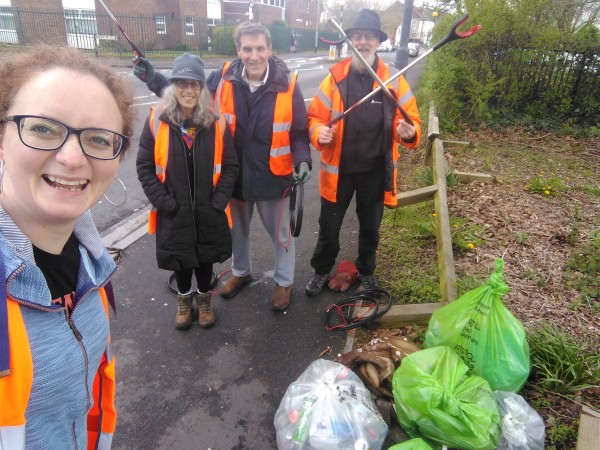
    Last month four of us turned out for an hour’s cleaning, managing to clear several bags of litter (as well as reporting half a dozen instances of fly-tipping. Ed.), having a bit of gentle exercise with tea and coffee afterwards, all punctuated by good company and good conversation.

    The end of April's litter pick

    If you can join us outside the Wellspring Centre (formerly the Settlement) at 10.00 am on Saturday, we’d be very pleased to see you.

  • Firefox Focus – first impressions

    Your ‘umble scribe is a great fan of the free and open source Firefox web browser and has been using the desktop version since version 0.x many years ago. One of its major attractions has been its emphasis on security and privacy.

    Until recently it was also the default browser on my smartphone, until I discovered Firefox Focus. Firefox Focus is a free and open-source privacy-focused mobile browser based on Firefox which is available for Android and iOS devices. First released in December 2015, it was initially a tracker-blocking application for mobile iOS devices, but was developed into a minimalistic web browser shortly afterwards.

    Firefox Focus iconAccording to Mozilla, Firefox Focus is a dedicated privacy browser with automatic tracking protection. meaning web pages load faster and your data stays private. It’s also easy to delete history, passwords and cookies, so advertisers and other ne’er-do-wells don’t follow you around online. Just tap the erase button on the search field and all that data is gone. Tracking protection is also very strong. The browser blocks a wide range of common trackers by default, including social trackers and those sticky ones that come from things like Facebook ads.

    After using Firefox Focus for one week, I can say I’m impressed with the way it works. Although it required me to learn how to use tabbed browsing (hint: hold down a link in your search results and a menu appears, offering the option to open the link in a new tab. Ed.), once that was cracked, I was away. As for fast page loading, that’s not disappointing either, even on notoriously slow-loading sites, like that of Bristol City Council, which still seems to be powered by a horse turning a shaft in the basement of the Counts Louse (which some call City Hall. Ed.). 😉

    If you value your privacy and security, I’d recommend Firefox Focus on your mobile device.

  • Bureaucratic logic

    The West of England Combined Authority (WECA) is a combined authority consisting of the local authorities of Bristol, South Gloucestershire, and Bath and North East Somerset.

    The authority’s functions, as specified by the West of England Combined Authority Order, mostly cover planning, skills and local transport.

    And this post is specifically concerned with transport and buses in particular.

    Since passing pensionable age last year, your ‘umble scribe has been entitled to a concessionary bus pass offering him free bus travel within England, subject to various conditions.

    That being so, your correspondent has found himself doing things he hasn’t done for many a decade, like running for buses. 😀

    At the start of April, significant changes were made to bus services within the WECA area. To announce the changes, posters were put up at bus stops. At the foot of each poster, some useful information is given (not that the remainder of the posters did not also provide useful information. Ed.), as shown in the photo below.
    Further assistance
If you are unable to access information online, our Transport Operations Team is available to assist you on 01173741266 or via email on transport.operations@westofengland-ca.gov. uk

    Like your ‘umble scribe, readers may also be perplexed at the advice given to those without internet access to contact the Transport Operations Team by email. Obviously a kind of bureaucratic logic of which normal mortals do not wot is at work, together with a degree of perspicacity to which the fictional Yes Minister could only aspire.

    That’s not to say that the authority does not have aspirations. Indeed, the term vision appears some 500 times* on the WECA website, according to a site-specific Google search.

    Those working at the authority are therefore in need of a doctor in the opinion of the late West German Chancellor Helmut Schmidt, who famously quipped “Wer Visionen hat, sollte zum Arzt gehen“, usually translated into English as Anyone who has visions should go to the doctor. Perhaps a logician would also not go amiss. 😉

    * = This count is a lot less than the instances of vision on the Bristol City Council website (posts passim).

    Update 07/05/23: five weeks after the actual timetable changes were implemented, new revised timetables have finally started to appear at bus stops; see photo below. No need to rush as it appears that if you’re a local government organisation, you are at complete liberty to do your allotted tasks entirely to your own satisfaction!
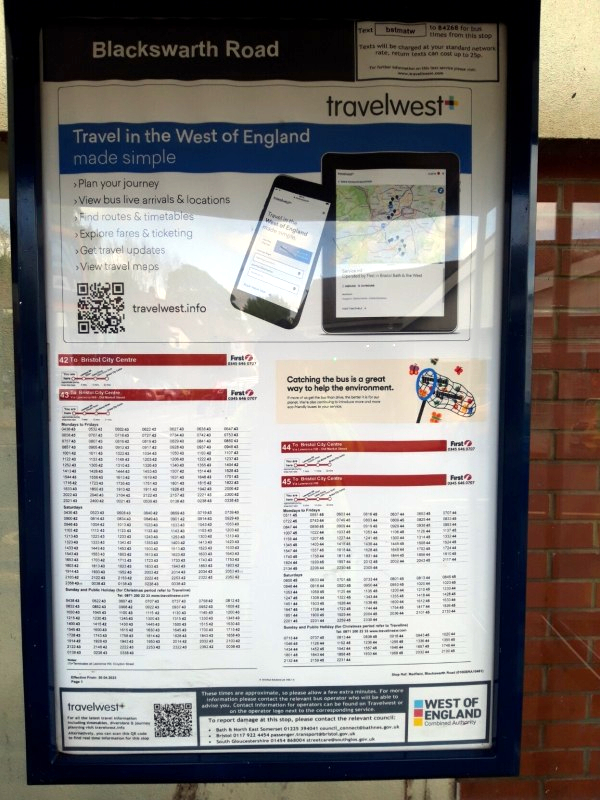
    New timetable information at bus stop on Church Road Bristol
  • Bilingual illiteracy

    Playwright Oscar Wilde gave his character Lady Augusta Bracknell some memorable lines in his play The Importance of Being Earnest.

    Of these, one in particular related to the difference between misfortune and carelessness:
    To lose one parent, Mr Worthing, may be regarded as a misfortune; to lose both looks like carelessness.

    In the case of contractors working for gas supply company Wales & West Utilities in Abertawe/Swansea, carelessness seems to be their modus operandi, as per this report on the Swansea Bay News website.

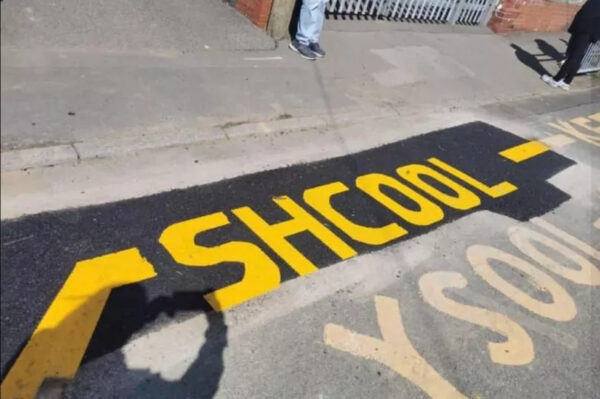
    On a job outside Llangyfelach Primary School, the utility’s contractors managed to spell school incorrectly as shcool. Sharp-eyed Cymraeg-speaking readers will aslo notice that its Welsh equivalent ysgol is also misspelt as ysool, although this appears to be from an earlier job, judging by the colour differences in the asphalt.

    Road markings showing School and Ysool
    Image credit: Rob Jones

    Speaking to the BBC, Wales & West Utilities said the cock-up had occurred during repairs to the local gas network. Its spokesman Phil Whittier said: “Unfortunately, (we) have misspelt the word ‘school'”. However, denied any responsibility for the misspelling of ysgol. The BBC reports that Swansea Council has been contacted about that incorrect spelling.

    The error has gone around the world, being mocked as far afield as Australia, with some parents suggesting on social media those responsible be made to write school out correctly one hundred times.

  • Sunak and his low-carbon escort

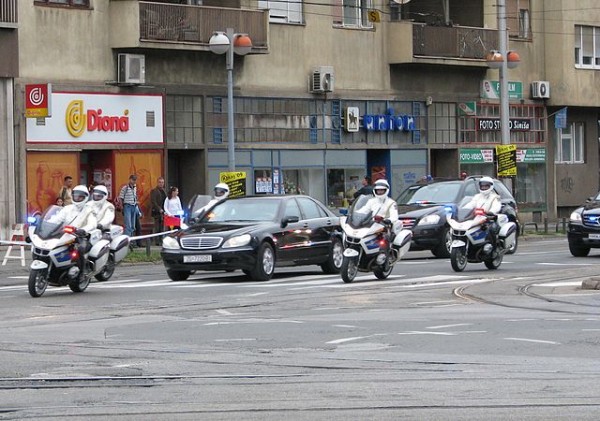
    It’s not unusual for heads of government and state to have their motorcades accompanied by motorcycle escorts, as seen in the example below from 2009 of the then Chinese president Hu Jintao‘s visit to Zagreb in Croatia.

    Hu Jintao motorcade Croatia 2009
    Image courtesy of Wikimedia Commons
    On Sunday – the day of the London marathon – a fleet of cars containing the alleged Prime Minister was spotted surrounded by two sets of police officers – one on bicycles and the other on foot.

    Sunak has in recent months been criticised for his disproportionate use of flying, both on private aircraft and on military ones, including one of a mere 25 minutes’ duration.

    The Telegraph has suggested the action was to thwart the attentions of environmental protesters from Extinction Rebellion.

    If that were not the case and Fishy Rishi was making a vain attempt to reduce his carbon footprint, your ‘umble scribe would like to introduce him to a new word to add to his vocabulary: greenwash.

  • Mail continues its anti-Welsh campaign

    Why does the Daily Mail hate Cymraeg – and by implication the speakers of that language so much?

    It was one of those Anglophone media outlets that blew its top earlier this week over the decision by a second Welsh national park authority to call the national park solely by its Welsh name – a name for prominent local topographical features that reaches back over a millennium (posts passim).

    Yesterday it discovered and did a hatchet job on a petition currently gathering signatures on the Senedd Cymru website calling for the exclusive use of Welsh place names,

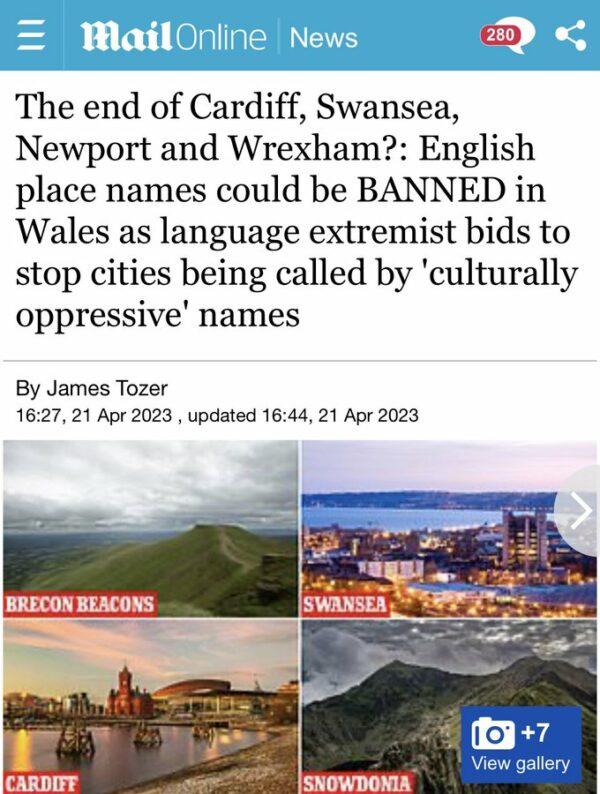
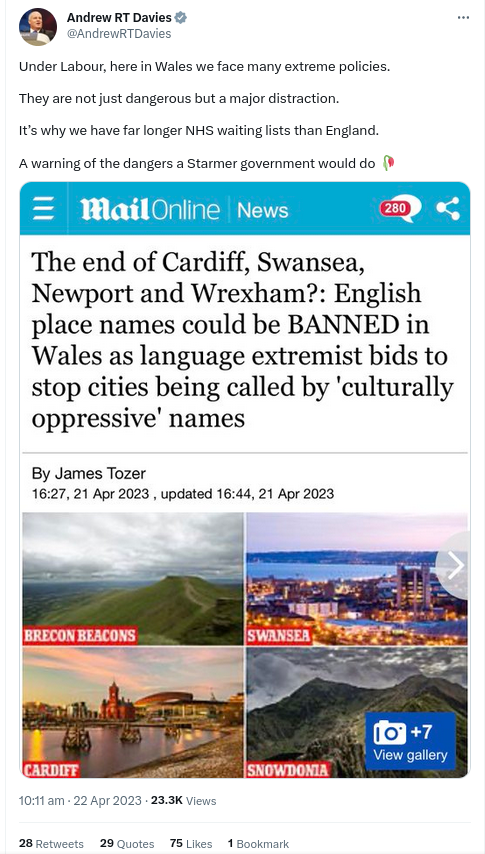
    Headline reads The end of Cardiff, Swansea,
Newport and Wrexham?: English place names could be BANNED in Wales as language extremist bids to stop cities being called by ‘culturally oppressive’ names

    To quote the same places named by the Mail, your ‘umble scribe sees no problem at all in Caerdydd, Abertawe, Casnewydd and Wrecsam being referred to by their names in the local vernacular, which have existed for centuries. He also believes that if the Mail is against something, what is being ranted about is inevitably worthwhile.

    The Mail’s anti-Welsh piece was also boosted by Andrew RT Davies, leader of the Welsh Conservatives, who used it as a means of attacking what he called extreme policies likely to be introduced by a future Labour government, no doubt winning approval from his colonial masters at CCHQ in London SW1.

    Tweet reads Under Labour, here in Wales we face many extreme policies. They are not just dangerous but a major distraction. It’s why we have far longer NHS waiting lists than England. A warning of the dangers a Starmer government would do

    Since the Mail’s intercession the petition, which was languishing with a signature count of some 250, has now amassed over 300.

    Da iawn! 😀

    Update 23/04: Following coverage in the Welsh media of the Mail’s bigotry, the number of signatories this evening is now approaching 700, well above the threshold for its consideration by the Senedd’s petitions committee, if somewhat short of the 10,000 needed for a debate in the chamber.

Posts navigation