• French Customs censured for illegal retention of personal data

    CNIL logoFrench IT news site Le Monde Informatique reports that the French Customs authorities have been sent a formal notice by the CNIL, France’s data privacy regulator, in respect of an illegal data file containing the details of more than 45,000 people, including copies of identity documents and records of criminal offences.

    French Customs logoBusinesses are not the only organisations with which the CNIL has found fault for holding illegal files containing personal data. Public sector organisations can also fall foul of the law.

    The French Customs authorities, which come under the control of the Ministry for the Economy have been caught red-handed following a report in respect of Customs’ file used for recording information about vessels and their crews which is known as SIRENE. Intended to identify all the people checked at sea or in port in order to combat fraud, this system was in fact developed and implemented with no legal basis and not in accordance with the law, according to the CNIL

    Checks were carried out by Customs’ Channel-North Sea-Atlantic coastguard service and inspections revealed that recourse to this system did not comply with France’s Data Protection Act. This data system actually lists information about the vessels checked and their passengers, including personal information such as marital status, address, occupation and copies of identity documents, as well as criminal convictions (drug trafficking, counterfeiting, off-the-books employment, failure to co-operate, sexual assault, possession of illegal weapons, intentional homicide and murder).

    6 months to comply or be fined

    All told, the details of 45,793 persons – including 392 minors – are included in the SIRENE file. “The creation and use of the SIRENE file are not provided for by any legislation (for example a law or a decree). In addition, the CNIL has not received a request for an opinion concerning its implementation, in violation of the Data Protection Act (articles 87 and 89, the CNIL explained. Other grievances have also been lodged against the Ministry for the Economy, such as the failure to send an impact assessment in respect of the protection of personal data and the lack of a clear distinction between the data of the different categories of persons concerned. or the fact that the latter were not made aware that their data had been included.

    Following the CNIL’s formal notice, the Ministry for the Economy and Customs have 6 months to comply otherwise a penalty could be issued.
  • Bore Da, Bannau Brycheiniog!

    Yesterday the news was announced that, following the recent decision by its fellow national park authority in North Wales, the one covering a large swathe of south Wales would henceforth be called the Bannau Brycheiniog National Park in English.

    There was also a video to accompany the name change.

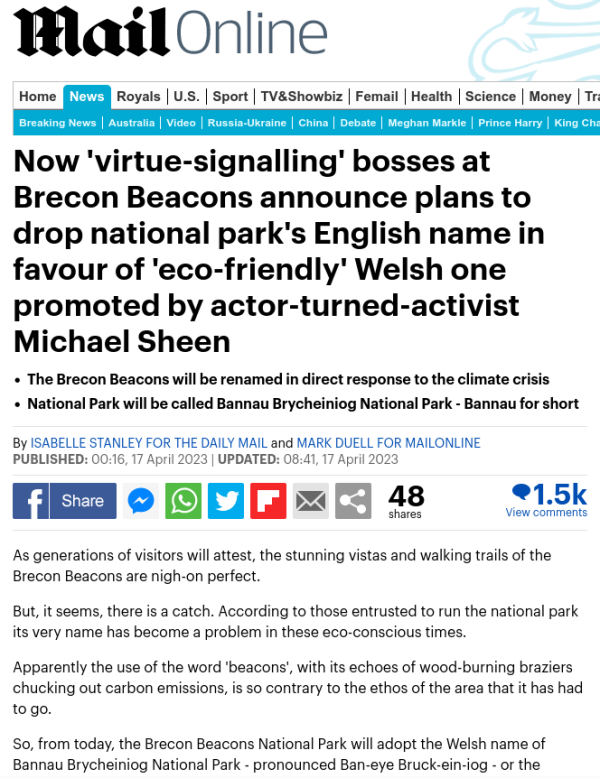
    However, the change has not gone down well, particularly in the rabid right-wing monoglot English press, as shown by the image below from yesterday’s Daily Mail website.

    Headline reads Now 'virtue-signalling' bosses at Brecon Beacons announce plans to drop national park's English name in favour of &'eco-friendly' Welsh one promoted by actor-turned-activist Michael Sheen
    Snowflakes!

    Not forgetting to add all their typical smears, they’re touchy souls at the Mail, aren’t they? Nevertheless, like all good Anglophone monoglots, they cannot even get the pronunciation of Bannau Brycheiniog right. In Brycheiniog, the ch is pronounced as in the Scottish loch, not like an English ck as written in the Mail.

    Furthermore a ‘columnist‘ at The Independent also did not want to be excluded from being outraged and mocking the Welsh language, as Nation Cymru reports.

    Nor has the change met with universal approval in Wales itself.

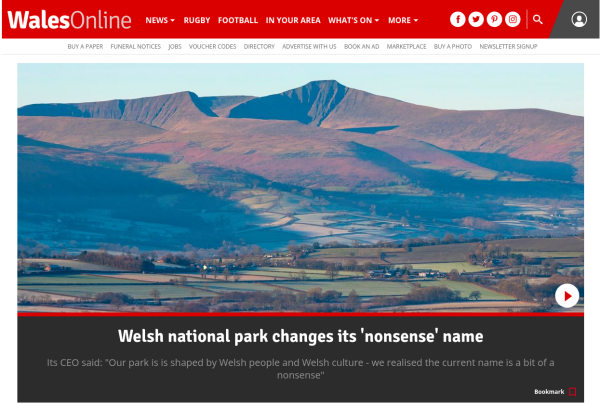
    To being with, Reach plc’s Cardiff-based Wales Online title adopted a provocative stance with its headline at the top of yesterday’s home page (clickbait for a largely monoglot Anglophone readership not known for voicing its support for either Cymraeg or Cymdeithas yr Iaith? Ed.).

    Headline reads Welsh national park changes its nonsense name

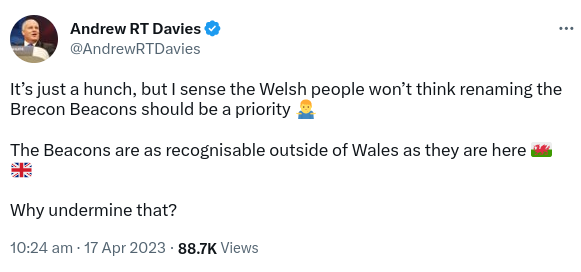
    However, the all-Wales whinging trophy has to go to the Welsh Conservatives, those faithful servants of their colonial masters in London SW1, with the charge being headed by their Senedd and Welsh ‘leader‘, one Andrew RT Davies, who planted the Welsh Tories firmly in the Anglophone camp.

    Tweet reads: It’s just a hunch, but I sense the Welsh people won’t think renaming the Brecon Beacons should be a priority. The Beacons are as recognisable outside of Wales as they are here. Why undermine that?

    This earned him plenty of derision, particularly from his fellow Welsh, of which the following is typical.

    Tweet reads Why do you hate Welsh people having our own language and identity?

    If Mr Davies doesn’t like his compatriots using their own language and celebrating their own heritage (the hills were known as the Bannau Brycheiniog long before the monoglots arrived in force), perhaps he ought to relinquish his seat in the Senedd Cymru and find a nice safe Tory constituency in the English Conservative heartlands.

    I for one shall look forward to visiting the Bannau Brycheiniog and Eryri (the national park formerly known as Snowdonia. Ed.).
  • The Galleries – Bristol’s sunlit uplands?

    Unicorns are commonly described as horse-like creatures with a single large, pointed, spiralling horn projecting from their foreheads. They have been depicted as such in European art for at least a millennium, although their origins stretch way back into history to the Bronze Age Indus Valley Civilisation and the Middle East.

    In a more recent context, the sunlit uplands first popularised in Churchill’s “This was their finest hour” speech in 1940 was dusted off by the Brexit zealots and Europhobes to denote the boundless possibilities which faced the country once it had extricated itself from the stranglehold of the alien and oppressive European Union.

    Those on the Remain side of the argument eagerly populated these mythological mountain pastures with herds of unicorns to illustrate the delusions of the Brexiteers. Those who turned the unicorns loose on the sunlit uplands have since prove correct in the mockery: Brexit has been an absolute disaster with increased bureaucracy and delays at the Channel ports, not to mention the 5% plus decline in GDP

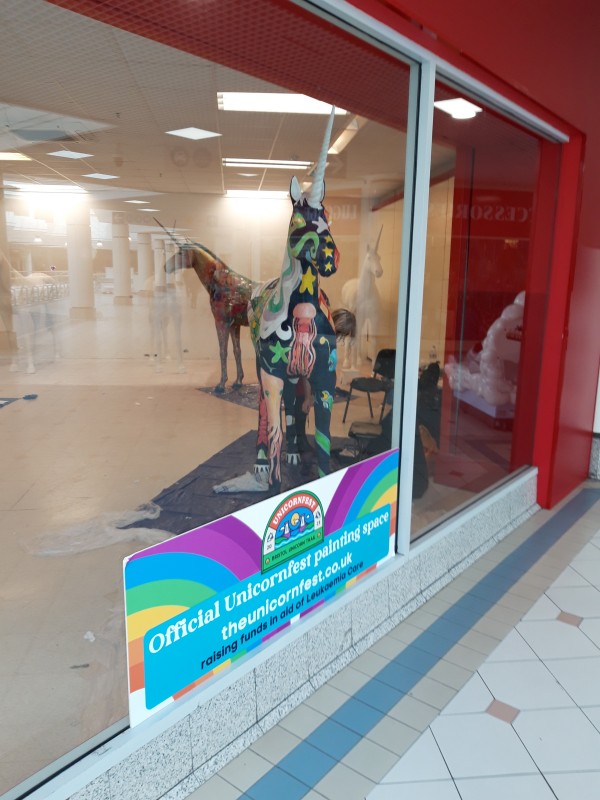
    Being built on what were the banks of Bristol’s tidal River Frome (long since culverted. Ed.), the Galleries shopping centre could not in any way be classified as belonging to any uplands, sunlit or otherwise. Nevertheless, one empty shop unit on the top floor was populated by a whole herd of unicorns.

    A decorated plastic unicorn on a wheelboard

    Had they migrated from those Phoebus-favoured hills? Despite the £116.8m cost to the taxpayer and low visitor numbers of the original, was the city planning its very own Festival of Brexit?

    The answer was staring your bemused correspondent in the face in one of the shop’s windows.

    Yet another tarted-up unicorn

    It was another of those local sculpture trails (posts passim), this time featuring unicorns instead of gorillas or Gromits, ostensibly to celebrate the 650th anniversary of the Bristol gaining county status in 1373, presumably by the usual practice of the time of local worthies giving the reigning monarch a large amount of cash in return for a charter or, as stated on the festival website:

    Unicornfest, part of the 650th anniversary celebrations for Bristol, seeks to unite the business and creative sectors, as well as local communities and schools across Bristol and the surrounding area, bringing art, colour and fun to the streets of the city this year.
  • Seriously

    The language used in official responses to news stories seems to have been rigid and formulaic in recent times, particularly amongst those organisations within or linked to the public sector.

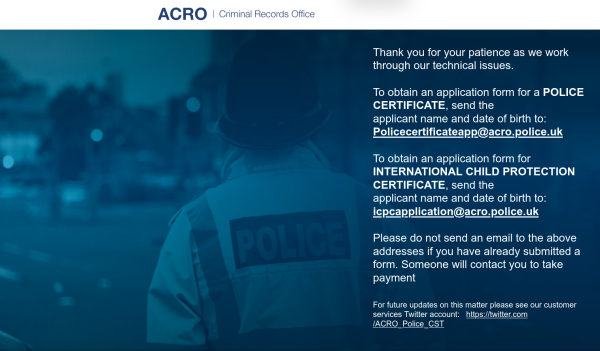
    Today’s edition of The Register reports that ACRO, the UK’s Criminal Records Office was taken offline due to a security breach. The site currently displays a holding page blaming ‘technical issues‘, a fine example of misleading bureaucratic language.

    This is the site’s holding page as this post is published.

    Text reads Thank you for your patience as we work through our technical issues. To obtain an application form for a POLICE CERTIFICATE, send the applicant name and date of birth to: Policecertificateapp@acro.police.uk. To obtain an application form for INTERNATIONAL CHILD PROTECTION CERTIFICATE, send the applicant name and date of birth to: icpcapplication@acro.police.uk. Please do not send an email to the above addresses if you have already submitted a form. Someone will contact you to take payment. For future updates on this matter please see our customer services Twitter account:   https://twitter.com/ACRO_Police_CST

    El Reg notes that manages ACRO people’s criminal record information, running checks as needed on individuals for any convictions, cautions, or current prosecutions. It with British police and businesses, as well as exchanging this data with other countries, particularly where people wish to move or emigrate to another country and a certificate of good behaviour is required from the British police. ACRO has access to data from the Police National Computer via an information sharing agreement with the Cabinet Office.

    The data typically handled by ARCO includes name and address history, extended family information, a new foreign address, legal representation, passport information, photo and data PIN cautions, reprimands, arrests, charges or convictions.

    Earlier this week, ACRO emailed users to inform them that it had “recently been made aware of a cyber security incident affecting the website between 17th January 2023 and 21 March 2023“, adding that “we have no conclusive evidence that personal data has been affected by the cyber security incident; however it is only right that we inform you of the situation. We are very sorry that because of your interaction with ACRO your data could have been affected, and we are working tirelessly to resolve this matter.”

    Anonymous generic hacker complete with hoodie

    The message went on to say that “robust measures” had been taken as soon as the breach was discovered. It won’t be the first time that pulling the plug on a website has been described by a public sector organisation spokesperson as “robust”, If your systems were truly “robust”, taking the site offline would not have been necessary.

    After intoning the “robust” mantra, ARCO then goes on to say: “We take data security very seriously and will ensure that the matter is fully investigated…. Translating this into plain English, this means “Oh dear! We’ve been caught out!”

    The fact that ARCO had not taken data security “very seriously” is clearly highlighted by two facts:

    • Firstly, ARCO did not notice crooks were gaining access to its computer systems for more than two months; and
    • Secondly, it has now freely admitted that it is going to take steps to find out how the breach happened and prevent its reoccurrence. A clear case of that old adage of shutting the stable door after the horse has bolted.

    The public sector relies heavily on public trust to do its work. If it really does want to be taken seriously, tough measures need to be taken and implemented, not just for IT security, but in connection a very ancient and fundamental idea: that of honesty.

  • Speaking truth to power

    The Twitter account of the British Government’s Home Office is normally a conduit for the worst ideas dreamt up by the alleged government’s most authoritarian and repressive ministry.

    As such it tends to repeat and amplify the dog-whistle racism and xenophobia embodied in the hostile environment that has characterised its attitude to non-British people, particularly if they are not white, since the Home Secretary was one Theresa May, who later went on to do bad prime minister impressions in the Westminster Palace of Varieties.

    The post of Home Secretary is currently occupied by one Sue-Ellen Cassiana “Suella” Braverman, a woman of no discernible talent other than being incompetent and nasty.

    Braverman is currently on her second term of office as Home Secretary, having been initially appointed as such under the premiership of one Elizabeth Mary Truss on 6 September 2022. However, like her boss, Braverman did not last long in post, resigning because she had made an “honest mistake” (a likely story. Ed.) by sharing an official document from her personal email address with a colleague in Parliament, an action which breached the Ministerial Code.

    On 25 October, Braverman was re-appointed as the home secretary by the prime minister Rishi Sunak, in direct contradiction of his promise of “integrity, professionalism and accountability”. Does someone who broke the Ministerial Code have any integrity or professionalism?

    Since her re-appointment, has continued with hostile policies towards refugees and asylum seekers with a modern take on the reintroduction on the prison hulks of two centuries ago to house these people before they are deported to that shining beacon of human rights known as Rwanda.

    Yesterday, the Home Office’s Twitter account finally admitted how dangerous the Home Secretary was, calling her “one of the greatest injustices in modern Britain” and calling for her end.

    Tweet reads It is time to put an end to one of the greatest injustices in modern Britain. The Home Secretary, @SuellaBraverman

    The post has since been deleted.

  • NSW takes gibberish to new level

    It has often been remarked that Britain and the USA are two countries divided by a common language.

    However, let’s not forget that the spread of English around the world resulted in the development of different varieties of English around the world, all with varying degrees of (in)comprehensibility.

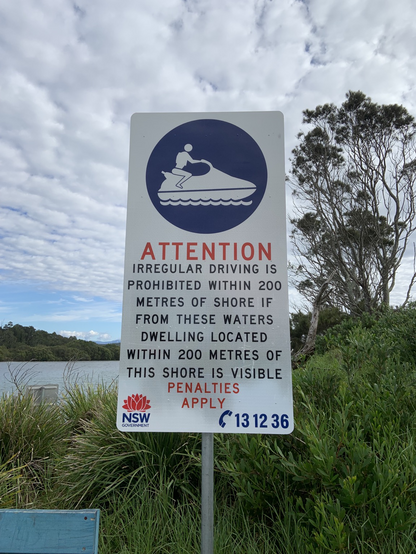
    A prime example of something beyond the comprehension of your ‘umble scribe turned up this morning in his social media feed. It contains a fine example of some prime official gibberish from the state authorities of New South Wales in Australia.

    If you, dear reader, can make any sense of it, please feel free to use the comment form below to provide a translation into British English; furthermore, please feel free to add any punctuation which you deem will aid comprehension as the original notice has none. 😀

    Sign reads ATTENTION IRREGULAR DRIVING IS PROHIBITED WITHIN 200 METRES OF SHORE IF FROM THESE WATERS DWELLING LOCATED WITHIN 200 METRES OF THIS SHORE IS VISIBLE PENALTIES APPLY
  • Happy 25th, curl!

    Version 8 of the curl command line too has been released, German It news website reports. This coincides with the software’s 25th birthday.

    The release of a new major version (8.0O of curl (Client for URLs) has been released just in time for the software’s 25th birthday. The data transfer command line tool has barely changed. The new release has far more to do with publicising the birthday of the software and its libcurl program library. This was explained by curl’s initiator and maintainer Daniel Stenberg when announcing the release. In moving to a version 8Stenberg also wanted to avoid ending up with a curl version seven with point releases running to three figures (7.xxx).

    Little has changed within curl itself with this release: 8.0 is just the first release of curl that no longer runs on systems without working 64-bit data types, as can be gathered from the release notes. Otherwise, the new version contains 130 bug fixes, including six vulnerabilities of which Stenberg classifies five as “low” and one as “medium“. Furthermore, there are rewards ranging from $480 to $2,400 for those who successfully squash curl’s bugs.

    To celebrate the release, some of the project’s figures have also been released. There have been 215 releases, whilst 41 contributors (of whom 23 were new) collaborated on version 8.0. A total of 2,841 persons have contributed to curl’s code; mostly only once, as Stenberg comments in his Youtube video.

    Curl itself is a very popular command line tool for sending and receiving data with URL syntax, whilst libcurl is a transfer program library which handles most internet protocols and is used in many third party applications.

  • Corsica: linguistic colonialism in action

    Flag of CorsicaOn Tuesday 9th March, the Administrative Court in Bastia overturned those articles of the rules of procedure of the Corsican Assembly and the Corsican Executive Council that provide for debates to be held in both Corsican and French, Corse Matin reports. The Court regards these provisions as infringing Article 2 of the French constitution, according to which “the language of the Republic is French“.

    Former prefect of Corsica Pascal Lelarge, had lodged an appeal in this matter, requesting withdrawal of the decisions adopting these two rules of procedure, in view of the fact that references to the notion of the Corsican people and the Corsican language as a possible working language for the Corsican assembly, undermine to the French constitution.

    “An unthinkable situation”
    Gilles Simeoni, President of the Corsican Executive Council, and Marie-Antoinette Maupertuis, President of the Corsican Assembly, issued the following statement:
    This decision is tantamount to depriving the elected representatives of Corsica of the right to speak their language during debates within the Assembly of Corsica, the Executive Council of Corsica and acts of public life. Accepting this situation is unthinkable for us.

    Even regardless of the appeal to be lodged against this judgement, this court decision and its reasoning only confirm the absolute necessity of a constitutional revision, in particular to guarantee the Corsican language the status of joint officiality, an essential condition for its survival and development.

    With the rules of procedure of the Corsican Assembly having been adopted unanimously, at the next session we will propose that all groups adopt a common position in the face of the legal and political situation created by the judgment of the Administrative Court in Bastia, which is subject to an appeal.
Posts navigation