• Dortmund plots course for open source

    The City of Dortmund wants to examine the potential of free software and open standards for the city council until the end of 2019, German IT news website heise reports.

    Munich’s decision last year to abandon open source is not the final word in open source matters in German local authorities. Dortmund’s city council has decided to investigate the potential of free and open source software “systematically” in the field of municipal ICT.

    Dortmund panorama
    Dortmund panorama. Image courtesy of Wikimedia Commons.

    A free software working group has been established and will work together with the council’s personnel board and Do-FOSS citizens’ action group in developing a free software strategy which should be produced by the end of 2019. Dortmund is thus an open source pioneer in North Rhine-Westphalia (NRW). The NRW E-government Law stipulates that open and standardised file formats shall be used by public authorities for sending files to citizens and companies.

    Less dependence, more flexibility

    Amongst other things, efforts will be made to reduce reliance on suppliers and become more flexible in software use. The aspect of transparency and “Green IT” are also pre-requisites for the strategy. The German Federal Environment Office has determined that free software could save resources due to lower hardware requirements and longer life cycles. Moreover, a more flexible choice of suppliers could also improve local authorities’ negotiating position with proprietary software vendors.

    Do-FOSS, which has been calling for years for a switch in public sector procurement towards free software and open standards, is hailing the decision as a “milestone“. In addition, a draft for the introduction of “Open Data Dortmund” is to be submitted to the local authority by next summer. DO-FOSS is now hoping that a comprehensive approach will now be developed within the council for the free and open source IT.

    Back in January Mayor Ullrich Sierau and the personnel board signed the Digital Dortmund 2018-2030 Charter (PDF, German), in which the use of open standards was agreed for the council’s ICT.

  • A bridge renaming too far

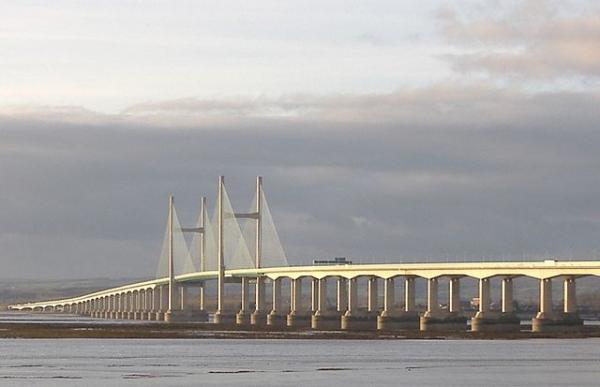
    Today I’ve written to my MP, Thangam Debbonaire, about Whitehall’s plans to rename the Second Severn Crossing and lumber it with the uninspiring and sycophantic moniker of the Prince of Wales Bridge.

    Second Severn Crossing
    Second Severn Crossing seen from Severn Beach. Picture courtesy of Wikimedia Commons.

    This move went down really badly in Wales, particularly in view of the total lack of public consultation and many tens of thousands of people have signed a petition objecting to the move, as reported by Wales Online.

    Besides the renaming being described variously as “pathetic“, “insulting” and “patronising” (and there is more than a hint of (neo-)colonialism about it. Ed.), many Welsh residents would like any change of name to be made in honour of someone who has actually done something for Wales, rather than sit around for decades waiting for his mum to die before he can take on her job.

    It now looks to be turning out to be equally unpopular in the West Country as the comments on this Bristol Post report seem to suggest.

    My email to Thangam is transcribed below.

    May I draw your attention to the following piece on the Post’s website: https://www.bristolpost.co.uk/news/bristol-news/backlash-grows-30000-sign-petition-1436994

    It’s not just the Welsh that object to it being renamed after Charles Windsor with no public consultation. I, one of your constituents and a long-term republican, also signed the petition. There are enough structures sycophantically named after the royals in any event.

    Perhaps you would like to join your Welsh colleagues in campaigning against this arbitrary change dreamed up in Whitehall and now being imposed insensitively upon the Westminster Village’s colony over the Severn! 🙂

    Regards, etc.

    Finally, it’s worth mentioning that most locals either side of the Severn estuary will still continue to refer to it as the Second Severn Crossing, no matter what the sycophants in London SW1 ultimately decide what to name it.

  • LibreOffice 6.0.3 release announced

    On Thursday, The Document Foundation (TDF), the organisation behind the free and open source Libreoffice productivity suite, announced the release of LibreOffice 6.0.3, the third minor release of the LibreOffice 6 family.

    Compared to the previous release, LibreOffice 6.0.3 around 70 bug and regression fixes.

    LibreOffice 6.0.3 represents the bleeding edge in terms of features and as such is targeted at early adopters, tech-savvy and power users, while LibreOffice 5.4.6 – provided as an alternative download option – is targeted at more conservative mainstream users and enterprise deployments.

    LibreOffice 6 splash screen

    Download LibreOffice

    LibreOffice 6.0.3 is immediately available for download for all major platforms – Linux, Mac OSX and Windows – at the following link: https://www.libreoffice.org/download/download/.

    As per usual, technical details about LibreOffice 6.0.3 bug and regression fixes can be found in the change logs for RC1 and RC2.

    Professional support

    TDF advises mainstream users and companies to deploy LibreOffice with the support of certified developers, migrators and trainers.

    Several companies on TDF’s Advisory Board provide either value-added LTS versions of LibreOffice or consultancy services for migration and training.

    Donate to help LibreOffice development

    LibreOffice users, free software advocates and community members can support The Document Foundation with a donation. Donations help TDF to maintain its infrastructure, share knowledge and fund attendance at events like LibreOffice Conference, which this year takes place in Tirana.

  • France – plus ça change…

    …Plus ce n’est plus la même chose ! 🙂

    As I sit in my sister’s apartment on the coast of Brittany this Easter, the thought comes to mind that it’s nearly five decades since my first visit to France as a callow schoolboy in 1971.

    This realisation has prompted me to consider just how much France has changed – albeit gradually but nevertheless steadily – over the intervening years. Below are four (for the sake of brevity. Ed.) obvious changes your ‘umble scribe has noticed have changed, haven’t changed and are completely new.

    Things that have changed or are now apparently rare

    • The distinctive smell of French built-up areas, the odour being composed mostly of bad plumbing and the pungent aroma of Gauloises and Gitanes.
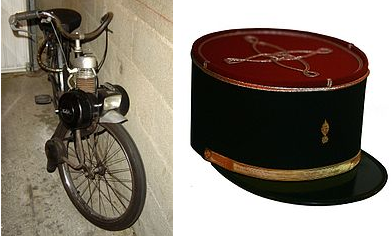
    • Mopeds, particularly the 50cc Mobylette or front wheel drive Solex, plus the classic Citroën 2CV.
    • In one and a half weeks here, I have yet to see someone working for the French state wearing a kepi. This headgear is now only worn by Customs officers and gendarmes on ceremonial occasions and by the military on “appropriate occasions”.
    • The lack of public conveniences; the average small French local authority now has more public loos than even large city authorities in the UK (who’ve been shutting theirs under austerity and costs-savings measures. Ed.).
    Solex and kepi
    The Solex and the kepi – destined for obsolescence?

    Things that haven’t changed

    • Grumpy-looking gendarmes and police officers.
    • The excellent quality of food on markets and in supermarkets and shops, plus affordable prices for alcoholic beverages.
    • French motorists’ psychopathic attitude to other motorists and contrasting extreme courtesy to cyclists.
    • Drinkable coffee and lovely hot chocolate in bars and cafés.

    Novelties

    • Ubiquitous cycle helmets, along with cycle routes and cycle lanes.
    • Roundabouts working on the same principal as in the UK (traffic on the roundabout has priority over that entering) have proliferated in the last 2 decades.
    • Pre-packed British style sandwiches on sale in supermarkets, along with ready meals: definitely a retrograde step. 🙁
    • Major stores opening on Sundays.

    If any readers wish to add to either list, comments are welcome below.

  • French seaweed farmers to sue Hanna-Barbera for breach of copyright?

    In Brittany collecting seaweed off the beaches and out at sea for use as fertiliser on fields has a long tradition.

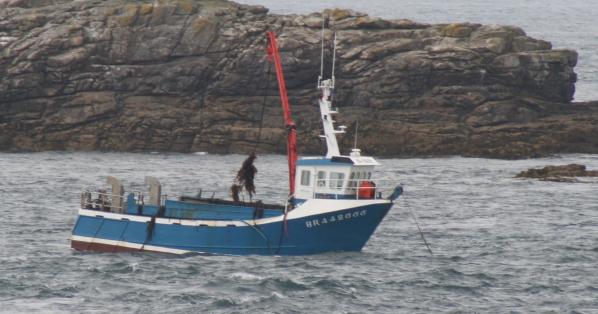
    In the early 1960s, the job of collecting seaweed was given a major mechanical boost with the invention of the scoubidou, a corkscrew-like tool that is used for the commercial harvesting of seaweed, consisting of an iron hook attached to a hydraulic arm. Its invention is credited to Yves Colin and it is largely used for gathering oarweed.

    A scoubidou can be seen in action below.

    A scoubidou in action off the coast of Brittany
    A scoubidou in action off the coast of Brittany

    Scooby-Doo the cartoon dogLet’s fast forward to the USA in 1969. At animation company Hanna-Barbera, a character in the shape of a male Great Dane called Scooby-Doo has just been invented and becomes the eponymous hero of an animation series featuring amateur detectives.
    The franchise proved very successful with the cartoon series being shown all around the world, culminating in a feature length film in 2002.

    News has now emerged that Breton seaweed harvesters, also known as goémoniers, might now be considering suing the animation company for copyright infringement.

    Breton seaweed harvesters’ spokesperson Avril Fouelle has commented: “It’s only right that we seek recompense. If it hadn’t been for those darn kids in Hollywood stealing our terminology for financial gain, Brittany’s géomoniers would today be living more comfortably than they do.”

  • Mad dogs – an Englishman speaks

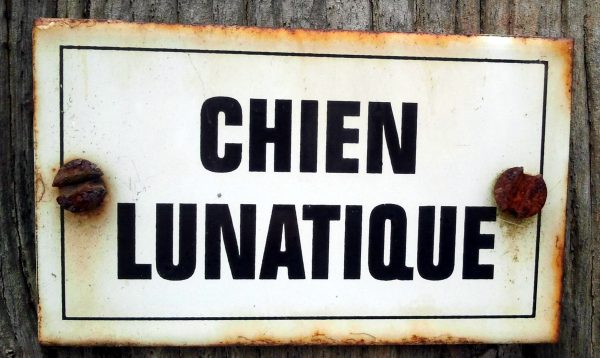
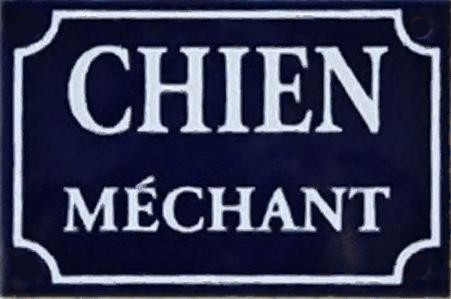
    During my first visits to France in my teens one frequently saw blue-enamelled signs mounted on gates and walls and bearing the words “Chien méchant“, the French equivalent of “Beware of the dog“. However, we used to translate it literally and, as the only other creature we’d come across which could also be described as “méchant” (= naughty*) was children, we settled on “naughty dog” as the accepted definition or translation and had a good chuckle. However, as time progressed and language studies reached higher levels, one gradually came to realise that literal translation is often unreliable, as exemplified by our French four-legged friends.

    The classic French "Chien méchant" sign from yesteryear
    The classic French “Chien méchant” sign from yesteryear

    Yesterday afternoon in Sainte Marine when out walking with my sister we came across the sign below.

    sign with French wording mad dog

    The alleged four-legged friend to which the sign refers is clearly a canine which has strayed well beyond being merely “méchant“, is clearly mentally unstable and would – if human and resident in England and Wales – be admitted to hospital against its will under the Mental Health Act.

    However, for we open source enthusiasts, “mad dog” – or in this case “maddog” – has other connotations. “Maddog” is the nickname of programmer Jon Hall, the Executive Director of Linux International, a non-profit organisation established by computer professionals with the aim of supporting and promoting Linux-based operating systems.

    Finally, any mention of mad dogs by an Englishman would be incomplete without a passing nod to Noel Coward, so here it is. 😀

    * = With enhanced vocabulary knowledge one subsequently became aware of other meanings of “méchant“, such as nasty or spiteful, which although laden with anthropomorphism are particularly pertinent to dogs and their bite. 😀

  • Fishy business

    When it comes to advertising, your correspondent shares George Orwell’s opinion as expressed in 1936 in “Keep the Aspidistra Flying“, i.e.:

    The public are swine; advertising is the rattling of a stick inside a swill-bucket

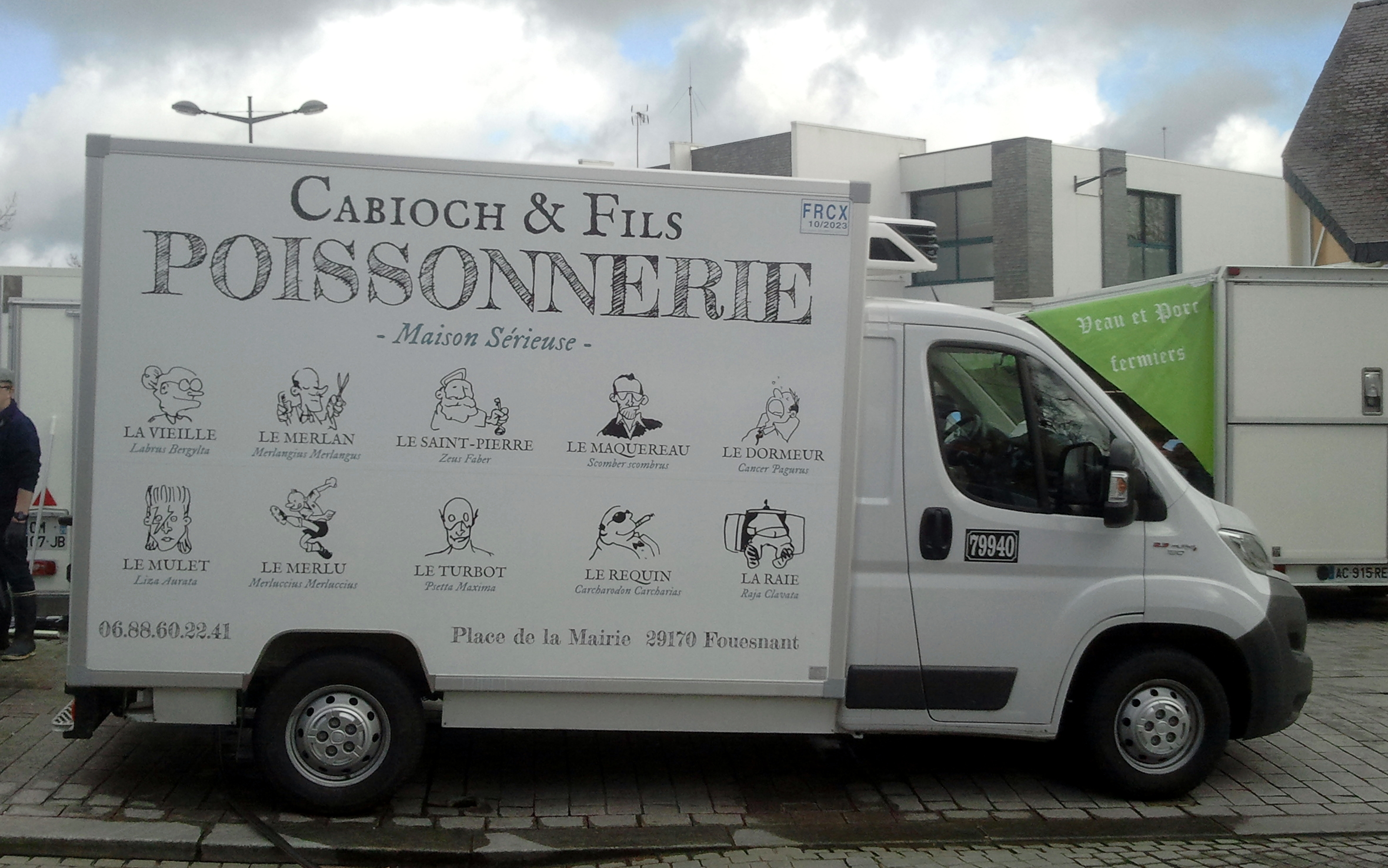
    However, I’ll make an exception for a local fishmonger’s van seen on Good Friday in Fouesnant market in Brittany and depicted below.

    Fish van seen in Fouesnant market. Brittany
    Click on the image for the full version

    Billing themselves as a hard-working/responsible/serious company (Maison sérieuse), Poissonnerie Cabioch & Fils’ signwriter clearly has a humorous streak when it comes to advertising her/his client’s common items of trade.

    For those not well versed in French, the bounties of the sea shown on the side of the van are listed below with their equivalents in English. Some also have slang meanings in French. Each link in the list leads to the relevant Wikipedia page in the respective language for the species concerned.

    Talking of fishy things, it’s very nearly April Fools’ Day, or for the French “Poisson d’avril“. For children, “Poisson d’avril” consists of sticking a paper fish on the backs of people they wish to make fun of.

    The earliest known occurrence of “Poisson d’avril” in French is found in the “ Doctrinal du temps présent” by the 15th century French poet and priest Pierre Michault, dating from 1466. However, its use to describe a traditional trick played on 1st April is only confirmed in the 17th century, when its earliest known occurrence is found in “La Vie de Charles V, duc de Lorraine” by historian Jean de Labrune published in 1691. It is first recorded in the dictionary of the Académie française, the guardians of the French language, in 1718.

    Fish fingers going over a weir
    A fish-fingery April Fools’ prank. Image courtesy of Wikimedia Commons.

    Finally fish – in this case rotten fish – also come into play in French if one wants to call someone every name under the sun; the equivalent French expression is “engueuler comme du poisson pourri“.

  • LibreOffice 5.4.6 released

    LibreOffice logoToday The Document Foundation (TDF) announced the availability of LibreOffice 5.4.6, the sixth minor release of LibreOffice 5.4 family which is currently targeted for deployment in an enterprise or corporate environment and conservative users.

    Download LibreOffice

    LibreOffice 5.4.6 is available for immediate download.

    LibreOffice 5.4.6 includes almost 60 bug and regression fixes. Technical details about the release can be found in the RC1 and RC2 change logs.

    Professional support

    TDF advises mainstream users and companies to deploy LibreOffice with the support of certified developers, migrators and trainers.

    Several companies sitting in TDF’s Advisory Board provide either value-added LTS versions of LibreOffice or consultancy services for migration and training.

    Donate to help LibreOffice development

    LibreOffice users, free software advocates and community members can support The Document Foundation with a donation. Donations help TDF to maintain its infrastructure, share knowledge and fund attendance at events like LibreOffice Conference, which this year takes place in Tirana.

  • Railway works on (four) track

    My home is very close to Stapleton Road railway station and for some time now Network Rail has been carrying out its Four Track project up Filton Bank between Bristol Temple Meads and Filton Abbey Wood.

    In the final week of July 2017 and the first two weeks of August that year, the disused viaduct over the old course of the River Frome (culverted for the polluting monstrosity that is the M32 motorway. Ed.) and Stapleton Road. The viaduct was originally decommissioned in the early 1980s, allegedly for safety reasons. Network Rail has released a time lapse video of the viaduct’s demise.

    This June the replacement viaduct will be in situ and hopefully there will be another time lapse video to record its installation.

    Below are a couple of photographs of works now underway for the replacement viaduct.

    Piling works for the new viaduct
    Piling works underway for the new Stapleton Road viaduct.
    General view of the works site for the new viaduct
    General view of the works site for the new viaduct

    Meanwhile, further down towards Temple Meads, trackbed preparation works are well underway at Lawrence Hill station near the site of the Wain Brook culvert (posts passim). Note the use of geotextile beneath the sand.

    Trackbed preparation works at Lawrence Hill
    Trackbed preparation works at Lawrence Hill

    According to Network Rail, the Filton Bank Four-tracking project will:

    • enable a significant increase in the number of passenger trains, helping to meet growing demand;
    • enable an increase in freight operations, supporting our economy;
    • increase the line’s flexibility, reducing disruption as a result of maintenance.

    Since September 2015, Network Rail has been carrying out a broad range of enabling works along Filton Bank, and these will continue up until the new tracks are laid in Autumn 2018. These works include:

    • the provision of a fourth platform at Filton Abbey Wood Station;
    • six major earthwork sites to create new trackbed;
    • around 10 miles of plain line track,12 switch and crossings and three miles of track drainage;
    • upgrades to six underbridges, a new viaduct at Stapleton Road and improvements to three footbridges;
    • resiting of two GSM-R; communications masts;
    • work on around 30 signalling structures;
    • route clearance work at 10 structures.
  • Trinity Mirror local “news” – readers respond

    Ever since the takeover of the Local World newspaper titles by Trinity Mirror in October 2015, several Local World titles seem to or actually have given up on reporting serious local news preferring to give preference to what are essentially advertorials (e.g. restaurant reviews) and trivia instead of the hard work of investigating corruption and wrongdoing in the local corridors of power and/or amongst the
    city’s so-called great and good.

    This certainly seems to ring true if one examines the Bristol Post, the city’s newspaper of warped record.

    Today’s most spectacular piece of trivia from the Temple Way Ministry of Truth concerns an encounter with an unpleasant object in the men’s toilets of McDonalds, not a caterer likely to feature in the aforementioned restaurant reviews (McDonald’s restaurants is a well-known modern oxymoron. Ed.).

    When allowed to comment, Post readers are not shy in expressing their views, as shown by the exchange below on the offending article.

    comments read 1 This is not news and 2 The Post isn't a newspaper

    As alluded to above, most of the Post’s alleged online news content can accurately be described as “clickbait“, which is defined by Wikipedia as “web content whose main goal is to entice users to click on a link to go to a certain webpage or video. Clickbait headlines typically aim to exploit the “curiosity gap,” providing just enough information to make readers curious, but not enough to satisfy their curiosity without clicking through to the linked content“.

Posts navigation