• LibreOffice 5.3.3 released

    Yesterday The Document Foundation (TDF) announced the release of LibreOffice 5.3.3, the latest release of the “fresh” series, which is aimed at early adopters, power users and technology enthusiasts.

    For more conservative users and enterprise deployments, TDF suggests LibreOffice 5.2.7, the latest “still” series release, with the backing of professional support by certified professionals.

    Compared with its predecessor, LibreOffice 5.3.3 incorporates more than 70 patches, including an update of the Sifr monochrome icon set and several fixes for interoperability with Microsoft Office file formats.

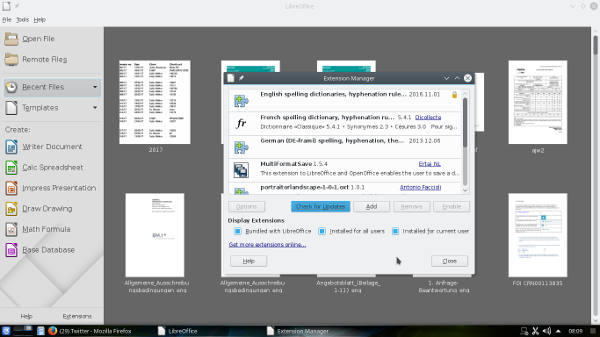
    LibreOffice 5.3.3 running on the author's Debian GNU/Linux laptop
    LibreOffice 5.3.3 running on the author’s Debian GNU/Linux laptop

    As regards those 70 patches mentioned above, users can see which bugs they’ve help to fix in both release candidates, RC1 and RC2 respectively.

    Download LibreOffice

    LibreOffice 5.3.3 is immediately available for download for all major platforms – GNU/Linux, Mac OSX and Windows. If your GNU/Linux system can handle Flatpak format, there’s a special link for that.

    Support LibreOffice with a donation

    As with every release, LibreOffice users, free software advocates and community members are invited to support TDF’s work with a donation.

  • Election special: Tory buzzword bingo

    Cricket fans have long been acquainted with the delights of Boycott Bingo (posts passim), where the regular verbal mannerisms on Test Match Special of the greatest living Yorkshireman have been turned into a game.

    Following the recent announcement of the snap general election next month, followers of politics can now play their own game of buzzword bingo with the stock phrases and soundbites of the nation’s political leaders and election candidates.

    Expect these buzzwords to be wheeled out until everyone is absolutely fed up with them, usually after about 48 hours.

    The Conservatives’ soundbites are particularly limited in scope and number and, from what I’ve seen and heard, to call their candidates’ and leader’s performance wooden would be an insult to trees.

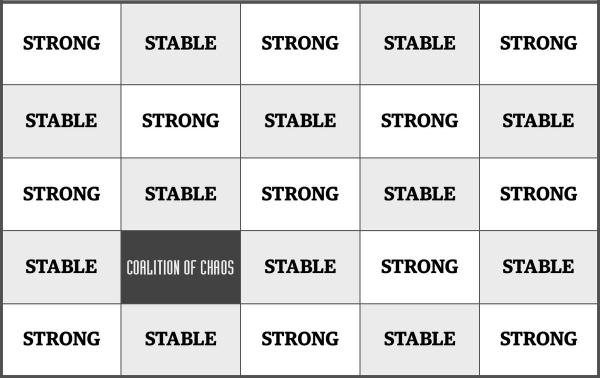
    Below, courtesy of The Guardian, is your very own buzzword bingo card for use with Tory leader Theresa May (whose main method of operation seems to consist of avoiding saying anything of substance. Ed.) and her colleagues.

    Good luck!

    bingo card featuring words strong, stable and coalition of chaos

  • Hello Slimbook Excálibur

    Courtesy of MuyLinux, I’ve become aware of the Slimbook Excálibur, a 15-inch laptop with an aluminium body and backlit keyboard.

    From the video, it’s a smart-looking piece of equipment.

    The machine’s specification is as follows:

    • Intel i5-6200U / i7-6500U CPU
    • Dedicated NVIDIA GeForce 940M 2GB GPU
    • 4GB / 8GB / 16GB DDR 3 RAM
    • 120GB / 250GB / 500GB SSD
    • Optional 500GB / 1TB / 2TB HDD

    Slimbook has a selection of up to 11 Linux distributions, including Antergos, Debian, elementary OS, Fedora, KDE Neon, Kubuntu, Linux Mint, openSUSE, Ubuntu, Ubuntu MATE and Xubuntu, which can be pre-installed; or those desperate for their fix of proprietary can also have Windows installed instead if they pay the necessary licence fee.

    Excálibur pricing starts at €799.

  • Still verminous

    At the Conservative Party conference in 2002, new party chairwoman Theresa May stunned delegates with her keynote speech by saying the following:

    Yes, we’ve made progress, but let’s not kid ourselves. There’s a way to go before we can return to government. There’s a lot we need to do in this party of ours. Our base is too narrow and so, occasionally, are our sympathies, You know what some people call us: the nasty party.

    Since 2010 the Conservatives have proved in government that they haven’t changed and they’re still the Nasty Party writ large with their austerity policies that have cut funding to local authorities, cutting benefits for the disabled and referring to the unemployed as scroungers and shirkers.

    Theresa May has since moved on from Conservative Party chairwoman via the Home Office to doing Prime Minister impressions at a lectern outside 10 Downing Street and at the despatch box in the House of Commons. Although her 2002 admonishment might have been the first time that a prominent Tory had criticised the party, the Tories’ political opponents have been doing so along the same lines for decades.

    Aneurin Bevan at the microphoneOne of the most prominent of these criticisms in the post-war period came on 4th July 1948 when Aneurin Bevan, then the Labour government’s Minister of Health, addressed a Labour Party rally in Manchester on the anniversary of Labour’s accession to power.

    Bevan’s speech was largely a review, followed by a pledge that the Government could carry out its entire programme, including nationalisation of the steel industry, a pledge in the party’s 1945 election manifesto.

    However, Bevan recalled what he described as the bitter experiences of his early life. For a time he was forced to live on the earnings of an elder sister and was told to emigrate.

    On this point, he remarked:

    That is why no amount of cajolery, and no attempts at ethical or social seduction, can eradicate from my heart a deep burning hatred for the Tory Party that inflicted those bitter experiences on me. So far as I am concerned they are lower than vermin. They condemned millions of first-class people to semi-starvation.

    Yes, that’s right. In Bevan’s eyes, the Conservatives were “lower than vermin“.

    Oxford Dictionaries defines vermin as follows:

    Wild animals which are believed to be harmful to crops, farm animals, or game, or which carry disease, e.g. rodents.

    It also offers the additional sub-definition below:

    People perceived as despicable and as causing problems for the rest of society.

    As regards its origin, the word vermin first appears in Middle English and comes from from Old French based on Latin vermis ‘worm’ since it originally denoted animals such as reptiles and snakes.

    However, this demotion of the Tories to rank below rats, mice and the like wasn’t the only attack on the Conservatives during Bevan’s speech, since he is also reported as asking the meeting rhetorically at one point: “For what is Toryism, except organised spivvery?“. This reference to wartime black marketeers may sound anachronistic, but there are still senior members of the Conservative Party who are even nowadays referred to as spivs (posts passim) – and by others apart from your ‘umble scribe.

    Finally, in view of the impending general election, it might be worth recalling what Bevan went on the say about the Conservatives of his time, since these words still have relevance and pertinence today.

    Now the Tories are pouring out money in propaganda of all sorts and are hoping by this organised sustained mass suggestion to eradicate from our minds all memory of what we went through. But, I warn you young men and women, do not listen to what they are saying now. Do not listen to the seductions of Lord Woolton. He is a very good salesman. If you are selling shoddy stuff you have to be a good salesman. But I warn you they have not changed, or if they have they are slightly worse than they were.

    Ouch! All that needs changing to make the above quotation contemporary to the 2017 election would be to replace the name of Woolton with that of a present-day prominent right-wing Tory grandee. Will any opposition candidate do so?
  • Debian to shut down its public FTP servers

    Debian logoDebian is a mature Linux distribution that serves as the basis for many other distros, such as the Ubuntu family.
    Your ‘umble scribe has been a loyal Debian user for at least a decade and has always found it to be secure, stable and reliable operating system.

    Since its inception, Debian has offered downloads of its disk images by both the FTP and HTTP network protocols.

    However, Debian news has now announced that its public FTP service will be closed down in November 2017.

    The relevant text of the announcement is reproduced below.

    After many years of serving the needs of our users, and some more of declining usage in favor of better options, all public-facing debian.org FTP services will be shut down on November 1, 2017. These are:

    • ftp://ftp.debian.org
    • ftp://security.debian.org

    This decision is driven by the following considerations:

    • FTP servers have no support for caching or acceleration.
    • Most software implementations have stagnated
      and are awkward to use and configure.
    • Usage of the FTP servers is pretty low as our own installer has not offered FTP as a way to access mirrors for over ten years.
    • The protocol is inefficient and requires adding awkward kludges to firewalls and load-balancing daemons.

    Information for users

    The DNS names ftp.debian.org and ftp.<CC>.debian.org will remain the same. The mirrors should just be accessed using HTTP instead:

    • http://ftp.debian.org
    • http://security.debian.org

    Information for developers

    Our developer services will not be affected. These are the upload queues for both the main and the security archive:

    • ftp://ftp.upload.debian.org
    • ftp://security-master.debian.org
  • British press puts truth in intensive care

    In 1918 US Senator Hiram Warren Johnson is purported to have said: “The first casualty when war comes is truth.

    There may not be a war, but classifying the status of truth as a mere casualty may be insufficient and it now finds itself on life support in intensive care when the predominantly right-wing British press is reporting politics, particularly politics abroad.

    Yesterday saw France go to the polls in the first round of the 2017 presidential election, with 11 candidates standing.

    Under the French system, the 2 front runners in the first round of the election go forward to a straight winner takes all ballot in the second round.

    In yesterday’s ballot the independent candidate Emmanuel Macron polled around 23.7% of vote with Marine Le Pen, leader of the fascist Front National coming in second on roughly 21.5%.

    Early opinion polls also give Macron a lead of over 20 percentage points over Le Pen with regard to second round voting intentions and he’s currently predicted to garner 60% of second round votes, thus excluding Le Pen from the Elysée Palace.

    However, looking at certain sections of the British press, anyone would think right-wing intolerance had triumphed in this first round.

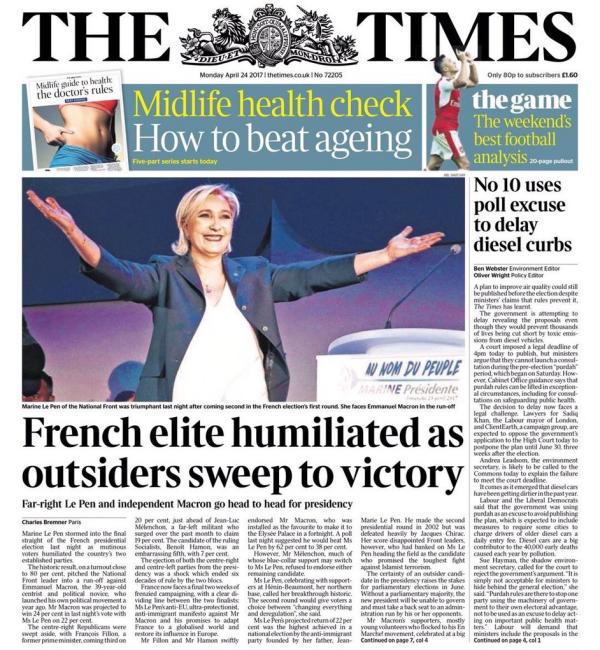
    Here’s The Times, formerly regarded as Britain’s newspaper of record, now reduced to a sad mouthpiece parroting the extreme right-wing agenda of the deeply unpleasant Rupert Murdoch.

    Times front page featuring large photo of Marine Le Pen

    Note the large photograph of Marine Le Pen. It’s also worth noting that despite the hype from right-wing media around the world, a $9.8m loan to the FN from a Russian bank with Kremlin links and alleged Russian social media support, Le Pen polled little better than in the 2012 presidential election when she finished third with nearly 18% of the vote.

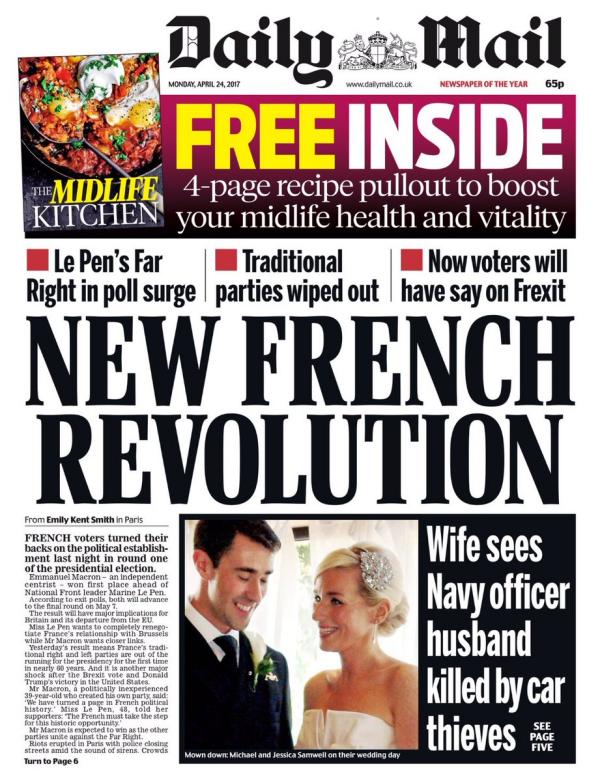
    However, The Times was not alone in its stilted coverage. Here’s the Daily Mail’s front page.

    Daily Mail front page misreporting

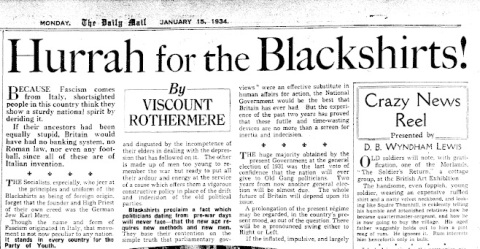
    All that can be said is that editor Paul Dacre has presided over misinformation and distortion on a massive scale, but then again the Mail has decades of experience in promoting fascism dating right back to the 1930s and its founder Viscount Rothermere’s infamous “Hurrah for the Blackshirts” piece.

    Mail's Hurrah for the Blackshirts headline

    Comme on dit en France, plus ça change…

  • Vocabulary – what a bummer

    It’s a well-known adage that Britain and the United States are 2 countries divided by a common language.

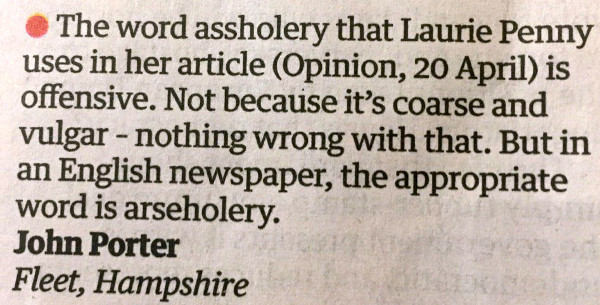
    However, that doesn’t seem to stop constant encroachment from over the other side of the Atlantic, as illustrated by the following letter from yesterday’s The Grauniad (dead tree edition).

    shot of letter complaining assholery should have been arseholery

  • Saints, dragons and public holidays

    Today is St George’s Day, the saint’s day of England’s patron saint and the purported day of Shakespeare’s birth (as well as being the day of his actual death in 1616. Ed.).

    George was first adopted as England’s patron saint in the 14th century, when he was given the job and his predecessor St Edmund the Martyr, the 9th century king of East Anglia, was given the medieval equivalent of his P45. Nevertheless, traces of a cult of St George in England are discernible from the 9th century onwards in the form of a liturgy used at that time at Durham Cathedral, a 10th century Anglo-Saxon martyrology and in dedications to Saint George at Fordington in Dorset, Thetford in Norfolk, Southwark and Doncaster.

    According to legend, George was a Roman soldier of Greek origin and officer in the guard of the Roman emperor Diocletian, who ordered his death for George failing to recant his Christian faith.

    Looking at patronage, George is much more than the patron saint of England. Four other countries also have him as their patron saint, i.e.:

    • Georgia;
    • Malta;
    • Portugal; and
    • Romania.

    Furthermore, George is also the patron saint of Spain’s autonomous communities of Aragon and Catalonia.

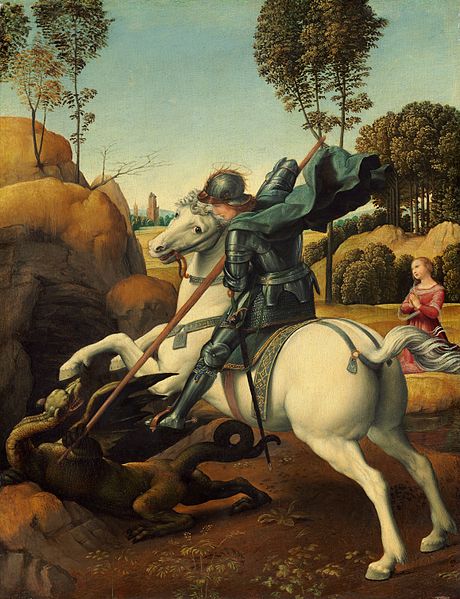
    The best known feat about St George is his alleged dragon slaying. Just like his being a member of Diocletian’s guard, this is also legend. In the medieval romances, the lance with which Saint George is said to have slain the dragon was called Ascalon after the Levantine city of Ashkelon, which is in the modern state of Israel. As regards any factual basis for the legend, some evidence links the legend back to very old Egyptian and Phoenician sources in a late antique statue of Horus fighting a “dragon”. This links the legendary George – who should not be confused with the historical George – to various ancient sources of mythology around the eastern Mediterranean.

    Raphael's painting of George slaying the dragon
    George slaying the dragon as painted by Raphael

    Speaking of dragons, the Old English Wordhord Twitter account came up with “ligdraca” – a fire-drake or dragon vomiting flames – for St George’s Day.

    screenshot of tweet for lidraga

    Celebrating St George’s Day has been more common in the past in England, although there have been times when it was celebrated less or not at all.

    Indeed, Keith Flett informs us that its celebration was popular until the Reformation, but it was still marked. Under the Commonwealth, its celebration was banned in 1645 under the Long Parliament which sat from 1640 to 1660. When the English in their folly decided to invite Charles Stuart back in 1660 after the death of Cromwell, celebrating St George’s Day was restored.

    Unlike St Andrew’s Day in Scotland, St George’s Day is not a public holiday (confusingly called a bank holiday in British English. Ed.). Indeed the countries of the United Kingdom have amongst the lowest numbers of public holidays in the developed world, whilst the UK as a whole has the the fewest of any G20 country or EU member state.

    Whether to respond to this shortcoming or not, it’s been reported today that Labour leader Jeremy Corbyn will announce that Labour will introduce four new bank holidays – one for each of the patron saints of the countries making up the United Kingdom – if the party wins the forthcoming general election. This will be sold on the doorstep as a measure “to give workers the break they deserve“: and that’s definitely something for which I can vote.

  • First LibreOffice 5.4 bug hunting session soon

    The first bug hunting session for LibreOffice 5.4 – the next major release of this popular free and open source office suite – has been announced on The Document Foundation blog.

    bug hunt banner giving details

    LibreOffice 5.4 is due to be released at the end of July with many new features: those already implemented are summarised on the release notes wiki page; and there are still more new features to be disclosed.

    The LibreOffice QA team is organizing the first Bug Hunting Session on Friday 28th April to find, report and triage bugs. Testing will be carried out on the first alpha release of LibreOffice 5.4, which will be made available (for Linux, Mac OS X and Windows) on the pre-releases server shortly before the session.

    Full details of the event are available on the specific wiki page.

    Mentors to help testers report and confirm bugs will be available on 28th April from 8.00 a.m. UTC to 10.00 p.m. UTC. Moreover, as this this particular Alpha release (LibreOffice 5.4.0 Alpha1) will be available until the middle of May, hunting bugs will also be possible on other days.

    During the day there will be two dedicated sessions: the first to chase bugs on the main LibreOffice modules between 3.00 p.m. UTC and 5.00 p.m. UTC; and the second to test a set of the top 7 features between 5.00 p.m. UTC and 7.00 p.m. UTC.

Posts navigation