Bristol

  • Stormy afternoon

    Bristol suffered heavy rainfall and a thunderstorm yesterday afternoon, resulting in some local flooding and power outages according to the Bristol Post/Bristol Live.

    And guess who was out in it?

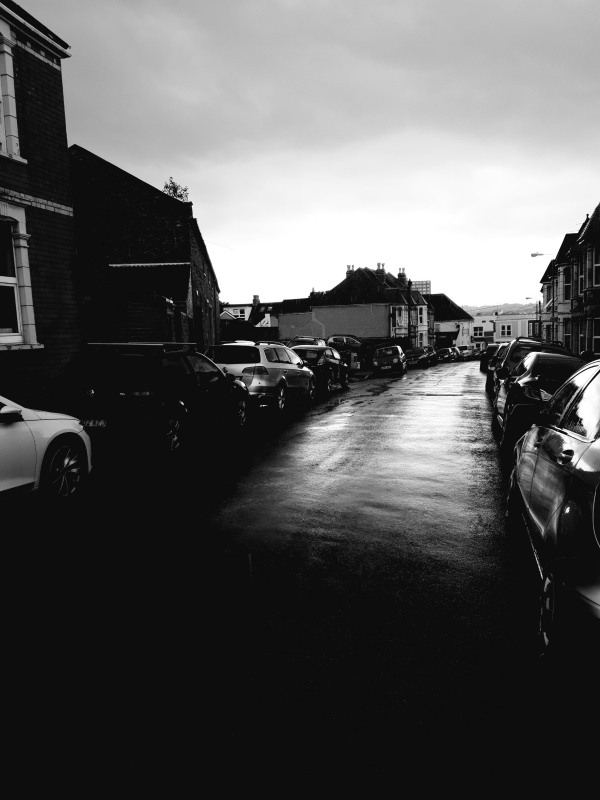
    Never mind. It resulted in a spectacularly atmospheric photograph taken a few minutes from home and shown below in glorious black and white for additional impact.

    The shot was taken looking westwards from the top of Eastbourne Road, Easton towards the higher ground of Cotham and Clifton.

    The view looking west from Eastbourne Road in Easton
  • Games arcades for sale

    One of the mainstays of local news reporting has been the opening of new businesses in the locality.

    And in this the Bristol Post is superficially no different from other regional titles.

    However if one looks beneath the surface of such reporting, some divergences from other local press publications may be observed, in particular the lack of copy quality control.

    Such an instance occurred yesterday in a piece on the opening of a new business in a vacant shop in The Galleries in Bristol’s Broadmead shopping centre. Whilst the headline suggests that the new business will be selling access to 1980s arcade games such as Donkey Kong and Pac-Man*, the piece’s strapline and the opening words of the third paragraph of the copy suggest otherwise.

    Screenshot of original Donkey Kong game
    Screenshot of original Donkey Kong game

    They both read as follows:

    More than a hundred 1980s retro video game arcades are on offer.

    If games arcades really are on offer rather than poorly proofread copy, the shop would need a capacious stock warehouse, slightly more capacious than the facilities usually available in BS1. 😀

    *= Pac-Man is in fact a 1990s video game, released on 31st May 1990. This other major howler in the piece could have been avoided by the use of a secret research technique know to the cognoscenti as 5 minutes’ Googling.

  • Electrifying

    One of the staples of local news reporting is the activities of the emergency services – police, ambulance, coastguard, fire service – and in this regard Bristol Live – formerly the Bristol (Evening) Post is no exception.

    Yesterday’s online edition reported on the fire service’s attendance at a possible incident on Colston Street (soon to revert to its original name of Steep Street after the city’s Victorian great and good renamed it after a slave trader. Ed.).

    However, once again the reporter’s poor English is disappointing to read.

    In the second paragraph readers are informed that

    The alarm was sounded after what was believed to be an electric fire in Colston Street at around 8.22pm.

    Where was the said domestic appliance left? In the roadway? On the footway/pavement?

    Clarification was helpfully supplied by the fire service, whose spokesperson commented as follows:

    Upon investigation, the issue was determined to be under the pavement and originating from an area of recently excavated electrical works.

    So the fire, if it ever existed in the first place, was electrical, not electric.

    As an aid to passing hacks wishing to improve their vocabulary, there follows below a handy pictorial guide to the difference between the two. 😀

    An electrical fire
    An electrical fire. Image courtesy of Wikimedia Commons.
    Electric fire
    An electric fire (aka electric heater). Image courtesy of Wikimedia Commons.
  • Tree catches train?

    One of the joys of reading the Bristol Post/BristolLive website is their hidden exclusives – the ones that are really newsworthy, but are buried in other pieces, such as in this example from Wednesday.

    Headline reads Woman died after being hit by branch leaning out of train window, inquest hears

    The flippant side of me wants to ask the journalist about the circumstantial details implied by the headline. What was a tree doing on the train in the first place? What kind of ticket was it sold? Where was it travelling from and to? Did it pay full price for the ticket or was it a railcard holder? Did it buy anything from the buffet during its journey? And ultimately why did it feel the need to stick a branch out of the window when the train was travelling at 75 mph, particularly as it resulted in a person’s death?

    The tragic story of a life cut short by a moment’s carelessness has been turned upside down by sloppy headline writing, which implies that part of the tree was poking out of a train window was the cause of death, rather than the deceased being careless, leaning out of a train window being struck by lineside vegetation.

    However, despite my flippancy above, I do realise and appreciate that it must be very distressing to the victim’s friends and family to have the read the circumstances of the incident so misrepresented by someone allegedly supposed to be working for an organ whic is supposed a trusted source of local news.

    As the victim came from Penarth, WalesOnline, the Reach plc’s South Wales equivalent of BristolLive, has also carried the story, but with a clear and unambiguous headline.

    Please take note, servants of the Bristol’s Temple Way Ministry of Truth.

  • The vision thing

    The vision thing” is a comment made by George H. W. Bush ahead of the 1988 United States presidential election when urged to spend some time thinking about his plans for his prospective presidency.

    The embracing of vision – with or without the thing – is widespread in public life in Britain at both local and national levels. Every party leader is expected to have one; and any plans for the wholesale remodelling of large areas of our town and cities are expected incorporate vision too.

    An investigation into the prevalence of vision in the organs of the British state reveals just how ingrained use of the term is. A quick Google search for items containing “vision” on websites within the .gov.uk domain is revealing.

    Screenshot of Google search revealing 2.3m uses of vision on central and local government websites

    No, your eyes do not deceive you – 2.3 million instances of use.

    Looking more locally, a recent search (mid-April) of the Bristol City Council website for the term returns a total of over 4,200 hits. It has probably risen since last month (and with all that evident ocular deployment, one would have thought that the inhabitants of the Counts Louse – which some refer to as City Hall – would realise there’s a major cleanliness problem with the city’s streets. Ed.).

    Screenshot of Google search of Bristol City Council website for use of vision

    With all that vision in use in the country, opticians and their colleagues must be raking in the money. 😀

    Helmut Schmidt
    Sie hatten Recht, Herr Bundeskanzler!

    Or is it necessarily opticians and associated practitioners that should be profiting from this phenomenon? There is some scepticism about the benefits of visions.

    George H.W. Bush was mentioned at the start of this post. One of his contemporaries was the former West German Chancellor Helmut Schmidt.

    Schmidt was very dismissive of visions and is on record as stating the following:

    Wer Visionen hat, soll zum Arzt gehen.

    This translates into English as:

    Anyone who has visions should go to the doctor.

    Will anyone working for the British state be visiting their GP soon, either individually or en masse?

    I doubt it.

    Finally, when someone summoned up the courage to ask Schmidt what his big vision was, he is reputed to have referred them to Bush! 😀

  • May blossom

    We’re now in May and one reliable natural occurrence of the time of year is the flowering of common hawthorn (Crataegus monogyna), which is also known as the oneseed hawthorn, or single-seeded hawthorn.

    Other common names include may, mayblossom, maythorn, quickthorn, whitethorn, motherdie, and haw.

    The Woodland Trust have produced a short video depicting one year in the life of the hawthorn.

    The specimen below can be found in the Easton section of the Bristol & Railway Path near the Brixton Road access point.

    Hawthorn tree on Railway Path in Easton

    Hawthorn is amongst the first trees to start budding in the spring (the above specimen first put out leaves in late January. Ed.) and is also a fast-growing plant. This may explain the alternative name of quickthorn.

    As it forms a dense, thorny mass of branches, it is often used for hedging, particularly where livestock has to be contained.

    Besides its agricultural value as hedging, common hawthorn can support more than 300 insects. It is a food plant for caterpillars of numerous moths. Its flowers are eaten by dormice and provide nectar and pollen for bees and other pollinating insects. The haws (berries) are rich in antioxidants and are eaten by migrating birds, such as redwings, fieldfares and thrushes, as well as small mammals.

    Furthermore, the dense, thorny foliage makes fantastic nesting shelter for many bird species of bird.

    Green Man ceiling boss, Rochester Cathedral

    Folklore and symbolism

    Hawthorn is a pagan symbol of fertility and has associations with May Day stretching back beyond written history. It was the forerunner of the Maypole and its leaves and flowers provided the source of May Day garlands as well as appearing in the wreath of the Green Man.

    In medieval times hawthorn was never brought indoors as it was generally believed that bringing its blossom indoors would result in illness and even death. In those times it was also commonly believed that hawthorn blossom smelled like the plague. In more recent times scientists have discovered the chemical trimethylamine (which smells like ammonia or rotting flesh. Ed.) in hawthorn blossom is also one of the first chemicals formed in rotting animal fish, hence the tree’s traditional linking with illness and death.

    In spite of the beliefs and symbolism outlined above, the young hawthorn leaves, flower buds and young flowers are all edible. The leaves are often described as having the flavour of bread and cheese. They can be added to green salads and grated root salads. The developing flower buds are particularly good. The haws can be eaten raw (beware a stomach upset. Ed.), but are most commonly used to make jellies and wines.

    A final personal note

    In my own life, the blossoming of the hawthorn always reminds me that spring is giving way to early summer.

    In particular, it reminds of when I was 8 years old and my mother took my 2 younger siblings and me by train all the way from Stafford to Harling Road in Norfolk – the nearest station to my grandmother’s home. The journey took the best part of a day (showing how difficult it was to travel cross-country in England, even in pre-Beeching times. Ed.). The fields on either side of the railway lines on which we travelled were thick with hawthorn blossoming pink and white.

    Whenever I see hawthorn in bloom these days, I’m immediately reminded of that one train journey, even though it’s now almost 6 decades in the past.

    Update: After writing this post, I asked both my siblings if they remembered that journey and if so, what they recalled. My sister replied that she recollected the journey as being interminable and her chief memory was all the trackside telegraph poles, whilst my brother – the youngest of us – responded with a question as to whether that was the railway trip during which he was sick. He obviously had other matters than lineside shrubbery on his mind. 😀

  • Illiteracy or bloody-mindedness?

    It’s now 10 years since TidyBS5 was inaugurated by local residents with the support of local ward councillors to campaign for a more pleasant street scene in the Bristol council wards of Easton and Lawrence Hill.

    During all that time, both residents and councillors has persistently call on Bristol City Council to increase both the presence and visibility of enforcement action, but our efforts have only been rewarded in the last couple of years with higher fixed penalty notices (FPNs) for environmental crimes in 2019 and the recent recruiting of more enforcement officers (posts passim).

    Largely as a result of the actions of local residents raising awareness of environmental blight, the streets of Lawrence Hill and Easton are now marginally freer of fly-tipping than they were then, but problems still persist, not helped by the lower footfall due to lockdown and the amount of DIY and building works being undertaken.

    This was spotted at the junction of Walton Street and Chaplin Road.

    Photo shows fly-tipping beneath sign advising no fly-tipping, CCTV in operation

    Is this an example of illiteracy or bloody-mindedness? Kindly give your answers in the comments.

  • Greens take impressive lead in recycling box poll

    It’s one week to go to the elections for Bristol City Council, the elected Mayor of Bristol (with 2 of the 9 candidates standing for election to the office vowing to hold a referendum with a view to abolishing the autocratic post. Ed.), the West of England Combined Authority Mayor and the Avon & Somerset Police & Crime Commissioner.

    My recycling box is rapidly filling up with election materials as the parties all vie for my cross against their candidates’ names on the four ballot papers (Hint to canvassers: don’t bother with my house any more; I’ve already voted by post! Ed.).

    Following the arrival on the latest leaflet on the doormat, the poll has been updated and now shows the following state of the parties.

    Screenshot of spreadsheet showing Greens with 4 leaflets and other parties with 1 each

    The Greens seem determined to win Lawrence Hill ward and are pulling out all the stops. As they’re normally in fourth place, the Tories have managed on token leaflet as have the Liberal Democrats, who were once renowned for their zeal in bunging up letterboxes with their literature.

    Why has there only been one Labour leaflet? Is this a symptom of lower levels of activism in the wake of members deserting the party after the election of Keir Starmer (whom some unkindly refer to as Keith. Ed.)?

    All will become clear next week.

    Maybe.

  • Local elections 2021 – the recycling poll

    It’s getting close to election time again and the period of what is informally known as “purdah” (also known rather more formally and stuffily in local authority circles as the “pre-election period” Ed.), which has very little to with purdah’s original definition, i.e. a religious and social practice of female seclusion prevalent among some Muslim and Hindu communities, and more to do with preventing central and local government from making announcements about any new or controversial initiatives that could be seen to be advantageous to any candidates or parties in the forthcoming election.

    Here in the Bristol area, elections are being held not only for the local council, but also for the elected Mayor of Bristol, the Avon & Somerset Police and Crime Commissioner and the Mayor of the West of England Combined Authority (WECA).

    As is usual with matters electoral, I keep a record on a LibreOffice spreadsheet of all election leaflets received, which ultimately end up in their rightful place – the waste paper recycling box (apart from personally addressed material, which is fed to the confidential waste shredder. Ed.).

    The latest state of the parties – as of first thing this morning – is shown below.

    Screenshot of election leaflet spreadsheet

    As can be seen, the Greens are clearly putting a major effort into depriving Labour of their 2 ward seats for Lawrence Hill in the council chamber.

    Whilst elections may be regarded as a vehicle of change, there are certain features that are reassuringly familiar and are thus recycled election after election.

    For instance, the first leaflet received after the notices of persons nominated were announced was one from the Liberal Democrats, as per their decades-long reputation for opportunism.

    That leaflet also comprised other reassuringly familiar Liberal Democrat tropes, such as the bar chart below for the WECA Mayor. I am reliably informed by a fellow linguist who took a ruler to the y axis, that the column sizes are reasonably accurate (for once. Ed.)

    Bar chart scanned from LibDem election leaflet

    That just leaves the equine graphic with the heading “It’s a 2 horse race! (Insert_party_name) can’t win here!” and the traditional graphics requirements for LibDem leaflets will have been fulfilled.

    More leaflets can of course be expected to land on the doormat as polling day approaches, so updates will be provided in due course.

Posts navigation