tech

  • LibreOffice 25.2.7 released

    The Document Foundation (TDF) has today announced the release of LibreOffice 25.2.7, the final maintenance release for the LibreOffice 25.2 family, which is now available for download. Users of LibreOffice 25.2.x should update to LibreOffice 25.8.x, as LibreOffice 25.2.x is approaching the end of its support period.

    Libre Office banner

    LibreOffice 25.2.7 fully supports two ISO document format standards: the open ODF or Open Document Format (ODT, ODS and ODP) and the closed proprietary Microsoft OOXML (DOCX, XLSX and PPTX) formats.

    Products based on the LibreOffice Technology are available for all major desktop operating systems (Windows, macOS, Linux and ChromeOS), mobile platforms (Android and iOS) plus the cloud.

    For business use, TDF recommends a LibreOffice version optimised for businesses from one of its partner companies, with dedicated value-added features and other benefits such as service level agreements (SLAs) and security patch backports for three to five years.

    Manuals for the LibreOffice 25.2 family are also available in many languages for download. Furthermore, end users can get first-level technical support from volunteers on the user mailing lists and the Ask LibreOffice website.

    Finally, LibreOffice users, free software advocates and community members can support The Document Foundation and the LibreOffice project by making a donation.

  • ICC to ditch Microsoft

    The International Criminal Court (ICC/CPI) in The Hague wants to become independent of US technology out of fear of reprisals from Donald Trump, the vindictive and bullying forty-seventh president of the United States (who is on a mission to Make America Grate Again, or something similar. Ed.), German news site heise reports.

    The International Criminal Court in The Hague
    The International Criminal Court in The Hague.
    Image courtesy of Wikimedia Commons.

    The institution plans to replace the Microsoft software currently used in its workplaces with OpenDesk, an open source software suite currently being developed by Zendis, a company owned by the German Federal government.

    The decision was taken due to the sanctions imposed by the current US Trump regime against court employees such as Chief Prosecutor Karim Khan, under which Microsoft simply blocked Mr Khan’s access to email account. He was therefore forced to switch to the Swiss email service Proton. Back in May the ICC/CPI stated its work had virtually been paralysed due to its heavy reliance on service providers like Microsoft.

    Furthermore, it is believed the US government in Washington is considering further measures against the International Criminal Court, which could also severely restrict its ability to function.

    Achieving Digital Sovereignty

    While the International Criminal Court only has 1,800 employees that need to be freed from dependency on US software, this can be regarded as a sign that geopolitics is increasingly concerned with technology. Business and politics recognise the dependence on US tech companies is a problem, particularly because the current US regime is using technology as a bargaining chip.

    The ICC/CPI is not alone in moving away from the Beast of Redmond: for example, the German Army has also concluded a framework agreement with Zendis for “sovereign communication and collaboration solutions” such as OpenDesk.

  • Auntie’s hardware malfunction

    Back on 2nd February 2004 singers Justin Timberlake and Janet Jackson issued a statement attempting to explain the 38th Super Bowl half-time show controversy, during which Jackson’s right breast was exposed. In that statement the phrase wardrobe malfunction was coined.

    Fast forward to August 2025 and it would appear that the nation’s quasi-state broadcaster has had what can only be described as a hardware malfunction in which the wrong sort of device was exposed.

    Earlier today BBC Breakfast had a long segment about the 30th anniversary of the release of Microsoft’s Windows 95 operating system.

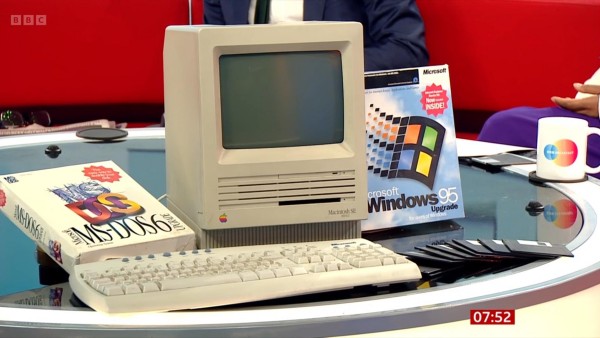
    As this is TV there were some visual props on hand, as shown in the screenshot below.

    Screenshot showing Windows 95 upgrade pack, a pile of floppy disks, MS-DOS 6 installation pack and a Macintosh SE

    Observant readers will have noted that the hardware used is in fact a Macintosh SE, a machine manufactured and sold by Apple between March 1987 and October 1990.

    That’s right! It was discontinued five years before Windows 95 was introduced.

    Furthermore, the Macintosh SE also ran on Apple’s Classic Mac OS, not MS-DOS and Windows.

    In bygone times, the BBC used to brag about the accuracy and trustworthiness of its broadcasting. It still does, but that boasting appears to be on very shaky foundations indeed.

    Who else likes the smell of facepalm in the morning? 😉

  • Gemsbok

    One neoligism (posh for new word. Ed.) that has become prominent in recent times is doomscrolling, defined as the activity of spending a lot of time looking at your phone or computer and reading bad or negative news stories.

    This can naturally be extremely depressing, hence the tendency of folk to seek comfort in online content not concerned with people’s inhumanity to their fellows to alleviate the feelings of despair, be this fluffy cat and dog photos, even fluffier photos of sheep (yes, I’m looking at you, Mastodon! Ed.). These are joined by wildlife and avian photography.

    One of the sources of wildlife images that turns up in your ‘umble scribe’s timeline comes courtesy of Namibia Weather. This features a live webcam at a waterhole in the Gondwana Namib Park, which claims to be Namibia’s first live webcam and regularly posts stills from the feed on Mastodon.

    Waterhole in the Namib Desert with drinking wildebeest

    The wildlife varies by the minute if you watch the live Youtube feed. Besides wildebeest, other large mammals that regularly visit the waterhole are South African oryx, otherwise known as gemsbok Note the striking monochrome facial markings.

    Gemsbok at the watering hole

    Sometimes cats, dogs or even sheep are just not a good enough antidote… Happy browsing! 😀

  • First… for greenwashing

    First Group has a virtual monopoly on public transport in Bristol via its buses and GWR Trains. However, its inability to run any service to timetable – no matter how important – has earned it the nickname of Worst Group.

    First Bus was all over the local media at the start of June when it announced the opening of a new bus depot in the city’s Hengrove area for servicing its fleet of electric buses which will eventually total 74 vehicles.

    One of Worst's new electric double decker buses.

    Your ‘umble scribe recently tried out one of the new double decker electric buses on the Number 24 route, which runs between Ashton and Southmead Hospital. On the whole the experience was very positive. The bus was clean, the ride silent and smooth. However, at this point a significant however enters the picture, namely that your correspondent was less than impressed by the greenwashing on the sides of the bus.

    Text reads I'm a zero-emission electric bus

    According to Wikipedia, greenwashing may be defined as follows:

    Greenwashing (a compound word modeled on “whitewash”), also called green sheen, is a form of advertising or marketing spin that deceptively uses green PR and green marketing to persuade the public that an organization’s products, goals, or policies are environmentally friendly. Companies that intentionally adopt greenwashing communication strategies often do so to distance themselves from their environmental lapses or those of their suppliers.[6] Firms engage in greenwashing for two primary reasons: to appear legitimate and to project an image of environmental responsibility to the public.

    Whilst the engines of the new buses produce zero greenhouse gases or particulate emissions, that does not necessarily mean the vehicles are entirely free of emissions, especially when significant elements of the vehicle produce particulates due to wear and tear caused by their function. The two components involved are the brakes and tyres.

    Until First acquires vehicles with zero tyre and brake wear, they should continue to be called out for being less than honest with the (travelling) public.

  • Gone quishing

    QR code with link to one of the reference articles for this postIn recent times, QR codes have started to be exploited in phishing attacks, as reported and explained by The Daily Record. This has given rise to another neologism and such attacks are also known as ‘quishing’.

    The phenomenon has been very prevalent in Cymru recently, as noticed by the Rhyl Journal.

    Denbighshire County Council and Conwy County Borough Council has urged residents to take care, as neither use QR codes as a payment method at council-run car parks.

    Similarly, more than 20 fake QR code reports have been made regarding parking meters across the promenade in Llandudno.

    For comprehensive advice on fake QR codes and how to avoid them, plus other scams visit Stop Scams UK.

    NB: The QR code at the top of this post contains a QR code to one of the links used in the piece.

  • Grammer, AI style

    From your ‘umble scribe’s social media timeline.

    Social media post by @prettybbuckley reading well no over an image featuring the text but truly wasn’t sure how., which Grammarly AI has suggested should be corrected to was trulyn't [sic]

    We all occasionally need help with English grammar, even we pensioners who have spent decades working at linguists, but the above ‘suggestion‘ from Grammarly could be diplomatically described as unhelpful.

    According to Wikipedia, “Grammarly is an American English language writing assistant software tool. It reviews the spelling, grammar, and tone of a piece of writing“, as well as being a tool for detecting plagiarism.

    On its own website, Grammarly is described as ‘Grammarly, the trusted AI assistant for everyday communication‘.

    On the basis of the above howler, your correspondent would not trust it to write out the alphabet in the correct sequence.

  • New abbreviation in the wild

    Ever since it was first coined in 2002, the online world has benefited from the creation of the slang abbreviation TL;DR, i.e. too long; don’t read, indicating that a body of text is not worth one’s while to read.

    The abbreviation is used in both upper and lower case versions.

    As the Wikipedia entry states, ‘TL;DR is commonly used in online discussions, comment sections, and social media posts. Writers often employ the acronym to summarize a preceding lengthy text, allowing readers who prefer brevity to quickly understand the main point. Conversely, readers might use TL;DR as a critique, signaling that a text was excessively verbose or lacked clarity‘.

    Official recognition of the abbreviation came some 11 years after its first appearance, as Wikipedia explains.

    In August 2013, TL;DR was officially added to Oxford Dictionaries Online, recognizing its widespread use in digital communications. Merriam-Webster also documented the term, noting its establishment as part of modern digital lexicon.

    Human brain made out of electrical circuits denoting artificial intelligence. Image courtesy of Wikimedia Commons.TL;DR has now been joined by another new slang abbreviation, AI:DR. This denotes that the text in question has been produced by generative AI, that environmentally costly means of producing low quality output (affectionately known as slop. Ed.) without human intervention.

    There is already speculation that AI is being deployed in regional newspaper offices in titles owned by Reach plc, but that would prove difficult to verify as the quality of their content starts from a very low base anyway. 😀

    Your correspondent trusts that readers and the wider public will not be shy in using this new abbreviation accordingly.

  • LibreOffice advises don’t use OpenOffice!

    The developers of LibreOffice, the most popular free and open source alternative to Microsoft’s ubiquitous office suite, are advising against the use of its OpenOffice progenitor due to security vulnerabilities and its lack of development, German news site heise reports.

    In a post on Mastodon, they point to security vulnerabilities that have been known for years but still remain unfixed. According to minutes of the Apache board meeting in March 2025, there are three security vulnerabilities in OpenOffice that are more than a year old. This has been confirmed by a representative of the Apache Software Foundation (ASF) security team.

    Post reads 
Hi everyone! We still see people on the fediverse recommending OpenOffice, despite it having year-old unfixed security issues. So if you see someone recommending it, please inform them about the risks - but also that there are actively maintained successor projects (like LibreOffice).

    According to the record there are numerous other, previously unaddressed issues with OpenOffice software, including vulnerabilities have existed since at least November 2023. “We are making progress in identifying improvements to address these issues,” the ASF security team representative explains.

    LibreOffice: Apache Foundation is harming open source

    Furthermore, the LibreOffice developers accuse the ASF of not developing OpenOffice actively any more, but of feigning to do so with minor changes to HTML tags and blank lines. This harms the entire open source community. The ASF has not commented on these allegations. However, OpenOffice has an active project management committee and retains its status as a top-level project within the ASF, according to spokesperson Brian Proffitt. In fact, the recent commits in the OpenOffice GitHub repository have primarily consisted of correcting typographical errors and making minor amendments to translations.

    The current version of OpenOffice, 4.1.15, was released in December 2023. It included several bug fixes and dictionary updates, whilst it last received new features with the release of version 4.1 in April 2014. In the light of this, the LibreOffice team recommends using alternatives and in particular its own office suite.

  • Generative AI art – the ultimate comment

    The photograph below showed up in your ‘umble scribe’s social media feed today and is the best comment he has seen to date in respect of the so-called “AI slop” (or just plain “slop”. Ed.) produced by generative AI engines.

    Message reads Say no to generative AI art. Buy art from a real degenerate.

    However, your ‘umble scribe is not the only person who questions the utility of generative AI, let alone its accuracy and/or faithfulness. Here’s the historian Dan Snow of History Hit clearly suffering from the output of generative AI in respect of great events in world history Whoever would have guessed the USA had ships in the thick of the Battle of Trafalgar? :-D.

Posts navigation