One of the staples of local news reporting is the activities of the emergency services – police, ambulance, coastguard, fire service – and in this regard Bristol Live – formerly the Bristol (Evening) Post is no exception.
Yesterday’s online edition reported on the fire service’s attendance at a possible incident on Colston Street (soon to revert to its original name of Steep Street after the city’s Victorian great and good renamed it after a slave trader. Ed.).
However, once again the reporter’s poor English is disappointing to read.
In the second paragraph readers are informed that
The alarm was sounded after what was believed to be an electric fire in Colston Street at around 8.22pm.
Where was the said domestic appliance left? In the roadway? On the footway/pavement?
Clarification was helpfully supplied by the fire service, whose spokesperson commented as follows:
Upon investigation, the issue was determined to be under the pavement and originating from an area of recently excavated electrical works.
So the fire, if it ever existed in the first place, was electrical, not electric.
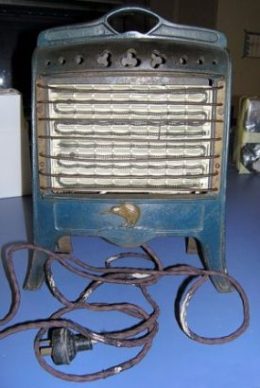
As an aid to passing hacks wishing to improve their vocabulary, there follows below a handy pictorial guide to the difference between the two. 😀
An electrical fire. Image courtesy of Wikimedia Commons.
An electric fire (aka electric heater). Image courtesy of Wikimedia Commons.
The outcome of the now-concluded G7 summit in Cornwall was to have been so different. Flying in the Red Arrows to impress the forrins with high-speed aerobatics, wheeling in Elizabeth Mountbatten-Windsor and her family in to schmooze and press the flesh; even the notoriously fickle English weather behaved itself.
Yes, the impression part-time alleged prime minister Alexander Boris de Pfeffel Johnson and his organising committee wanted to do was show a reinvigorated English Empire, confident and occupying a major place on the world stage now Brexit had been done and the country had broken free of the shackles ostensibly imposed upon it by the Brussels Eurocrats.
However, what has emerged is the English Empire’s diminished role and importance in the world as a consequence of Brexit. The G7 media headlines have been dominated by the problems caused by Brexit and in particular the UK’s failure to implement the Northern Ireland Protocol, a binding international treaty signed as part of the divorce agreement between the EU and the English Empire, a matter which earned the part-time alleged prime minister a rebuke from US president Joe Biden.
However, Biden’s was not the only reprimand earned in recent days by Johnson’s government of none of the talents. On social media David Frost, the English Empire’s chief Brexit negotiator, who is also known as Frosty the No Man on account of his negotiating style, earned the displeasure of those on Twitter who can see further than the White Cliffs of Dover for turning up to a crunch meeting with the EU wearing tacky Union Jack socks.
In addition, Frost and other members of the alleged government have been widely quoted in the right-wing British media as calling on the evil EU to be less purist in its interpretation of the Withdrawal Agreement and Northern Ireland Protocol. Consulting an online dictionary, one of the definitions of purism is a strictadherence to particularconcepts,rules.
That’s right. The EU is and always has been a rules-based, whereas Britannia has long preferred to waive the rules.
The above-mentioned meeting between the EU and the English Empire did not end well, with EU officials clearly exasperated by the attitude of the English Empire government.
In particular, the words attributed to on EU official quoted have been interpreted as patronising by the Daily Brexit, which some still call the Express.
According to the Daily Brexit:
An aide to the EU chief told Channel 4 News that the tweet “was in English so that the British can understand it”.
This anonymous quote clearly falls into the definition of a studied insult.
In this context studieddenotes an insult that is either the result of deliberation and careful thought or is based on learning and knowledge.
Never trust a man who combs his hair with a balloonCorruption and the part-time alleged prime minister of the English Empire (which some still call the United Kingdom. Ed.), one Alexander Boris de Pfeffel Johnson, are often closely entwined.
Disregarding the current crowdfunded litigation against the government's awarding of PPE and other contracts during the pandemic, which was frequently characterised as less than transparent and evidence of a chumocracy, due to the frequent involvement of Tory party donors, I am reliably informed by Keith Flett’s blog that Johnson and his third bride Carrie Symonds recently spent a mini-honeymoon at Chequers, the grace and favour country house in Buckinghamshire provided at public expense for the use of prime ministers, alleged, part-time or other.
Keith Flett’s blog post also comes with the interest fact that William Cobbett, the pamphleteer, journalist, Member of Parliament and farmer, referred to such sinecures as Chequers as the “Old Corruption“.
Further delving into the topic of the Old Corruption took me to the website of St Stephen’s Chapel in Westminster, which reveals that, before the 1832 Reform Act, the “Old Corruption was a system by which the elite benefited from selling of offices, sinecures (jobs which paid a salary for little or no work) and pensions. Patrons also influenced the small electorate, often through monetary incentives, to secure election for their friends and allies to parliament“.
However, the sale of offices and other abuses did not entirely die out after the enactment of the so-called “Great” Reform Act of 1832.
Honours continued to be sold throughout the Victorian era, culminating in the actions of David Lloyd George when Prime Minister. Lloyd George made the practice of selling honours more systematic and more brazen, charging £10,000 for a knighthood, £30,000 for baronetcy and £50,000 upwards for a peerage, and by so doing prompting the Honours (Prevention of Abuses) Act 1925. Furthermore, practically every single prime minister since has repaid favours with honours such as a seat in the House of Lords, knighthood or such like.
More evidence of corruption, neither ancient nor modern, but extremely blatant, emerged this past week and once again involved a certain Alexander Boris de Pfeffel Johnson, the other members of the cast being one Peter Cruddas, billionaire, and the House of Lords Appointments Commission.
In December 2020, it was announced that Cruddas, a former Tory Party treasurer, would be made a life peerage after a nomination Johnson, despite the contrary advice of the House of Lords Appointments Commission.
As reported by the Mirror, a few days later Cruddas made a donation of half a million pounds to the Tory Party.
The Old Corruption is perhaps not so old at all, but surprisingly contemporary
Bristol Live, formerly the Bristol (Evening) Post, aka the Temple Way Ministry of Truth, has an enduring reputation locally for the poor quality of some of its reporting.
The report gets off to a bad start with the headline boldly and falsely proclaiming Popular Weston-super-Mare seafront water park to close this month, making it sound as if the attraction is to close permanently, not temporarily.
However, the real howler in the piece occurs in the obligatory quotation from a Town Council spokesperson. In his second sentence he is quoted as saying:
We apologise for the incontinence and look forward to welcoming you back with new improvements ready for the summer holidays.
Whether the specified incontinence originated from any communication from the council, erroneous predictive text or any other source is unclear. Nevertheless, earlier in the piece readers are informed that “the water has remained off due to covid [sic] guidelines“, so the origin of any incontinence is unclear.
When the facility reopens, we are informed that the cost of admission is £2.50 per child.
In view of the purported incontinence, perhaps that ought to be raised to a Tena. 😉
Walruses are rare visitors to British waters and even rarer ones to waters further south. Hence there has been unprecedented press interest in the travels of one in the western Atlantic, since nicknamed Wally.
Wally was first spotted in Ireland on 15th March, before making his way to Tenby in west Wales.
His further travels then saw him making an appearance in Cornwall, before turning up in the last week in the western French seaside town of Les Sables d’Olonne, as reported by France Bleu.
Wally the walrus at the foot of the jetty at Les Sables d’Olonne. Not the bollards for mooring vessels. Photo courtesy of Commune des Sables d’Olonne
Walruses are not regular visitors to the waters of western France, preferring the colder waters of more northerly latitudes.
Indeed, France Bleu quotes Olivier Van Caennait, from the Pelagis Observatory at the University of La Rochelle, who stated:
As with everywhere else Wally has visited, the French authorities have advised that people rein in their curiosity and stay at least 50 metres away from the walrus at all times.
With his having spent time in west Wales, Wally’s arrival on France’s western seaboard naturally attracted the attention of WalesOnline, who managed to introduce a sly dig at those beastly French for injuring one of God’s creatures (something the Brits would never do! Ed.).
Besides the chauvinism, the WalesOnline reporter managed to achieve a miraculous mutation in maritime infrastructure when shipping the story from western France to south Wales.
By the time the story was posted online by WalesOnline, the port’s entry jetty had inexplicably mutated in one photo caption into a slipway. The newsroom staff clearly don’t know the difference between a jetty and a slipway, so here’s a handy photo reference for future use.
Slipway in Swanage
Jetty in Cox’s Bazaar, Bangladesh
I have, however, given up on trying to work out what is meant by “riprap of a dike” in the WalesOnline report, but have a suspicion it might refer to a revetment. If you can abolish my ignorance, please do so in the comments below.
One of the joys of reading the Bristol Post/BristolLive website is their hidden exclusives – the ones that are really newsworthy, but are buried in other pieces, such as in this example from Wednesday.
The flippant side of me wants to ask the journalist about the circumstantial details implied by the headline. What was a tree doing on the train in the first place? What kind of ticket was it sold? Where was it travelling from and to? Did it pay full price for the ticket or was it a railcard holder? Did it buy anything from the buffet during its journey? And ultimately why did it feel the need to stick a branch out of the window when the train was travelling at 75 mph, particularly as it resulted in a person’s death?
The tragic story of a life cut short by a moment’s carelessness has been turned upside down by sloppy headline writing, which implies that part of the tree was poking out of a train window was the cause of death, rather than the deceased being careless, leaning out of a train window being struck by lineside vegetation.
However, despite my flippancy above, I do realise and appreciate that it must be very distressing to the victim’s friends and family to have the read the circumstances of the incident so misrepresented by someone allegedly supposed to be working for an organ whic is supposed a trusted source of local news.
As the victim came from Penarth, WalesOnline, the Reach plc’s South Wales equivalent of BristolLive, has also carried the story, but with a clear and unambiguous headline.
Please take note, servants of the Bristol’s Temple Way Ministry of Truth.
Buses are Bristol’s major mode of public transport and as your ‘umble scribe is now in possession of a geriatric’s bus pass, he might actually get around to exploring their possibilities.
One linguistic peculiarity of using the city’s buses which must be perplexing to outsiders and visitors is the use of the term drive to denote the person in charge of the vehicle. This normally takes the form of the grateful form of address “Cheers Drive” as passengers get off at their intended stops.
It now seems that the buses themselves have also taken to addressing potential passengers in dialect, as per this photo courtesy of the WeLoveKeynsham Twitter account.
Of course, it’s not always been a smooth ride on the city’s buses.
Back in 1963, there was a boycott of the city’s buses led by youth worker Paul Stephenson and others over the Bristol Omnibus Company’s shameful and discriminatory refusal to employ black or Asian people.
Furthermore, the reliability of quality of services has been a perennial problem and formed the subject of Fred Wedlock’s song, Bristol Buses.
Today the WalesOnline website features a textbook example of an ambiguous headline, i.e one that has or expresses more than one possible meaning.
Ambiguity in a headline – or anywhere else in a piece of factual reporting – is not an example of good writing style.
A headline should be clear, convey sufficient information to interest or pique the curiosity the (potential) reader and not be capable of being misinterpreted.
WalesOnline is part of the Reach plc* stable of regional press titles.
Reach titles have past form with ambiguous headlines (posts passim).
One would almost think it’s written into the group’s style guide (if it has one. Ed.).
* The Reach stable also includes the national titles, the Daily Mirror and Daily Brexit (which some still call the Express. Ed.)
Yesterday the Information Commissioner’s Office (ICO) reported that it had fined American Express Services Europe Ltd. (Amex) £90,000 for sending four million unlawful, unsolicited marketing emails.
IT news site The Register has done some number crunching and worked out that the fine imposed by the ICO is equivalent to 0.021p per offending email or 0.009 per cent of Amex’s annual profits.
The regulator instigated investigations after receiving complaints from American Express customers who had specifically opted out of receiving marketing information. During its investigation the ICO found that American Express had sent over 50 million so-called “servicing emails” to customers (which anyone sensible would call spam. Ed.). The ICO revealed that between 1st June 2018 and 21st May 2019, over 4 million of those emails were marketing emails, designed to encourage customers to make purchases on their cards, thus benefiting the company financially.
Andy Curry, the ICO’s Head of Investigations said:
This is a clear example of a company getting it wrong and now facing the reputational consequences of that error.
The emails in question all clearly contained marketing material, as they sought to persuade and encourage customers to use their card to make purchases. Amex’s arguments, which included, that customers would be disadvantaged if they weren’t aware of campaigns, and that the emails were a requirement of its Credit Agreements with customers, were groundless.
Our investigation was initiated from just a handful of complaints from customers, tired of being interrupted with emails they did not want to receive. I would encourage all companies to revisit their procedures and familiarise themselves with the differences between a service email and a marketing email, and ensure their email communications with customers are compliant with the law.