The British government has announced it is now consulting and seeking comments on its latest open standards proposals.
The standards on which it is inviting comments are:
Exchange of location point information
An open standard for the exchange of location information, allowing coordinates to be translated between systems.
Exchange of property / place address information
A proposed standard to define and exchange address information between government departments. This is not about changing your postal address, but it could change the way government records information about your location.
Once the comment period closes, proposals will be assessed by a panel composed of civil servants and industry specialists, which will decide whether the proposal should go forward for consideration by the Open Standards Board. The Open Standards Board will then make a recommendation about the standard’s adoption across government.
One feature that Microsoft has been really making a great fuss about is the implementation (finally) of virtual desktops for the first time in a way that can be accessed easily by users.
A virtual desktop is a term used with respect to user interfaces to describe ways in which the virtual space of a computer’s desktop environment is expanded beyond the physical limits of the screen’s display area through the use of software. This compensates for a limited desktop area and can also be helpful in reducing clutter.
Microsoft is calling the Windows 10 implementation of virtual desktops Task View.
Windows 10 with Task View virtual desktops shown near the bottom of the screen.
Whenever a new release of Windows comes out, users of other operating systems such as Mac OS X and the various distributions of Linux, always wonder what baubles will be ‘copied’ from their OS of choice.
This time, it’s virtual desktops.
On Linux systems both major window/display managers – GNOME and KDE – have had virtual desktops for well over a decade.
Indeed, the first version of KDE, released 17 years ago in July 1998, included them, as shown in the following screenshot.
KDE version 1 showing 4 virtual desktops in use. The virtual desktops can be accessed via the taskbar or pager in the desktop’s top right-hand corner.
GNOME also included virtual desktops as early the GNOME 2.0 release which appeared in 2002.
Windows has actually had API support for virtual desktops since Windows NT 4, which was released back in 1996, which just shows how long it takes a lumbering quasi-monopolostic behemoth to get round to implementing things.
I’d sooner use an operating system that was a pioneer, rather than a laggard that attempted to imitate the best of others. 🙂
Thank you for summiting [sic] your statement to Full Council in regards [sic] to the fly-tipping and litter issues you are currently experiencing in Easton.
Easton has historically been an area where greater resources have been needed, and this is still the case today: the Council provides more resources for this area to remove waste and litter than in most other parts of the city. The introduction of communal bins seems to have improved the situation in Easton; prior to their introduction there was more widespread fly tipping [sic] throughout the area. In some cases, however, this measure has led to fly-tipping occurring around the bins, as it has been observed in other parts of the city, from Clifton to St Pauls. The communal bin areas are proactively patrolled by our contractor, who responds to fly-tip and street cleansing reports made through Customer Services or submitted on webforms throughout Bristol. Training has been provided to our contractor’s operatives to search waste for evidence of its potential source & evidence is passed to Streetscene Enforcement Team to investigate.
We require the support of the public to help us identify offenders and would encourage all residents and visitors to Bristol to report incidents of fly-tipping they observe to Bristol City Council as soon as possible. To take enforcement action against offending individuals or businesses requires evidence and the more information we receive, the more likely we can build a case and target them. Recruitment is currently underway to return the Streetscene Enforcement Team to a full complement of 6 officers. This will allow for the officers to concentrate their activities within smaller areas and allow for more proactive work and operations. For instance, all businesses on Stapleton Road are currently in the process of being visited to check that they have relevant commercial waste contracts and make them aware that we are searching for evidence of commercial waste being deposited in the domestic communal bins. The Streetscene Enforcement Team continues to explore new ways of working with partners, both within the Council and local community, to target environmental crime and support improvements to the local environment. For this reason, we appreciate your efforts in working with us to achieve a cleaner Easton, and thank you for your patience while we effect the necessary improvements.
Yours sincerely,
(signed)
George Ferguson CBE
Mayor of Bristol
Having carefully examined the text of Hannah’s reply and the one I received, it can be confirmed that the two responses are identical, even down to the same typographical errors.
Whilst I am pleased to learn that IT skills in the Mayor’s office have now reached a level equivalent to those of novice computer users, it is disconcerting that the staff in the Mayor’s office still think it appropriate to draft the same response to 2 statements on the same subject that raised different points. This illustrates the continuing contempt by council officers for residents of the inner city – a contempt that should never have been allowed to develop in the first place, let alone persist down the decades.
Bristol City Council should not be allowed to get away with this.
At the same full council meeting there were 3 statements from campaigners trying to prevent part of the River Frome flood plain being used for luxury housing by Colston’s School. I wonder if they received identical responses too. If any of those campaigners did, kindly mention it in the comments below.
At this year’s Akademy conference for KDE developers, the makers of the Linux desktop environment presented a version of the Plasma desktop for mobile devices, heise reports. Plasma Mobile will be an open alternative to today’s widely used mobile operating systems, but one in which the user’s privacy and freedom are to the fore.
An early development version of Plasma Mobile is running on the LG Nexus 5. It can be deployed with the Ubuntu Phone flashing tools. The developers have their sights on a usable version for the 2016 Akademy 2016. Ubuntu Phone serves as the technical foundation upon which the Qt GUI framework and KDE Frameworks runs, together with the Wayland display manager which brings the Plasma shell to the display. In addition to KDE and Qt apps, Plasma Mobile can also runs Ubuntu Mobile apps.
The Open Document Format for Office Applications (ODF) Version 1.2, the native file format of the free and open source LibreOffice productivity suite and many other applications, has been published as International Standard 26300:2015 by ISO/IEC.
ODF defines a technical schema for office documents including text documents, spreadsheets, charts and graphical documents like drawings or presentations.
“ODF 1.2 is the native file format of LibreOffice. Today, ODF is the best choice for interoperability, because it is widely adopted by applications and is respected by applications in every area”, says Thorsten Behrens, Chairman of The Document Foundation. “ODF makes interoperability a reality and transforms the use of proprietary document formats into a relic of the past. In the future, people will tell stories about incompatible document formats between two releases of proprietary office suites as a bygone problem”.
ODF is developed by the OASIS consortium. The current version of the standard was published in 2011 and then was submitted to ISO/IEC in 2014.
The standard is available in three parts – schema, formula definition and packages – from the repository of Publicly Available Standards as a free download, as follows:
ODF 1.2 is supported by all the leading office suites and by a large number of other applications. It has been adopted by the UK Cabinet Office as the reference for all documents exchanged with the UK Government (posts passim) and is currently proposed as the reference standard by the Référentiel Général d’Interopérabilité 1.9.9 of the French Government. In addition, ODF 1.2 has been adopted by many European public sector organisations. Furthermore, in Brazil, ODF is part of the electronic government programme – Progranma do Governo Eletrônico (e-PING).
Amongst some technology enthusiasts free and open source software is promoted with a zeal approaching that of Christian evangelism, i.e. the preaching of the gospel or the practice of giving information about a particular doctrine or set of beliefs to others with the intention of converting others to the Christian faith.
Does this mean that free and open source software – also referred to by the acronym FOSS – is now a religion?
Since the foundation of the FOSS movement a couple of decades ago, there have been many developments in information technology and the working of the internet.
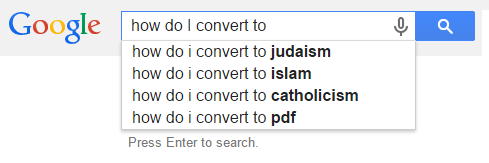
Of these one of the most notable is the development by Google of predictive search terms; as one types, Google tries to anticipate the final search string. This can have some interesting results, as evidenced by the screenshot below.
PDF – Portable Document Format – was originally a proprietary standard developed by Adobe Systems. It was released as an open standard on 1st July 1 2008 and published by the International Organization for Standardization as ISO 32000-1:2008, at which time control of the specification passed to an ISO Committee of volunteer industry experts.
No information is available as to when Judaism, Islam and Catholicism are to be released as open standards under the auspices of the International Organization for Standardization. 😉
One of the great tools not available to previous generations of those producing print for public consumption is the spell checker – an application program that flags words in a document that may not be spelled correctly. Spell checkers may be stand-alone, capable of operating on a block of text or as part of a larger application, such as a word processor, email client, electronic dictionary or search engine.
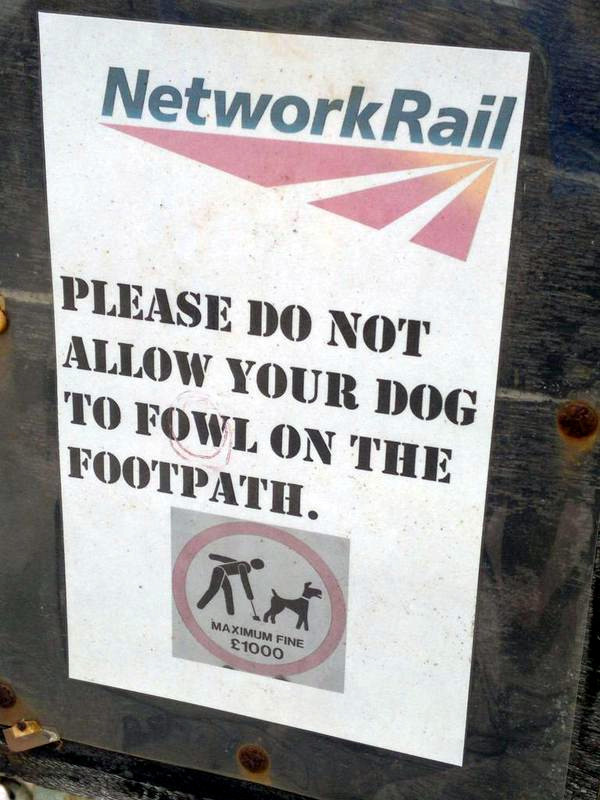
However, some people and/or organisations still seem reluctant to use them, such as UK railway infrastructure operator Network Rail, which chickened out on the occasion shown below and thus qualified for a residency in Homophone Corner. 🙂
According to Alessandro Tomasicchio, the councillor with responsibility for technological innovation, “In this way we guarantee the participation of citizens in public sector decision-making.”
In addition, the council is adopting ODF – the standard file format of LibreOffice and other open source office suites – as the standard file format that meets all the authority’s technical requirements.
Management of the project entails various kinds of skills, from the analysis of flows of documents within the council to the management of interactions between users and IT systems. Great attention has been paid to staff training and internal communication, which are regarded as fundamental elements for achieving the local authority’s goal.
After analysing the software solutions available and practical testing, the Innvoation Department decided to adopt the free and open source LibreOffice suite, which is compatible with other proprietary office suites, including MS Office currently used by Bari.
The choice of LibreOffice, unlike proprietary software, is compliant with the provisions of Article 68 of the [Italian] Digital Administration Code and the Apulia Region‘s law on the adoption and promotion of open source by public sector organisations.
By the end of the current year at least 75% of Bari’s workstations will migrate from Microsoft Office to LibreOffice.
Antonio Cantatore, head of Bari’s Innovation Department also stated that one reason for switching to LibreOffice would be major savings in the total cost of ownership (TCO). By not having to pay licence fees to Microsoft for the Office package currently installed on 1,700 of Bari’s workstations, the local authority is looking at costs savings €75,000 +VAT.
The Call for Papers is still open until 15th July 15, 2015. Tracks for papers are based on Development, Quality Assurance, Localization, Documentation and Native Language Projects, Ease of Use, Design and Accessibility, Migrations and Deployments, Certifications and Best Practices, ODF, Document Liberation and Interoperability and Building a Business around LibreOffice.
The conference website also includes some practical info about travel and accommodation.
After the Russian Communications Minister Nikolai Nikiforov suggested a common approach by the BRICS states – Brazil, Russia, India, China and South Africa – to solving the dependency on imported software earlier this year, Russia recently announced a list of possible options, German IT news site heise reports. There is to be a concerted promotion of open source projects as a part of the national programme to ensure economic development. In addition to two Linux distributions developed by Russian companies, the ReactOS project has also been chosen as a Windows alternative worthy of promotion. However, what that actually means remains unclear for the time being. The Russian programme is only envisaging software alternatives being made available within 10 years.
Although the ReactOS project has no announced any major technical progress since the integration of rudimentary support for NTFS, the developers have nevertheless not been inactive: “Over 750 bug reports filed by the community have been processed, resulting in appreciably better software compatibility,” ReactOS developer Colin Finck remarked in a discussion with heise. In particular, the emulation implemented in the last year for executing 16-bit applications (NTVDM) and Java support have been improved.
ReactOS screenshot. Image courtesy of Wikimedia Commons.
Thus not only can the installation routine of Oracle’s Java Runtime Environment be executed with the current build of ReactOS, but also ancient software such as the FreeGEM desktop or previously barred applications such as Skype. Support for the UDF file system for reading optical data carriers is also new.
Grant showing results
Initial results are also being produced by the student scholarship system which had been selected by Verein ReactOS Deutschland e.V. after a successful funding campaign over the last year on fundraising site Indiegogo. “With the completion of the new Explorers and Shell32 with theme support, which has been rebuilt from the ground up, the system interface works more nimbly and is also more comfortable to use as regards Explorer,” Finck explains. He has now started work on a printer stack which should be ready by December 2015 and could become a component of ReactOS 0.4.0.
No deadline for new release
Although there is no definite deadline for a new release of ReactOS with all new features, the project is nevertheless making automatic daily build versions available for download. The ReactOS developers themselves classify both the daily builds and previous releases as alpha versions which are only recommended for testing.
The ReactOS community is hoping for a further surge in development from the first ReactOS Hackfest, which is taking place in Aachen, Germany from 7th to 12th August 2015. According to the organisers, more than half of the current ReactOS developers have already registered for the event. According to current plans, improving ReactOS’ hardware support and working on the forthcoming version 0.4.0 shall form the focus of the event.


 ODF defines a technical schema for office documents including text documents, spreadsheets, charts and graphical documents like drawings or presentations.