Even though the elderly have had a bath thanks to ambiguity and poor proofreading in the Evesham Journal’s dead tree version, this age discrimination has thankfully been eliminated from the paper’s online version of the report.
No pensioners were harmed – or dunked – in the drafting of this blog post.
It’s now 10 years since TidyBS5 was inaugurated by local residents with the support of local ward councillors to campaign for a more pleasant street scene in the Bristol council wards of Easton and Lawrence Hill.
During all that time, both residents and councillors has persistently call on Bristol City Council to increase both the presence and visibility of enforcement action, but our efforts have only been rewarded in the last couple of years with higher fixed penalty notices (FPNs) for environmental crimes in 2019 and the recent recruiting of more enforcement officers (posts passim).
Largely as a result of the actions of local residents raising awareness of environmental blight, the streets of Lawrence Hill and Easton are now marginally freer of fly-tipping than they were then, but problems still persist, not helped by the lower footfall due to lockdown and the amount of DIY and building works being undertaken.
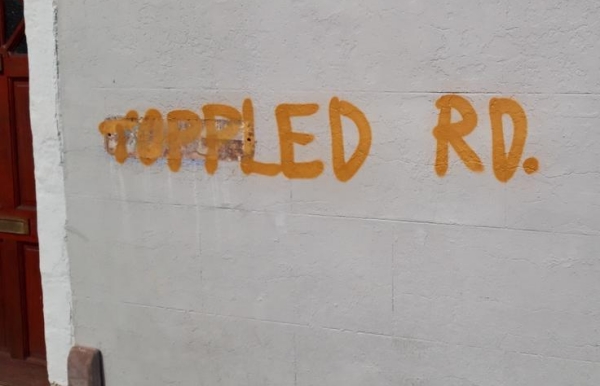
This was spotted at the junction of Walton Street and Chaplin Road.
Is this an example of illiteracy or bloody-mindedness? Kindly give your answers in the comments.
It’s one week to go to the elections for Bristol City Council, the elected Mayor of Bristol (with 2 of the 9 candidates standing for election to the office vowing to hold a referendum with a view to abolishing the autocratic post. Ed.), the West of England Combined Authority Mayor and the Avon & Somerset Police & Crime Commissioner.
My recycling box is rapidly filling up with election materials as the parties all vie for my cross against their candidates’ names on the four ballot papers (Hint to canvassers: don’t bother with my house any more; I’ve already voted by post! Ed.).
Following the arrival on the latest leaflet on the doormat, the poll has been updated and now shows the following state of the parties.
The Greens seem determined to win Lawrence Hill ward and are pulling out all the stops. As they’re normally in fourth place, the Tories have managed on token leaflet as have the Liberal Democrats, who were once renowned for their zeal in bunging up letterboxes with their literature.
Why has there only been one Labour leaflet? Is this a symptom of lower levels of activism in the wake of members deserting the party after the election of Keir Starmer (whom some unkindly refer to as Keith. Ed.)?
It’s getting close to election time again and the period of what is informally known as “purdah” (also known rather more formally and stuffily in local authority circles as the “pre-election period” Ed.), which has very little to with purdah’s original definition, i.e. a religious and social practice of female seclusion prevalent among some Muslim and Hindu communities, and more to do with preventing central and local government from making announcements about any new or controversial initiatives that could be seen to be advantageous to any candidates or parties in the forthcoming election.
As is usual with matters electoral, I keep a record on a LibreOffice spreadsheet of all election leaflets received, which ultimately end up in their rightful place – the waste paper recycling box (apart from personally addressed material, which is fed to the confidential waste shredder. Ed.).
The latest state of the parties – as of first thing this morning – is shown below.
As can be seen, the Greens are clearly putting a major effort into depriving Labour of their 2 ward seats for Lawrence Hill in the council chamber.
Whilst elections may be regarded as a vehicle of change, there are certain features that are reassuringly familiar and are thus recycled election after election.
For instance, the first leaflet received after the notices of persons nominated were announced was one from the Liberal Democrats, as per their decades-long reputation for opportunism.
That leaflet also comprised other reassuringly familiar Liberal Democrat tropes, such as the bar chart below for the WECA Mayor. I am reliably informed by a fellow linguist who took a ruler to the y axis, that the column sizes are reasonably accurate (for once. Ed.)
That just leaves the equine graphic with the heading “It’s a 2 horse race! (Insert_party_name) can’t win here!” and the traditional graphics requirements for LibDem leaflets will have been fulfilled.
More leaflets can of course be expected to land on the doormat as polling day approaches, so updates will be provided in due course.
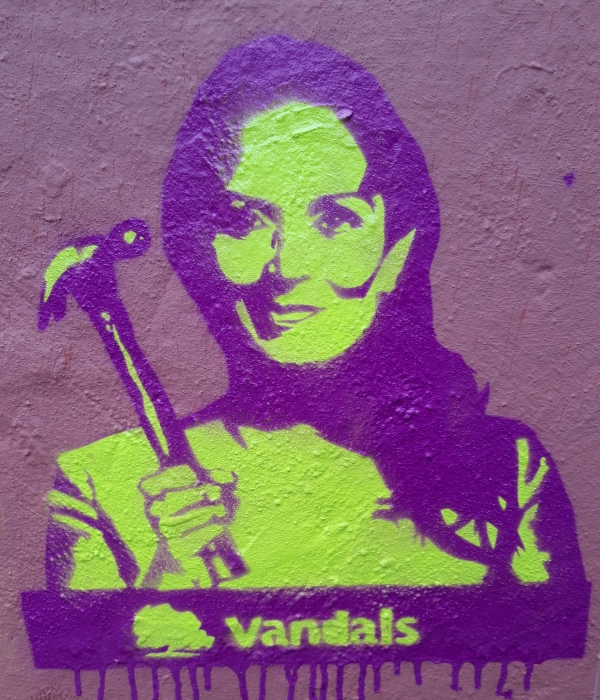
Spotted earlier this week in Stratford, London and arriving on my screen via social media.
It is believed to have been created by London-based conceptual, video and installation artist Jeremy Deller, whose work has strong political overtones.
Mirror, mirror on the wall, who’s the scruffiest of them all?
Speaking from Chequers, a visibly shocked an astounded Worzel Gummidge apologised to those who had expressed their anger on social media and added: “Anyone would think I always looked as if I’d been dragged through a hedge backwards, like former London Mayor Alexander Boris de Pfeffel Johnson!”
One fascinating aspect of the country’s foolhardy departure from the European Union is the fate of Britons in the 27 member states of the European Union; and more particularly how they are depicted here now that the “free and independent coastal state” of Brexitannia has “taken back control“.
Keen observers of the British media will note all foreigners seeking to come to the English Empire (which some refer to as the United Kingdom. Ed.) to settle are referred to as “migrants“. When used by the right-wing press or politicians, “migrants” has a clear pejorative tone to the effect that these people are not as good as us.
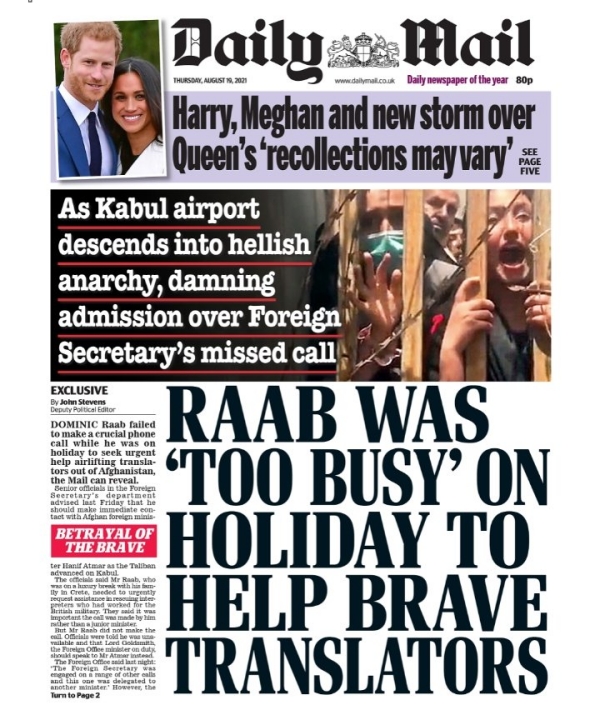
However, in line with British exceptionalism as Brits seeking to or having taken up residence abroad are termed “expats” by the fourth estate, as per this typical specimen from yesterday’s Daily Brexit, which some still call Daily Express.
Expats? Emigrés? Immigrants?
Of course, what the Daily Brexit forgets is that even in Greece and Cyprus, holders of those nice, new and allegedly blue British passports will still be classed as third country citizens by the Greek and Cypriot authorities; and if they try staying there for longer than the maximum period without applying for a residence permit, they’ll be regarded as illegal immigrants, just as they are now finding out on the Costa del Sol.
“Expat” is of course a truncation of the term “expatriate“, with the shorter form’s first recorded use in the first half of the 1960s.
When people move for work, settlement or other reasons, the language used about them is always full of meaning. In earlier, less judgemental times those who left British shores to settle abroad might have been referred to as “émigrés” or “emigrants“, whilst those coming here for permanent settlement were “immigrants“, which had more than its fair share of negative connotations in times past.
Nowadays all those negative connotations are to a certain effect by “migrant“, which, unlike “immigrant” or “emigrant” is not specific about the person’s direction of travel.
Nevertheless, I can see the exceptionalism continuing and am not expecting the Daily Brexit to refer to Brits resident abroad as “British immigrants” at any time soon. 😉
Having been brought up in rural Shropshire, I normally wouldn’t have paid a lot of attention to corvids when I lived there.
However, things are different now I’m an inner city resident and appreciate all the birdlife I see.
As regards corvids specifically, magpies and carrion crows seem to be the most numerous. Indeed, magpies nested in the large ash tree in the ‘pocket park‘ around the corner a couple of years ago.
Furthermore, jays, those most colourful of British resident corvids, are not unknown in Easton, whilst sightings of ravens are rarer (posts passim).
Indeed, the only members of the resident 8 strong British corvid family that I’ve not seen locally over the years are the chough (which tends to prefer sea cliffs as habitat. Ed.) and hooded crow, which is more readily found found in N and W Scotland, N Ireland and on the Isle of Man as a replacement for the carrion crow.
Croydon Street crow’s nest in top of sycamore.
Monday was a lovely sunny day and returning from my constitutional, I was passing down Croydon Street when I noticed a crow alight in a nest in a roadside sycamore tree. A crow’s nest is best described as a roughly crafted collection of sticks in the fork of a tree. Most corvids are not builders of complicated or artistic-looking nests.
As I was attempting to get a halfway decent shot of the nest, the other bird in the pair turned up with fresh nest material in its beak. It can be seen in the picture below. Apologies for the wobbly camera work: I was leaning back and pointing the camera straight up at arm’s length.
Croydon Street crow’s nest with bird to left
Update: there’s also a crow’s next in a tree in the pocket park on Chaplin Road.
The BBC reports that Tesco is to introduce collection points for soft plastic packaging such as crisp packets, pet food pouches and bread bags at its stores in England and Wales.
This follows a successful trial in 2018 at 10 stores.
The roll-out will start with facilities being installed in 171 stores in south-west England and Wales.
Tesco is hoping to collect 1,000 tonnes of soft plastic a year and customers may return packaging from other retailers as well as its own packaging provided all packaging presented for collection is clean.
Soft plastic is notoriously hard to recycle and most currently ends up going to landfill or being incinerated.
Given Bristol’s wide range recycling collections, this type of plastic makes up the majority of my residual waste collected by the refuse lorry.
With this move, Tesco is finally living up to its “Every little helps” motto.