For many years the garage sitting at the apex of the junction of Russelltown Avenue, Cannon Street and Whitehall Road in BS5 has featured a changing sequence of slogans painted by Stan Jones, who lives in the house to which the garage belongs.
It was 2017 when I first noticed it and, at that time, it focussed on the madness of Brexit.
Exit Brexit
In 2019 its message was still focussed on Brexit but had been repainted to featur the wording “Buck Foris” (fine use of a Spoonerism there. Ed.) and “Fromage not Farage“, so I think it’s fair to say Stan is not impressed with the right-leaning part of what passes for Britain’s political class.
In 2019 Stan’s efforts accidentally suffered the attentions of Bristol City Council’s fight against graffit. There was, however, a happy outcome as Stan received an apology and some paint from the corporation, as the Bristol Post reported at the time.
Below is Stan’s latest contribution, which really needs no further comment from me.
Keith Hann, director of corporate affairs for frozen food retailer Iceland has been dismissed with immediate effect after he was found to have made disparaging remarks about both the Welsh language and Wales itself.
The supermarket, which has its corporate headquarters on Deeside (Welsh: Glannau Dyfrdwy) in North Wales, was forced to apologise on Wednesday after reports emerged of Hann describing Welsh as “gibberish”
It also stated that Hann’s remarks did not reflect the company’s views and added it was a proud Welsh company.
Many Welsh customers contacted Iceland on Twitter stating they would be boycotting the company’s stores as a result of Hann’s crass insensitivity.
In addition to calling Welsh gibberish, Hann wrote on his blog that the Welsh language sounded “like someone with bad catarrh clearing his throat”.
Furthermore, in a tweet which has since been deleted, Hann wrote that the “inhabitants of the UK’s Celtic fringe loathe all visitors“.
Going back to my schooldays over 5 decades ago, I recall being taught in English language classes that to rubber stamp means officially to approve a decision without giving the matter in question any proper scrutiny or thought.
Rubber stamping is indicative of lack of care, attention and is indicative of perfunctoriness.
Furthermore, the definition I was taught all those long years ago is confirmed by Collins Dictionary, which states:
When someone in authority rubber-stamps a decision, plan, or law, they agree to it without thinking about it much.
Nevertheless, there seems to be a general trend nowadays in the press to use this verb routinely for the approval of any decision, whether or not it is preceded by lengthy or indeed any debate at all.
It’s as if to rubber stamp has become synonymous with to approve, which is really isn’t.
One very guilty party in this respect is the Bristol Post, now rebranded as Bristol Live by its Reach plc masters, as per this example from 12th February, where we read:
The plan is due to be rubber stamped at a council meeting on Monday (February 15).
If there’s one thing I know about planning meetings (having attended them. Ed.), it’s that their decisions are never rubber stamped, as councillors serving on planning committees generally tend to consider all applications in the most minute detail. There’s no waving agenda items all through in a couple of minutes, so members can retreat early to the pub or somewhere else more interesting than a council meeting room.
I hope any passing member of the fourth estate will take note of – and act upon – the content of this little post.
The City of London Police have reported that Mirwais Patang, aged 27, of Hillingdon, London, who stole the identity of a legitimate court interpreter and falsely provided court interpreting services in 140 cases was sentenced to two years imprisonment, suspended for two years, at Southwark Crown Court on 12 February 2021.
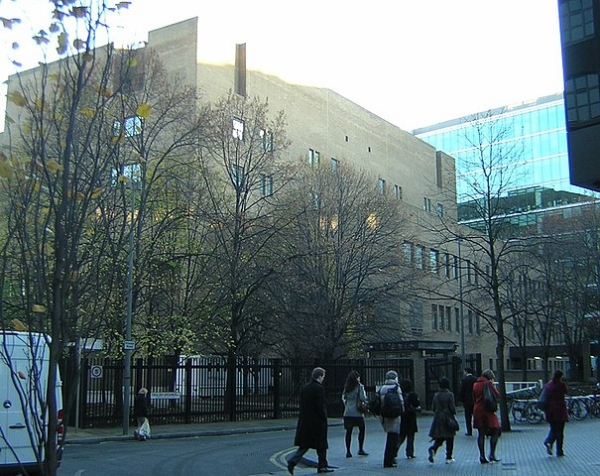
Southwark Crown Court. Image courtesy of Wikimedia Commons
Patang must also complete 300 hours of unpaid work within 24 months. He had previously pleaded guilty to 2 counts of forgery and 2 counts of fraud on 27 August 2020, plus a further 6 counts of fraud, and one count each of conspiracy to commit fraud and forgery.
Patang first acted as an interpreter of Pashto and Dari in March 2012, using his own name and identity to register with Capita, the company contracted by the Ministry of Justice (MoJ) to provide court interpreting services between January 2012 and October 2016.
Patang doctored a community interpreting certificate to prove his qualification to Capita and subsequently worked on 88 cases between March 2012 and August 2016, earning £35,574.
In September 2014, Patang stole the identity of a more qualified court interpreter. By using this identity, he earned just over £30,000 working on 52 cases between September 2014 and July 2015.
His fraudulent activity was eventually uncovered when Capita alerted HM Courts and Tribunals Service (HMCTS) to discrepancies in timesheets Patang had submitted. This resulted in the City of London Police launching a fraud investigation.
Furthermore, evidence collected by the City of London Police showed Patang had paid his friend, Solimann David, also of Hillingdon, £1,400 to attend court on his behalf and provide translating services for eight weeks even though David also had no qualifications to act as an interpreter.
David, also aged 27, pleaded guilty to a single count of conspiracy to commit fraud. He was also sentenced at Southwark Crown Court on 12 February 2021 to six months imprisonment, suspended for one year. He must complete 100 hours of unpaid work within 24 months.
Detective Andy Cope, from the City of London Police’s fraud team, said:
“The blind greed shown by Patang, and the total disregard for the implications of his actions and what it might mean for the integrity of serious criminal trials, is truly appalling. By thinking of only his own financial gain, he has undermined confidence in the criminal justice system and put victims of crime through unfair stress and worry.”
When related to property, the noun premises is defined by Collins Dictionary as:
a piece of land together with its buildings, esp considered as a place of business.
When related to property, premises has since time immemorial (or even longer. Ed.) been a plural noun.
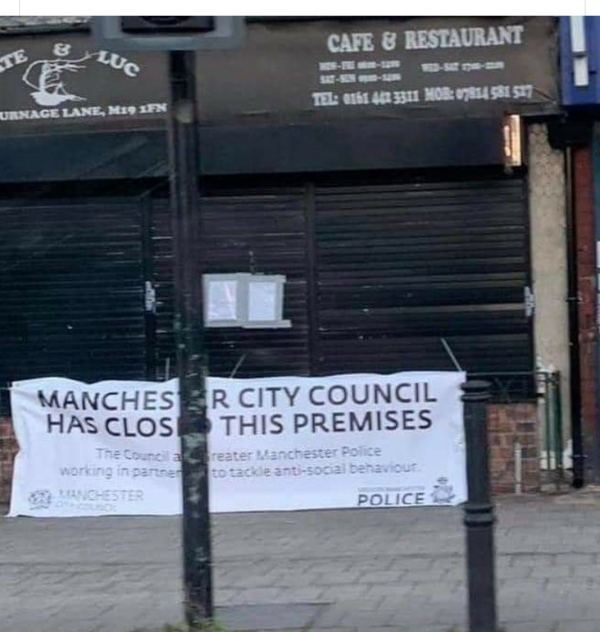
However, it is a source of constant surprise how many people these days regard premises as a singular noun, as shown by this recent example, courtesy of Manchester City Council.
A singular example
However, it should be remembered that premise does exist as a singular noun, in which instance it takes the following definition:
something that is supposed to be true and is used as a basis for developing an idea.
Local authorities are not the only people to get confused about premises and premise as regards use of the plural and singular.
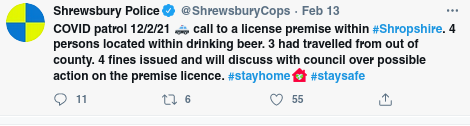
Take this example on Twitter courtesy of the constabulary in Shrewsbury.
A singular licence
That’s right. Why have a premises licence when a premise licence will do just as well? I’m sure Mr Plod meant the former, but having a licence for a premise raises many new questions indeed.
Professor Paul Brains of Washington State University has included the confusing of premises and premise in his book, Common Errors in English Usage. Read his simple, eloquent distinction.
Premises are also quite particular about where any action takes place too. Anything that happens always, always takes place on them, not in them.
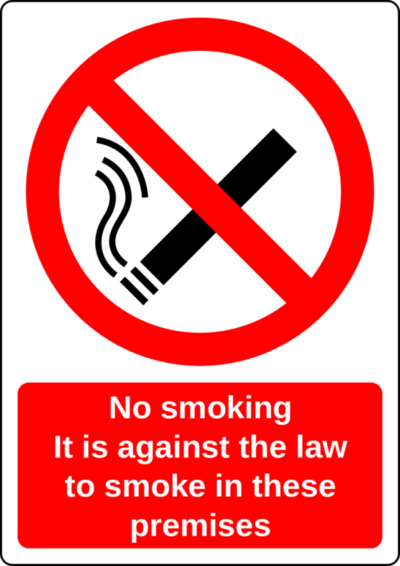
The introduction of a blanket ban on smoking indoors gave rise to a wave of illiteracy, as exemplified by this typical example.
Image courtesy of Wikimedia Commons
It does feel as though those of use who are held to higher standards of language use and/or were taught proper English (Ahem! Ed.) are fighting a losing battle. Will premises become increasingly singular? Will actions take place in them ( or it? Ed.) in future?
For the answers to such questions, one must wait and see.
Only time can tell as language always has been dynamic, i.e. a moving target: and what is regarded as proper usage will always be subject to change, just like language itself.
Occasionally in recent weeks, this blog has provided information on keyboard shortcuts for unusual characters (unusual for English that is. Ed.) on a Linux keyboard.
The last of these took the umlaut (diaresis) as its subject (posts passim).
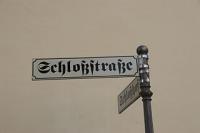
German road sign for Schloßstraße in Erfurt
Today, attention turns once again to German and the s key, which can produce two characters, depending upon the combination of keystrokes.
Depressing the AltGr key and s produces “ß“, the German sharp s or esszett, usually transcribed in English as ss.
The other character that can be produced is “§“, which can be produced with the AltGr, Shift and s keys.
Known as the Section sign, it is believed to originate from the Latin signum sectionis, meaning section sign and usually turns up in with reference to legal documents.
Where more than one section of a legal text is involved, the sign is repeated, i.e §§.
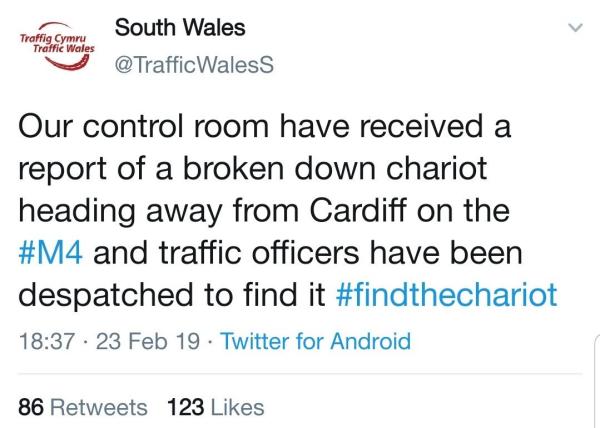
After Wales’ 21-13 decisive victory in yesterday’s Six Nations rugby fixture in Cardiff, Traffig Cymru, the Welsh Government’s traffic information service, couldn’t resist having a bit of fun on Twitter at the expense of the England squad and English rugby fans.
Swing low…
I wonder if the chariot had been rescued by a band of angels before Mr Plod had a chance to find it… 😀
Gloucestershire Live is a sister title of the Bristol Post/Bristol Live and as such provides a similar mediocre quality of journalism to its victims readers.
My Gloucestershire friends have this morning confirmed via social media that as far as the governance of the county is concerned, politics inevitably equals the Conservatives and the Blue Team dominate what is effectively a de facto one-party state.
In Ireland, any predominantly Irish-speaking area is known as a Gaeltacht (plural: Gaeltachtaí). The island’s Gaeltachtaí are shown in green on the map below.
The green-shaded area beneath the Dingle Peninsula is the Iveragh Peninsula (Irish: Uíbh Ráthach) in County Kerry and an interesting appointment has just been made here.
Yesterday Irish broadcaster RTE reported that a Russian had been appointed as an Irish language officer there and would be leading efforts to revive the Irish language there.
RTE states:
Victor Bayda, a native of Moscow, has taken up the post with Comhchoiste Ghaeltacht Uíbh Ráthaigh, a community organisation in the south Kerry Gaeltacht of Uíbh Ráthach.
Mr Bayda is a fluent Irish speaker and has been teaching it in Moscow for about fifteen years. In addition to Irish, Mr Bayda also speaks Dutch, Scots Gaelic, Welsh, Swedish, French, German and Icelandic.
His duties in his new post will include implementing a comprehensive language plan aimed at arresting the decline of the language on the peninsula, where 60% of the residents claim the ability to speak Irish.
According to the 2016 Irish census, just 7% of the Gaeltacht population speak Irish daily outside the education system.
Mr Bayda becomes the tenth Irish language planning officer to be appointed so far in Gaeltacht areas.
In 2017, Victor posted the video below on Youtube.

![Text on building reads What the [insert word of choice] is happening?](http://xislblogs.xtreamlab.net/slwoods/wp-content/uploads//sites/23/2021/02/600px_insert_word_whitehall_road.jpg)

 Going back to my schooldays over 5 decades ago, I recall being taught in English language classes that to rubber stamp means officially to approve a decision without giving the matter in question any proper scrutiny or thought.