The screenshot below comes from the Bristol Post website early this morning and shows 2 news items in succession about Nick Gargan, the Chief Constable of Avon & Police.
Is being suspended for ‘inappropriate behaviour’ part of a typical light-hearted day for Avon & Somerset’s finest?
Answers in the comments below, Bristol Post hacks and sub-editors. 🙂
On Friday evening the Open Rights Group organised one of a series of nationwide European Digital Rights hustings at St Werburgh’s Community Centre in Bristol. This was a chance for local people to quiz MEP candidates from the South West about their views on digital rights and ask them to sign up to the 10 point Charter of Digital Rights.
Green European Parliament candidate Audaye Elesedy signs the Charter of Digital Rights at St Werburgh’s Community Centre. Picture credit: Brent Longborough
As Chair of St Werburgh’s and having a keen interest in digital rights, I volunteered my services and was surprised to be asked to chair the event.
When I arrived, Ed Paton-Williams from the ORG had already shown up and there was little to organise in the room apart from setting up the wifi, a couple of notices with the wifi details and the last minute provision of water for the top table.
In alphabetical order, the candidates who attended were:
Hadleigh Roberts (Labour) (who, incidentally, is a fellow translator. Ed.).
We were supposed to have been joined by Julia Reed from UKIP, but she pulled out at the last moment. Could this have had something to do with a little Twitter bother?
After a brief introduction from Ed Paton-Williams and a warm welcome to all to the Centre from me, we were off with candidates’ opening statements. All stuck fairly well to the 2 minutes limit for speaking (and many thanks to Hadleigh for the use of his phone with the stopwatch app! Ed.).
As chair I got to ask the first question: has the EU done enough to allow open source software to compete with proprietary products such as Microsoft Office?
Some interesting answers followed: Hadleigh and Jay both raised the cost of licensing for small businesses; Audaye raised the use of open standards such as Open Document Format.
The meeting was then thrown open to questions from the floor. The first concerned data protection and the UK’s government’s desire to make money from selling data provided by citizens. Once again there were some fascinating answers of which I’m reminded of two points in particular: Jay believed people should be compensated financially for the use of their data, whilst Hadleigh stated that companies shouldn’t be buying people’s data. A point made from the floor was that people are very mistrustful of the way the government uses – and loses – data.
The next question from the floor raised the matter of TTIP. Some candidates, particularly those with links to business, favoured TTIP’s implementation; Georgina said it should be given a chance. Other, more wary candidates feared the consequences of TTIP’s proposals to allow corporations to take governments to court for changes to the competitive commercial landscape. TTIP was also seen as a big threat to personal control of data. Snowden’s revelation of US spying on the EU during TTIP negotiations were mentioned by Audaye.
This led neatly into the next matter: surveillance. Georgina thought there was too much scaremongering going on about data collection. It’s there to protect us from paedophiles and terrorism, adding: “States knew perfectly well that surveillance happening… on the internet there’s no such thing as privacy.” Jay responded that we’re struggling with oversight in the UK and that access to communications data shouldn’t be a habitual thing. Hadleigh remarked that the public have to be given a guarantee that they won’t be spied on unless they’ve committed crime. Audaye stressed that Germany has gained a competitive advantage in digital sector because its far stronger privacy culture compared with the UK.
Thangam Debonnaire, Labour’s candidate for the Bristol West parliamentary constituency and a former musician, asked about how the EU should make sure copyright law helps creators protect their income. There was general agreement in the responses that Digital Rights/Restrictions Management (DRM) hadn’t really done anything to stop so-called ‘piracy’, (better known to some of us by its correct definition of ‘copyright infringement’. Ed.). Furthermore, artists deserve better compensation from the likes of iTunes and Spotify. The general impression is that this area still needs attention as the music and film industries are still struggling to come to terms with the internet after a couple of decades.
In one of the final questions, the power of the UK in the EU was raised from the floor. Candidates pointed out that the UK hadn’t really lost any power, but had lost influence due to its attitude. As regards attitude, the behaviour of UKIP in the European Parliament was criticised severely by the candidates. Proceedings in the Parliament were described as generally civilised and polite. However, UKIP’s MEPs were criticised for being rude to their fellow parliamentarians and failing to do any work on the committees on which they are supposed serve.
The hustings concluded with closing statements from all candidates and a vote of thanks to them from the chair.
For me it was a baptism of fire, never having chaired a hustings event before. But the candidates were – apart from a minor bit of mudslinging – models of politeness and made my job in the chair a pleasure. There was none of the two speakers talking at once that I witnessed the previous week at Radio 4’s broadcast from Bristol of Any Questions?
The tenor of the meeting is perhaps summarised by this tweet from local councillor Rob Telford.
Very open debate this evening, lots of audience participation and intelligence, more of a conversation really! #EUDigitalDebate
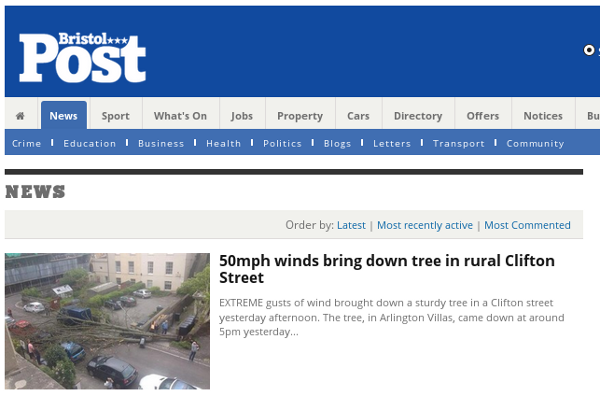
Earlier today, the news section of the Bristol Post transported the city’s affluent district of Clifton to the countryside, describing it as ‘rural’, as shown in the following screenshot.
According to the Oxford English Dictionary rural has many meanings; the one implied by the Post’s usage is the OED’s definition 1c:
Employed or stationed in country districts.
Are the people of Clifton yokels?
Bristol absorbed Clifton in the 19th century, so any green wellies seen will be very clean and not covered in cow’s muck; they’ll be worn for fashion not for necessity. Although Clifton’s renowned Downs are still common land, the locals don’t seem to graze much livestock upon them. Nevertheless, some activities which may be regarded as animal take place up there.
The word rural has since been removed from the headline.
I always believed press articles supposed to be sub-edited before being posted. Apparently this does not seem to be the usual practice down at the Temple Way Ministry of Truth.
In Bristol’s Barton Hill district, there’s a lovely little pub affectionately known as the Little Russell (its real name is the Russell Arms; the ‘Big’ Russell used to be nearby on Church Road, Lawrence Hill, but has long since closed. Ed.).
It’s a friendly place and is little changed from when it first opened in the 19th century.
One change in recent years, however, is the addition of a fine mural by local artist Andie that covers 2 walls of the yard, which has since the smoking ban become the pub’s smoking area. Part of the mural is shown below.
Rainbow Worrier at the Little Russell. Click on the image for a larger version
The train in the shot is known as Rainbow Worrier because it’s green and has a shady-looking character in a hoodie in the cab. Note the machine gun and the fish-shaped bombs; they’re more reason to worry.
Andie is definitely a man with a sense of humour and I love his punning references; note ‘Royal Male’ on the next locomotive.
Rainbow Worrier itself reminds me of reading about the armoured trains that used to chug up and down the Russian railway network around the time of the Russian revolution. For instance, the Czechoslovak Legion used heavily armed and armoured trains to control large lengths of the Trans-Siberian Railway (and of Russia itself) during the Russian Civil War. One of the Czechoslovak Legion’s armoured trains is shown below.
Czechoslovak Legion armoured train. Picture courtesy of Wikimedia Commons
I wonder if these trains or the later ones used in World War 2 were what inspired Andie; or was he just having fun?
Election leaflets from the Liberal Democrats are renowned amongst followers of politics for their inaccuracies, in particular their dodgy ‘bar chart’ graphs.
With the European Parliament elections later this month, sitting Liberal Democrat MEP for the South West Graham Watson has been getting his leaflets out. Those leaflets feature the picture below.
Here we have a typical picture of smiling Liberal Democrats campaigning for better rail services in Bristol. Keen watchers of politics will notice some familiar local LD faces, such as former Bristol councillor ‘Jolly’ Jon Rogers, sitting Bristol councillor Tim Kent and Bristol West MP Stephen Williams.
Keener eyes will also spot prominent local transport campaigner and Green Party member Julie Boston, as well as sitting Bristol Labour councillor Mark Bradshaw.
Ever since it reopened a couple of years ago with Peter Gibbs behind the bar, The Volunteer Tavern in the St Jude’s district of Bristol has gone from strength to strength and now provides excellent beers and fine food in a quiet oasis amid the city’s bustle.
I was there on Sunday and noticed what is possibly the city’s most tuneful planter full of bedding plants.
I’ve heard of a player piano (also known as a pianola. Ed.), but never a planter piano!
Today’s online edition of the Bristol Post features a great headline to this story, as per the screenshot below.
There is however one thing wrong with the headline: it isn’t true since male tortoises – being reptiles – don’t have a penis, but a cloaca (which is the Latin word for sewer. Ed.) – an opening that serves as the only opening for the intestinal, reproductive and urinary tracts of certain species.
To be fair the fact that male tortoises have cloacas is indeed mentioned by the Post’s unnamed author in paragraph 2:
The four year-old spur-thighed tortoise is suffering from a prolapse of the cloaca which requires immediate treatment.
“Never let the truth get in the way of a good headline” seems to be a maxim of the British press at both local and national levels.
Finally, this blog wishes Cedric and his owner every success in remedying Cedric’s problem. 🙂
The Open Rights Group (ORG), an organisation which exists to preserve and promote your rights in the digital age, is holding a meet-up at 8.00 pm on Thursday 24th April 2014 at St Werburgh’s Community Centre, Horley Road, Bristol, BS2 9TJ (map).
The European Court has completed its preliminary examination of the case and has asked the British Government to justify how GCHQ’s practices and the current system of oversight comply with the right to privacy under Article 8 of the European Convention on Human Rights.
The court has also given the case a rare priority designation. The British government now has until 2nd May to respond, after which the case will move into the final stages before judgement.
Join ORG in Bristol to hear from Dan Carey, the solicitor for the application, as he explains what the challenge hopes to achieve and how it will progress from here.
We’ll also be hearing about the Don’t Spy On Us campaign from ORG’s Policy Director, Javier Ruiz, as ORG asks the public to sign its 6 key principles on mass surveillance.
The event will provide a fun and informal way to meet with other local ORG supporters, as well as an opportunity to learn about mass surveillance.
Please join the meetup group if you’re interested in coming along.
Below is a picture of part of an actual election leaflet delivered recently to somewhere in South Bristol by the local Liberal Democrats.
Is it a three horse race too, Lib Dems?
Note that local party hacks have omitted to change this generic national leaflet’s wording from ‘Anywhere Council’ to the name of the relevant local authority.
I for one would like to wish the candidate involved – [Insert Name Here] – every success.
Cabot Circus is hardly my favourite place in Bristol. It’s an out-of-town shopping centre with associated multi-storey car park plonked at the inner city end of the M32. It consists of 3 floors full of identikit national chain stores, plus CCTV and surly security guards to track and/or keep out those who have no intention of buying overpriced, mass-produced consumer tat they probably don’t want, definitely don’t need and most likely cannot really afford.
Today I noticed another reason for avoiding Cabot Circus – mobile phone surveillance.
Warning! Big Retail is watching you.
Note the exemplary use of newspeak: spying on your mobile is “in use at this site to improve our customer service“.
I’m not convinced by the bland assurance regarding personal data either, as will be explained below.
The Footpath technology in use in Cabot Circus has been developed by a company called Path Intelligence and is in use in a number of shopping centres around the UK, including Gunwharf Quays in Portsmouth, Princesshay in Exeter, the Buchanan Galleries in Glasgow, Bon Accord & St Nicholas in Aberdeen and The Centre, Livingston, all of which like Cabot Circus are operated by Land Securities Ltd. The surveillance system works through units placed in shops which detect the changing signals of mobile phones.
Unless people entering the shopping centre happen to see the warning signs (which are conveniently placed alongside lots of others telling the public what they’re not allowed to do, such as use skateboard, take photographs. Ed.) they’re probably unaware that their phones are being monitored.
According to Path Intelligence, the Footpath technology works as follows:
The vast majority of visitors to any given location now carry a mobile (cell) phone. To be able to make and receive calls, the telephone network must understand the phone’s geographical location. The technology behind this is complicated, but in basic terms, the phone and the network continuously ‘talk’ (ping) to each other (sending a unique signal), sending and updating information every time the location of the phone changes.
Footpath technology from Path Intelligence consists of discreet monitoring units able to read the anonymous signals that all mobile phones send. So we’re able to ‘see’ where the phone is (but not the data on it) and map its geographic movements from location to location accurately to within a few meters [sic]. In isolation the information isn’t very revealing but when aggregated, patterns and trends start to emerge. It’s those patterns and trends that are of interest in business planning.
The data collected is fed back to our data centers [sic] 24 hours a day, seven days a week, to be audited and have sophisticated statistical analysis applied. This results in continuously updated information on the flow of people in any monitored location.
As no source code is available for Footpath, no check can be made on its lack of ability to collect personal data or telephone numbers.
At present the technology is not capable of recording phone numbers or personal information, but this will probably change as the system improves and as highlighted by Big Brother Watch:
However, as technology improves, those facilities will become more accessible, and consumers need to have faith that the law protects their privacy. Uncertainty over when and how technology is being used only undermines trust and confidence in any system using mobile phones.
To avoid being tracked, turn off your mobile when visiting Cabot Circus or any other shopping centre operated by Land Securities.

 On Friday evening the