English usage

  • A confusing spell in Red(e)cliff(e)

    One of the oldest districts of Bristol is Redcliffe (or Redcliff. Ed.).

    According to its Wikipedia entry, Redcliffe – the more common spelling – was once part of the manor of Bedminster before its absorption into the city of Bristol in the 13th century.

    However, the spelling of Redcliff(e) has long caused controversy.

    Richard Ricart, a town clerk of Bristol, in his The Maire of Bristowe is Kalendar, written between 1480 and 1508 and recording the history of Bristol since the 12th century, refers throughout to Redcliff, although there is also an occasional unusual reference to Redecliff. Both appear in this extract documenting the digging of St. Augustine’s Trench (later renamed St. Augustine’s Reach. Ed.) in 1240:

    This yere was the Trenche y-made and y-caste of the ryvere, fro the Gybbe Tailloure unto the key, by the maanovre of alle the Cominalte, as wele of Redcliff warde as of the Towne of Bristowe. And the same tyme thenhabitaunts of Redecliff were combyned and corporatid with the Town of Bristowe. And as for the grounde of Seynt Austyn’s side of the forseid ryver hit was yeve and grauntid to the Cominaltee of the seid Towne by Sir William a Bradstone then Abbot of Seynt Austyns for certeyn money therfore to hym paide by the seide Cominaltee. As appereth by olde writyng therof made bitwene the forseid Maire and Cominaltee and the seid Abbot and Covent.

    Redcliff these days tends to appear mostly in street names, such as Redcliff Street – the ancient road leading from Bristol Bridge to the former Redcliffe Gate in the city’s medieval walls – whilst Redcliffe is the more common version.

    A couple of quick text searches via Google of Bristol City Council’s website for Redcliff and Redcliffe gives the following results.

    • Redcliff: 1,120 results
    • Redcliffe: 4,020 results

    However, confusion as the spelling of Redcliff(e) has a long history. This is amply illustrated by the painting below by James Johnson entitled Redcliffe Street. It was painted around 1825 and hangs in Bristol City Museum & Art Gallery.

    image of   James Johnson's picture of Redcliffe Street, c. 1825
    Image courtesy of Wikimedia Commons

    Kerry McCarthy, MP for Bristol East, has now stepped into this confusing orthographic and municipal muddle via the following tweet dated August 21st.

    Before boundary changes preceding the 2010 election, Redcliff(e) was part of Kerry’s Bristol East constituency.

    It has to be conceded that there is plenty of merit in Kerry’s suggestion, although she maintains she was only ‘moaning in Twitter’.

    Bristol is nevertheless one of those places which changes at a glacial pace and place names in Bristol are frequently named after long-vanished owners/occupiers. For instance, most older inhabitants of the city still refer to the local authority’s headquarters as the Council House (pronounced Counts Louse locally. Ed.), even though one of the first acts of elected Mayor George Ferguson was to rename it with the American-sounding City Hall in a cosmetic exercise.

    Does Kerry’s campaign have any chance of success? Your views are welcome in the comments below.
  • Builder’s English?

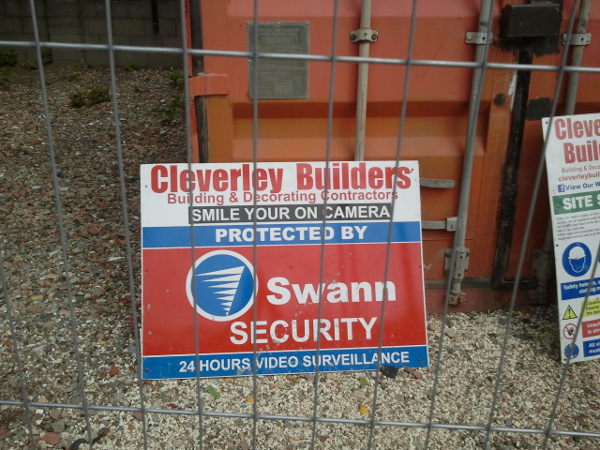
    Seen this morning on Church Road, Lawrence Hill, Bristol.

    sign stating smile your on camera

    The person who wrote the copy must have fallen asleep in English classes when the difference between the abbreviated second person conjugation of the verb ‘to be’ and the second person possessive adjective was being explained.

    Never mind, poor English skills don’t seem to have been a barrier to employment with Cleverley Builders of Whitchurch, Bristol or Swann Security; it was uncertain to your correspondent as to who had produced the sign. However, the ability to lie on signage is also valued by Cleverley Builders and/or Swann Security as no evidence of the physical presence of video surveillance equipment could be discerned.

    If the author of the sign happens to read this, help is at hand to assist you in learning the distinguish them.

    Neither of my parents, both of whom left school at 14 years of age and received not much more than a primary education in rural Norfolk in the 1930s and 1940s would not have made such a glaring mistake in English – a mistake which seems all too commonplace amongst the beneficiaries of the modern British education system.

  • Bristol Post Balls – bad punning and sexism

    Regular readers will be aware that the Bristol Post is not renowned for the quality of its journalism.

    However, the dreadful pun and sexism of today’s front page of the dead tree edition marked a new low in the paper’s already woeful standards.

    image of Bristol Post front page with sexist pun

    Bad puns are annoying in headlines at the best of times and sexism is tolerated far less than when the fifty-something males in charge of producing Bristol’s daily work of fiction first started out in what was then called journalism.

    There has been a steady stream of criticism of the Bristol Post on Twitter throughout the day.

    However, the paper has not sought to respond to any of its critics, presumably because the person in charge of the Twitter account has yet to notice the ‘reply’ button.

    In addition, some of Bristol’s Twitterati have also been alerting the national media to The Post’s disgraceful front page seeking to trivialise a sexual assault.

    With front pages like the one above, is it any surprise that the Post’s circulation figures (as measured by ABC) are falling by nearly 11% per year? Not to me it isn’t!

    Update 18/08/14: Bristol 24-7 is reporting today that Bristol City councillor Naomi Rylatt has written to the Press Complaints Commission (PCC) over the above front page headline, describing it as a “disgusting attempt at humour“.

  • Cricket explained

    The second Test series between England and India is currently taking place in Southampton (it’ll be day 3 today. Ed.) and my radio is tuned to the epic poem that is the BBC’s Test Match Special from 10.25 until the close of play each day, with the likes of Aggers, Blowers, Tuffers and Geoffrey Boycott (posts passim) filling the air with their wise words and wit.

    Cricket is a complex game that can take a long time to understand fully and I’m still occasionally baffled by the commentators. For the uninitiated, the many different laws and the strange names for positions on the field can seem overwhelming. For instance, which other game has a position on the field called ‘cow corner’*?.

    Below is a simple explanation for the uninitiated, which I originally heard at school decades ago as a brief summary of the game for foreigners.

    You have two sides, one out in the field and one in. Each man that’s in the side that’s in goes out, and when he’s out he comes in and the next man goes in until he’s out. When they are all out, the side that’s out comes in and the side that’s been in goes out and tries to get those coming in, out. Sometimes you get men still in and not out. When a man goes out to go in, the men who are out try to get him out, and when he is out he goes in and the next man in goes out and goes in. There are two men called umpires who stay out all the time and they decide when the men who are in are out. When both sides have been in and all the men have been out, and both sides have been out twice after all the men have been in, including those who are not out, that is the end of the game.

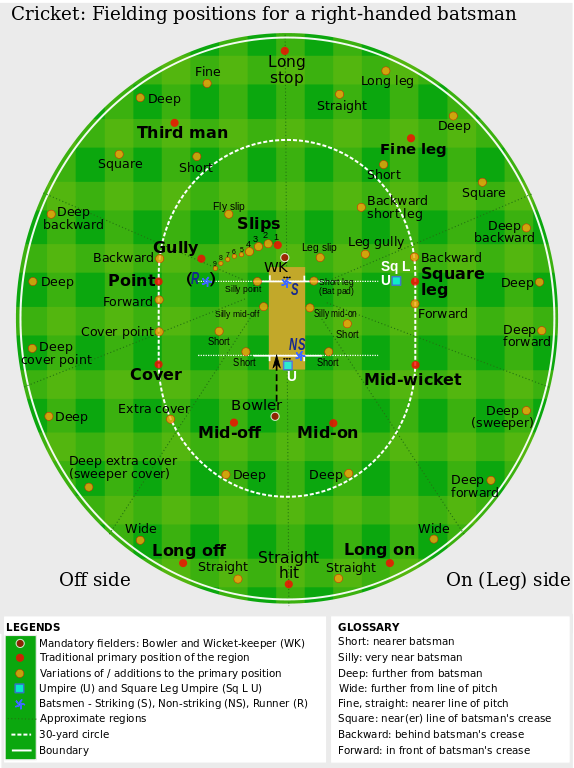
    For those who need help with fielding positions, Wikimedia Commons has helpfully provided the following graphic.

    image of cricket fielding positions

    Note that the fielding positions would be reversed for a left-handed batsman.

    * Cow corner = the area of the field (roughly) between deep mid-wicket and wide long-on. So called because few ‘legitimate’ shots are aimed to this part of the field, so fielders are rarely placed there โ€“ leading to the concept that cows could happily graze in that area.

  • Generational change: graffito

    Punk is dead” is a phrase recalled from my early twenties and apparently dates from 1978. Furthermore, “Punk is Dead” is also the title of a song by the legendary anarchist punk band Crass.

    This morning a variation on the phrase drifted into my Twitter feed, as shown by the photograph below.

    grafitti stating punk is dad

    For today’s younger people, about the age that I was when punk first emerged, the leading lights of punk rock such as The Clash, Sex Pistols and their contemporaries have probably been added to the likes of The Beatles, Bob Dylan, Jimi Hendrix and other more typical exponents of “Dad Rock“.

    Additional research has revealed that “Punk is Dad” is the title of a song by Berlin-based band Ohrbooten.

    Could the graffito be cheap promotion for Ohrbooten’s offering – or is it just bad spelling? ๐Ÿ™‚

  • LibreUmbria@Scuola nominated for Egov 2014 prize

    News arrived via my inbox this morning that LibreUmbria‘s programme in schools (LibreUmbria@Scuola), which took place in recent months in collaboration with Perugia’s third teaching district (posts passim), has been nominated for this year’s Egov Prize. LibreUmbria is the project that is promoting the use of free and open source software amongst public sector organisations in Italy’s Umbria region.

    Egov Prize logo

    The basic idea behind the Egov Prize has always been the fusion and sharing of good practice which other public sector organisations can use as an example and from which they can benefit. This will be the 10th year the prize will have been awarded.

    LibreUmbria@Scuola aims to raise awareness and promote the use of free software in schools, from the primary level upwards by training parents and teachers who will in turn train others by acting as mentors.

    The LibreUmbria@Scuola project has been implemented in arranging free seminars at schools for parents and teachers, on digital culture topics (the relationship between boys and technology, shared knowledge and free software, security, use of social media, cyberbullying). In addition to the seminars, computer courses in using the LibreOffice productivity suite running on Ubuntu Linux were also provided.

  • Caption chaos

    Being sloppy is one thing at which the Bristol Post consistently excels and the situation only looks to get worse following the announcement by David Montgomery of Local World – the owners of the Bristol Post – on the future direction of its titles and the role of journalists.

    Today’s most glaring howler features photographs with the wrong captions in this article, as illustrated below.

    incorrectly captioned photo from Bristol Post

    That’s the first locomotive I’ve seen with blonde hair! ๐Ÿ˜‰

    The chaos continues with subsequent photographs in the series too.

    incorrectly captioned photo from Bristol Post

    How anyone can confuse a girl with a locomotive is anyone’s guess.

    Is the Post employing visually-impaired journalists?

    We should be told.

  • Bristol Post: England invests £168 in roads

    Road works traffic signAccording to yesterday’s online edition of the Bristol Post, the Department of Transport is to invest the princely sum of £168 – the largest amount it has spent on tarmac for four decades – in England’s road network.

    Of this total, the amount earmarked for local authorities in the Bristol area swells magically to more than £2 mn., according to a this piece by an unidentified Post hack.

    The second paragraph of the report reads as follows:

    The handout from a £168 funding pot which will see more than £3 million potholes filled is part of what is being billed as โ€œthe biggest investment in roads since the 1970sโ€.

    For those who prefer their information unmangled by the illiterates of the local media, the original Department of Transport press release is available here.

  • Ah! Bristo

    One of the features of the variety of English spoken in Bristol is the terminal ‘L’ – a final, intrusive โ€˜Lโ€™ on words ending in a vowel sound. As a consequence, Bristolians live in areals of the city and some of them do their shopping in Asdal.

    This terminal L found its earliest expression in the city’s name itself, which has mutated from Brigstowe in Saxon times.

    However, the terminal L is now under threat from poor writing and editing at the Bristol Post (or should that be Bristo Post? Ed.), as revealed in this blatant advertisement masquerading as news, complete with obligatory screenshot.

    Bristol Post screenshot

    More of this poorly written junk can be expected in future as the Bristol Post – along with the rest of the Local World group to which it belongs – will be making increasing use of user-provided content, presumably to save on employing trained journalists.

  • Another variant on the HMRC fake email

    This morning I discovered the fake HMRC email below in one of my inboxes.

    I’m disappointed to note that the senders of this one are only offering me a refund of £830.99; the previous bunch of scammers were offering £1,400.

    TAX RETURN FOR THE YEAR 2014
    RECALCULATION OF YOUR TAX REFUND
    HMRC 2010-2011
    LOCAL OFFICE No. 3819
    TAX CREDIT OFFICER: Jarrett Horn
    TAX REFUND ID NUMBER: 9896077
    REFUND AMOUNT: 830.99 GBP

    Dear Applicant,

    The contents of this email and any attachments are confidential and as applicable, copyright in these is reserved to HM Revenue & Customs.

    Unless expressly authorised by us, any further dissemination or distribution of this email or its attachments is prohibited.

    If you are not the intended recipient of this email, please reply to inform us that you have received this email in error and then delete it without retaining any copy.

    I am sending this email to announce: After the last annual calculation of your fiscal activity we have determined that you are eligible to receive a tax refund of 830.99 GBP

    You have attached the tax return form with the TAX REFUND NUMBER ID: 9896077, complete the tax return form attached to this message.

    After completing the form, please submit the form by clicking the SUBMIT button on form and allow us 5-9 business days in order to process it.

    Our head office address can be found on our web site at HM Revenue & Customs: http://www.hmrc.gov.uk

    Sincerely,

    Jarrett Horn
    HMRC Tax Credit Office
    Preston<br /.
    TAX REFUND ID: UK9896077-HMRC

    This email was delivered from a Korea Telecom server and came with an attachment -Refund-Form-ID_9896077.zip (the number in the zip file varies).

    Some of the language used – e.g. ‘fiscal activity‘ – is also a clue to its bogus nature. HMRC is supposed to use simpler English than that. Furthermore, note that the title seems to suggest the tax return concerned is for 2014, but the refund relates to 2011-2012. Not even HMRC is that slow in refunding money.

    If you’re on a Windows machine, opening that zip file is fraught with danger as the archive contains a Trojan which, when run, attempts to drop cryptolocker, ransomware and loads of other malware on your computer.

    As stated in an earlier post, HMRC never sends notifications of a tax rebate by email or asks taxpayers to disclose personal or payment information by email.

    As before, if you receive one of these emails, you are advised to forward it to phishing@hmrc.gsi.gov.uk and then delete it.

    Once again, consult HMRCโ€™s website for comprehensive advice on phishing and bogus emails.

Posts navigation