politics

  • Big turnout for the Big Clean

    Saturday 28th March dawned grey and drizzly for the TidyBS5 Big Clean organised by Up Our Street and local residents.

    For your correspondent it dawned even earlier; the alarm clock was set for 6.00 a.m. to ensure he was sufficiently awake to be interviewed down the line about TidyBS5 and the event on BBC Radio Bristol by their Saturday breakfast show presenter Ali Vowles.

    However, the rain did not put off an amazing 33 people – including one PCSO from Trinity Road Police Station – turning up at Lawrence Hill roundabout at 11.00 a.m. to help remove litter from the area for a couple of hours. Indeed, such a number of participants was so unprecedented that more litter pick equipment had to be ferried down from the Up Our Street Office.
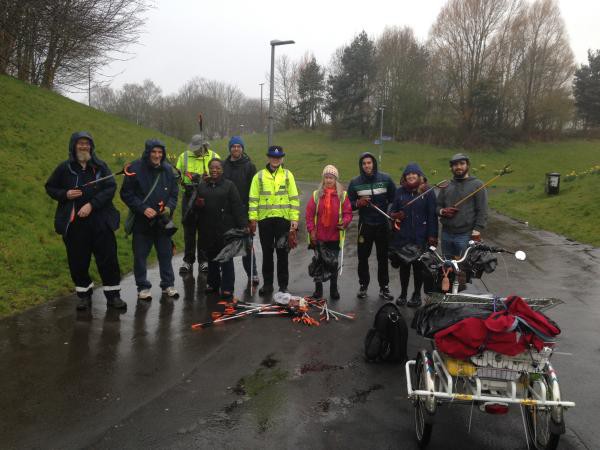
    Big Clean group photo
    Photo courtesy of Lorena Alvarez

    Also amongst the hardy souls who turned up was a contingent from the Good Gym, which takes exercise out of the gym. Members runs to a venue, help a local community project and then run back. Your ‘umble scribe is very pleased we attracted their support.
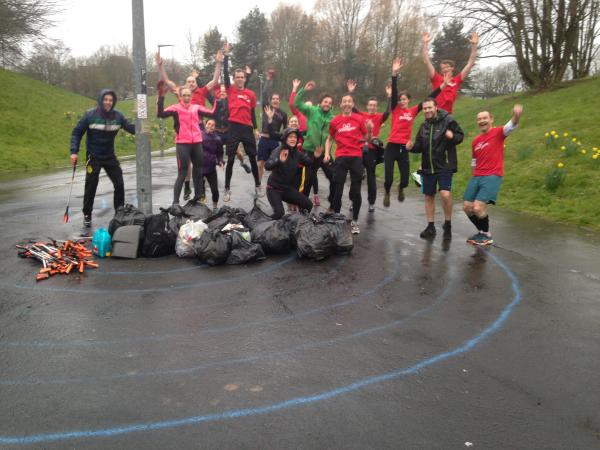
    Good Gym leaping about after collecting rubbish
    Photo courtesy of Lorena Alvarez

    Local councillor Marg Hickman also attended to show her support. Wouldn’t it be good if we could get Bristol Mayor George Ferguson to turn out for the next one and put some physical effort into Bristol’s year as European Green Capital? 😉

    After receiving safety instructions (avoid picking up broken glass, no needles, etc. Ed.) we then scattered to various sites around the area to get work.
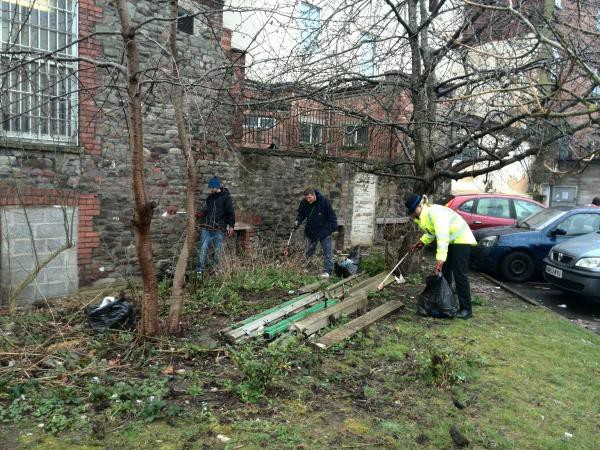
    litter pickers between Big Russell and Lidl
    Photo courtesy of Anthea Sweeney

    Areas cleaned included:

    • The grassed island in then centre of Lawrence Hill roundabout;
    • The grassed area fronting Lawrence Hill at the end of Payne Drive;
    • Public open space along Croydon Street;
    • The old course of the River Frome beneath the railway adjacent to the Coach House off Stapleton Road; and
    • The area of grass and shrubbery alongside the former Earl Russell pub (the ‘Big Russell’. Ed.) and Lidl on Lawrence Hill.

    A fantastic amount of rubbish was removed and collected later in the weekend by Bristol City Council.

    collected rubbish awaiting removal by Bristol City Council
    Photo courtesy of Lorena Alvarez

    Well done and many thanks to all who took part.

  • Godwin 0, Vandals 1

    Early this morning the demolition crews finally starting their assault on the 1860s school in Marybush Lane, Bristol (posts passim).

    Within a couple of hours the demolition contractors had all but flattened the Pennant sandstone and Bath stone structure built by eminent Victorian architect and Aesthetic Movement member, E.W. Godwin, as shown in the photos below.

    views of the demolition of Marybush Lane school from two angles
    More of East Bristol’s heritage turned to dust

    One less of Godwin’s works now survives for people to appreciate. In Bristol his only remaining works are – to the best of my knowledge – the grade II*-listed Carriageworks on Stokes Croft dating from 1862 and his refurbishment of St. Philip & St. Jacob Church, which lies just across Tower Hill from Marybush Lane and was contemporaneous with the building of the school.

    The efforts of The Victorian Society and local campaigners to save the school from demolition by the vandals from the site’s owners, the Homes & Communities Agency, have therefore been in vain. When objections were first raised to its demolition, the HCA displayed both ignorance and arrogance. Firstly, it denied that the school had been designed by Godwin. When presented with incontrovertible evidence by opponents, it then had the arrogance to deny its initial ignorance.

    I shall shed a tear into my beer tonight for this loss of yet another part of East Bristol’s history and heritage. The east side of Bristol, traditionally its poorer side, has long been treated with contempt and disregarded by both the city’s great and good and outsiders; and this latest vandalism just confirms that.

    During the 1930s the city’s unemployed, in the form of the National Unemployed Workers’ Movement (NUWM) used to hold their meetings at the school.

    If a future walk by Bristol Radical History Group is ever done on the unemployed, a halt in Marybush Lane – no doubt in front of some cheap and nasty residential development, will be prefaced by the words, “On this site used to stand…”, a growing phenomenon in a city where only the heritage of the great and good seems to be valued.

    So in conclusion well done Mayor George Ferguson and Bristol City Council for failing to lift a finger to save Godwin’s school and well done HCA for an act of heritage vandalism committed without compunction.

  • Trade insults BS5

    Bristol City Council’s streetscene enforcement officers (the local authority’s litter and fly-tipping police. Ed.) are currently active in the Stapleton Road area of Bristol 5.

    One of the major problems with which they’ve been getting to grips is that of traders fly-tipping in the streets and dumping their waste in the communal bins intended for household waste only.

    image of trade waste - in this case lots of flattened cardboard packaging - fly-tipped by communal bin in Pennywell Road, Easton
    Trade waste – in this case lots of flattened cardboard packaging – fly-tipped by a communal bin in Pennywell Road, Easton

    Tidy BS5 campaigners are actively assisting the enforcement officers in the efforts by identifying suspected offenders and directing officers to regular sites for the fly-tipping of trade waste.

    Traders are supposed to pay for their own waste disposal. By abusing the facilities provided for residents, they may be saving themselves money on their waste contracts, but are also insulting the community whose members constitute their customers; and that has to stop.

    So far, the council has handed out 5 fixed penalty notices of £300 each to local traders for waste matters and more are clearly needed before their work is done, if it ever will be.

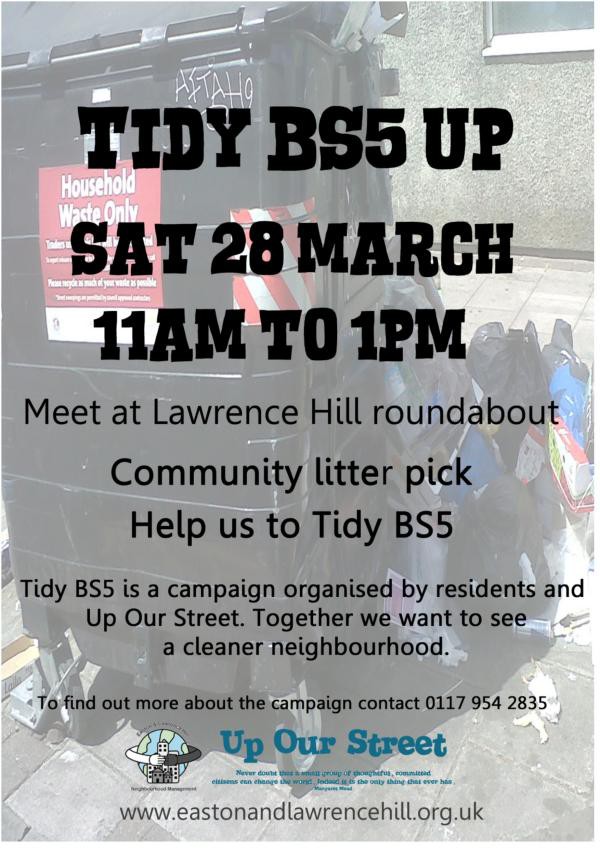
    In the meantime, if you’ve got time free on Saturday, don’t forget to turn out for the Tidy BS5 Big Clean community litter pick, meeting at 11 a.m. at Lawrence Hill roundabout. Yours truly will be rising slightly earlier as BBC Radio Bristol wishes to interview me on its breakfast show.

    Big Clean publicity poster

    Last but not least, yet another reminder about signing the TidyBS5 e-petition!

  • Getting wrecked – the story of East Bristol’s heritage

    Bristol has a long and proud history stretching back beyond Saxon times.

    However, it also has a slightly shorter and not so proud history of allowing important heritage and buildings of historical interest to disappear under the demolition contractor’s wrecking ball, particularly in East Bristol, long treated with contempt by the city fathers.

    This contempt for the heritage of East Bristol has been eloquently illustrated in recent times.

    First there was the loss some 10 months ago of the fine Victorian school in Avonvale Road (posts passim). With the connivance of Bristol City Council, this was sacrificed on the altar of bland modern architecture sponsored by the academy schools programme.

    The loss of Avonvale Road school was followed just one month later by the demolition of Ebenezer Chapel in Midland Road, the last non-conformist chapel in that part of the city and a rare example of a Romanesque style chapel (posts passim) in contrast to the more usual Gothic style. The site of the Ebenezer Chapel is now occupied by a bland, modern block of flats.

    A third important building in East Bristol is now under threat of demolition by its owners, the Homes & Communities Agency, who in my opinion don’t know what a treasure they’ve got in their property portfolio. It’s on the left in the photo below.

    photo of Marybush Lane School. Unlike Bristol24/7 I at least asked the permission of the photographer to use it and credited it accordingly
    The old ambulance station site in Tower Hill. Photo used by kind permission of Chris Brown

    What the picture shows is the site of Bristol’s old ambulance station in Tower Hill. The tracked vehicle on the right is sitting atop the remains of the uninspiring 1960s building forming part of the station complex. The most interesting part of the site is the stone building on the left.

    That building dates from circa 1860 and was originally the parish school in Marybush Lane built for St. Philip and St. Jacob Church. It was designed by eminent Victorian architect and designer E.W. Godwin, a local boy whose best-known building is Northampton’s Guildhall. Godwin was born Old Market Street in 1833 and is believed to have attended St. Philip and St. Jacob as a worshipper. Locally Godwin also designed the grade II*-listed Carriageworks building on Stokes Croft, an early example of the Bristol Byzantine style.

    The Victorian Society is calling on the Mayor of Bristol, George Ferguson, to step in to save the former school, which has been refused spot listing, despite its local historical importance. The Victorian Society’s Conservation Adviser, Sarah Caradec, said: “Bristol should take this last minute opportunity to save this early example of Godwin’s work in the area he was born and brought up in. Far too many examples of Godwin’s work have already been lost. Although English Heritage rejected an application to spot list the building, it recognised its strong local interest as an early Godwin building, as well as its group value with the associated Grade II*-listed Church of St Philip and St Jacob, which were restored by Godwin in the 1860s. We urge the Mayor of Bristol to recognise the building’s value and act now to ensure that the HCA build around it.”

    It’s not just the connection with Godwin that makes the old school valuable. If it disappears beneath the wrecking ball, an important part of Bristol’s working class history will also be lost.

    During the harsh economic times of the 1930s when millions were out of work, the Bristol branch of the National Unemployed Workers Movement (NUWM) held its meetings at the school. Bristol Radical History Group has material related to the activities of NUWM in Bristol, whilst the excellent BRH publication Bread or Batons?, written by Dave Backwith and Roger Ball, can be purchased from Hydra Books in Old Market Street.

    Will the HCA see sense?

    Will George Ferguson intervene?

    Only the next couple of weeks will tell.

  • The return of the spiv

    Grant ShappsOne consequence of the current media focus (which continues today, with the Mirror describing his tactics as “sleazy”. Ed.) on the business activities of Conservative Party Chairman Grant Shapps (right) has been a linguistic one.

    Many people have rediscovered a word which came to prominence during World War 2 – spiv.

    This word has often been used by those commenting on online articles on Shapps’ dubious business activities to describe the man himself.

    Oxford Dictionaries defines a spiv as:

    A man, typically a flashy dresser, who makes a living by disreputable dealings.

    During World War 2 those disreputable dealings usually meant that spivs circumvented the strict rationing regulations and/or could procure commodities or items that were hard to get.

    image of James Beck playing Pte Joe WalkerThe spiv was personified during my younger years by Private Joe Walker (left) in the TV comedy Dad’s Army. Walker was played by actor James Beck, who died suddenly at the age of 44 during production of the programme’s sixth series in 1973. In the series, Walker is a valuable asset to the platoon, due to his many “business” connections and his uncanny ability to conjure up almost anything that is rationed or no longer in the shops due to the war – and he will also have it in vast supply (for a price).

    Arthur English in character as a spivFor a generation older than mine, the spiv was perhaps characterised by comedians such as Arthur English (right), whose usual persona in the early days of his career was a stereotypical wartime “spiv”. As a consequence of this persona, Arthur English became known as “The Prince of the Wide Boys” (meaning in this context a man who lives by his wits, wheeling and dealing. Ed.). Wide boy is also a term that could possibly be applied to Shapps as an alternative to spiv.

    As regards the origins of spiv, there are several possibilities.

    Oxford dictionaries reckons it originates in the 1930s and is perhaps related to “spiffy“, meaning “smart in appearance”, which dates back to 19th century slang in this context.

    Another possibility is that it’s related to “spiff“, a bonus for salespeople (especially for drapers but later for car salesmen, etc.) for managing to sell excess or out of fashion stock. The seller might offer a discount, by splitting his commission with the customer. A seller of stolen goods could give this explanation for a bargain price.

    Yet another suggested origin is that it comes from the nickname of Henry “Spiv” Bagster, a small-time London crook in the early 1900s who was frequently arrested for illegal street trading and confidence tricks. National newspapers reported his court appearances in 1903-06.

    Furthermore, it has been speculated that it is VIPs backwards. In addition, further speculation has it that the word was also a police acronym for Suspected Persons and Itinerant Vagrants.

    Finally, there are also hints that it could have been borrowed from Romany. In that tongue, spiv is a word for sparrow, implying the person is a petty criminal rather than a serious “villain”.

  • Highlighting a foul practice

    Dog fouling is one of the banes of modern life; it’s filthy, a health hazard and – as any local councillor will tell you – a permanent source of correspondence for them from the electorate.

    Over in Bedminster someone has been patrolling the streets and highlighting the problem of dog fouling by spraying the canine visiting cards left in public places with yellow paint, as shown in the example below from Stillhouse Lane.

    dog poo sprayed yellow

    Over in BS5, there’s someone else who also goes round the Easton and Redfield areas with a spray can of paint attacking dog faeces, in this case spraying them fluorescent green.

    Bristolians can report dog fouling online to the City Council, who respond quickly to the laziness of dog owners who cannot be bothered to clean up after their pets.

    In closing here’s a final reminder to those who let their dogs foul the streets and don’t clean it up: it’s an offence that could land you with a fine of £80, which might be a little more inconvenient than stooping and scooping. 🙂

  • Response to open standards FoI request

    A response has been received today to my FoI request to Bristol City Council on open standards (posts passim).

    The reply was received in a record 10 working days and reads as follows:

    Bristol City Council has been a long-term supporter of open standards wherever possible. We have frequently voluntarily adopted national government policy on open standards and open source, recognising the benefits of this approach.

    We adopted StarOffice in 2005 and moved to the Open Document Format as our standard for office productivity files at the point it was incorporated in the StarOffice / OpenOffice.org products. We had to move to Microsoft Office in 2010 due to the lack of standards support in the local government applications market, partly due to the fact that national government policy was not mandated at local level and therefore did not have the desired effects on the document standards context. However we retained the ability to create, open and collaborate on ODF by implementing LibreOffice alongside Microsoft Office on all council PCs. Therefore we are already capable of using ODF to collaborate on government documents.

    In terms of publishing government documents to citizens, we have historically used PDF, but are now attempting to replace all information, advice and guidance, and application forms with fully digital services. Over time this will replace old PDF documents with HTML. If there are documents that meet a user need to download and read offline, we can produce PDF/A format from the open source PDF Creator software that is also available on every council PC.

    I’m very pleased to note that BCC has LibreOffice installed on every council machine. They kept that quiet! Perhaps they’ll use it to send me replies to my FoI requests in future instead of the propensity to use MS Office formats. But just to make sure, I’ll include a plea for a reply in an open format in all my future requests. 🙂

    Read the original FoI request and response on WhatDoTheyKnow.

  • Wikimedia Foundation takes NSA to court

    image of scales of justiceThe Wikimedia blog reports that yesterday the Wikimedia Foundation filed suit against the US National Security Agency (NSA) and the Department of Justice (DOJ). The lawsuit challenges the NSA’s mass surveillance programme and more specifically its large-scale search and seizure of internet communications — frequently referred to as “upstream” surveillance. The Foundation’s aim in filing this suit is to end the mass surveillance programme in order to protect the rights of the Foundation’s users around the world. It has been joined in the suit by eight other organisations (National Association of Criminal Defense Lawyers, Human Rights Watch, Amnesty International USA, Pen American Center, Global Fund for Women, The Nation Magazine, The Rutherford Institute and the Washington Office on Latin America) and represented by the American Civil Liberties Union (ACLU). The full complaint can be found here (PDF).

    “We’re filing suit today on behalf of our readers and editors everywhere,” said Jimmy Wales, founder of Wikipedia. “Surveillance erodes the original promise of the internet: an open space for collaboration and experimentation, and a place free from fear.”

    Privacy is the bedrock of individual freedom. It’s a universal right that sustains the freedoms of expression and association. These principles enable inquiry, dialogue and creation and are central to Wikimedia’s vision of empowering everyone to share in the sum of all human knowledge. When they are endangered, the Wikimedia Foundation’s mission is threatened. If people look over their shoulders before searching, pause before contributing to controversial articles or refrain from sharing verifiable but unpopular information, Wikimedia and the world are poorer for it.

    The Foundation’s case challenges the NSA’s use of upstream surveillance conducted under the authority of the 2008 Foreign Intelligence Surveillance Act Amendments Act (FAA). Upstream surveillance taps the internet’s “backbone” to capture communications with “non-U.S. persons”. The FAA authorises the collection of such communications if they fall into the broad category of “foreign intelligence information”; this includes nearly any information that could be construed as relating to national security or foreign affairs. The programme casts a vast net and consequently captures communications that are not connected to any “target”, or may be entirely domestic. This includes communications by the Foundation’s users and staff.

    The NSA has interpreted the FAA as offering it free rein to define threats, identify targets and monitor people, platforms and infrastructure with little regard for probable cause or proportionality. Wikimedia believes that the NSA’s current practices far exceed the already broad authority granted by the US Congress through the FAA. In addition, it believes such practices violate the US Constitution’s First Amendment (protection of freedom of speech and association) and the Fourth Amendment, which protects against unreasonable search and seizure.

    In addition, the Wikimedia Foundation believes that the NSA’s practices and limited judicial review of those practices violate Article III of the US Constitution, which relates to the judicial system. A specialized court, the Foreign Intelligence Surveillance Court (FISC), hears matters related to foreign intelligence requests, including surveillance. Under US law the role of the courts is to resolve “cases” or “controversies”, not to issue advisory opinions or interpret theoretical situations. In the context of upstream surveillance, FISC proceedings are not “cases” since there are no opposing parties and no actual “controversy” at stake as FISC merely reviews the legality of the government’s proposed procedures. According to the Foundation this is the kind of advisory opinion that Article III was intended to restrict.

    In 2013, the U.S. Supreme Court dismissed a previous challenge to the FAA, Amnesty v. Clapper, because the parties in that case were found to lack “standing”. Standing is an important legal concept requiring a party to show that they’ve suffered some kind of harm in order to file a lawsuit. The 2013 mass surveillance disclosures included a slide from a classified NSA presentation that made explicit reference to Wikipedia, using the Foundation’s global trademark. Because these disclosures revealed that the government specifically targeted Wikipedia and its users, Wikipedia believes it has more than sufficient evidence to establish standing.

    Reposted from Bristol Wireless.

Posts navigation