Today’s cock-up by the Bristol Post, from a story entitled ‘Man on lilo rescued after drifting out to sea off Weston-super-Mare’, has gained Bristol’s newspaper of record a seat in homophone corner.
For the benefit of passing Post journalists a homophone is “a word that is pronounced the same as another word but differs in meaning. The words may be spelled the same, such as rose (flower) and rose (past tense of “rise”), or differently, such as carat, caret, and carrot, or to, two, and too.”
Now let’s see (or sea. Ed.) what landed the Post this particular accolade.
The second AshesTest match is currently underway at Lord’s in London between England and Australia.
Over the years I’ve become a fan of the live coverage provided by the Test Match Special team on Radio 4 LW; local Bristol community station BCfm interferes with the signal on Radio 4’s FM signal where I live.
Geoff BoycottAs a consequence, I’ve got to know and appreciate the consummate broadcasting skills of Aggers, Blowers and company, including Geoff Boycott, regarded by some as the ‘greatest living Yorkshireman’.
One of the joys of listening to the coverage is the banter between the team, especially the ribbing of Boycott and the interplay between him and Aggers in particular.
Now Geoffrey is not known for keeping his counsel to himself, being a man of strong opinions. Like all of us, he’s got little foibles in his speech and recurring phrases, affectionately known as ‘Boycottisms‘. These Boycottisms have been used to produce ‘Boycott bingo’ cards like the example below.
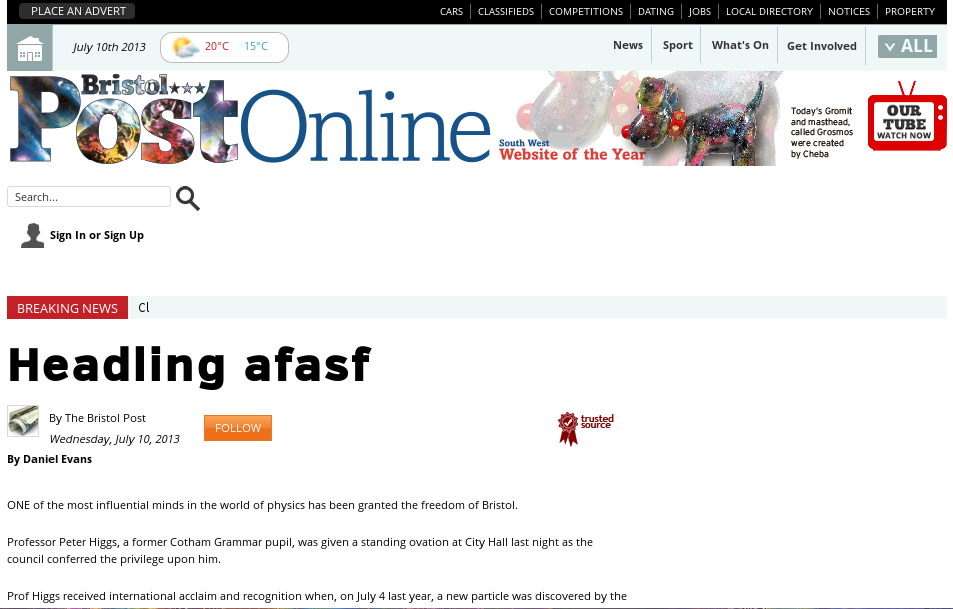
Below is a screenshot of the story in today’s Bristol Post reporting on Professor Peter Higgs – one of the team that postulated the existence of the particle named after him back in the 1960s – being granted the freedom of the city of Bristol.
Headline quality control in action. Click on image for full size version.
The phrase “to spend a penny”, meaning to use a public lavatory, has its origins in the use of coin-operated locks on public toilets in the UK. When these were first introduced, the fee for use was normally one penny (1d); and it stayed at that level for decades, well into the second half of the twentieth century.
However, the cost of being caught short and having to use a public lavatory has undergone a massive inflationary rise if a report in today’s Bristol Post is to be believed.
Pictured above is an old English bank note with a face value of 10 shillings; that’s equivalent to 240 pence.
The Bristol Post report states that people could be charged up to 50p (that’s ten shillings in old money. Ed.) to spend a penny in a new block of town centre toilets in Portishead, which could cost up to £40,000 to build.
The Post quotes Portishead Town Council Clerk Jo Duffy as follows on the likely cost of spending a penny:
There would be a charge levied for using the toilets, which could be up to 50 pence per visit. However the town council is keen to keep the charge at a lower level of around 20 pence if possible.
Even 20 pence for a pee is extortionate, in my opinion.
This blog has covered the peculiarities of life in North Somerset before now (posts passim) and at least one person leaving a comment on the Post report feels relieved he’s not a resident:
Every day I wake up and thank the Lord that I don’t live in North Somerset.
This blog has written before about politicians’ scrapes with technology and their apparent inability to cope with it (posts passim).
Below is a screenshot of a tweet (since deleted) by Andrew Selous, the Tory MP for South West Bedfordshire commenting on Chancellor of the Exchequer Gideon Osborne’s comprehensive spending review in the House of Commons earlier today.
Tweet by Andrew Selous MP
Andrew should also know that the first rule about criticising others’ use of language is to make sure one’s own is impeccable (but they probably omitted to teach him that at Eton. Ed.).
Tux – the Linux kernel mascotOne item I missed from my list of highs on last week’s Barncamp post was hearing Naomi from Sheffield recite the Linux Lord’s Prayer she’d devised many years earlier; I first heard Naomi recite it round the campfire in June 2010. This year at Barncamp, Naomi performed it on stage during the Open Mic session on Saturday night.
The prayer is reproduced below for those you have yet to come across it. I hope you enjoy it.
Our father, who art in /sbin,
init is thy name.
Thy PID is 1;
Thy children run
In user space as they do in kernel.
Give us this day our daily RAM
And forgive us our interrupts
As we are nice to those who interrupt us.
Lead us not into uncaught exception
And deliver us from SIGKILL
For thine is the system
And thou art the saviour
For ever and ever – until we upgrade yer!
Vater Unser, der Du da bist in /sbin,
init ist Dein Name.
Deine PID ist 1,
Deine Kinder laufen
Im Benutzermodus wie auch im Kernel.
Unser tägliches RAM gib uns heute
Und vergib uns unsere Unterbrechungen
Wie auch wir vergeben unseren Unterbrechern.
Und führe uns nicht in unbehandelte Ausnahmen
Und erlöse uns von dem SIGKILL
Denn Dein ist das System
Und die Kraft und die Herrlichkeit
In Ewigkeit – Bis wir Dich updaten!
Sean Benyon, Labour councillor for Bristol’s Southville ward, has either bought fellow councillor Gus Hoyt’s old mobile phone (posts passim) or has fallen into the same predictive text trap as his Green colleague down the Counts Louse.
Justice Secretary & Lord Chancellor Chris GraylingFormer BBC producer and current Secretary of State for Justice Chris Grayling MP is the first non-lawyer to serve as Lord Chancellor since the earl of Shaftesbury in 1672-3.
His lack of legal training could explain lots: he’s been brought in to do a hatchet job on the justice and legal system; some of the changes he’s planning to implement would never be contemplated for an instant by lawyers.
Whilst in opposition, Grayling became known as a national politician through his “attack dog” pressure on leading Labour politicians.
Grayling seems completely unworried about removing the right of the accused to pick an advocate of his/her choice under the criminal legal system. Indeed, he’s positively contemptuous of those that end up in the dock!
‘I don’t believe that most people who find themselves in our criminal justice system are great connoisseurs of legal skills. We know the people in our prisons and who come into our courts often come from the most difficult and challenged backgrounds.
Yes, you did read that correctly. If you need to rely on legal representation funded by criminal legal aid, Grayling thinks you’re too thick to pick your own lawyer, so why not let the state pick one for you. Furthermore, by lumping together people who find themselves in the criminal justice system with those in prison, Grayling arrogantly seems to be equating being in the dock automatically with being guilty. What happened to the presumption of innocence, Mr Grayling?
However, Grayling’s contempt and abuse is not confined solely to those unfortunates in the dock. Several times in the interview he refers to the provision of legal services as an ‘industry’.
When I did economics 4 decades ago, the economy consisted of 3 sectors: primary (e.g. agriculture, mining), secondary (e.g. manufacturing, industry) and tertiary (e.g banking, insurance, legal services).
By referring to the ‘legal services industry’ Grayling has moved legal services from the tertiary to the secondary sector. In so doing he has reduced the role of the skilled legal professional to that of a mere machine operative and that of their clients to the widgets that the machine produces. Grayling is thus guilty of treating people as objects, which is not just a retrograde step for justice, but for British society as a whole.