It is often said that with the wealthy the most sensitive part of their anatomy is the bank balance. Be that as it may, the above exchange proves this is not necessarily a default position for all plutocrats. In the case of Musk the ego is clearly his most delicate organ.
Last week the blog of The Document Foundation (TDF) announced the release of LibreOffice 24.2.4, the latest point release of the office suite since its switch to the new version numbering system.
The updated release is available for immediate download for all major operating systems, GNU/Linux, MacOS and Windows. It includes over 70 bug and regression fixes compared with LibreOffice 24.2.3 to improve the software’s stability.
LibreOffice is the only office suite with a feature set comparable to – if not better* than – the ubiquitous and overpriced Microsoft Office suite.. It also offers a range of interface options to suit all user habits, from traditional to modern, and makes the most of different screen form factors by optimising the space available on the desktop to put the maximum number of features just a click or two away.
This blog has often drawn attention to the inability of modern journalists (or should that be media employees? Ed.) to understand ambiguity, i.e. the quality of a statement being open to more than one interpretation, and how to avoid it by using language as a precision, not a blunt instrument.
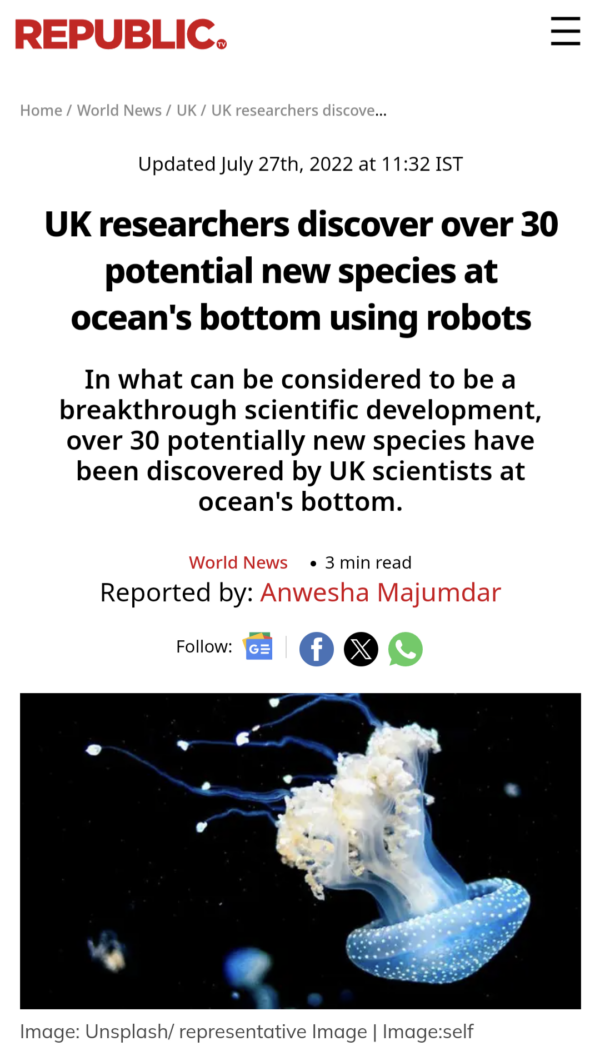
The example below dates back to 2022, comes from India’s Republic and dives beneath the waves to the bottom of the sea. It arrived in your ‘umble scribe’s social medial timeline late last week, so apologies if you’ve already seen the howler below.
The story was originally published in The Guardian. Republic’s reporter Anwesha Majumdar does not disclose in the rewrite why aquatic life in the deep oceans is using robots.
The region of Schleswig-Holstein on the Jutland Peninsula is no stranger where matters of sovereignty are concerned.
In the nineteenth century there was the Schleswig-Holstein Question, was a complex set of diplomatic and other issues arising in the 19th century from the relations of two duchies, Schleswig (Sønderjylland/Slesvig) and Holstein (Holsten), to the Danish Crown, to the German Confederation, and to each other.
In the twenty-first century digital sovereignty has become a matter of political importance to the north German federal state of Schleswig-Holstein.
The blog of The Document Foundation reports today that, following a successful pilot project, the state has decided to move from Microsoft Windows and Microsoft Office to Linux and LibreOffice (and other free and open source software) on the 30,000 PCs used by the state government.
According to a statement by the Premier of Schleswig-Holstein, the components of its digitally sovereign workplaces are being based on a total of six project pillars:
Switching from Microsoft Office to LibreOffice;
Switching the operating system from Microsoft Windows to Linux;
Collaboration within the state government and with third parties: use of the open source products Nextcloud, Open Xchange/Thunderbird in conjunction with the Univention AD connector to replace Microsoft Sharepoint and Microsoft Exchange/Outlook;
Design of an open source-based directory service to replace Microsoft Active Directory;
Appraising specialist procedures with regard to compatibility and interoperability with LibreOffice and Linux; and
Development of an open source-based solution to replace Telekom-Flexport.
According to Schleswig-Holstein’s Digitalisation Minister Dirk Schrödter, digital sovereignty is an integral part of the state government’s digital strategy and work programme. “This cannot be achieved with the current standard IT workstation products. We take digital sovereignty seriously and are moving forward: the decision to change office software is a milestone, but only the beginning of the change: the change to free software for the operating system, the collaboration platform, the directory service, specialist procedures and telephony will follow.”
Yesterday the blog of The Document Foundation (TDF) announced the simultaneous release of two versions – 23.2.2 and 7.6.6 respectively of the LibreOffice productivity suite. Both releases bugs and regressions to improve quality and interoperability for individual productivity.
As usual LibreOffice 7.6.6 is an update to a release not at the project’s cutting edge, but is designed for more conservative users who don’t necessarily want – or need – the suite’s latest features.
Both versions are now available for download. All LibreOffice users are encouraged to update their current version as soon as possible to take advantage of the improvements and bug fixes in the new releases. For those using proprietary operating systems, the minimum requirements are Microsoft Windows 7 SP1 and Apple MacOS 10.15.
For business use, TDF strongly recommends the LibreOffice Enterprise family of applications from its partners with a wide range of dedicated value-added features and other benefits such as SLAs. Details here.
LibreOffice users, free software advocates and community members can support the work of The Document Foundation by making a donation to it.
Today, 27th March is Document Freedom Day, which every year publicises and raises awareness of how open standards and open document formats enable us to read and write as we so wish.
Was there ever a time you were sent an important file that the software onyour computer couldn’t read properly? Do you remember having to purchase or download a new application just so you could open an attachment you needed for your work? The same thing happens tens of thousands of times every day. Can you imagine how much knowledge sharing doesn’t happen just because the sender and receiver – either intentionally or unintentionally – use different file formats? Incompatibilities like these are typically caused by secret (“closed”) and privately held (“proprietary”) file formats.
Document Freedom Day is a chance to inform the world about open standards, which are crucial for the exchange of information, independence from software suppliers like the Beast of Redmond and to ensure long-term access to our data. LibreOffice – the office suite used and recommended by your ‘umble scribe – is a fine example of how to use open standards such as Open Document Format (ODF).
In recent days, pastry products purveyor Greggs suffered an IT outage that left shops unable to process certain types of payment, the BBC reported yesterday. The company has over 2,000 branches and employs 21,500 persons.
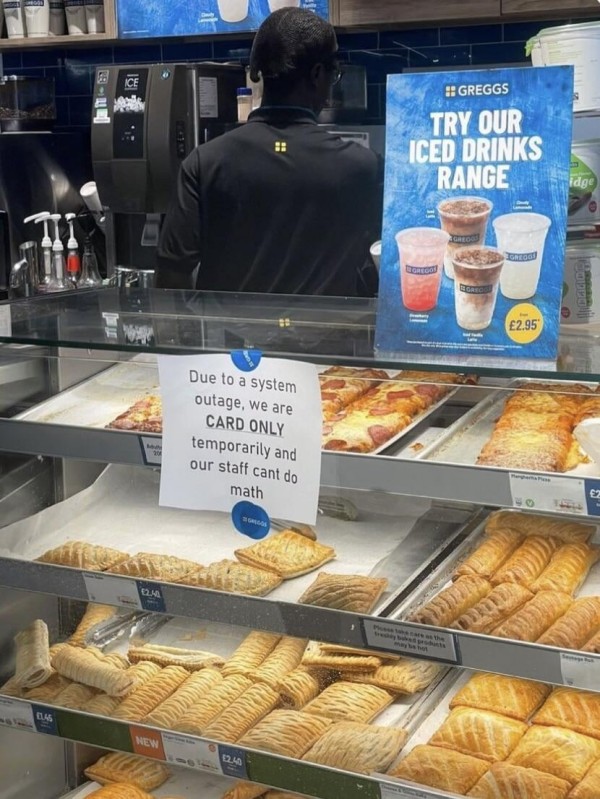
Some shops were forced to close and posted notices saying they were closed for the day or could only accept certain payment types. Fans of hot pastry-based snacks took to social media, with some labelling it as bordering on a national emergency. One of the more interesting signs from an unidentified branch of Greggs is shown below.
Yes, you did read that correctly: “Due to a system outage, we are CARD ONLY temporarily and our staff cant do math“.
A system outage is not the only woe to beset this particular branch of Greggs. First of all, there’s a punctuation thief about, unless the staff cant is hypocritical and sanctimonious talk, typically of a moral, religious, or political nature from employees. Secondly, what is this math? Mathematics, the knowledge that includes the topics of numbers, formulas and related structures, shapes and the spaces in which they are contained, and quantities and their changes, is abbreviated differently by speakers of British and American English; the former with maths, the latter with math, as in the well-known US phrase, (you) do the math.
Fears of the creeping Americanisation of British English have been doing the rounds for about a century already, but are becoming more prevalent due to the pervasiveness of US culture and a general lack of awareness of the distinctions between the two dialects. For instance, your ‘umble scribe would call something that ran his laptop a program, whilst something broadcast on the radio or TV would be a programme: some folk – quite possibly younger – would use program without distinction for both.
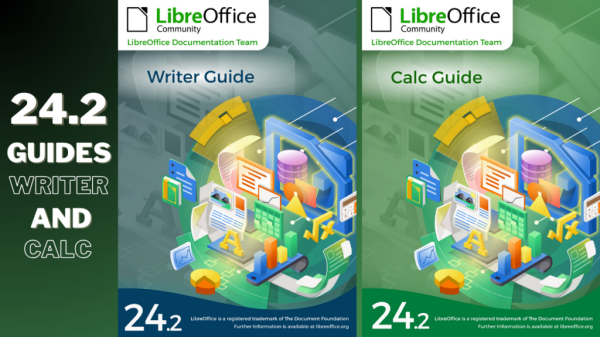
Last week The Document Foundation blog revealed that new guides have been produced for the latest 24.2 versions of Writer and Calc, LibreOffice‘s word processor and spreadsheet programs respectively.
The new guides are in essence updates of the guides produced for the preceding LibreOffice 7.6 guides.
The Writer guide has been reviewed and updated by Jean Weber and has changed from being a single page document to a full-sized book. The latest Writer guide includes all these updates:
Comments can now use styles;
New features in the Navigator;
Save with password dialog now has a password strength meter;
Insert Special Characters dropdown now shows a character description;
Improved support for multi-page floating tables;
“Legal” ordered list numbering: make a given list level use Arabic numbering for all its numeric portions;
Miscellaneous changes in the names of some fields and buttons;
German news site heise reports that German-speaking literary translators associations are demanding stricter regulation of Artificial Intelligence (usually abbreviated to AI) due to its threats to art and literature.
“Art and democracy too are being threatened.” This is being said by German-speaking literary translators associations in Germany, Austria and Switzerland in respect of the increasing “automation of intellectual work and human speech“. They have therefore collaborated on an open letter (PDF) in which they are demanding strict regulation of AI.
Image courtesy of Wikimedia Commons.
Regulation must ensure that the functionality of generative AI and its training data must be disclosed. Furthermore, AI providers must clearly state which copyrighted works they have used for training. No works should be used for this purpose against the wishes of copyright holders. In addition to this, the open letter states that copyright holders should be paid if AI is trained using their works and a labelling requirement should be introduced for 100% AI content.
“Human language is being simulated now”
“A translation is the result of an individual interaction with an original work”, the translators write. This interaction must take place responsibly. How a sentence is constructed and what attention is focused on guides the inner experience of readers. The language skills needed for this are developed and honed in the active writing process. “The creation of a new literary text in another language makes the translator a copyright holder of a new work.”
However, text-generating AI can only simulate human speech, according to the translators. “They have neither thoughts, emotions nor aesthetic sense, know no truth, have no knowledge of the world and no reasons for translation decisions.” Due to their design, language simulations are often illogical and full of gaps; they contain substitute terms and statements that are not always immediately recognised as incorrect.
“AI multiplies prejudices”
The translators continue by saying that When AI products are advertised, it is suggested that the AI can work independently, “understand” and “learn”. “This means the huge amounts of human work on which the supposedly ‘intelligent’ products are based are kept secret.” Millions of copyrighted works are ‘scraped‘ from illegally established internet libraries to create language bots.
These and other arguments are combined in a “Manifesto for Human Language”. In it the translators write as follows: “Bot language only ever reproduces the status quo. It multiplies prejudices, inhibits creativity, the dynamic development of languages and the acquisition of language skills.” Text-generating AI is attempting to make human and machine language indistinguishable. It is not designed as a tool, but a replacement for human skill.
However, AI is not intelligence at all, since this also includes emotional, moral, social and aesthetic intelligence, practical sense and experience which arise from physicality and action. “In this respect, the technical development of language bots cannot be termed ‘progress'”, the open letter states.
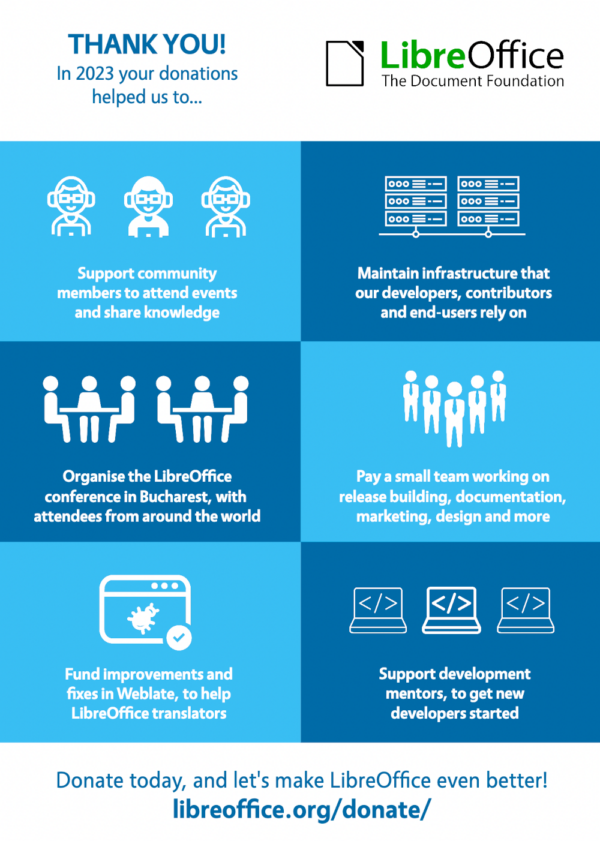
Yesterday the blog of The Document Foundation (TDF), the German non-profit organisation behind LibreOffice, published a post detailing how donations received during 2023 were used to continue development of the software and running the TDF and events
The post included a handy graphic displaying the disbursement of funds visually, which is shown below.
Graphic courtesy of The Document Foundation
Your ‘umble scribe would urge anyone who can to contribute their expertise, whether that’s writing or documentation, or helping to test pre-release versions; and if you can’t manage that, then donate! 😀

 In the twenty-first century digital sovereignty has become a matter of political importance to the north German federal state of Schleswig-Holstein.
 In recent days, pastry products purveyor Greggs suffered an IT outage that left shops unable to process certain types of payment,