language

  • Calibre 1.7 released

    Version 1.7 of Calibre, the cross-platform e-book reader and management software, was released on 18th October, Softpedia reports.

    Calibre’s features include:

    • Library management;
    • E-book conversion;
    • Syncing to e-book reader devices;
    • Downloading news from the web and converting it into e-book form;
    • Comprehensive e-book viewer;
    • Content server for online access to your book collection.
    image of calibre interface
    Calibre running on the KDE desktop under Linux

    A complete list of changes since the last version release can be found in Calibre’s release announcement.

    The new version is available for download for Linux, Mac OSX and Windows.

  • Capita T&I attempts sub-contracting to fulfil MoJ contract

    Sub-contracting is quite common in the language business. Every week or two I’ll do a job for an agency that’s been placed with them by another (usually larger) agency.

    This seems to go all the way to the top and is not confined to translation: interpreting jobs also get sub-contracted.

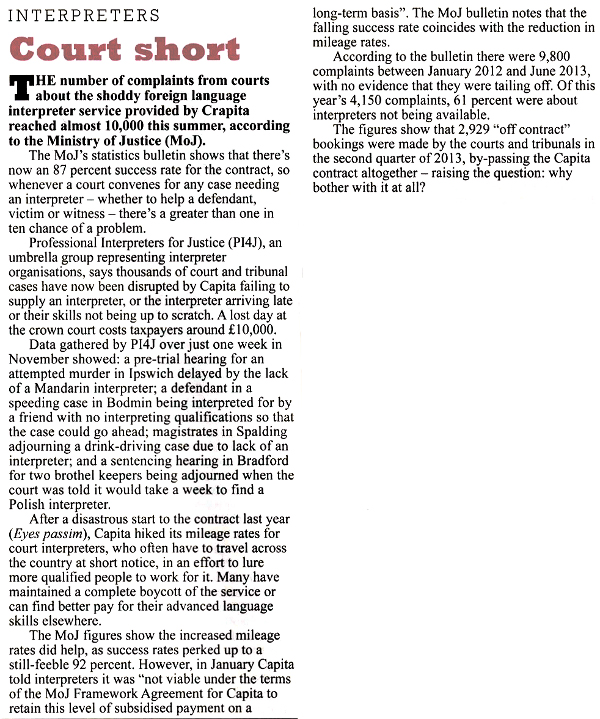
    As regards interpreting, RPSI Linguist Lounge last week published a post written by Oskar offering evidence that Capita Translation & Interpreting are also playing the same game to attempt to meet their contractual obligations to the Ministry of Justice under the framework agreement for interpreting services for courts and tribunals. Oskar’s words are reproduced in full below.

    I did some private work for solicitors last week at Uxbridge Magistrates Court. I spoke to a Romanian interpreter from thebigword. It seems that C-ta are unable to fulfil their contractual obligations, so courts are trying to call other agencies. On several occasions I was told by interpreters working outside of London that in several counties – Cambs, Notts, Northants, courts revert to calling other agencies or small/local agencies were approached by C-ta and asked to subcontract their interpreters in several languages. With regard to their so-called tier system, I have been advised that for NHS bookings they send people classified as Tier 4, what’s next then: a proverbial cleaning lady, mind you, these ladies are better paid and promptly as well. Who is behind upholding this unprofitable, undermanned and badly managed contract? Why aren’t SOCA or other LEA investigating it already?

  • Bristol Post Balls – an embarrassing vowel movement in public

    Crosby Stills & NashThere’s hardly a day goes by without the Bristol Post screwing up somewhere.

    Today it features a glowing review of veteran US three part vocal harmony and guitar group Crosby, Stills & Nash.

    However, at one point the language is not so much glowing as glaringly wrong when Mr Harnell trips over a near homophone:

    Despite hoovering up the Gross National Product of Columbia in his darkest days, David Crosby’s voice remains a thing of wonder.

    Columbia? The female personification of the United States of America?

    I think the reviewer had got his vowels muddled and actually meant Colombia, a South American country famous for the supply of a variety of white nasal decongestant allegedly enjoyed at one time by Mr Crosby.

  • PI4J survey

    PI4J logoProfessional Interpreters for Justice (PI4J), the umbrella group for interpreter organisations, has been campaigning since 2011 against the Ministry of Justice’s Framework Agreement and outsourcing of criminal justice interpreting to Capita Translation & Interpreting (formerly Applied Language Solutions/ALS).

    PI4J, in conjunction with Involvis, has just launched an online survey for interpreters (its fourth. Ed.) and, as well as hearing from interpreters about their current situation and thoughts about the future, also wants to hear interpreters’ views about PI4J and how they see its role. Should PI4J continue and if so, what is its primary role?

    The Capita T&I contract ends in October 2016 but re-tendering will begin much sooner and PI4J’s focus needs to be on what happens next.

    The survey will be open for responses until 10pm on Sunday 20th October 2013.

    Take the survey.

  • An apposite typo?

    I’m not a regular reader of the minutes of meetings of Bristol City Council’s Audit Committee. However, there’s an absolute corker of a typographical error on page 3 of the draft minutes of its 24th September 2013 meeting (PDF).

    image of BCC audit committee minutes

    Will anyone down at the Counts Louse (as real Bristolians call or) or City Hall (as the Mayor has renamed it) be eagle-eyed enough to notice?

    Under no circumstances Lord Fraud should not be confused with Lord Freud, a Conservative peer who only pretends to be a Parliamentary Under-Secretary at the Department for Work and Pensions with responsibility for welfare reform. 😉

  • Guardian latest media outlet to confuse translators and interpreters

    The Guardian, immortalised in Private Eye as The Grauniad for its error-prone typographical propensities, now reveals its errors are not restricted to orthography.

    The home page of today’s online edition has a link to an item on machine translation and online translation tools. The perils of machine translation is a topic which has also featured on this blog (posts passim).

    However, the link to the report is illustrated by an image depicting interpreters at work, as the following screenshot shows.

    screenshot from Guardian website

    This means The Guardian is now the latest media outlet in the UK willing to employ illiterates who can’t tell interpreters from translators along with the likes of the BBC (posts passim) and the Bristol Post (posts passim).

    This blog has a handy illustrated guide on the difference between these two sorts of linguists should employees of any of the above organisations need enlightenment.

  • Bristol Post Balls – spelling it out

    Thursday saw the launch of the latest Apple iPhone models – the 5C and 5S – when scores of people with more money than sense queued overnight to make an elitist US technology company even richer.

    Naturally the Bristol Post covered it in Friday’s edition as there’s an Apple shop in Bristol’s monument to Mammon otherwise known as Cabot Circus.

    Part of the Post’s coverage consisted of a photo gallery, which featured as follows in its news section.

    screenshot of Bristol Post gallery item

    How does one spell queue? Certainly not how the Post has done.

    This crime against orthography is also perpetuated on the gallery page itself.

  • Argentina introduces Huayra Linux

    The Argentine state has developed its own Linux distribution based on Debian GNU/Linux, Germany’s Heise reports. Huayra Linux (the word huayra is from Quechua and means wind) is part of the Conectar Igualdad programme, which is aimed at closing the digital divide in Argentina by equipping schools better. Three million netbooks were handed out to pupils and teachers under this programme between 2010 and 2012. Huayra Linux is an important building block for achieving this programme’s goals since it frees users from reliance on proprietary software suppliers, such as Microsoft.

    Huayra Linux logo

  • Language row over new Belgian national stadium

    A dispute has broken out in Belgium over the language to be used in the new national stadium just one day after agreement was finally reached to build it, Reuters reported at the end of last week.

    The planned 60,000 capacity stadium will be the centrepiece of Brussels’ bid to host matches during the 2020 European football championships and replace the current 45,000 seat King Baudouin Stadium (formerly known as the Heysel Stadium).

    The venues are only about 1 kilometre apart, but while the King Baudouin Stadium is in Brussels (which is officially bilingual but largely French-speaking), its planned successor is in the Dutch-speaking region of Flanders.

    Flemish politicians are indignant of Brussels extending its francophone to Flanders. Flemish Sports Minister Philippe Muyters has stated that language rules must be respected.

    “One of the underlying elements should be an agreement on the use of Dutch there,” said Muyters on a television programme last Wednesday.

    Language is a frequent source of controversy in Belgium. The 6.23 mn. Flemish majority fiercely protects its Dutch language and culture and is constantly alert to encroachments by French speakers, who comprise some 3.32 mn. of the Belgian population.

  • Made redundant? No, I was ‘catalyzed’

    For decades, managers have been trying to come up with anodyne terms for dismissing people and making them redundant.

    Some of the more common ones are: give someone their notice, get rid of, discharge, terminate; lay off; sack, give someone the sack, fire, boot out, give someone the boot, give someone their marching orders, show someone the door, can, pink-slip; cashier.

    Following this trend, bosses at Bristol City Council have now come up with another, ‘to catalyze’, as evidenced by a mole down the Counts Louse (since renamed ‘City Hall’ by Mayor Red Trousers (posts passim). Ed.) who tweeted the following yesterday.

    screenshot of BCCDisgruntled tweet

    I’m sure all employees of the council are reassured that the management has their best interests at heart by not wanting to hurt their feelings as they’re unceremoniously handed their P45s and shown the door.

Posts navigation