food

  • The English north-south divide: another Roman legacy?

    In Monty Python’s Life of Brian, Reg, the leader of the People’s Front of Judea (PFJ) asks: “All right, but apart from the sanitation, the medicine, education, wine, public order, irrigation, roads, a fresh water system and public health, what have the Romans ever done for us?

    Moving well north and west from Judea to England and asking the same question about the benefits of Roman rule for the locals, one unexpected legacy of oppression under the hob-nailed caliga may well be the north-south divide, but does that political, cultural and linguistic division, which has been a permanent fixture in your ‘umble scribe’s life, really date back over one and a half millennia? It is a recognised phenomenon that has even merited its own Wikipedia page.

    Anyway, back to the Romans.

    The Roman province of Britannia was in existence from the invasion of Claudius in 43 CE until with withdrawal of the legions in around 410 CE.

    Some time, either in the late second century or early third century CE the province of Britannia was split into two, with Britannia Superior (Upper Britain) in the south governed from Londinium (London) and Britannia Inferior (Lower Britain) in the north governed from Eboracum (York). It is not known where the boundary between the two administrative regions was demarcated, with the boundary in the graphic below being purely conjectural.

    Roman province of Britannia divided into Britannia Superior and Britannia Inferior. Image courtesy of Wikimedia Commons

    Both Britannia Superior and Britannia Inferior were later sub-divided further. In 296, the emperor Diocletian undertook a major reorganisation of the empire. The newly named Diocese of Britannia was subdivided into four provinces, Britannia Prima and Maxima Caesariensis from Britannia Superior and Britannia Secunda (capital in Eboracum) and Flavia Caesariensis (capital in Lindum (Lincoln)) from Britannia Inferior.

    When Catholic Christianity came to England, it followed a similar pattern to the fate of the Roman imperial province: firstly administration as a sole archbishopric from Canterbury, then the division of the country into two provinces, Canterbury and York, with the latter archbishopric being established 735, after being a bishopric from 626. This administrative ecclesiastical division has persisted to this day, with the Archbishop of York being regarded as the Church of England’s second most senior cleric.
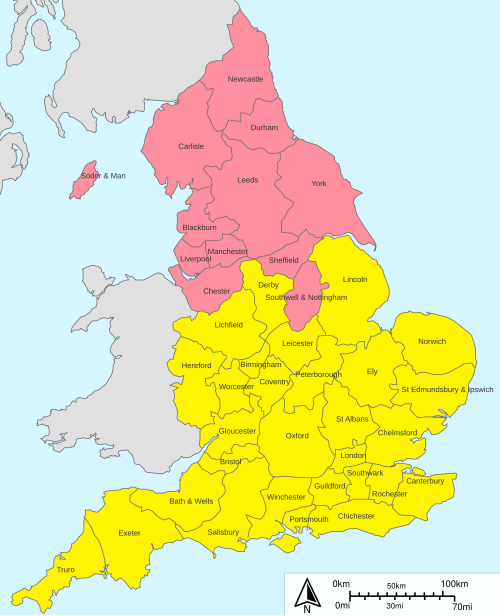
    Provinces of the Church of England. York in pink, Canterbury in yellow. Image courtesy of Wikimedia Commons

    At about the same time that the early church was developing, so were England’s seven Saxon kingdoms (established by the descendants of incomers from continental Europe from the 5th century onwards, who intermarried with the locals and whose culture became the dominant one in what was later to become England. Ed.) – otherwise known as the Heptarchy. Of these, one of the largest was Northumbria, whose capital was likewise York and whose southern boundaries extended from the Mersey estuary in the west to the Humber estuary in the east.
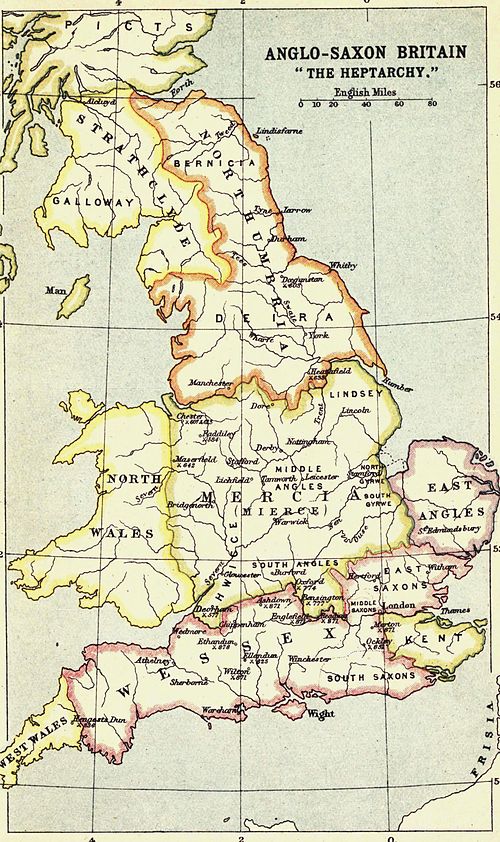
    The Heptarchy, Image courtesy of Wikimedia Commons

    However, other factors than ecclesiastical and administrative division need to be taken into account. These include the arrival and settlement of large parts of England with Norse speakers from the mid-ninth century onwards, ultimately resulting in the establishment of the Danelaw. The settlement of large numbers of Norse speakers also had a profound effect on the development of what became modern English, simplifying some of the more complicated syntax of Old English inherited from its Germanic roots, as well as enriching the language with such everyday nouns as egg and knife, plus adjectives like sly. Wikipedia has a list of English words of Norse origin, but your ‘umble scribe does not consider it complete as it has been reckoned that up to 3,000 modern English terms have their origins in Old Norse. But perhaps the most telling distinction is the difference in the origin of dialect words between the north and the south (e.g. the northern use of beck for a stream and in certain regions gan for go).

    The north-south divide also played a role in that most famous year in English history – 1066, involving as it did a fraternal dispute between the two sons of Godwin of Wessex, namely Harold (who some, particularly William of Normandy believed had usurped the English crown which he believed had been promised to him. Ed.) and Tostig, earl of Northumberland. As earl of Northumberland, Tostig governed with difficulty. He was never popular with the Northumbrian ruling class, a mix of Danish invaders and Anglo-Saxon survivors of the last Norse invasion. Tostig was said to have been heavy-handed with those who resisted his rule, including murdering several members of leading Northumbrian families. On 3rd October 1065, the thegns of York and the rest of Yorkshire descended on York and occupied the city. They killed Tostig’s officials and supporters, then declared Tostig outlawed for his unlawful actions. Shortly after, Kind Edward the Confessor exiled Tostig at the behest of his brother Harold.

    When Edward died and was succeeded by Harold, his rule was challenged by Tostig and Harald Hardrada of Norway, both of whom were killed at the Battle of Stamford Bridge on 25th September 1066. Hard on the heels of that encounter, Harold Godwinson himself lost the crown by being defeated by William (nicknamed both the Conqueror and the Bastard. Ed.) Duke of Normandy at Hastings on 14th October 1066.

    The Norman takeover of England was not wholeheartedly welcomed everywhere and more particularly he William faced a series of rebellions and border skirmishes in Dover, Exeter, Hereford, Nottingham, Durham, York and Peterborough. However, the biggest revolt came in the northern part of England and is generally know to history as the Harrying of the North. In 1086, twenty years after William the Bastard’s invasion and the battle of Hastings, his great survey of the country known as the Domesday Book lists many areas as being waste, i.e. unproductive land yielding no tax revenue, so great had been his retribution for the revolt against his rule.

    The fourteenth century is our next halt on this journey down the English north-south divide.

    In 1381 there was a popular uprising now known to history as the Peasants’ Revolt (although plenty of people other than peasants were involved. Ed.) occurred. Although the main events occurred in the south-east of England, particularly Essex, Kent and London, revolts and public unrest occurred in other parts of England too; and the north did not escape.

    Wikipedia records that:

    In the town of Beverley, violence broke out between the richer mercantile elite and the poorer townspeople during May. By the end of the month the rebels had taken power and replaced the former town administration with their own. The rebels attempted to enlist the support of Alexander Neville, the Archbishop of York, and in June forced the former town government to agree to arbitration through Neville. Peace was restored in June 1382 but tensions continued to simmer for many years.

    Hard on the heels of the events of 1381, 1395 was a pivotal year in English literary history with the appearance of Geoffrey Chaucer’s Canterbury Tales. Chaucer himself wrote (and probably spoke) in the East Midlands dialect which was prevalent in places such as London, Oxford and Cambridge, and was one of the most influential medieval English dialects in forming Modern English. However, he knew the Northern dialect too and it is spoken by the two northern clerks in the Reeve’s Tale.

    The tale concerns Symkyn, a miller of Trumpington near Cambridge. He overcharged the steward of Soler Hall (which later became part of Trinity College), the college steward was too ill to face him. Two clerical students there, John and Aleyn, originally from Strother in north east England (a place now lost in the historical and geographical record. Ed.), are outraged at this theft and vow to beat the miller at his own game. The north-eastern accent of the two clerks is also the earliest surviving attempt in English literature to record a dialect from an area other than that of the main writer and is believed to be the first effort in English to extract comedy from imitating accents.

    And that linguistic divide has existed since at least Chaucer’s time, with occasional low-level mutual disdain for the accents and dialects of north and south. One of my nieces – a Lancashire lass – did her degree in London. Whilst in London she was constantly told how northern she sounded; during visits back to the red rose county, the perceived loss of her accent and perceived adoption of southern speech were also remarked upon.

    Over the centuries distinct differences other than linguistic have also grown up. Take food for instance. Bury has long been regarded by many as the traditional home of black pudding, whilst London will always be associated with jellied eels. Pie lovers generally associate decent pies with the north (see Hairy Bikers. Ed.). Turning to music, London has the Royal College of Music; Manchester is home to the Royal Northern College of Music. On the sports field the north has long been the home of rugby league (13 players per side) whilst rugby union (15 per side) has long predominated in the south. Plenty of other examples in other fields are also available.
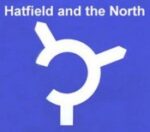
    Motorway style signage indicating roundabout exit for Hatfield and the NorthBefore drawing to an end, it’s worth noting that where the north and south of England both begin and end is not fixed. If one is on the M1 down near London, the motorway signage clearly indicates that the North begins beyond Hatfield in Hertfordshire. In contrast, my Mancunian friend Steve defines the start of the North as anywhere north of a horizontal line at Knutsford Services on the M6 in line with the general rule that the further north one goes, the further north the south begins.

    So, returning to and paraphrasing the PFJ’s Reg, apart from the sanitation, the medicine, education, wine, public order, irrigation, roads, a fresh water system and public health, did the Romans also give England its north-south divide? Have your say in the comments below.

  • It’s Pi Day

    Today is March 14th, or in the American system of time and date notation 3.14.

    the numbers 3, 1 and 4 just happen to be the first three numbers of Pi (π), a mathematical constant denoting the ratio of a circle’s circumference to its diameter.

    Pi Day was first celebrated in the United States after being founded in 1988 by the late Larry Shaw, formerly an employee of the Exploratorium science museum in San Francisco. Celebrations often involve either eating pie or holding Pi recitation competitions, or both.

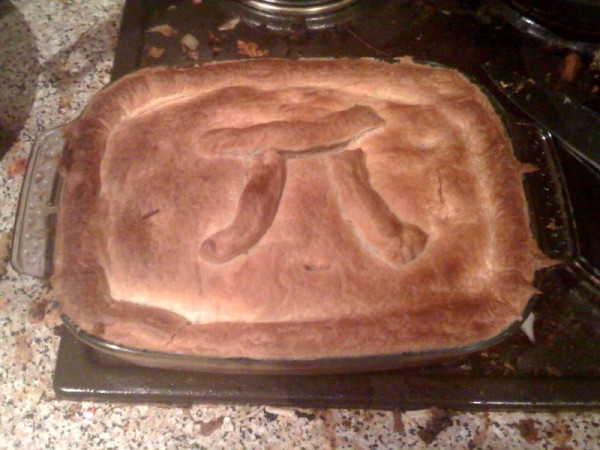
    Steak and ale pie complete with Pi
    A magnificent home-made Pi pie.
    Image courtesy of Wikimedia Commons

    Besides Pi Day, some people also celebrate Pi Approximation Day on 22nd July (22/7).

  • Pizza places to close in two non-existent counties

    According to Wikipedia, “A county is a type of officially recognized geographical division within a modern country, federal state, or province.”

    Within England shires were established in the Anglo-Saxon period, shires were established as areas used for the raising of taxes and usually had a fortified town at their centre. This became known as the shire town or later the county town. In many cases, the shires were named after their shire town (for example Bedfordshire).

    Middlesex is one of the thirty-nine historic counties of England. Its name is derived from its origin as a homeland for the Middle Saxons in the early Middle Ages, with the county subsequently part of that territory in the ninth or tenth century. As a county it managed to survive for the best part of a millennium, finally being abolished by the London Government Act 1963, which came into force on 1 April 1965.

    The cardboard county of Avon has a rather different history to the former shire named after the home of the Middle Saxons. It was a non-metropolitan and ceremonial county in the west of England which existed between 1974 and 1996. Named after the Bristol Avon, it comprised the cities of Bath and Bristol plus parts of south Gloucestershire and Somerset, which formed the other two local authorities – Northavon and Woodspring – within the county. Avon proved to be deeply unpopular, with locals bemoaning in some instances Bristol’s loss of county status in its own right, as well as traditional affiliations to both Gloucestershire and Somerset respectively. In 1996, the county was abolished and its administrative area split between four new unitary authorities: Bath and North East Somerset, Bristol, North Somerset and South Gloucestershire.

    Although both Middlesex and Avon have officially been abolished that does not mean their use has been discontinued, usually by the uninformed. There are still organisations out there which believe Bristol is part of Avon and that the county named after the Middle Saxons still exist. One of these is currently in the news.

    Pizza Hut logoOne of those organisations is Pizza Hut, which has announced a number of closures of its outlets in the Untied Kingdom, as reported by the Bristol Post/Live.

    All told, 68 Pizza Hut restaurants will close after the company behind its the US brand’s UK venues entered administration. These include the following five outlets in the aforementioned non-existent counties, as listed by Bristol’s paper of (warped) record:

    • Bristol, Avon;
    • Cribbs Causeway, Avon;
    • Enfield, Middlesex;
    • Feltham, Middlesex; and
    • Hayes, Middlesex.

    A few news outlets, such as the BBC, actually took the trouble to remove the erroneous county labels instead of blindly copying and pasting the list verbatim from the original press release.

    For those still in need of a junk food fix, plenty of other pizza outlets are still open to the public in both real and non-existent counties. 😀

  • Gourmet baked goods

    The story of baked pastry dough wrapped around is tasty filling is a long one. Sometime before 2000 BCE, a recipe for chicken pie was written on a tablet in Sumer – the earliest known civilisation – in southern Mesopotamia (now south-central Iraq. Ed.), according to Wikipedia.

    Moving forward a couple of millennia, the 1st century Roman cookbook Apicius includes several recipes involving a pie case.

    It would therefore seem evident humans have been munching pastry baked around a filling for at least two millennia.

    Coming right up to date, one of today’s largest producers of baked goods in the Untied Kingdom is Greggs, founded in the Gosforth area of Newcastle upon Tyne in 1939. From the 1970s onwards, Greggs embarked on a string of acquisitions and mergers. In June 2025 the chain had 2,649 outlets and also employs over 33,000 staff. Some items are only sold in particular regions, whilst the company also sells some of its products (e.g. bakes, melts and pasties) through the Iceland supermarket chain.

    As a mass market supplier, Greggs is frequently mocked for being down-market and this brings us neatly to humour and punning, a social media staple.

    Post reads 'What’s the matter babe? You've not even touched
your Gregg’s Benedict.'

    Greggs Benedict?

    Sounds delicious!

    However, there was once – but no longer – an actual Greggs Benedict available under a fine dining ‘experience’:

    For breakfast and brunch, don’t miss out on the “Greggs Benedict” – the Greggs Sausage, Bean and Cheese Melt reimagined with smoked ham, poached Cacklebean eggs and a velvety Hollandaise sauce. Our ‘Full English’ celebrates the icon that is the Greggs Sausage Roll alongside bacon, mushroom, tomato, baked beans and a choice of eggs – scrambled, poached or fried. The dish also comes as a vegetarian and vegan option.

    Bon appétit !

  • Golden Arches anthropophagism?

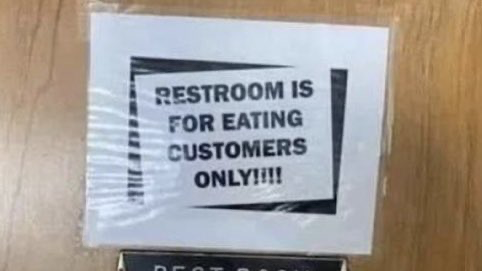
    The photograph below popped up in your ‘umble scribe’s social media feed this morning.

    Sign reads Restroom is for eating customers only!!!

    Judging by the use of the term restroom, the sign was apparently affixed to the door to the toilets of a fast food outlet somewhere in the USA, allegedly in a branch of junk food giant McDonalds, according to the original social media post.

    Note the three exclamation marks at the end of the phrase. One is usually sufficient.

    It is not known how long the chain itself – or indeed the United States as a nation – has permitted cannibalism either within or outwith toilet facilities, let alone endorsed the practice.

    One pertinent question springs to mind: “Do you want fries with that?

    Bon appétit !

    Just ignore the smell and the sound of running water…

  • All day?

    A crime against the English language appeared in my social media feed today. It loomed out of a photograph of part of the menu from an unidentified McDonald’s drive through somewhere in the United States.

    Menu for All Day Breakfast, but served ONLY UNTIL 1PM
    Dies irae* if you roll up at 1.01 pm?

    It centres on the use of the word day whose meaning for this context is provided by Merriam-Webster:

    “the time of light between one night and the next”.

    When combined with the words all and breakfast one would expect the fare proffered to be provided throughout the hours of daylight between sunrise and sunset; or at the very least to be available between the business’ opening and closing times.

    Not “ONLY UNTIL 1PM” as the menu shouts loudly.

    The picture seems to have been taken some while ago, as the price of eggs in the USA has rocketed due to avian influenza and Walmart is rationing egg purchases. The egg shortage has not gone unnoticed under the golden arches either: Newsweek reports a customer of a McDonald’s in Fairfield, Connecticut was charged $7.29 per Egg McMuffin and complained about it on social media.

    * = Day of wrath (usually divine. Ed.).

  • Two cities, two cuisines, one politics

    All cultures, countries and regions around the world have their own local cuisines, some indigenous, some introduced by incomers and yet others a mixture of the two.

    Also termed food cultures, your correspondent notes that food is often inextricably linked to politics as well as identity, as has been apparent in two separate examples from the cities of Bristol and Chicago.

    In your ‘umble scribe’s sixty-something years of existence, food in the Untied Kingdom (mis-spelling deliberate. Ed.) has changed beyond all recognition with dishes and tastes from right around the world become increasingly available. I well remember the curiosity and excitement when the first Chinese takeaway opened in my home town of Market Drayton in North Shropshire all those decades ago.

    Since those long gone days, takeaway food has become a staple in the British diet; and with the advent of delivery services such as JustEat and Deliveroo, customers can now order takeaways without having to rise from their sofas.

    In this post, your correspondent notes that in two separate cites – Bristol and Chicago.

    Bristol

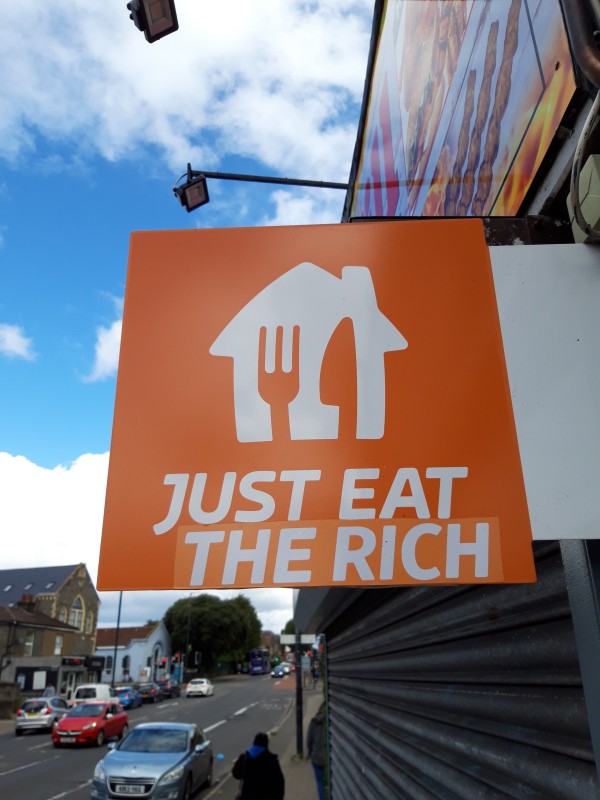
    First Bristol and a comment on the ephemeral nature of catering establishments despite everyone’s need for food and delivery services. The subvertising in the following photograph was spotted on the city’s Fishponds Road yesterday afternoon.

    Note how the subvertising has got the background colour of the original JustEat sign almost right, as well as matching the original font faithfully.

    Subvertised sign on disused takeaway now reading Just Eat The Rich

    As regards the phrase ‘Eat The Rich, your ‘umble scribe thought it was a modern phrase arising out of anarchist political thought in response to ever-increasing increasing wealth inequality and food insecurity. However, it actually goes back rather further.

    That rather further back takes us to the days of the Terror which followed the French revolution. On 17th October 1793, Pierre Gaspard Chaumette, President of the Paris Commune, gave a speech to the city in which he apocryphally remarked that the philosopher Jean-Jacques Rousseau said the following:

    Quand le peuple n’aura plus rien à manger, il mangera le riche.

    In English this translates to the following:

    When the people shall have nothing more to eat, they will eat the rich.
    Chicago

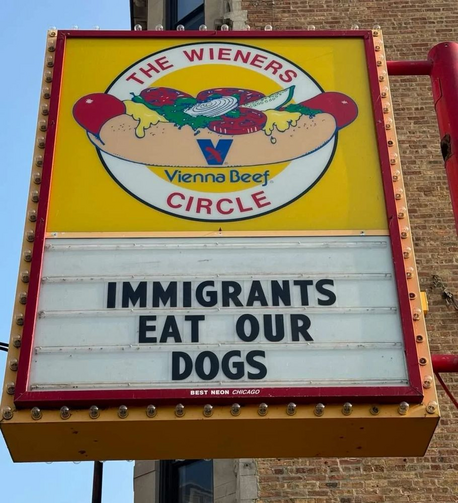
    Next to Chicago and more specifically The Wieners Circle, which describes itself as an ‘iconic hotdog stand on the north side of Chicago serving up high quality street food with a side of insults‘ [sic].

    The Chicago eatery has responded in feisty fashion to the unfounded assertion made by the disgraced former president, insurrectionist, convicted felon, adjudicated sexual predator, business fraudster, congenital liar and golf cheat, one Donald John Trump, that immigrants in Springfield, Ohio were eating residents’ pets during his recent televised debate with the Democrats presidential election candidate, Kamala Harris, as shown below.

    Illuminated sign for The Wieners Circle withe the addendum Immigrants eat our dogs

    Politics and food also have a long relationship. Back in 1798, Cartoonist James Gillray published ‘John Bull taking a Luncheon: – or – British Cooks, cramming Old Grumble-Gizzard, with Bonne-Chere‘ shortly after Nelson’s victory over the French at the Battle of the Nile. The strong link continues today as shown not only by these examples from Bristol and Chicago, but also by American Republicans renaming French fries ‘freedom fries‘ after French opposition to the 2003 Iraq war (cheese-eating surrender monkeys anyone? Ed.).

    Update 15/09/24: Trump has continued to make unsubstantiated claims about immigrants in Springfield to such an extent that his cult-like followers have targeted the Springfield’s city Hall and other buildings with bomb threats and a side serving of racial hatred.

  • Food and language

    Along with water, food is one of the essentials of life.

    Another of life’s essentials is language; it’s vital for communication and communal living in a social species such as ourselves.

    One of the elements of language is the adage, generally defined as something which people often say and which expresses a general truth about some aspect of life.

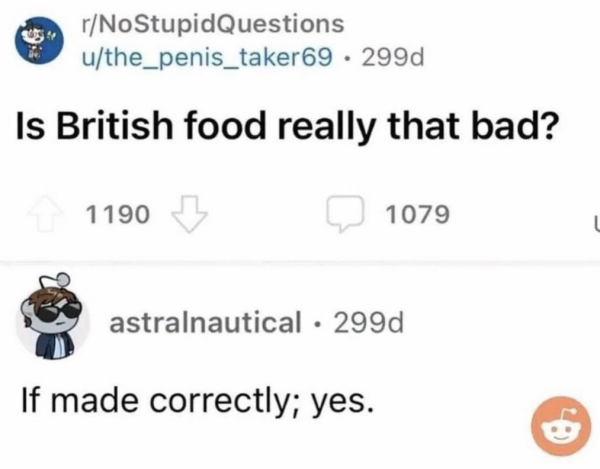
    In English one well-known adage is there’s many a true word spoken in jest, a propos of which the screenshot below turned up today in my social media feed.

    Conversation reads - Is British food really that bad? If made correctly; yes.

  • Happy retirement, Lesley!

    Regular readers will recall that the lovely community café at St Mark’s Baptist Church in Easton closed at the end of August (posts passim).

    Saturday last, 30th September, saw a retirement party for Lesley at the church. This was well attended by a broad range of people from Easton and beyond, all gathered to wish Lesley a happy retirement and partake of Lesley’s excellent cakes over which she’d laboured. These included not just church members, local traders, café users, foodbank volunteers and Abdul Malik from Easton Jamia Masjid, the mosque that faces the church across the street.

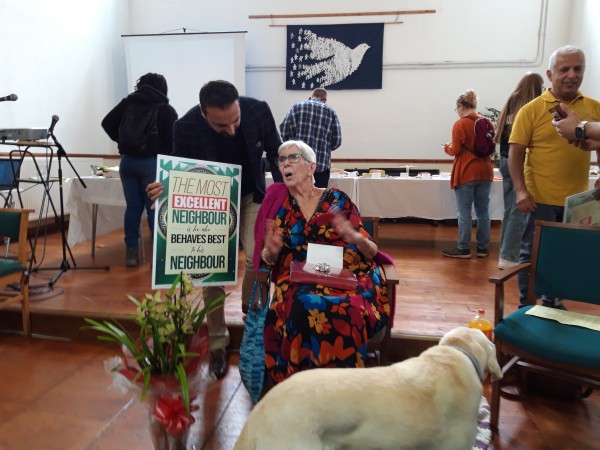
    Lesley with Abdul Malik from the church's close neighbour, from the mosque over the road.
    Lesley with Abdul Malik the church’s close neighbour, Easton Jamia Masjid.
    After a question and answer session with Lesley that covered the whole history of the café from its inception up to its closure in August, various people were invited out to the front, given a microphone and said a few words about the café, Lesley and so on. Abdul paid a great tribute (from what I could see wholly unscripted. Ed.) to Lesley and the collaboration between the chapel and mosque, particularly on large community events such as the Grand Iftar at the end of Ramadan.

    One of those invited to address the assembled throng was your ‘umble scribe, who was asked to read out his above-mentioned blog post, which was composed on the café’s final day and was received with general approbation.

    Lesley did drop some very serious hints that even though the café had now closed, that did not mean the end of catering activities for the community. Your correspondent will keep his ear to the ground and relay any information that comes to light.

    In the meantime, have a happy retirement, Lesley; and don’t be afraid to use your bus pass! 😉

  • A sad day in BS5

    Friday 25th August 2023 marked the end of an era and a sad day for Easton in Bristol. After 14 years of serving the public St Mark’s Community Café based at St Mark’s Baptist Church opened for the very last time after 14 years.

    Of the local media outlets, only the BBC appears to have covered this event, but gave it a very sympathetic write-up.

    Your ‘umble scribe has been going there 2 or 3 times a week for the past few years to enjoy baked potatoes, good cooking and the undisputed best cakes in all BS5, the latter baked by the remarkable Lesley, whose baking skills put my own late mother’s to shame (and that’s saying a lot, coming from a loyal eldest son!). My own particular favourites amongst her regular baked wares were farmhouse fruit, barra brith and anything with gooseberries or ginger. Furthermore, all the food served and the ingredients used to prepare it were ethically and locally sourced wherever possible.

    However, this was a café with a difference: paying customers like your correspondent meant that the homeless could eat there for free. Below is a short video with interviews of both customers and café staff/volunteers to give an idea of what has now entered the annals of local history.

    Although I’ll miss you all terribly, here’s wishing Lesley a happy retirement and I’d like to express my thanks to you, Nettie and all the café volunteers for keeping me fed over the years and being such wonderful people.

Posts navigation