Steve Woods

Written by a human.

  • Whitehall BS5 sends a message to Whitehall SW1

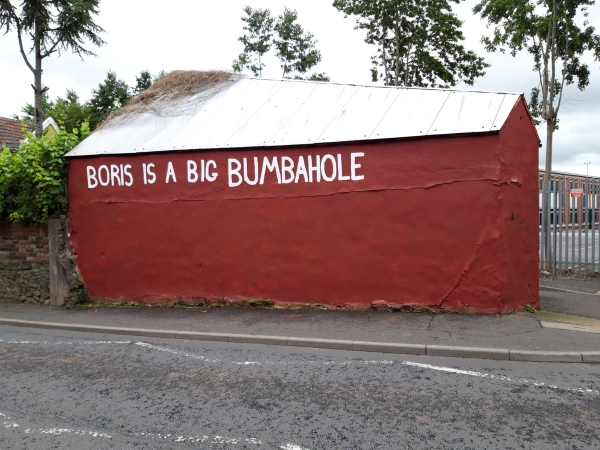
    This blog has written before about the changing messages that appear on a garage wall at the apex of the junction of Russelltown Avenue, Cannon Street and Whitehall Road (posts passim).

    The message has now changed again and reads as per the photo below.

    Text in photograph reads Boris is a big bumbahole

    According to Urban Dictionary, bumbahole is a synonym of arsehole in British English and asshole in American English.

    One can safely assume that the Boris being referenced is none other than the superannuated Billy Bunter-like figure of one certain Alexander Boris de Pfeffel Johnson, who has been inexplicably promoted beyond his competence to the office of Prime Minister of the English Empire, a job he fulfils to his own satisfaction on a part time basis.

    Among the less favourable characteristics of Bunter’s personality are gluttony, laziness, racism, deceit, sloth, self-importance and conceit, all of which have been extensively documented down the decades by others more eloquent than your ‘umble scribe (e.g. his former employer Max Hastings) as also being present in the part-time alleged prime minister’s character.

  • Estonia – government software is now public software

    Public Money Public Code logoThe Baltic Republic of Estonia has clearly taken note of the Free Software Foundation Europe’s Pubic Money Public Code campaign to have publicly funded software released as free software.
    Joinup,the EU’s news site for open source IT developments reports that the Estonian government decided to make all government software publicly available.

    The Estonian Parliament, the Riigikogu, approved the necessary changes to the Estonian State Property Act on 12 May 2021 and the the new rules came into effect on 1st June 2021.

    All software to which the Estonian state owns the property rights in whole or part shall henceforth ould be made available publicly. If only parts are owned by the state, those parts owned by the state will be made available.

    Under the new regulations, the authority in charge of the software shall decide if the software is to be made available and has to provide the following:

    • a description of the public software to be made available for use;
    • the conditions of use of the public software to be made available.

    However, there are some restrictions on the release of publicly-funded software to the pubic. For example, if such a release would be detrimental to the state, such as a potential threat to public order and national security or cybersecurity reasons, in which case the authority in question can refuse to make the software publicly available.

    With his move, Estonia joins other European countries such as Spain, Italy and France, which already publish most of government-owned software publicly

  • Boats grow legs

    Since the widespread dismissal from newsrooms of sub-editors, the very people who would have spotted and corrected any inaccuracies and/or anomalies, many more hidden exclusives are being reported nowadays by our free and inaccurate press, provided one knows where to look and reads carefully.

    Last week, the Shropshire Star had a hidden exclusive buried deeply in a piece on towpath repairs to the Shropshire Union Canal and local traders’ fear of loss of footfall in my home town of Market Drayton.

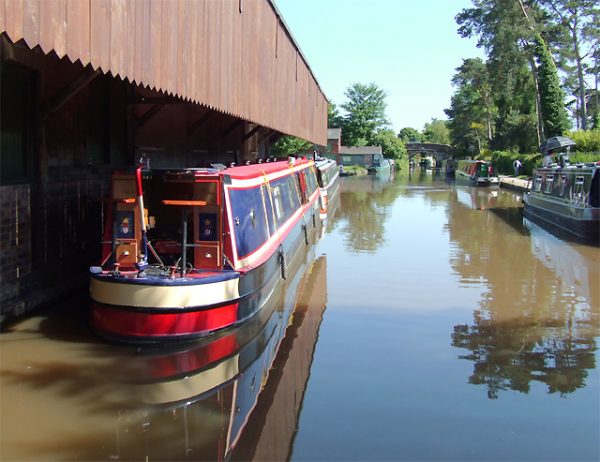
    Shropshire Union canal in Market Drayton
    Betton Mill on the Shropshire Union Canal in Market Drayton. Image courtesy of Wikimedia Commons.

    The Canal & River Trust, which manages the waterway, is planning to close the towpath through Market Drayton for repairs lasting two months. This will also entail a loss of moorings during the works.

    The fact that is has chosen do these works in the ten weeks from July 5 to September 10 hasn’t gone down too well with the director of one local boatyard, who is quoted as intimating that the closure would be a hammer blow to the summer trade, preventing visitors from mooring in the town and visiting shops and restaurants.

    In a quotation in the report, she said the following:

    It is basically the full length of the canal that goes through the town. Boats that would normally moor up and walk round the town, they won’t be able to do that.

    Boats that would normally moor up and walk around town?

    These two actions surely would be consecutive and not concurrent?

    When did boats evolve the means of locomotion to be able to walk round the town?

    Why have the national and international media not picked up the Star’s exclusive? After all, it is not every day that aquatic craft evolve enough to generate limbs.

    If you have an answer to any of the above questions, please leave them in the comments below. 😀

  • OpenStreetMap might move to EU member state

    OpenStreetMap is a great open source alternative to the commercial data slurping map services provided by technology giants such Microsoft (Bing) and Google.

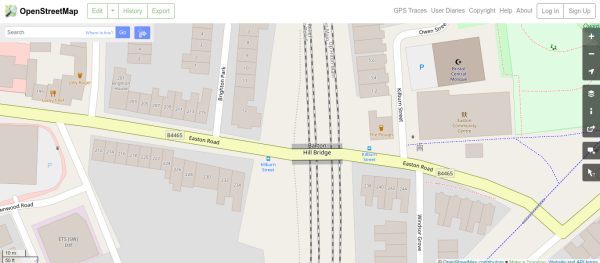
    OpenStreetMap view of part of East Bristol
    OpenStreetMap view of part of East Bristol

    At this point you might be wondering why your ‘umble scribe chooses to mention Brexit, the English Empire’s most stupid and damaging foreign policy decision since the 1956 Suez Crisis.

    Today’s Guardian announces that OpenStreetMap, which has been headquartered in the UK since its inception nearly 20 years ago, might be upping sticks and moving to a European member state very soon due to part-time alleged prime minister Boris Johnson’s pretend government taking back control and once again ostensibly becoming – in its mendacious words – an independent sovereign state. It’s such a pity the Blonde Bumbler’s kakistocracy doesn’t understand and never has understood the concept of pooled sovereignty.

    The OpenStreetMap Foundation, which was formally registered in 2006 – 2 years after the project began – is a limited company incorporated under the laws of England and Wales.

    Quoting an email from earlier this month, The Guardian quotes Guillaume Rischard, the Foundation’s treasurer, as saying the following

    There is not one reason for moving, but a multitude of paper cuts, most of which have been triggered or amplified by Brexit.

    One of these <empaper cuts is the failure of the Johnson régime and EU to agree on mutual recognition of database rights. While both have an agreement to recognise copyright protections, maps are data and fall outside the ambit of creative works. Until Brexit mapping were covered by an EU-wide agreement that protected databases, but since Brexit, there is no longer any mutual recognition and/or protection of any database made in the UK or EU on or after 1 January 2021.

    The Foundation’s other motives for moving from the UK include banking and payment concerns, plus the increased importance of the EU technology regulation matters.

    A statement issued by the Foundation includes the following:

    We are actively researching options to protect the OSM community’s interests, and one option under investigation is relocation to an EU member state. We have made no decisions so far.
  • GBeebies rinsed by Welsh soap

    The new right-wing TV channel GB News (affectionately known as GBeebies by some. Ed.) seems to be getting off to an even worse start than had been predicted.

    Today Nation Cymru reports that the channel is achieving worse viewing figures than some content on S4C, the Welsh language free-to-air television channel.

    The latest figures revealed that a maximum of only 32,000 tuned in on Thursday last week. whilst a mere 31,000 could be bothered to turn in for Chairman Andrew Neil’s own flagship show.

    No wonder he announced he was taking a break and flounced off back home to the south of, er, France.

    In particular, Nation Cymru notes that GBeebies’ viewing figures were lower than those of S4C shows such as the long-running Welsh language soap opera Pobol y Cwm, which attracts an audience of 44,000 viewers, according to S4C’s latest statistics.

    Pobol y cwm logo

    Moreover, there are other Welsh language shows produced by S4C that attract even higher figures, such as Patrol Pawennau (the Welsh language version of Paw Patrol. Ed.), which draws audiences of 161,000 people.

    With the channel being boycotted by advertisers, the amateurish broadcasting and technical expertise on display and Brillo scarpering back home to Grasse for an indefinite period, one might expect GBeebies’ days as a broadcaster to be numbered.

    Lovers of live disaster viewing had better get the popcorn in…

  • ODF 1.3 becomes OASIS standard

    ODF file iconVersion 1.3 of OpenDocument Format for Office Applications (ODF) has been approved as an OASIS Committee Standard, Italo Vignoli writes on The Document Foundation (TDF) blog.

    ODF is a free, open XML-based document file format for office applications for use for documents containing text, spreadsheets, charts and graphical elements. In addition,ODF is the native file format used by TDF’s free and open source LibreOffice productivity suite, as well as other free and open source suites such as Apache OpenOffice, whilst the format can also be handled by major proprietary office suites. Furthermore, ODF has been adopted by the UK government’s Open Standards Board for document exchange with citizens and other victims.

    ODF 1.3 is an update to the international standard Version 1.2, which was approved by the International Organization for Standardization (ISO) as ISO/IEC 26300 (2015). The update was approved with 14 affirmative consents and no objections.

    The most important new features of ODF 1.3 include digital signatures for documents and the OpenPGP-based encryption of XML documents, with improvements in areas such as change tracking and document security, additional details in the description of elements in first pages, text, numbers and charts.

    The full ODF 1.3 Specification can be downloaded from OASIS website.

    The new version of ODF has been funded by TDF.

    Finally, it is hoped that the new ODF 1.3 will complete the process to update its existing ISO/IEC standard 26300 in early 2022.

  • How the forget-me-not got its name

    Forget-me-nots (Myosotis) are a genus of flowering plants. The name Myosotis derives from the ancient Greek μυοσωτίς meaning mouse’s ear, which the leaves are said to resemble.

    According to its English Wikipedia page, the colloquial English name of forget-me-not has been in use since the late 14th century and is a direct translation from the German Vergißmeinnicht.

    Photo of forget-me-nots
    Myosotis. Image courtesy of Wikimedia Commons.

    However, it is to the French Wikipedia article on the foget-me-not that one needs to turn for the presumed origins of this commemorative colloquial plant name.

    According to one legend, a knight was walking by a river with his lady. He bent over to pick her a flower, but toppled over due to his armour and fell into the water. While he was drowning, he tossed the flower towards her crying out “Forget me not!”

    It goes without saying that the legend fails to explain why the hapless knight felt the need to don his armour for what was ostensibly a safe situation. No health and safety risk assessments or technical standards for PPE in those days!

    Talking of risky situations, the forget-me-not has become a flower of remembrance in the Canadian provinces of Newfoundland and Labrador where it is used to commemorate those who were killed in the First World War.

    Similarly in Germany the forget-me-not became a flower of remembrance for those who fell in conflict from WW1 onwards.

    In other countries, the forget-me-not has assumed a different commemorative function, one dealing with those suffering from Alzheimer’s disease and dementia, as happens in the Netherlands and New Zealand.

  • Writer of children’s books

    Yesterday, the right-leaning part of the population who seem to believe that culture as they know it is in danger of being cancelled (whatever that may mean. Ed.), was fulminating against yet another of those left-leaning organisations – English Heritage. Its crime: amending its online information about the children’s author Enid Blyton to reflect more accurately her writing and views.

    While English Heritage’s blue plaque commemorating Blyton remains unchanged, the charity’s online information about her now details the problematic aspects of her writing and views.

    In particular, the information on Blyton has been amended to describe her writing as including racism and xenophobia whilst lacking literary merit.

    To illustrate Blyton’s racism, English Heritage’s online content notes that in 1960 Macmillan refused to publish Blyton’s children’s novel The Mystery That Never Was, noting her “faint but unattractive touch of old-fashioned xenophobia”. As a child, I can’t say I remember noticing the racism and xenophobia so much on the very rare occasions I picked up Blyton as a child (the golliwogs should have started the alarm bells ringing. Ed.), but the lack of literary merit was clearly apparent to my developing brain. Her work came across as simplistic and formulaic, but my brother loved her stories, a matter in which he persisted despite the mocking and urging from my sister and me that he read something less lightweight.

    Although she did not specifically mention Blyton by name, it was clear that actor and comedian Joyce Grenfell clearly had Enid in her sights in her monologue Writer Of Children’s Books, as embedded below.

  • Electrifying

    One of the staples of local news reporting is the activities of the emergency services – police, ambulance, coastguard, fire service – and in this regard Bristol Live – formerly the Bristol (Evening) Post is no exception.

    Yesterday’s online edition reported on the fire service’s attendance at a possible incident on Colston Street (soon to revert to its original name of Steep Street after the city’s Victorian great and good renamed it after a slave trader. Ed.).

    However, once again the reporter’s poor English is disappointing to read.

    In the second paragraph readers are informed that

    The alarm was sounded after what was believed to be an electric fire in Colston Street at around 8.22pm.

    Where was the said domestic appliance left? In the roadway? On the footway/pavement?

    Clarification was helpfully supplied by the fire service, whose spokesperson commented as follows:

    Upon investigation, the issue was determined to be under the pavement and originating from an area of recently excavated electrical works.

    So the fire, if it ever existed in the first place, was electrical, not electric.

    As an aid to passing hacks wishing to improve their vocabulary, there follows below a handy pictorial guide to the difference between the two. 😀

    An electrical fire
    An electrical fire. Image courtesy of Wikimedia Commons.
    Electric fire
    An electric fire (aka electric heater). Image courtesy of Wikimedia Commons.
Posts navigation