19 years of KDE
KDE, one of the two best-used Linux desktop environments along with GNOME, will be celebrating 20 years since its first release.
In anticipation of this, here’s a recent video from autumn 2015 charting KDE’s progress to date.
KDE, one of the two best-used Linux desktop environments along with GNOME, will be celebrating 20 years since its first release.
In anticipation of this, here’s a recent video from autumn 2015 charting KDE’s progress to date.
As a fitting end to Bristol’s year as European Green Capital, Mayor George Ferguson has won the Greenwash Award in Private Eye’s Rotten Boroughs awards for 2015.
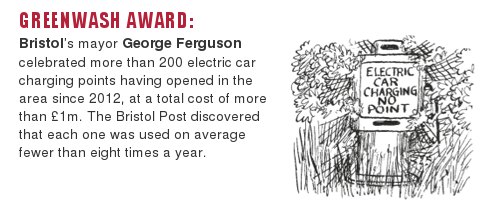
From your correspondent’s vantage point in the inner city, it has to be said that Bristol’s year as Europe’s beacon of best environmental practice has hardly been crowned with glory, with money wasted on pointless art projects, widespread wildlife habitat destruction and the continuing blight of fly-tipping.
Will George Ferguson be collecting his award in person from Lord Gnome? 😉
Only a couple of days after hearing of the creation of a giant statue of Mao Zedong (posts passim), reports have been received that the statue of the so-called Great Helmsman in Henan province has been destroyed.
Pictures such as the one below have been posted on Chinese social media.

The statue’s hands, legs and feet appear to have been hacked off and a black cloth draped over its head.
According to an unnamed local delivery driver, it was destroyed because it had occupied a farmer’s land.
This destruction brings to mind the traditional farmer’s challenge to trespassers: “Get off my land!” 🙂
Another reason for the destruction could be that Henan province was one of the regions worst hit by China’s great famine, a catastrophe that claimed tens of millions of lives that was caused by Mao’s disastrous “Great Leap Forward” – a bid for rapid industrialisation.
The official Chinese line is that the statue had not gone through the correct approval process before construction, according to The People’s Daily.
News emerged today in the British national press of a 36-metre tall statue of the late Chinese leader Mao Zedong being built in a village in China. Here’s The Guardian’s report of this story as an example.
The statue of the so-called “Great Helmsman” is being constructed at Zhushigang village in Tongxu County in Henan Province.
It is reported to be costing some RMB 3 mn. (approx. £312,000). The materials used in its construction are steel and concrete, with the exterior being coated in gold paint.

Reading about the statue and thinking about its future, not to mention what has happened to statues of past powerful leaders (particularly dictators. Ed.) around the world, Percy Bysshe Shelley‘s 1818 sonnet, Ozymandias came to mind.
I met a traveller from an antique land,
Who said—”Two vast and trunkless legs of stone
Stand in the desert. . . . Near them, on the sand,
Half sunk a shattered visage lies, whose frown,
And wrinkled lip, and sneer of cold command,
Tell that its sculptor well those passions read
Which yet survive, stamped on these lifeless things,
The hand that mocked them, and the heart that fed;
And on the pedestal, these words appear:
My name is Ozymandias, King of Kings;
Look on my Works, ye Mighty, and despair!
Nothing beside remains. Round the decay
Of that colossal Wreck, boundless and bare
The lone and level sands stretch far away.”
In antiquity, Ozymandias was a Greek name for the ancient Egyptian pharaoh Ramesses II. Shelley began writing Ozymandias soon after the announcement of the British Museum’s acquisition of a large fragment of a statue of Ramesses II from the thirteenth century BC, leading some scholars to believe that this had inspired Shelley.
In more modern times, Mao’s record is chequered. His supporters credit him with driving imperialism out of China, modernising the country and building it into a world power, promoting the status of women, improving education and health care, as well as increasing life expectancy as China’s population grew from around 550 million to over 900 million during his leadership. Mao is also known as a theorist, military strategist, poet and visionary.
On the other hand, his critics consider him a dictator comparable to both Hitler and Stalin who severely damaged traditional Chinese culture, as well as being a perpetrator of systematic human rights abuses who was responsible for an estimated 40 to 70 million deaths through starvation, forced labour and executions.
Look upon my works and despair indeed!
Today’s Guardian reports that the Home Office has postponed its plans to cut the pay of more than 2,000 interpreters from 1st January 2016. This comes in the wake of a threatened boycott from Home Office interpreters (posts passim), which could cause chaos in the running of the UK’s immigration system.
According to The Guardian, the Home Office has confirmed that any plans to cut pay will be deferred at least until February while negotiations with the interpreters take place. Considering that Home Office interpreters have not had a pay rise since 2002 (they get a basic £16/hr. on weekdays and slightly more at weekends. Ed.) and the Home Office’s desire to cut what is already fairly meagre pay do not bode well for those negotiations.
A meeting lasting more than two hours took place between interpreters and the Home Office on 21st December. At the meeting, Home Office civil servants warned the interpreters against speaking to the media in a blatant disregard of the interpreters’ rights under Article 10 of the Human Rights Act 1998. A further meeting between the Home Office and interpreters is planned for the middle of January.
The Home Office stated as follows after the 21st December meeting: “Following our meeting with the interpreters on 21st December, we intend to defer implementation of this change at least until 1st February 2016 to allow us time to give proper considerations to the views and opinions expressed.”
Given the government’s arrogant refusal to listen to anyone besides its donors and beneficiaries, it looks like the next linguistic sacrifices on Whitehall’s altar of austerity will be Home Office interpreters, following on from the Ministry of Justice’s interpreters, the overwhelming majority of whom refused to work for the abysmal rates offered by Capita Translation & Interpreting (posts passim) and have been boycotting court and tribunal work for the last couple of years.
Now that Christmas is just about out of the way for another year, the great speculation amongst Britain’s shoppers will be how soon into the New Year will Easter eggs appear on supermarket shelves. The customary 3 months as with all that Christmas tat? We’ll just have to wait and see.
As a user of free and open source software, I’ve had an early – or late – Easter egg already courtesy of the VLC media player, as shown below.

Unless you’re familiar with the language of tech aficionados, the previous statement and accompanying screenshot are probably incomprehensible.
In software an Easter egg is defined as “an intentional inside joke, hidden message, or feature in an interactive work such as a computer program, video game or DVD menu screen. The name has been said to evoke the idea of a traditional Easter egg hunt“.
One of the first occurrences of what are now known as Easter eggs appeared in the Atari video game Adventure, having been planted there by computer game developer Warren Robinett. It wasn’t too fancy or interesting, just a hidden object planted in the game that led to a screen that said “Created by Warren Robinett.” The developer had buried this object within the game code as Atari didn’t credit its games developers at the time.
Anyway, returning to the screenshot above, the Santa hat on the VLC program logo (the traffic cone in the middle of the window. Ed.) appears each year for the Christmas holiday period only; for the rest of the year, the logo is hatless.
Besides VLC, some well-known and widely used applications have also contained Easter eggs. For instance, Easter eggs in the 1997 version of Microsoft Office include a hidden flight simulator in Microsoft Excel and a pinball game in Microsoft Word, whilst on all Microsoft Windows operating systems before XP, entering the text “volcano” in the 3D Text screen saver will display the names of all the volcanoes in the United States. Microsoft removed this Easter egg in XP but added others. Microsoft Excel 95 contained a hidden Doom-like action game called The Hall of Tortured Souls.
Turning away from Microsoft, Apple is also not immune from Easter eggs. In 2012 an update to the Mac App Store for OS X Mountain Lion introduced an Easter egg in which apps, during the download process, were timestamped “January 24, 1984,” the date the original Macintosh went on sale. However, Easter eggs were not popular with Apple’s founder, the late Steve Jobs, who went through bouts of banning them.
In addition to being sophisticated and/or laden with deep significance, some Easter eggs can be very simple and bereft of any meaning, merely reflecting the playful personality of their creators. Here’s a prime example from the GNU/Linux apt-get command line tool used for managing software packages. Typing the command apt-get moo results in something similar to the following screenshot.

Anyway, I’m enjoying my festive Easter egg and I hope it’s not too late to wish all readers and visitors to this site the compliments of the season.
 The Internet Engineering Task Force (IETF) has as its mission “to make the internet work better by producing high quality, relevant technical documents that influence the way people design, use, and manage the Internet“.
As part of this work, the IETF develops and promotes voluntary Internet standards, in particular the standards that comprise the Internet protocol suite (TCP/IP).
These standards include HTTP status codes, which are derived from both IETF internet standards, IETF RFCs other specifications and some additional commonly used codes.
The IETF’s HTTP Working Group has recently published a draft RFC proposing a new HTTP status code – status code 451 – for use when resource access is denied as a consequence of legal demands.
The draft’s introduction gives the rationale for the proposal:
This document specifies a Hypertext Transfer Protocol (HTTP) status code for use when a server operator has received a legal demand to deny access to a resource or to a set of resources which includes the requested resource.
This status code can be used to provide transparency in circumstances where issues of law or public policy affect server operations. This transparency may be beneficial both to these operators and to end users.
Getting into detail, the draft states that responses using this status code should include an explanation in the response body of the details of the legal demand, i.e. the party making it, the applicable legislation or regulation and the classes of person and resource to which it applies.
The use of the 451 status code implies neither the existence nor non-existence of the resource named in the request. That is to say, it is possible that if the legal demands were removed, a request for the resource still might not succeed.
The draft also gives an example of status code 451 in action.
HTTP/1.1 451 Unavailable For Legal Reasons
Link: <https://spqr.example.org/legislatione>; rel=”blocked-by”
Content-Type: text/html
<html>
<head><title>Unavailable For Legal Reasons</title></head>
<body>
<h1>Unavailable For Legal Reasons</h1>
<p>This request may not be serviced in the Roman Province
of Judea due to the Lex Julia Majestatis, which disallows
access to resources hosted on servers deemed to be
operated by the People’s Front of Judea.</p>
</body>
</html>
For those unfamiliar with the People’s Front of Judea, here’s some background information. 🙂
One of the reasons behind the proposal is that existing status code 403 (Forbidden) was not really suitable for situations where legal demands mean access to resources is denied.
Comments on the draft will be received until 13th May 2016.
The numbering of the status code pays homage to science fiction author Ray Bradbury‘s 1953 dystopian novel, Fahrenheit 451.
 Professional Interpreters for Justice (PI4J), the umbrella group representing over 2,200 NRPSI registered and qualified interpreters working in 135 languages, has written to the Home Office’s Central Interpreters Unit in Liverpool regarding the proposed pay cut for Home Office interpreters which is due to come into effect on 1st January 2016 (posts passim).
The text of PI4J’s letter is reproduced below.
Central Interpreters Unit
Interpreter Operations Unit
UK Visas & Immigration
The Capital
New Hall Place
Liverpool
L3 9PPBy Email: CIU@homeoffice.gsi.gov.uk
21 December 2015
Dear Sir/Madam,
Re: Introduction of reduced rates of Home Office interpreters’ pay from 1st January 2016
Professional Interpreters for Justice (PI4J) is an umbrella group representing over 2,240 interpreters
from both the National Register of Public Service Interpreters (NRPSI) and the National Union of British Sign Language Interpreters (NUBSLI). Our aim is to work with government to ensure the quality of interpreting available to the Justice System and in the Public Sector.Reliable communication provided by qualified professional interpreters and translators is an essential resource which ensures that justice and human rights are upheld for non-English speakers and deaf people. This is put at risk if standards are dropped and quality is sacrificed.
On 20th November 2015 interpreters received a notice regarding a reduction in rates to due to take place on all bookings undertaken on behalf of the Home Office (HO), including UK Visas & Immigration, Border Force, Immigration Enforcement and HM Passport Office and any other bookings made through Interpreter Operations Unit, from 1st January 2016 onwards.
PI4J is extremely concerned about this decision to slash interpreters’ rates of pay, without any
consultation with or input from interpreters and their representative bodies.This decision will most certainly have serious implications for the supply of competent, qualified professional interpreters to the Home Office. These interpreters have provided ongoing linguistic support and expertise to the Home Office over the years, including in many rare and hard-to-find languages.
Interpreters have demonstrated in the last four years that they can and will refuse to work for low rates set by so-called ‘market forces’, thereby significantly reducing the pool of qualified interpreters and translators available to work in the public services.
This is evidenced by the detrimental decline within the Ministry of Justice’s Court Interpreting Service since they outsourced to a private agency in 2012. We assume that you are aware of the extensive coverage in the media regarding the subsequent disruption and chaos visited upon the courts and the delays and collapse of court cases, resulting in an enormous waste of time and money and two Parliamentary hearings (see below links).
PI4J has been at the forefront of the professional interpreters’ campaign against the unacceptable lowering of standards and quality in public service.
The standard of interpretation is fundamental to allow access to a fair hearing and justice for vulnerable minorities in the asylum and immigration system and to assist enforcement agencies in the prevention and detection of serious crime. They must be afforded equal access to the highest levels of linguistic support.
Standards must include minimum professional qualifications for Public Service Interpreters (PSI) and BSL/English Interpreters, Deaf interpreters and Sign Language translators, to include mandatory NRPSI/NRCPD/SASLI registration and independent regulation.
Without these safeguards, access to justice will be denied and human rights and race relations will be jeopardised.
In addition, we reiterate that in order to attract and retain qualified and experienced professional interpreters and language professionals, equitable and sustainable terms and conditions need to be put in place.
Professional interpreters invest substantial time, effort and money to gain and maintain their skills. The proposed cut means that Home Office interpreting work will become part of the low-paying industries.
It is important to point out that there has not been an increase in the Home Office interpreting rates for many years now. They were further eroded by inflation and the growing cost of living in the UK, especially in areas such as London. In addition, failure to provide reimbursement for travel time under 3 hours each way and travel expenses up to 100 miles, particularly in view of the remote locations of many of the Home Office and detainee centres, make the rates even more unattractive.
Remuneration must reflect the fact that these are gross hourly rates for self-employed interpreters, liable to pay Income Tax and National Insurance, who have no pension, holiday or sick pay, and no job security.
The impact of the cuts places interpreters’ livelihoods at risk and will mean that public service interpreting will no longer be a viable career. As skilled professionals they will seek to earn a better living in other sectors.
This in turn will result in reduced quality of language services and a back-log to a system which is already struggling.
Full support of professional interpreters and appropriate terms & conditions is the only way forward to ensure the quality and success of any future arrangements for the provision of language services in the public service sectors and to avoid a market exit.
In the interest of all involved and the system itself, we urge you to reconsider this troubling and counterproductive decision.
Yours faithfully,
Klasiena Slaney
For and on behalf of the Professional Interpreters for JusticeProfessional Interpreters for Justice (PI4J) Member Organisations:
Association of Police and Court Interpreters (APCI) – chairman@apciinterpreters.org.uk
Cymdeithas Cyfieithwyr Cymru; (CCC) – geraint@cyfieithwyrcymru.org.uk
Institute of Translation and Interpreting (ITI) – chiefexec@iti.org.uk
National Register of Public Service Interpreters (NRPSI) – chairman@nrpsi.org.uk
National Union of Professional Interpreters and Translators, part of Unite the Union (NUPIT)
– nupit@unitetheunion.org
National Union of British Sign Language Interpreters part of Unite the Union (NUBSLI)
– branchsecretary@nubsli.com
Society of Official Metropolitan Interpreters UK Ltd (SOMI) – board@somiukltd.com
The Chartered Institute of Linguists (CIOL) – keith.moffitt@ciol.org.ukLinks:
Professional Interpreters for Justice (PI4J), includes links to Parliamentary hearings and dossiers of failings
RPSI Linguist Lounge and Professional Interpreters’ Alliance, collected news reports about the outsourcing of public service interpreting in the UK
National Register of Public Service Interpreters (NRPSI)
National Registers of Communication Professionals working with Deaf and Deafblind People (NRCPD)
Scottish body for training and qualifying British Sign Language interpreters (SASLI)
National Union of British Sign Language Interpreters (NUBSLI)
The leaders of the Fair Payment Campaign for Home Office Interpreters have issued the statement below in response to the Home Office’s plan to cut their pay with effect from 1st January 2016 (posts passim). The statement originally appeared on Linguist Lounge.
The Fair Payment Campaign for Home Office Interpreters resulted from a notice they received in November 2015 in relation to a reduction in rates due to take place on all bookings undertaken on behalf of the Home Office, including UK Visas & Immigration, Border Force, Immigration Enforcement and HM Passport Office and any other bookings made through Interpreter Operations Unit, from 1st January 2016 onwards.
Professional qualified Home Office interpreters are standing up against the proposed cuts to our already meagre fees which have been unchanged in at least 13 years. While cuts are being proposed, we contend that we have in fact been subsidising the Home Office over the years by the lack of increase in our fees.
Many interpreters and their supporters have already written to the Home Office Central Interpreters’ Unit expressing their dismay and opposition to these cuts in rates which were already much eroded through inflation, and mean that it will no longer be feasible for them to continue working in this field.
This will result in a diminishing pool of qualified, experienced and vetted interpreters for the Home Office, detrimental both to them but especially so to the great number of vulnerable people who depend on reliable interpreting services to put their cases across since they are unable to do so themselves. Their lives may be at stake. The right to a fair hearing is enshrined in international human rights law.
As a result of our letters and petition, campaign leaders have been invited to meet with CIU senior managers on Monday 21st December 2015. We shall keep colleagues updated as to the outcome of that meeting.
We shall be listening to what they say, re-iterating the contents of our petition letter and also making a point to stand firm on those points.
We have it on good authority that the strength and unity of our campaign stands us in good stead: our unity is our strength.
We shall capitalise on this fact and we must not forget the fiasco with the Ministry of Justice outsourcing of Court Interpreting Services to a private agency in 2012, which resulted in many qualified interpreters declining to continue working in that sector and consequently the lowering of standards and quality of services, causing the delay and collapse of many court cases, as can be verified by the extensive media coverage about this matter which can be found on this Linguist Lounge.
We have collected hundreds of signatures and many interpreters are still contacting us to join the Campaign.
We have the support of non-Home Office interpreters, translators and non-linguists. Some of these supporters have also written to CIU about their dismay, disappointment and disgust at what is being proposed.
The Fair Payment Campaign for Home Office Interpreters also has a social media presence on both Twitter and Facebook.
 In the never-ending austerity drive, the government is now threatening to cut funding to Routes into Languages, a vital resource for language learning in the UK.
Language learning in the UK has lagged behind other countries – particularly other EU member states – for as long as I can remember and looks likely to get worse if this latest funding cut goes through.
A petition has been organised on the UK Government and Parliament petition website. The petition’s text reads as follows:
Routes into Languages (RiL) works with schools and colleges to promote language learning. It works with teachers to develop and roll out innovative projects such as Mother Tongue Other Tongue and the Foreign Language Spelling Bee which benefit students and motivate them to learn languages.
Routes into Languages has worked tirelessly across the country to develop a range of regional and national networks to support schools and teachers to be innovative, raise students’ aspirations and make the case for language learning.
To lose this resource would be devastating, the RiL Spelling Bee alone involved 77,000 Year 7 students last year and this is only one example of the work that Routes does to offer free opportunities to all schools.
Please sign the petition to change this decision.
At the time I signed, some 6,000 signatures had been added to the petition.