This morning on my walk from home in Easton to the Bristol Wireless lab in Bedminster, my eye was caught by blackthorn blossom standing out white against the blue sky.
Blackthorn blossom in Lawford’s Gate, Bristol
Blackthorn (prunus spinosa) derives its name from its thorny nature and its very dark bark.
As its Latin name denotes, it is a member of the plum family. Its fruits – sloes – are well known for their bitterness, unless picked after they’ve been bletted, i.e. attacked by autumn frosts. Their best-known use is for making sloe gin.
Sloes. Note the thorns. Image courtesy of Wikimedia Commons
The modern English word sloe comes from the Old English slāh. The same word is noted in Middle Low German, historically spoken in Lower Saxony. Similar words are found in other languages with Teutonic roots.
With its savage thorns, blackthorn has traditionally been used for making a hedge against cattle or a “cattle-proof” hedge.
Bristol has a long and proud history stretching back beyond Saxon times.
However, it also has a slightly shorter and not so proud history of allowing important heritage and buildings of historical interest to disappear under the demolition contractor’s wrecking ball, particularly in East Bristol, long treated with contempt by the city fathers.
This contempt for the heritage of East Bristol has been eloquently illustrated in recent times.
First there was the loss some 10 months ago of the fine Victorian school in Avonvale Road (posts passim). With the connivance of Bristol City Council, this was sacrificed on the altar of bland modern architecture sponsored by the academy schools programme.
The loss of Avonvale Road school was followed just one month later by the demolition of Ebenezer Chapel in Midland Road, the last non-conformist chapel in that part of the city and a rare example of a Romanesque style chapel (posts passim) in contrast to the more usual Gothic style. The site of the Ebenezer Chapel is now occupied by a bland, modern block of flats.
A third important building in East Bristol is now under threat of demolition by its owners, the Homes & Communities Agency, who in my opinion don’t know what a treasure they’ve got in their property portfolio. It’s on the left in the photo below.
The old ambulance station site in Tower Hill. Photo used by kind permission of Chris Brown
What the picture shows is the site of Bristol’s old ambulance station in Tower Hill. The tracked vehicle on the right is sitting atop the remains of the uninspiring 1960s building forming part of the station complex. The most interesting part of the site is the stone building on the left.
That building dates from circa 1860 and was originally the parish school in Marybush Lane built for St. Philip and St. Jacob Church. It was designed by eminent Victorian architect and designer E.W. Godwin, a local boy whose best-known building is Northampton’s Guildhall. Godwin was born Old Market Street in 1833 and is believed to have attended St. Philip and St. Jacob as a worshipper. Locally Godwin also designed the grade II*-listed Carriageworks building on Stokes Croft, an early example of the Bristol Byzantine style.
The Victorian Society is calling on the Mayor of Bristol, George Ferguson, to step in to save the former school, which has been refused spot listing, despite its local historical importance. The Victorian Society’s Conservation Adviser, Sarah Caradec, said: “Bristol should take this last minute opportunity to save this early example of Godwin’s work in the area he was born and brought up in. Far too many examples of Godwin’s work have already been lost. Although English Heritage rejected an application to spot list the building, it recognised its strong local interest as an early Godwin building, as well as its group value with the associated Grade II*-listed Church of St Philip and St Jacob, which were restored by Godwin in the 1860s. We urge the Mayor of Bristol to recognise the building’s value and act now to ensure that the HCA build around it.”
It’s not just the connection with Godwin that makes the old school valuable. If it disappears beneath the wrecking ball, an important part of Bristol’s working class history will also be lost.
During the harsh economic times of the 1930s when millions were out of work, the Bristol branch of the National Unemployed Workers Movement (NUWM) held its meetings at the school. Bristol Radical History Group has material related to the activities of NUWM in Bristol, whilst the excellent BRH publication Bread or Batons?, written by Dave Backwith and Roger Ball, can be purchased from Hydra Books in Old Market Street.
Today this blog can reveal exclusively that the much-maligned Bristol Post has discovered time travel. This was shown by an item published today, 20th March, entitled “Seven things to do in Bristol tomorrow, March 17“.
I’m now waiting for the follow-up article from the Post detailing how I can travel back in time to do those aforementioned seven things. 🙂
A week ago yesterday, there was a meeting of the TidyBS5 task force with council officers and Councillor Marg Hickman at the offices of Up Our Street.
It was a good opportunity for the officers to update community volunteers on what the council has done, is and will be doing.
Jane Street in Redfield earlier today
For Stapleton Road a deep clean is planned for this year; this will mean giving the footways a thoroughly good scrub and removing chewing gum from their surfaces. In addition, hanging baskets will be provided on approx. 30 lamp posts to help make the street a bit more colourful and attractive.
The city council’s streetscene enforcement team has now moved into the area and has already had some success: 5 traders have been issued with £300 fixed penalty notices for abusing the communal bins intended for household waste only. In addition, some minor offenders have been fined smaller amounts.
Turning to communal bins, task force members have been invited to assist in devising the communal bins consultation that the council is organising for the Stapleton Road corridor. Two task force members, Hannah and myself, informed officers that we were monitoring clearance times after fly-tipping had been reported. From my own monitoring since then, communal bins seem to be implicated in some 60% of sites notified to the council.
After the update from the offices, it was pointed out to them that, while all this attention being lavished on the Stapleton Road area was appreciated, it should not detract from equally bad problems along the Lawrence Hill/Church Road corridor, home to the infamous Jane Street (see above).
During my discussion on social media with BCC’s Chief Enterprise Architect Gavin Beckett about open standards (posts passim), he invited me to submit feedback on using the council website; this will be done from the aspect of reporting street cleaning matters, where the website still has a couple of interesting foibles.
Up Our Street is organising a community litter pick on Saturday 28th March from 11 am to 1 pm. Volunteers are asked to assemble at Lawrence Hill roundabout (map). For more details, contact Lorena on 0117 954 2835.
Dog fouling is one of the banes of modern life; it’s filthy, a health hazard and – as any local councillor will tell you – a permanent source of correspondence for them from the electorate.
Over in Bedminster someone has been patrolling the streets and highlighting the problem of dog fouling by spraying the canine visiting cards left in public places with yellow paint, as shown in the example below from Stillhouse Lane.
Over in BS5, there’s someone else who also goes round the Easton and Redfield areas with a spray can of paint attacking dog faeces, in this case spraying them fluorescent green.
In closing here’s a final reminder to those who let their dogs foul the streets and don’t clean it up: it’s an offence that could land you with a fine of £80, which might be a little more inconvenient than stooping and scooping. 🙂
Following the post on Friday on Bristol City Council‘s response to my open standards FoI request (posts passim), more information has come to light.
It was all sparked by a discussion on Twitter between myself and Alex, a leading member of the Bristol & Bath Linux Users’ Group (BBLUG).
It all revolved around what was really meant by the phrase “not fully digital” in respect of PDF files.
My speculation was that if text documents are scanned, these are usually converted to image-based PDFs with which the screen readers used by blind and visually impaired people can have problems.
It turned out this was a good point, but not the real reason.
The latter was supplied by Gavin Beckett, BCC’s Chief Enterprise Architect, who actually responded to my FoI request. It seems Gavin’s main reason for describing PDFs as “not fully digital” is that PDF is basically an attempt to make electronic files emulate paper. The move by the council away from PDF to HTML when responding to citizens is that more mobile devices (tablets and smartphones) are now being used by the public to communicate with the local authority and the latter wishes to provide the same – i.e. “fully digital” experience to all.
Finally Gavin promised to follow up with his colleagues my gripe about using MS formats for responding to FOI requests. He conceded this was one example where PDF would be better.
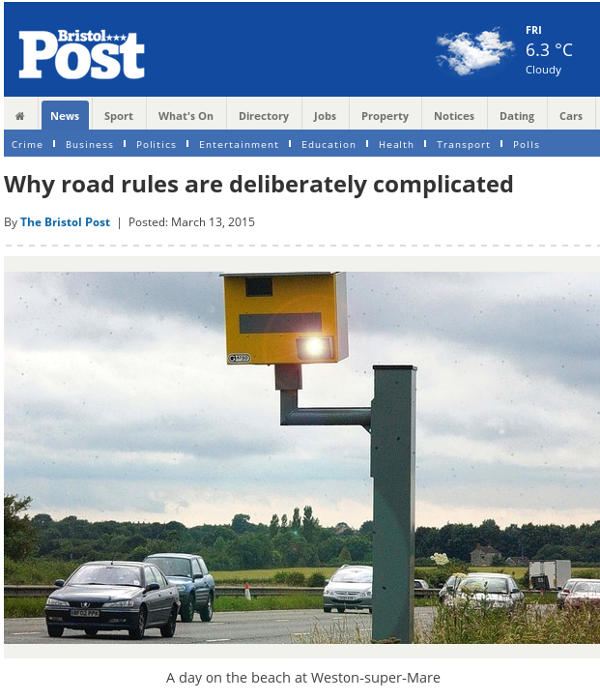
The Bristol Post is not immune to the odd error every five minutes or so and today is no exception, as is amply demonstrated by the screenshot below of an item from today’s online edition.
Even the image tag’s alt attributes include the wording “A day on the beach at Weston-super-Mare”.
If Weston beach has been covered in tarmac and is now reserved for use by motor vehicles, I do hope the highway engineers built it well above the high water mark for spring tides, which have a range sometimes in excess of 13 metres.
On the other hand, the Bristol Post does have form when it comes to writing the wrong captions for images on its website (posts passim).
The reply was received in a record 10 working days and reads as follows:
Bristol City Council has been a long-term supporter of open standards wherever possible. We have frequently voluntarily adopted national government policy on open standards and open source, recognising the benefits of this approach.
We adopted StarOffice in 2005 and moved to the Open Document Format as our standard for office productivity files at the point it was incorporated in the StarOffice / OpenOffice.org products. We had to move to Microsoft Office in 2010 due to the lack of standards support in the local government applications market, partly due to the fact that national government policy was not mandated at local level and therefore did not have the desired effects on the document standards context. However we retained the ability to create, open and collaborate on ODF by implementing LibreOffice alongside Microsoft Office on all council PCs. Therefore we are already capable of using ODF to collaborate on government documents.
In terms of publishing government documents to citizens, we have historically used PDF, but are now attempting to replace all information, advice and guidance, and application forms with fully digital services. Over time this will replace old PDF documents with HTML. If there are documents that meet a user need to download and read offline, we can produce PDF/A format from the open source PDF Creator software that is also available on every council PC.
I’m very pleased to note that BCC has LibreOffice installed on every council machine. They kept that quiet! Perhaps they’ll use it to send me replies to my FoI requests in future instead of the propensity to use MS Office formats. But just to make sure, I’ll include a plea for a reply in an open format in all my future requests. 🙂
Thanks to skimping on proof-reading, La Despensa Del Gourmet, a new Spanish delicatessen that’s recently opened in Prince Street, Bristol has a rather unusual offer at present, which sounds a bargain at £3.50!
Picture courtesy of Bristol Bites
Speculation has it that the proprietors are actually trying to offer a carbonated soft drink originally from America… However, that could be phallusy! 😉
Spotted on the pavement opposite House of Fraser, Cabot Circus, Bristol – one red bra.
Whose could it be?
There’s one person in Bristol who is well known for wearing red – the city’s elected Mayor, George Ferguson.
It is suspected that George has shed his clothing in public before, notably in Easton (posts passim).
Could the Mayor’s secret penchant for transvestism or covert gender reassignment finally have been revealed? If so, when will George tell the citizens of Bristol?
That’s a matter for George’s conscience and our speculation.
However, turning to serious matters, shedding clothing on the highway is technically littering. Bristolians can report litter, fly-tipping, graffiti, dog fouling and the like online via the links on the city council’s street care and cleaning page.



 Following the post on Friday on