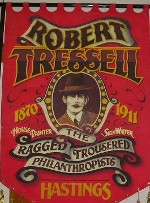
It charts the grim life of a group of men working as painters and decorators in the Edwardian era.
Tressell’s cast of hypocritical Christians, exploitative capitalists and corrupt councillors provide a backdrop for his main target — the workers who think that a better life is “not for the likes of them” – hence the title of the book. Tressell paints the workers as “philanthropists” who throw themselves into back-breaking work for poverty wages in order to generate profit for their masters.
The book’s hero, Frank Owen, is a socialist who believes that the capitalist system is the real source of the poverty he sees all around him. In vain he tries to convince his fellow workers of his world view, but finds that their education has trained them to distrust their own thoughts and to rely on those of their “betters”.
Chapter 28 is entitled ‘The week before Christmas’ and is reproduced below as a seasonal post.
During the next week Owen painted a sign on the outer wall of one of the workshops at the yard, and he also wrote the name of the firm on three of the handcarts.
These and other odd jobs kept him employed a few hours every day, so that he was not actually out of work.
One afternoon–there being nothing to do–he went home at three o’clock, but almost as soon as he reached the house Bert White came with a coffin-plate which had to be written at once. The lad said he had been instructed to wait for it.
Nora gave the boy some tea and bread and butter to eat whilst Owen was doing the coffin-plate, and presently Frankie–who had been playing out in the street–made his appearance. The two boys were already known to each other, for Bert had been there several times before–on errands similar to the present one, or to take lessons on graining and letter-painting from Owen.
‘I’m going to have a party next Monday–after Christmas,’ remarked Frankie. ‘Mother told me I might ask you if you’ll come?’
‘All right,’ said Bert; ‘and I’ll bring my Pandoramer.’
‘What is it? Is it alive?’ asked Frankie with a puzzled look.
‘Alive! No, of course not,’ replied Bert with a superior air. ‘It’s a show, like they have at the Hippodrome or the Circus.’
‘How big is it?’
‘Not very big: it’s made out of a sugar-box. I made it myself. It’s not quite finished yet, but I shall get it done this week. There’s a band as well, you know. I do that part with this.’
‘This’ was a large mouth organ which he produced from the inner pocket of his coat.
‘Play something now.’
Bert accordingly played, and Frankie sang at the top of his voice a selection of popular songs, including ‘The Old Bull and Bush’, ‘Has Anyone seen a German Band?’, ‘Waiting at the Church’ and finally–possibly as a dirge for the individual whose coffin-plate Owen was writing–‘Goodbye, Mignonette’ and ‘I wouldn’t leave my little wooden hut for you’.
‘You don’t know what’s in that,’ said Frankie, referring to a large earthenware bread-pan which Nora had just asked Owen to help her to lift from the floor on to one of the chairs. The vessel in question was covered with a clean white cloth.
‘Christmas pudding,’ replied Bert, promptly.
‘Guessed right first time!’ cried Frankie. ‘We got the things out of the Christmas Club on Saturday. We’ve been paying in ever since last Christmas. We’re going to mix it now, and you can have a stir too if you like, for luck.’
Whilst they were stirring the pudding, Frankie several times requested the others to feel his muscle: he said he felt sure that he would soon be strong enough to go out to work, and he explained to Bert that the extraordinary strength he possessed was to be attributed to the fact that he lived almost exclusively on porridge and milk.
For the rest of the week, Owen continued to work down at the yard with Sawkins, Crass, and Slyme, painting some of the ladders, steps and other plant belonging to the firm. These things had to have two coats of paint and the name Rushton & Co. written on them. As soon as they had got some of them second-coated, Owen went on with the writing, leaving the painting for the others, so as to share the work as fairly as possible. Several times during the week one or other of them was taken away to do some other work; once Crass and Slyme had to go and wash off and whiten a ceiling somewhere, and several times Sawkins was sent out to assist the plumbers.
Every day some of the men who had been ‘stood off’ called at the yard to ask if any other ‘jobs’ had ‘come in’. From these callers they heard all the news. Old Jack Linden had not succeeded in getting anything to do at the trade since he was discharged from Rushton’s, and it was reported that he was trying to earn a little money by hawking bloaters from house to house. As for Philpot, he said that he had been round to nearly all the firms in the town and none of them had any work to speak of.
Newman–the man whom the reader will remember was sacked for taking too much pains with his work–had been arrested and sentenced to a month’s imprisonment because he had not been able to pay his poor rates, and the Board of Guardians were allowing his wife three shillings a week to maintain herself and the three children. Philpot had been to see them, and she told him that the landlord was threatening to turn them into the street; he would have seized their furniture and sold it if it had been worth the expense of the doing.
‘I feel ashamed of meself,’ Philpot added in confidence to Owen, ‘when I think of all the money I chuck away on beer. If it wasn’t for that, I shouldn’t be in such a hole meself now, and I might be able to lend ’em a ‘elpin’ ‘and.’
‘It ain’t so much that I likes the beer, you know,’ he continued; ‘it’s the company. When you ain’t got no ‘ome, in a manner o’ speakin’, like me, the pub’s about the only place where you can get a little enjoyment. But you ain’t very welcome there unless you spends your money.’
‘Is the three shillings all they have to live on?’
‘I think she goes out charin’ when she can get it,’ replied Philpot, ‘but I don’t see as she can do a great deal o’ that with three young ‘uns to look after, and from what I hear of it she’s only just got over a illness and ain’t fit to do much.’
‘My God!’ said Owen.
‘I’ll tell you what,’ said Philpot. ‘I’ve been thinking we might get up a bit of a subscription for ’em. There’s several chaps in work what knows Newman, and if they was each to give a trifle we could get enough to pay for a Christmas dinner, anyway. I’ve brought a sheet of foolscap with me, and I was goin’ to ask you to write out the heading for me.’
As there was no pen available at the workshop, Philpot waited till four o’clock and then accompanied Owen home, where the heading of the list was written. Owen put his name down for a shilling and Philpot his for a similar amount.
Philpot stayed to tea and accepted an invitation to spend Christmas Day with them, and to come to Frankie’s party on the Monday after.
The next morning Philpot brought the list to the yard and Crass and Slyme put their names down for a shilling each, and Sawkins for threepence, it being arranged that the money was to be paid on payday–Christmas Eve. In the meantime, Philpot was to see as many as he could of those who were in work, at other firms and get as many subscriptions as possible.
At pay-time on Christmas Eve Philpot turned up with the list and Owen and the others paid him the amounts they had put their names down for. From other men he had succeeded in obtaining nine and sixpence, mostly in sixpences and threepences. Some of this money he had already received, but for the most part he had made appointments with the subscribers to call at their homes that evening. It was decided that Owen should accompany him and also go with him to hand over the money to Mrs Newman.
It took them nearly three hours to get in all the money, for the places they had to go to were in different localities, and in one or two cases they had to wait because their man had not yet come home, and sometimes it was not possible to get away without wasting a little time in talk. In three instances those who had put their names down for threepence increased the amount to sixpence and one who had promised sixpence gave a shilling. There were two items of threepence each which they did not get at all, the individuals who had put their names down having gone upon the drunk. Another cause of delay was that they met or called on several other men who had not yet been asked for a subscription, and there were several others–including some members of the Painters Society whom Owen had spoken to during the week–who had promised him to give a subscription. In the end they succeeded in increasing the total amount to nineteen and ninepence, and they then put three-halfpence each to make it up to a pound.
The Newmans lived in a small house the rent of which was six shillings per week and taxes. To reach the house one had to go down a dark and narrow passage between two shops, the house being in a kind of well, surrounded by the high walls of the back parts of larger buildings–chiefly business premises and offices. The air did not circulate very freely in this place, and the rays of the sun never reached it. In the summer the atmosphere was close and foul with the various odours which came from the back-yards of the adjoining buildings, and in the winter it was dark and damp and gloomy, a culture-ground for bacteria and microbes. The majority of those who profess to be desirous of preventing and curing the disease called consumption must be either hypocrites or fools, for they ridicule the suggestion that it is necessary first to cure and prevent the poverty that compels badly clothed and half-starved human beings to sleep in such dens as this.
The front door opened into the living-room or, rather, kitchen, which was dimly lighted by a small paraffin lamp on the table, where were also some tea-cups and saucers, each of a different pattern, and the remains of a loaf of bread. The wallpaper was old and discoloured; a few almanacs and unframed prints were fixed to the walls, and on the mantelshelf were some cracked and worthless vases and ornaments. At one time they had possessed a clock and an overmantel and some framed pictures, but they had all been sold to obtain money to buy food. Nearly everything of any value had been parted with for the same reason–the furniture, the pictures, the bedclothes, the carpet and the oilcloth, piece by piece, nearly everything that had once constituted the home–had been either pawned or sold to buy food or to pay rent during the times when Newman was out of work–periods that had recurred during the last few years with constantly increasing frequency and duration. Now there was nothing left but these few old broken chairs and the deal table which no one would buy; and upstairs, the wretched bedsteads and mattresses whereon they slept at night, covering themselves with worn-out remnants of blankets and the clothes they wore during the day.
In answer to Philpot’s knock, the door was opened by a little girl about seven years old, who at once recognized Philpot, and called out his name to her mother, and the latter came also to the door, closely followed by two other children, a little, fragile-looking girl about three, and a boy about five years of age, who held on to her skirt and peered curiously at the visitors. Mrs Newman was about thirty, and her appearance confirmed the statement of Philpot that she had only just recovered from an illness; she was very white and thin and dejected-looking. When Philpot explained the object of their visit and handed her the money, the poor woman burst into tears, and the two smaller children–thinking that this piece of paper betokened some fresh calamity–began to cry also. They remembered that all their troubles had been preceded by the visits of men who brought pieces of paper, and it was rather difficult to reassure them.
That evening, after Frankie was asleep, Owen and Nora went out to do their Christmas marketing. They had not much money to spend, for Owen had brought home only seventeen shillings. He had worked thirty-three hours–that came to nineteen and threepence–one shilling and threehalfpence had gone on the subscription list, and he had given the rest of the coppers to a ragged wreck of a man who was singing a hymn in the street. The other shilling had been deducted from his wages in repayment of a ‘sub’ he had had during the week.
There was a great deal to be done with this seventeen shillings. First of all there was the rent–seven shillings–that left ten. Then there was the week’s bread bill–one and threepence. They had a pint of milk every day, chiefly for the boy’s sake–that came to one and two. Then there was one and eight for a hundredweight of coal that had been bought on credit. Fortunately, there were no groceries to buy, for the things they had obtained with their Christmas Club money would be more than sufficient for the ensuing week.
Frankie’s stockings were all broken and beyond mending, so it was positively necessary to buy him another pair for fivepence three-farthings. These stockings were not much good–a pair at double the price would have been much cheaper, for they would have lasted three or four times longer; but they could not afford to buy the dearer kind. It was just the same with the coal: if they had been able to afford it, they could have bought a ton of the same class of coal for twenty-six shillings, but buying it as they did, by the hundredweight, they had to pay at the rate of thirty-three shillings and fourpence a ton. It was just the same with nearly everything else. This is how the working classes are robbed. Although their incomes are the lowest, they are compelled to buy the most expensive articles–that is, the lowest-priced articles. Everybody knows that good clothes, boots or furniture are really the cheapest in the end, although they cost more money at first; but the working classes can seldom or never afford to buy good things; they have to buy cheap rubbish which is dear at any price.
Six weeks previously Owen bought a pair of second-hand boots for three shillings and they were now literally falling to pieces. Nora’s shoes were in much the same condition, but, as she said, it did not matter so much about hers because there was no need for her to go out if the weather were not fine.
In addition to the articles already mentioned, they had to spend fourpence for half a gallon of paraffin oil, and to put sixpence into the slot of the gas-stove. This reduced the money to five and sevenpence farthing, and of this it was necessary to spend a shilling on potatoes and other vegetables.
They both needed some new underclothing, for what they had was so old and worn that it was quite useless for the purpose it was supposed to serve; but there was no use thinking of these things, for they had now only four shillings and sevenpence farthing left, and all that would be needed for toys. They had to buy something special for Frankie for Christmas, and it would also be necessary to buy something for each of the children who were coming to the party on the following Monday. Fortunately, there was no meat to buy, for Nora had been paying into the Christmas Club at the butcher’s as well as at the grocer’s. So this necessary was already paid for.
They stopped to look at the display of toys at Sweater’s Emporium. For several days past Frankie had been talking of the wonders contained in these windows, so they wished if possible to buy him something here. They recognized many of the things from the description the boy had given of them, but nearly everything was so dear that for a long time they looked in vain for something it would be possible to buy.
‘That’s the engine he talks so much about,’ said Non, indicating a model railway locomotive; that one marked five shillings.’
‘It might just as well be marked five pounds as far as we’re concerned,’ replied Owen.
As they were speaking, one of the salesmen appeared at the back of the window and, reaching forward, removed the engine. It was probably the last one of the kind and had evidently just been sold. Owen and Nora experienced a certain amount of consolation in knowing that even if they had the money they would not have been able to buy it.
After lengthy consideration, they decided on a clockwork engine at a shilling, but the other toys they resolved to buy at a cheaper shop. Nora went into the Emporium to get the toy and whilst Owen was waiting for her Mr and Mrs Rushton came out. They did not appear to see Owen, who observed that the shape of one of several parcels they carried suggested that it contained the engine that had been taken from the window a little while before.
When Nora returned with her purchase, they went in search of a cheaper place and after a time they found what they wanted. For sixpence they bought a cardboard box that had come all the way from Japan and contained a whole family of dolls–father, mother and four children of different sizes. A box of paints, threepence: a sixpenny tea service, a threepenny drawing slate, and a rag doll, sixpence.
On their way home they called at a greengrocer’s where Owen had ordered and paid for a small Christmas tree a few weeks before; and as they were turning the corner of the street where they lived they met Crass, half-drunk, with a fine fat goose slung over his shoulder by its neck. He greeted Owen jovially and held up the bird for their inspection.
‘Not a bad tanner’s-worth, eh?’ he hiccoughed. ‘This makes two we’ve got. I won this and a box of cigars–fifty–for a tanner, and the other one I got out of the Club at our Church Mission ‘all: threepence a week for twenty-eight weeks; that makes seven bob. But,’ he added, confidentially,”you couldn’t buy ’em for that price in a shop, you know. They costs the committee a good bit more nor that–wholesale; but we’ve got some rich gents on our committee and they makes up the difference,’ and with a nod and a cunning leer he lurched off.
Frankie was sleeping soundly when they reached home, and so was the kitten, which was curled up on the quilt on the foot of the bed. After they had had some supper, although it was after eleven o’clock, Owen fixed the tree in a large flower-pot that had served a similar purpose before, and Nora brought out from the place where it had been stored away since last Christmas a cardboard box containing a lot of glittering tinsel ornaments–globes of silvered or gilded or painted glass, birds, butterflies and stars. Some of these things had done duty three Christmases ago and although they were in some instances slightly tarnished most of them were as good as new. In addition to these and the toys they had bought that evening they had a box of bon-bons and a box of small coloured wax candles, both of which had formed part of the things they got from the grocer’s with the Christmas Club money; and there were also a lot of little coloured paper bags of sweets, and a number of sugar and chocolate toys and animals which had been bought two or three at a time for several weeks past and put away for this occasion. There was something suitable for each child that was coming, with the exception of Bert White; they had intended to include a sixpenny pocket knife for him in their purchases that evening, but as they had not been able to afford this Owen decided to give him an old set of steel graining combs which he knew the lad had often longed to possess. The tin case containing these tools was accordingly wrapped in some red tissue paper and hung on the tree with the other things.
They moved about as quietly as possible so as not to disturb those who were sleeping in the rooms beneath, because long before they were finished the people in the other parts of the house had all retired to rest, and silence had fallen on the deserted streets outside. As they were putting the final touches to their work the profound stillness of the night was suddenly broken by the voices of a band of carol-singers.
The sound overwhelmed them with memories of other and happier times, and Nora stretched out her hands impulsively to Owen, who drew her close to his side.
They had been married just over eight years, and although during all that time they had never been really free from anxiety for the future, yet on no previous Christmas had they been quite so poor as now. During the last few years periods of unemployment had gradually become more frequent and protracted, and the attempt he had made in the early part of the year to get work elsewhere had only resulted in plunging them into even greater poverty than before. But all the same there was much to be thankful for: poor though they were, they were far better off than many thousands of others: they still had food and shelter, and they had each other and the boy.
Before they went to bed Owen carried the tree into Frankie’s bedroom and placed it so that he would be able to see it in all its glittering glory as soon as he awoke on Christmas morning.
The Ragged Trousered Philanthropists is available free of charge in various formats (e.g. HTML, epub, Kindle, plain text) from Project Gutenberg.
 Joinup reports that the European Parliament’s Greens/EFA Group has started trial use of laptops running a tailored version of the Debian GNU/Linux distribution and “is reaching out to the Free Software community”, in order to achieve trustworthy email encryption in moves to counter mass surveillance by companies and governments.
 Professional Interpreters for Justice (PI4J), an umbrella group for professional interpreter organisations, estimates that court time costing £10.8 million was lost in 2012 and £6.7 million in 2013 up to November.
 There’s an open data meet-up taking place in central Bristol next month.

 Joinup, the EU’s open source public sector news website,